Segregated fund guarantees: what Canadian investors need to know
Segregated fund guarantees: what Canadian investors need to know ! Investor reviewing segregated fund contract Segregated fund guarantees are insurance-backed minimums, typically 75% or 100% of your invested capital, that pay out at contract maturity or upon death, in exchange for higher fees and a commitment to hold the contract to term.

Segregated fund guarantees: what Canadian investors need to know
Segregated fund guarantees are insurance-backed minimums, typically 75% or 100% of your invested capital, that pay out at contract maturity or upon death, in exchange for higher fees and a commitment to hold the contract to term. They are not mutual funds with a safety net bolted on. They are life insurance contracts that happen to invest in pooled securities, and that distinction shapes everything from how your estate is handled to what happens if your insurer fails.
The three common guarantee formats are:
- 75/75: 75% maturity guarantee and 75% death benefit guarantee
- 75/100: 75% maturity guarantee and 100% death benefit guarantee
- 100/100: 100% maturity guarantee and 100% death benefit guarantee
The first number always refers to the maturity guarantee; the second to the death benefit. A 100/100 contract means you or your estate will receive at least your full deposit back, provided you hold to maturity or die before then.
The core trade-offs up front: you pay higher management and insurance fees than you would on a comparable mutual fund, you may face surrender charges if you exit early, and the guarantee only applies if you meet the contract conditions. If you redeem before maturity, you typically receive market value, not the guaranteed amount.
Assuris protection: If your insurer becomes insolvent, Assuris steps in. For segregated fund guarantee protection, you retain the higher of $100,000 or 90% of the benefit amount. Two key Canadian regulatory bodies govern this space: Assuris (the industry-funded protection association) and the Autorité des marchés financiers (AMF) in Québec.
Table of Contents
- Worked examples: guarantee math and Assuris scenarios
- How Assuris and the AMF protect you in Canada
- Segregated funds versus mutual funds and GICs
- Who actually benefits from segregated fund guarantees?
- How to evaluate a segregated fund contract
- Key takeaways
- Why the guarantee details matter more than the guarantee label
- Llqpguide: study segregated fund mechanics for the LLQP exam
- Authoritative sources and further reading
- FAQ
Worked examples: guarantee math and Assuris scenarios
Concrete numbers make this clearer than any general description.
Maturity guarantee examples:
- 75/75 contract, $100,000 invested, market value at maturity $80,000: The 75% maturity guarantee pays $75,000. You receive $75,000, not $80,000, because the guarantee is a floor, not a top-up above market value.
- 75/75 contract, $100,000 invested, market value at maturity $120,000: You receive $120,000. The guarantee is irrelevant here; you get market value because it exceeds the guaranteed floor.
- 100/100 contract, $100,000 invested, market value at maturity $60,000: The 100% maturity guarantee pays $100,000. This is where the guarantee earns its keep.
Death benefit examples:
- 75/100 contract, $100,000 invested, policyowner dies when market value is $85,000: The 100% death benefit guarantee pays $100,000 to the named beneficiary.
- 75/100 contract, $100,000 invested, reset triggered at $130,000, policyowner dies when market value is $110,000: The death benefit guarantee now protects $130,000 (the reset value), so the beneficiary receives $130,000. Wealth Professional notes that this reset-and-lock-in mechanic is a common legacy-planning tool precisely because it can bypass probate and preserve a higher value for beneficiaries.
Assuris insolvency scenarios:
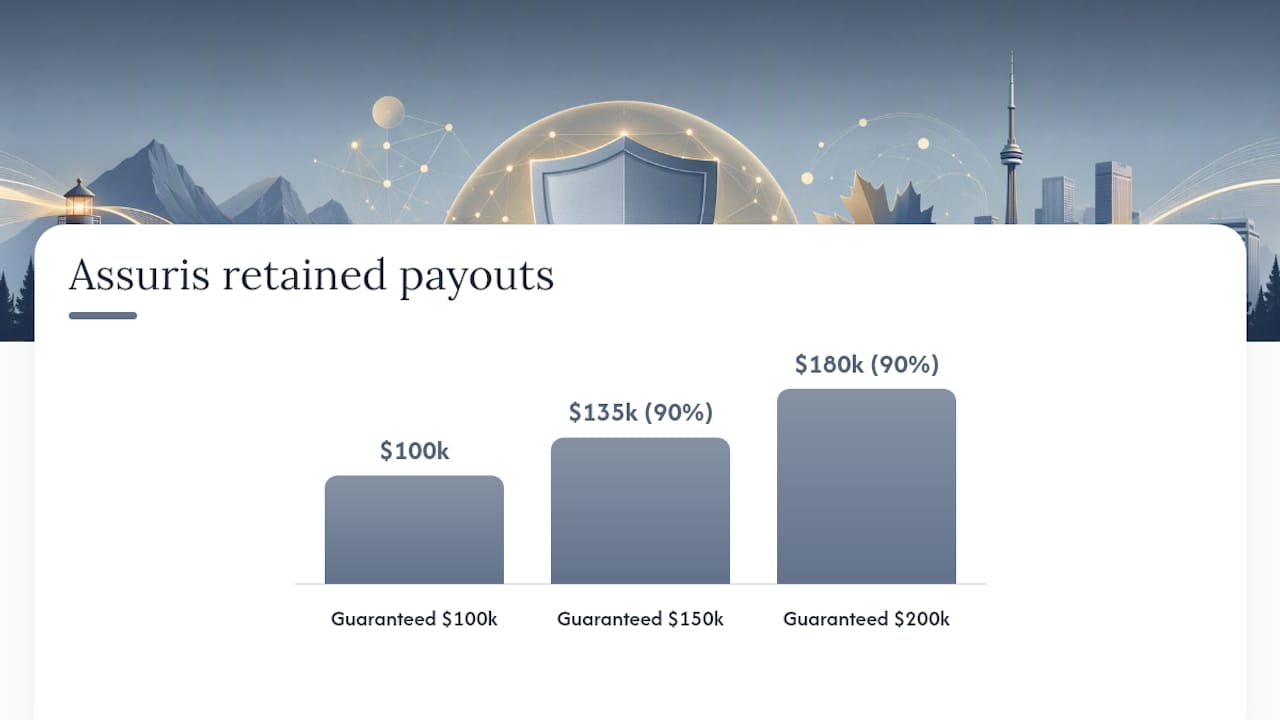
Assuris applies its protection separately to each policy. The rule: you retain the higher of $100,000 or 90% of the guaranteed benefit.
- $100,000 guaranteed benefit: 90% = $90,000; $100,000 floor applies. You retain $100,000.
- $150,000 guaranteed benefit: 90% equals more than $100,000, so you retain 90% of your benefit amount.
- $200,000 guaranteed benefit: 90% equals more than $100,000, so you retain 90% of your benefit amount.
Assuris protection in plain terms: For a $150,000 segregated fund guarantee, Assuris covers $135,000 (90%). For a $100,000 guarantee, the floor means you keep the full $100,000.
The payout phase has its own protection rule. Monthly income protection covers up to $5,000 per month or 90% of the promised monthly income, whichever is higher.
How Assuris and the AMF protect you in Canada
Canada’s regulatory framework for segregated funds sits at the intersection of insurance regulation and securities oversight. Provincially, insurance regulators (including the AMF in Québec) govern the contracts. Assuris provides the industry-funded backstop if an insurer fails.
Assuris protection types:
| Protection type | What it covers | Coverage limit | Who it protects |
|---|---|---|---|
| Segregated Fund Guarantee Protection | Death and maturity guarantee amounts | Higher of $100,000 or 90% of benefit | Policyowner or beneficiary |
| Accumulated Value Protection | Market value of the segregated fund account | Higher of $100,000 or 90% of accumulated value | Policyowner |
| Monthly Income Protection | Guaranteed monthly income in payout phase | Higher of $5,000/month or 90% of promised income | Policyowner |
The Assuris Memorandum of Operation contains the authoritative definitions and coverage schedules. It is publicly available and worth reading if you hold a large segregated fund contract or advise clients who do.
Assuris also notes that protection is applied separately to each policy, which matters if you hold multiple contracts with the same insurer. Each policy gets its own protection calculation, not a combined total.
The AMF’s guidance reinforces that the guarantee fee trade-off must be disclosed to investors and that contracts must clearly explain when guarantees apply and when they do not. Advisers selling segregated funds in Québec are subject to AMF oversight; advisers in other provinces fall under their respective provincial insurance regulators.
Pro Tip: Verify that your insurer is an Assuris member before purchasing. Most Canadian life insurers are, but membership is not automatic. The Assuris website lists all current members, and confirming membership takes about 30 seconds.
Segregated funds versus mutual funds and GICs
The comparison that matters most is not performance, it is what you are actually buying.
| Feature | Insurance-wrapped pooled funds (seg funds) | Mutual funds | GICs |
|---|---|---|---|
| Capital guarantee | Yes (75% or 100% at maturity/death) | No | Yes (typically 100% at term) |
| Fee profile | Higher (MER plus insurance charge) | Moderate | Low to none |
| Probate bypass | Yes (via named beneficiary) | No | No (unless held in registered plan) |
| Creditor protection | Possible (depends on beneficiary class) | No | No |
| Liquidity | Limited (surrender charges may apply) | Generally redeemable | Limited (locked in for term) |
| Registered account use | RRSP, TFSA, RRIF | RRSP, TFSA, RRIF | RRSP, TFSA, RRIF |
BMO’s industry commentary frames segregated funds as tools for investors who want downside protection and estate simplicity, not the lowest-cost long-term growth option. That framing is accurate.
When a GIC might suit you better:
- You want guaranteed return of 100% of capital with no market exposure at all
- Your timeline is short (1–5 years) and you do not need estate-planning features
- You are comfortable with CDIC deposit insurance rather than Assuris protection
- Fee minimisation is your primary goal
When a segregated fund might suit you better:
- You want market participation with a downside floor
- You have a named beneficiary and want to avoid probate
- You are a business owner or self-employed professional seeking creditor protection
- You need guaranteed income in retirement (GMWB product)
The estate-planning angle is the clearest differentiator. A GIC does not name a beneficiary; a segregated fund does. For someone with a blended family, a business, or a specific legacy goal, that difference can outweigh the fee gap.
Who actually benefits from segregated fund guarantees?
Not every investor needs a guarantee. The fee premium only makes sense in specific situations.
Profiles where guarantees tend to provide clear value:
- Investors approaching retirement with a defined timeline: If you need your capital intact in 10 years for a specific purpose (income drawdown, property purchase, care costs), a maturity guarantee removes the sequence-of-returns risk that could derail that plan.
- People prioritising estate passage: Named beneficiaries, probate bypass, and the ability to lock in a death benefit via resets make segregated funds a practical estate tool, particularly for those with complex family situations.
- Business owners and self-employed professionals: Creditor protection under provincial insurance legislation can shield policy proceeds from business creditors, a feature no mutual fund offers.
- Risk-averse retirees needing guaranteed income: The GMWB product provides a floor on lifetime income that a standard mutual fund portfolio cannot replicate without annuitisation.
Profiles where guarantees are less useful:
- Long-term buy-and-hold investors with a 20-plus-year horizon who prioritise lowest fees and can tolerate market volatility
- Investors who may need liquidity before the maturity date, since early redemption forfeits the guarantee
- Those who want absolute capital preservation with no market exposure, where a GIC is simpler and cheaper
- Younger investors whose time horizon makes the maturity guarantee largely redundant
The AMF’s guidance points in the same direction: segregated funds suit investors who genuinely need the guarantee features, not those who are buying them as a default or because they sound reassuring.
How to evaluate a segregated fund contract
Before signing any contract, work through this checklist.
- Confirm the guarantee levels. Is it 75/75, 75/100, or 100/100? Know what each number protects and under what conditions.
- Read the reset clause. How often can you reset? Is it automatic or client-initiated? What is the age cut-off? What happens if you miss a reset window?
- Get the full fee schedule. Ask for the MER, the insurance/guarantee charge listed separately, and any administration fees. Request historical MERs for the past three to five years.
- Review the surrender schedule. How long do charges apply? What percentage do you lose if you exit in year one versus year five?
- Confirm Assuris membership. Check the insurer’s name against the Assuris member list.
- Understand the impact of withdrawals. Ask specifically: “If I withdraw $10,000 in year three, how does that affect my guaranteed base at maturity?”
- Check permitted account types. Can this contract be held in your RRSP or TFSA? Are there restrictions on transfers?
- Clarify beneficiary and estate rules. Who is named? Can you change the beneficiary? Does the contract allow multiple beneficiaries?
- Ask about the maturity date. When does the contract mature? Can it be extended? What happens at maturity if you do not redeem?
- Request a written example. Ask the adviser to show you a worked calculation of the guarantee payout under a down-market scenario using your actual deposit amount.
Questions worth asking directly:
- “What triggers a reset, and can you show me the contract language?”
- “Show me the historical MERs and total charges for this specific fund over the past five years.”
- “If I die in year two before any resets, what does my beneficiary receive?”
Pro Tip: Request the actual contract excerpt showing the guarantee and reset language, not just the product summary. Product summaries are marketing documents. The contract is the legal document that governs what you receive.
Key takeaways
Segregated fund guarantees offer real downside protection for Canadian investors, but only when the contract conditions are met, the fees are understood, and the holding period aligns with the maturity date.
| Point | Details |
|---|---|
| Guarantee levels vary | Contracts offer 75/75, 75/100, or 100/100 formats; the first number is maturity, the second is death benefit. |
| Hold to maturity or death | Early redemption forfeits the guarantee and may trigger surrender charges; market value is all you receive. |
| Fees are higher by design | The AMF confirms that guarantee costs are embedded in the MER; always request historical fee figures before signing. |
| Assuris protects up to 90% | If your insurer fails, Assuris covers the higher of $100,000 or 90% of your guaranteed benefit, per policy. |
| Llqpguide covers this in depth | The Segregated Funds & Annuities module at Llqpguide prepares LLQP candidates on guarantee mechanics, contract features, and exam-ready scenarios. |
Why the guarantee details matter more than the guarantee label
Most people who buy segregated funds know they come with a guarantee. Far fewer know what the reset age limit is, how a partial withdrawal affects the guaranteed base, or what Assuris actually covers if their insurer fails. That gap between knowing a guarantee exists and understanding how it works is where real financial harm tends to happen.
The sales pitch for these products is easy to understand: your money is protected. The contract mechanics are harder. A 100/100 guarantee sounds like full protection, but if you withdraw 20% of your deposit in year three, the guaranteed base at maturity is not your original deposit anymore. It is reduced. If you miss every reset opportunity because you did not know they were available, your death benefit guarantee stays at the original deposit while the market value grows above it. You paid for a feature you never used.
What I see consistently in exam prep contexts is that candidates who understand the mechanics of segregated fund guarantees, the reset triggers, the withdrawal impact, the Assuris protection tiers, are far better equipped to explain these products honestly to clients. The LLQP exam tests this precisely because regulators know that advisers who cannot explain the contract cannot serve clients well.
The guarantee is not the product. The contract is the product. Read it.
Llqpguide: study segregated fund mechanics for the LLQP exam
Advisers and licence candidates who want to understand segregated fund guarantees at the contract level, not just the marketing level, will find the Segregated Funds & Annuities module at Llqpguide covers exactly this ground. The module walks through guarantee formats, reset mechanics, GMWB phases, Assuris protection rules, and the fee trade-offs the AMF expects advisers to disclose, all in the context of real LLQP exam questions.

Llqpguide’s platform includes unlimited practice quizzes, full-length mock exams, and in-lesson translation tools for 11-plus languages, so candidates can work through guarantee scenarios until the mechanics are second nature. Province-specific content means the rules you study match the exam you are writing, whether that is in Ontario, British Columbia, or Québec. Start with a free trial at Llqpguide and explore all LLQP modules to see where segregated funds fit in the full licensing curriculum.
Authoritative sources and further reading
- Guarantees on Segregated Funds | Assuris
- How Am I Protected? | Assuris
- Memorandum of Operation_amended and restated May 25, 2023
- Segregated funds | AMF
- Segregated funds 101 — What are they and how do they work (BMO article)
- Understanding the death benefit guarantee & reset option for segregated funds | Wealth Professional
- Steps to Determine Protection | Assuris
Recommended
Frequently asked questions
What are the guarantees on segregated funds?
Segregated fund guarantees are insurance-backed minimums, commonly 75% or 100% of your original deposit, that pay out at contract maturity or upon the death of the life insured. The guarantee only applies if you hold the contract to maturity or death; early redemption returns market value only.
What is the downside of segregated funds?
The main downsides are higher fees (the MER includes the cost of the guarantee), surrender charges if you exit early, and the requirement to hold to maturity to collect the guarantee. Investors who redeem before maturity pay the higher fees without receiving the protection they paid for.
How does Assuris protect segregated fund investors in Canada?
If your life insurer becomes insolvent, Assuris covers the higher of $100,000 or 90% of your guaranteed benefit per policy. In the payout phase, monthly income protection covers the higher of $5,000 per month or 90% of your promised monthly income.
What is the regulatory framework for segregated funds in Canada?
Segregated funds are regulated as insurance contracts under provincial insurance legislation. The AMF oversees them in Québec; other provinces have their own insurance regulators. Assuris provides industry-funded protection if an insurer fails, with coverage rules set out in its Memorandum of Operation.
Who should consider segregated fund guarantees?
Segregated fund guarantees tend to suit investors with a defined holding timeline who need downside protection, people prioritising estate passage to named beneficiaries, business owners seeking creditor protection, and retirees who want guaranteed income through a GMWB product. Long-term investors focused on minimising fees are generally better served by lower-cost alternatives.