Canada LLQP Translation: 8–12 Week Bilingual Plan and Accommodations
Canada LLQP Translation: 8–12 Week Bilingual Plan and Accommodations ! Candidate studying electronic LLQP reference manual Translation is not automatically provided for the Life Licence Qualification Program.

Canada LLQP Translation: 8–12 Week Bilingual Plan and Accommodations
Translation is not automatically provided for the Life Licence Qualification Program. If you need language assistance, you have to request it formally, and the request has to be backed by documentation. Your real advantage is structural: get your CIPR number, request any needed accommodation early, and treat the official reference manual on your exam tablet as your bilingual lookup tool from week one of studying.
TL;DR:
- Candidates must formally request language accommodations with supporting documentation during registration, as there is no automatic translation or live interpreter support.
- During the exam, only the embedded electronic reference manual is permitted; translation apps, dictionaries, or personal interpreters are not allowed.
- Building a bilingual glossary over 8 to 12 weeks, with frequent manual lookup drills and mock exams, significantly improves accuracy and speed in using the manual.
- Regulators cap attempts at four per module, with at least a one-year wait after four failures, and registration names must match official ID to avoid disqualification.
- Using dedicated study platforms with built-in translation tools and practice exams aligns your preparation with actual exam conditions, providing a practical edge.
Table of Contents
- What is the LLQP translation guide process for accommodations?
- What translation help is actually allowed during the exam?
- Building an 8 to 12 week bilingual study plan
- LLQP logistics every multilingual candidate needs to know
- How LLQP Guide supports bilingual exam prep
- An honest note on translation and the LLQP
- Ready to build your bilingual study plan?
- Sources
- FAQ
What is the LLQP translation guide process for accommodations?
There is no button that turns your LLQP exam into French, Punjabi, or Tagalog. What exists instead is a formal accommodation process, and it runs through your provincial insurance regulator or examination administrator, not through the exam software itself.
Start by confirming which body governs your registration. In British Columbia, that’s the Insurance Council of British Columbia, which publishes its exam registration details and links to the Accommodation Request Form directly on its site. Ontario candidates work through FSRA. Every provincial regulator runs a version of the same intake process, so find yours before you assume a rule from one province applies to another.
- Locate the Accommodation Request Form on your regulator’s website, usually under exam registration or candidate resources.
- Gather supporting documentation. The Accommodation Policy from the Insurance Council of BC lists acceptable evidence, generally a statement from a qualified professional such as a physician, psychologist, or other regulated practitioner confirming the need.
- Submit the form during registration, not after you’ve booked your sitting. Requests are assessed case by case, and late submissions risk being processed after your preferred exam date.
- Wait for a written decision. Approved accommodations might include extended time, text-to-speech software, or a modified schedule. Follow up through the same office if you haven’t heard back within the timeline your regulator states.
What accommodations will not include is a live translator reading exam questions aloud in your first language, or a personal interpreter sitting beside you. Regulators are explicit that supports remove barriers to demonstrating competency. They do not lower the competency bar itself, and language preference on its own rarely qualifies without documented need behind it.
Pro Tip: Apply for accommodation the same week you register for your course, not the week before your exam. Documentation from a qualified professional can take longer to arrange than most candidates expect.
What translation help is actually allowed during the exam?
The LLQP exam is delivered on a tablet loaded with an electronic copy of the approved reference manual, and that detail changes everything about how you should think about translation. According to the LLQP Examinee Information Guide, this manual is the only outside material permitted at your seat. No internet access, no personal notes, no phone-based translation app.
That single rule reshapes your entire prep strategy. Instead of hunting for translation help mid-exam, which isn’t available anyway, your job beforehand is to become fast and fluent inside the one document you’re guaranteed to have open in front of you.
Here’s what’s actually permitted versus what candidates sometimes assume is allowed:
- Approved: the electronic reference manual built into your exam tablet
- Approved, with prior application: assistive technology like text-to-speech software, granted only through the accommodation process
- Not approved: personal dictionaries, translation apps, internet searches, or a companion interpreter
- Not approved: any device other than the tablet issued at the test centre
Regulators lean on the approved curriculum manual as the standard reference for industry terminology, which means the fastest path to passing isn’t finding a workaround. It’s mastering the exact phrasing regulators expect and knowing where in the manual that phrasing lives.
A candidate who has mapped 40 key terms to specific manual pages during study will consistently outperform one hoping to improvise a translation on exam day. Build a habit now: every time you hit an unfamiliar term in a lesson, note which page of the manual defines it and rehearse the lookup until it takes seconds, not minutes.
Building an 8 to 12 week bilingual study plan
Give yourself two to three months if English or French isn’t your first language. Rushing a four-week plan usually backfires because vocabulary acquisition, not concept comprehension, is what eats your time.
Start by building a bilingual quick reference: term, plain-language definition, and the manual page number where it appears. Update it weekly as you move through Life Insurance, Accident & Sickness, Segregated Funds & Annuities, and Ethics & Professional Practice.
- Weeks 1 to 4: vocabulary drills alongside module lessons, five to ten new terms a day tied to manual pages.
- Weeks 5 to 8: timed lookup drills. Give yourself 30 to 45 seconds to find a term in the manual, then a full module quiz weekly.
- Weeks 9 to 12: full-length mock exams under real time constraints, reviewing every missed question against your glossary.
Track two numbers as you go: your mock exam score and your average lookup time. If lookups still take over a minute by week ten, that’s your signal to drill terminology harder before booking a sitting.
Pro Tip: Practise every mock exam under the same constraints as the real thing, tablet only, no phone nearby, no browser tab open “just in case.” Muscle memory under pressure is what actually gets built during these weeks.

LLQP logistics every multilingual candidate needs to know
A few regulatory facts shape your whole timeline, and missing one of them can cost you a sitting fee or a full exam attempt.
- You need an approved LLQP course completion and a valid CIPR number before you can schedule an exam date.
- The exam runs as separate modules, each timed at 75 minutes, scored on multiple-choice format, with the tablet reference manual available throughout.
- Regulators cap attempts at four per module. After a fourth failure, a one-year waiting period applies, with minimum wait times enforced between earlier attempts too.
- A mismatch between your registration name and your government-issued photo ID is one of the most common reasons candidates get turned away at the door, along with attempting to bring an unauthorized translation device to your seat.
Plan your accommodation request and your study calendar around these fixed points, not around other considerations.
How LLQP Guide supports bilingual exam prep
The lessons build around four core modules commonly tested: Life Insurance, Accident & Sickness, Segregated Funds & Annuities, and Ethics & Professional Practice, with province-specific content and unlimited practice quizzes layered on top. That structure matters for a translation-focused study plan because it means your glossary building and your quiz practice happen against the same material, not two disconnected resources.

The in-lesson translation tools cover multiple languages, which gives you a practical way to build the bilingual glossary described earlier without stopping every few minutes to look up a term elsewhere. You read a lesson, see the translated term inline, and note the manual page reference in the same sitting.
A workable routine: pull glossary entries directly from lessons as you study each module, run timed lookup drills against your growing list, then take a full mock exam to see where your readiness actually stands. If a mock exam still exposes gaps after a few cycles, that’s useful information, not a setback, and it tells you exactly where to file an accommodation request if the barrier turns out to be more than vocabulary.
An honest note on translation and the LLQP
Accommodations exist, but they run on paperwork, not last-minute requests. If you wait until two weeks before your exam to ask, you’re gambling with a process built around case-by-case review and documentation from a qualified professional.
The open-book tablet format is genuinely in your favour if you use the preparation window well. Confidence on exam day comes from hundreds of timed lookups done in practice, not from hoping a workaround appears when you’re sitting in the test centre.
— Reza
Ready to build your bilingual study plan?
Most LLQP candidates cobble together a course manual, a generic quiz bank, and a translation app that isn’t allowed anywhere near the actual exam. This platform is built differently: province-specific lessons, unlimited practice quizzes, and full mock exams sit inside the same platform as in-lesson translation tools for multiple languages, so your glossary building and your exam practice happen in one place instead of three.
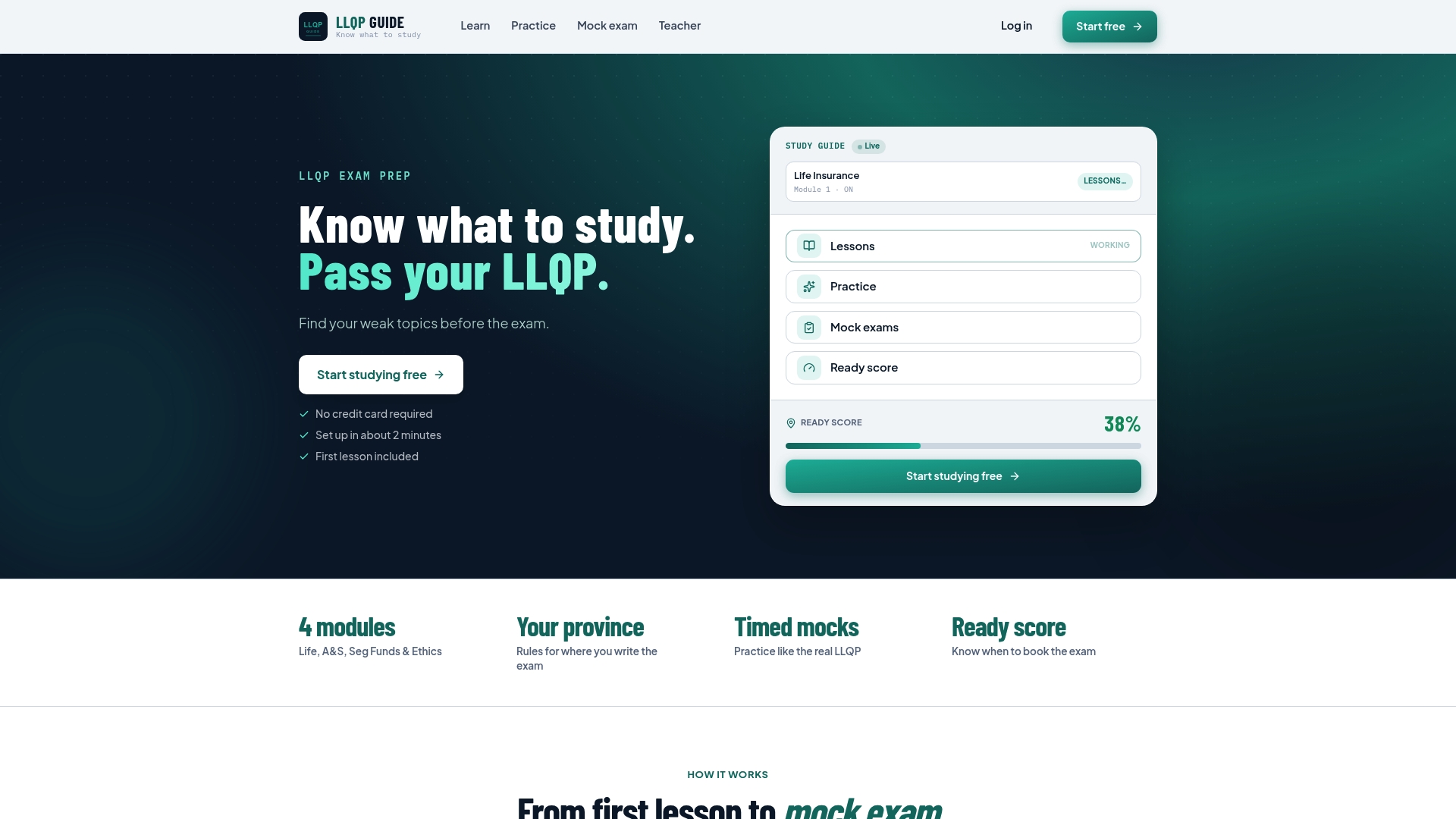
Start with the free trial to test the translation tools against a real module, Ethics is a good place to see how the terminology drilling feels, and run a timed mock exam before you decide anything. If it fits your study rhythm, plans run weekly at $40, monthly at $125, or yearly at $400. Check the full module breakdown to see where translation support shows up across Life Insurance, Accident & Sickness, Segregated Funds & Annuities, and Ethics, then build your bilingual glossary from there.
Sources
- Life licence qualification program (LLQP) — FSRA (Ontario)
- LLQP exam information and registration — Insurance Council of British Columbia
Recommended
Frequently asked questions
Is the LLQP hard to pass for non-native English speakers?
The exam tests insurance competency, not English fluency, but unfamiliar terminology can slow you down under time pressure. A bilingual glossary keyed to the official manual, built over an 8 to 12 week study window, closes most of that gap for candidates preparing in a second language.
How should I prepare for the LLQP if English isn't my first language?
Build your study plan around the same manual you'll use in the exam, since that's your only permitted reference on test day. Combine vocabulary drills, timed lookup practice, and full mock exams, and request any needed accommodation early rather than waiting until your exam date is close.
How many times can you take the LLQP exam?
Regulators allow four attempts per module, with minimum waiting periods enforced between attempts. After a fourth failure, a one-year waiting period applies before you can try that module again.
Where can I find free study material for the LLQP exam?
Your provincial regulator's course provider list is a solid starting point, along with the official Tablet User Guide, which is free and explains exactly what you'll see on exam day. For structured lessons, unlimited quizzes, and translation tools built around the same manual, Llqpguide's resource library covers all four modules.
Can I bring a translator or translation device into the LLQP exam?
No. Only the electronic reference manual loaded onto your exam tablet is permitted, and personal translation devices, apps, or interpreters are not allowed under standard exam rules. Text-to-speech software is available only if approved in advance through a formal accommodation request.