No Urdu LLQP: 4 Steps Urdu Speakers Need to Pass in Canada
No Urdu LLQP: 4 Steps Urdu Speakers Need to Pass in Canada ! Candidate building a bilingual insurance glossary No.

No Urdu LLQP: 4 Steps Urdu Speakers Need to Pass in Canada
No. The LLQP exam is administered exclusively in English and French, and there is no Urdu version anywhere in Canada. If Urdu is your first language, the practical path forward is to prepare using approved English or French study materials, lean on permitted translation aids to bridge vocabulary gaps, and confirm current rules directly through your provincial regulator or an LLQP eligibility overview before you register.
TL;DR:
- The LLQP exam is only available in English and French, requiring Urdu speakers to study in these languages with translation aids.
- Exam preparation should focus on understanding concepts first, building a bilingual glossary, and practicing timed mock exams to improve speed.
- Reattempts on a module require a minimum 24-hour wait, with longer waits after multiple failures, so targeted study on weak areas is essential.
- Fees are $66 per module for in-person exams and $84 for virtual exams, with the total cost depending on the number of attempts and formats used.
- No official Urdu-language courses exist; candidates should rely on approved resources with translation tools and self-built glossaries for effective study.
Table of Contents
- Why the LLQP exam is English and French only
- How the LLQP exam is structured
- Practical study strategies for Urdu-speaking candidates
- Registration, fees, and exam-day logistics
- If you fail a module: retake rules and reattempt planning
- Approved resources and how to use them
- Are there Urdu-language LLQP courses or materials?
- Accommodations and supports for Urdu-speaking candidates
- The real challenges Urdu speakers face, and how to work around them
- How to prepare legally and effectively as an Urdu speaker
- Working with Urdu-speaking candidates: an author’s note
- How Llqpguide supports Urdu-speaking LLQP candidates
- Where to confirm the official rules
- Sources
- FAQ
Why the LLQP exam is English and French only
Insurance regulators need every candidate tested against the same standard, in the same wording, so the results mean the same thing province to province. That’s why the LLQP is only available in English and French in Canada, with no exception carved out for other languages regardless of where you live or which insurer eventually hires you. It isn’t a policy accident. It reflects how the exam gets built, translated once between the two official languages, and locked down for consistency.
A few bodies shape how that plays out in practice:
- Provincial regulators, such as the Financial Services Regulatory Authority of Ontario (FSRA), set the licensing rules and approve exam content.
- The Canadian Insurance Services Regulatory Organizations (CISRO) coordinate the harmonized curriculum so a licence earned in one province is recognized in others.
- Durham College acts as the national exam administrator, handling scheduling, proctoring, and delivery for candidates across the country.
For Urdu-speaking candidates, the real implication isn’t just passing a test. It’s that you need to be comfortable with insurance terminology in English or French because that’s the language you’ll use with clients, underwriters, and compliance documents after you’re licensed. Treat the exam prep as vocabulary training for your actual career, not just a hurdle to clear.
How the LLQP exam is structured
The LLQP is split into four separate modules, and you need to pass all four to qualify for a licence:
- Life Insurance — policy types, underwriting basics, and product mechanics.
- Accident & Sickness — health and disability coverage concepts.
- Segregated Funds & Annuities — investment linked insurance products (required in most provinces, though rules vary).
- Ethics & Professional Practice — conduct standards, disclosure obligations, and consumer protection.
You don’t have to write all four in one sitting. Most candidates space them out, which lets you concentrate study time on one set of terminology at a time rather than juggling four vocabularies at once. This modular structure, part of the LLQP harmonization framework coordinated across provinces, exists partly to stop candidates from passing on aggregate while being weak on one critical module, ethics being the obvious one nobody wants to be shaky on.
On format, you have choices:
- In-person paper or electronic exams at a designated testing centre.
- Virtual proctored exams you write from home or another private location, monitored in real time.
Both formats carry the same weight. FSRA has been explicit that virtual exams are monitored for integrity, and any sign of unauthorized aids, a second person in frame, notes off screen, someone else typing, can mean disqualification and denial of a licence. Question counts and timing are published module by module through the exam administrator, so check the current breakdown for your province before you book, since these details do shift.
Practical study strategies for Urdu-speaking candidates
Passing in a second or third language comes down to method, not raw hours. Here’s what actually moves the needle:
- Learn concepts before vocabulary. Understand what “replacement” or “material change” means in insurance terms before you memorize the English word. Ethics and consumer protection questions test judgment, not translation speed.
- Build a bilingual glossary as you go. Every time a term trips you up, log it with a plain definition and an Urdu note. Labelled flashcards work well here because you’re testing recall, not just recognition.
- Use in-lesson translation tools while studying, not during practice tests. Translate to understand, then quiz yourself in English or French so exam day isn’t the first time you’ve seen the term without a crutch.
- Take full-length mock exams under timed conditions. Simulating the real clock exposes where language slows you down, usually longer reading time per question, so you can adjust pacing before it costs you.
Pro Tip: Don’t translate word for word during practice. Translate to confirm understanding once, then drill the English or French term repeatedly until it’s automatic. Exam day rewards speed, not a second language pass in your head.
Registration, fees, and exam-day logistics
Registration happens through Durham College’s exam portal, the national administrator for LLQP testing, or your provincial regulator’s linked system if you’re writing in Ontario or another specific province. Have your approved course completion certificate, government ID, and candidate profile details ready before you book, since mismatched information can cause delays later.
Fees changed recently and it’s worth knowing the current numbers before you budget:
- Paper or electronic in-person exam: $66 per module.
- Virtual online exam: $84 per module.
Durham College raised LLQP exam fees effective August 1, 2025, moving the in-person paper/electronic rate to $66 per module and the virtual option to $84 per module, according to FSRA’s announcement.
Bring valid government-issued ID that exactly matches the name on your exam registration. Your results stay valid for one year from the pass date to apply for your licence, so don’t let paperwork sit. Confirming your licensing application steps early avoids a scramble later, since name mismatches between your exam record and your regulator application are a common reason licences get stuck in review.
If you fail a module: retake rules and reattempt planning
One failed module doesn’t derail your entire licence path, but the waiting periods are stricter than most candidates expect. You must wait a minimum of 24-hour between any two attempts on the same module. After a third unsuccessful attempt at that same module, FSRA’s licensing guidance requires a mandatory three-month wait before you can try again, and later failures can push that wait out to six months.
A few things worth knowing before you rebook:
- Waiting periods apply per module, not to your whole LLQP journey, so a failed Ethics attempt doesn’t delay your Life Insurance retake.
- Reattempt timing is enforced by the exam administrator, so check your specific wait window rather than assuming the minimum applies.
- Use the wait productively: isolate exactly which topics tripped you up, rebuild your glossary around those terms, and run at least one more timed mock exam before you rebook.
Candidates who fail twice on the same module almost always report the same pattern, they went back in with the same study approach that didn’t work the first time. Change something concrete, whether that’s pacing, vocabulary depth, or how you’re using translation tools, before you spend another $66 or $84 on a retake.
Approved resources and how to use them
Start with what regulators themselves publish. The FSRA LLQP program page and the CIRO exam hub both list official syllabi and sample materials, and any course you take to meet the prerequisite requirement has to come from a provincially approved provider.
From there, structured practice tools do the heavy lifting:
- Province-specific lessons that match the exact syllabus version your regulator uses, since content can differ slightly between provinces.
- Unlimited practice quizzes so you’re not capped at a handful of attempts per topic.
- Full-length mock exams that mirror real exam timing and question distribution.
- A readiness score that flags which module, or which topic within a module, still needs work before you book.
- In-lesson translation tools built for candidates studying in a second or third language, useful for confirming a term’s meaning without breaking your study flow.
Llqpguide’s platform includes each of those features, built around the same four modules you’ll be tested on, including dedicated Life Insurance and Segregated Funds & Annuities lesson tracks. Pair that kind of structured practice with your own bilingual glossary and repeated timed drills, and the terminology gap shrinks a lot faster than trying to absorb an English or French textbook cold.
Are there Urdu-language LLQP courses or materials?
No provincially approved course provider currently delivers LLQP prerequisite training or exam content in Urdu. Every approved course, whether delivered online or in a classroom, is taught in English or French because that’s the language the regulator ultimately tests you in.
What does exist, and what’s genuinely useful, are Urdu-supported study aids that sit alongside the official English or French curriculum rather than replacing it. In-lesson translation tools, the kind built into platforms like Llqpguide, let you look up a term’s meaning in your own language while you’re studying the actual English content, without turning the whole lesson into a translated document. That distinction matters because a fully translated Urdu course would risk teaching you concepts in a way that doesn’t map cleanly onto how the exam phrases its questions.
Bilingual glossaries you build yourself, module by module, tend to outperform any generic translated guide because they’re built around the exact terms that trip you up personally. Community study groups made up of other Urdu-speaking candidates can also be a real asset, not for translating the exam (which isn’t permitted), but for talking through concepts in whichever language makes the idea click, then switching back to English or French for the actual practice questions.
If you find a course or app claiming to offer a full Urdu LLQP exam or an Urdu certification path, treat it with real suspicion. No such official pathway exists in Canada, and anything claiming otherwise isn’t tied to a provincial regulator.
Accommodations and supports for Urdu-speaking candidates
Language accommodations for the LLQP are limited, and it helps to know exactly where the line sits so you’re not caught off guard on exam day. Extra time or accessibility accommodations exist for documented disabilities under provincial human rights frameworks, but being a non-native English or French speaker doesn’t, on its own, qualify you for extended time or a translated exam paper.
That said, a few practical supports are worth knowing about. Some approved course providers offer study sessions or office hours where instructors will explain concepts in plainer English if a candidate is struggling, though this varies a lot by provider and isn’t guaranteed. Exam administrators, including Durham College, publish detailed instructions and glossaries of exam-format terminology (things like “select all that apply” or “flag for review”) in advance, which is worth reading closely since format confusion costs more marks than people expect.
If you have a genuine disability related accommodation need, whether that’s a processing disorder, a visual impairment, or something else, apply through your provincial regulator’s accommodation request process well ahead of your booking date, since these requests typically need documentation and lead time. Language alone won’t qualify, but it’s worth checking your specific province’s current policy directly, since accommodation frameworks do get updated and a call to the regulator costs nothing.
The most reliable “accommodation” available to every candidate, regardless of language, is simply more practice time before booking. There’s no shortcut around that, but there’s also no penalty for taking it.

The real challenges Urdu speakers face, and how to work around them
The biggest issue usually isn’t understanding insurance as a concept. It’s the density of specific legal and technical phrasing packed into exam questions, where one misread word (say, “may” versus “must”) changes the correct answer entirely. English idioms and legal phrasing common in Canadian insurance contracts don’t always have a direct one to one Urdu equivalent, which slows down reading comprehension exactly when speed matters most.
Timing pressure compounds this. If you’re mentally translating each question before you can answer it, you’re burning minutes native English or French speakers don’t spend, and the exam clock doesn’t adjust for that. The fix isn’t trying to read faster under pressure. It’s reducing how often you need to translate at all by drilling vocabulary until recognition is automatic, so you’re reading the question once in English, not translating it internally and then answering.
A second real challenge is idiomatic or example-based questions, the ones that describe a client scenario in casual language rather than textbook phrasing. These reward broad reading exposure, not just memorized definitions. Reading sample questions from Ontario-specific practice materials regularly, even a handful a day, builds pattern recognition for how these scenarios are usually phrased.
The third, and most underrated, challenge is confidence under time pressure. Candidates who’ve built strong vocabulary but never practised full-length timed mock exams often underperform their actual knowledge simply because the clock rattles them. Repetition under real exam conditions is the fix, and it’s the one most candidates skip.
How to prepare legally and effectively as an Urdu speaker
Stick to prerequisite courses from providers your provincial regulator has actually approved. That’s non-negotiable, since an unapproved course won’t satisfy your licensing requirement no matter how good the content is. Beyond that requirement, everything else is about how you study, and there’s real flexibility there.
Permitted aids include translation tools used during your own study sessions (not during the actual exam), bilingual dictionaries you build yourself, flashcard apps, and study groups. What’s not permitted, ever, is bringing any translation device, notes, or a second person into the actual exam room or virtual proctoring session. FSRA has been direct that virtual exam integrity is actively monitored, and any unauthorized aid discovered during or after the exam can mean disqualification.
A realistic prep sequence looks like this: complete your approved prerequisite course, build your terminology glossary as you go rather than after, use structured practice quizzes to find weak spots by module, and finish with multiple full-length timed mock exams before you book your actual exam date. If your province is shifting proctoring rules, Ontario ending remote proctoring in mid-2026 is one example, check the current format requirement before you commit to a study timeline built around a virtual sitting that might not be available by your target date.

Working with Urdu-speaking candidates: an author’s note
The candidates who struggle most aren’t weak on insurance concepts. They’re weak on English phrasing under time pressure, and that’s a fixable, mechanical problem, not an ability gap. If Urdu is your first language, pick one module, register, and start building your vocabulary list today rather than waiting until you feel “ready” in a general sense.
— Reza
How Llqpguide supports Urdu-speaking LLQP candidates
This study platform offers in-lesson translation built directly into the same province-specific lessons you’re using to learn the material, so you’re never stuck stopping mid-study session to look up a term elsewhere.
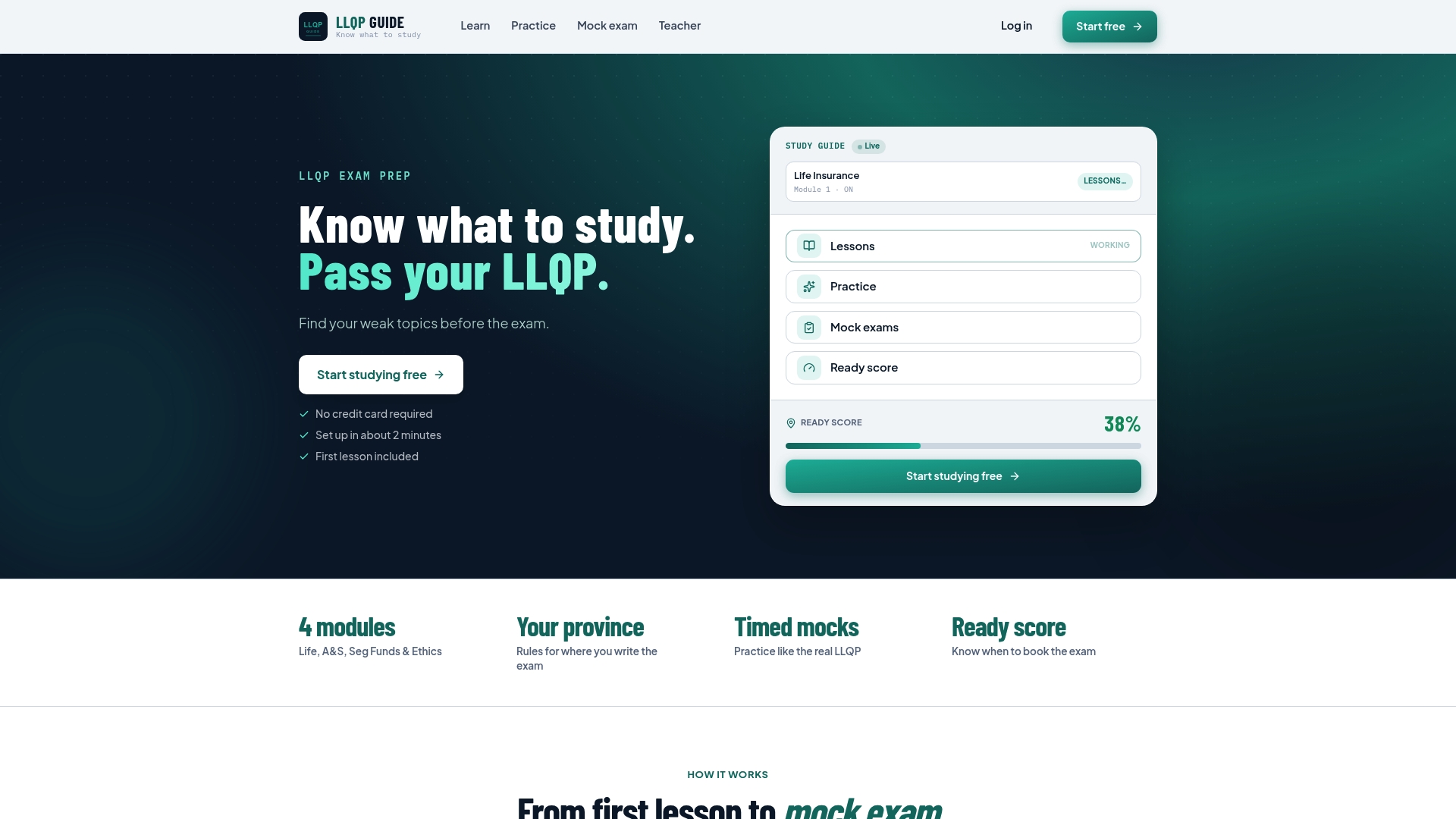
The platform covers all four modules, Life Insurance, Accident & Sickness, Segregated Funds & Annuities, and Ethics & Professional Practice, with unlimited practice quizzes and full-length mock exams built to mirror real exam conditions. A readiness score tracks which topics you’re actually weak on, rather than leaving you guessing at what to review next. That combination, translation support plus targeted remediation, is built specifically for candidates studying in a second or third language, including Urdu speakers preparing across Canada. Plans run $40 per week, $125 per month, or $400 per year, and you can start with a trial before deciding whether to subscribe.
Where to confirm the official rules
Before you register or book a retake, check these directly:
- FSRA’s LLQP program page for provincial rules and fee announcements.
- Durham College’s exam administrator portal for booking, scheduling, and format changes.
- CIRO’s exam hub for harmonized curriculum references and published syllabi.
Sources
- LLQP eligibility and overview (LLQPCanada)
- Life Licence Qualification Program (LLQP) | Financial Services Regulatory Authority of Ontario
Recommended
Frequently asked questions
Is the LLQP exam easy?
Most candidates find it moderately difficult, not because the insurance concepts are complex, but because four modules of dense terminology under time pressure adds up. Pass rates aren't published province by province in most cases, so treat "easy" as relative to how much focused, concept-based study you put in before test day.
What happens if I fail my LLQP exam?
You can retake the specific module you failed after a minimum 24 hour wait, but after a third unsuccessful attempt on the same module, you face a mandatory three month wait, with longer waits possible after further failures. The waiting period applies only to that module, not your entire LLQP progress.
How much does the LLQP exam cost in Canada?
As of the August 2025 fee update, Durham College charges $66 per module for a paper or electronic in-person exam, and $84 per module for a virtual online exam. Since you must pass all four modules, total cost depends on how many attempts and formats you use.
How many exams is the LLQP?
The LLQP consists of four separate module exams: Life Insurance, Accident & Sickness, Segregated Funds & Annuities, and Ethics & Professional Practice. You can write them together or spread them across separate sittings, but you need a passing result on all four to qualify for your licence.
Is the LLQP exam available in Urdu?
No, the LLQP exam is only offered in English and French anywhere in Canada. Urdu-speaking candidates can use translation study tools while preparing, but the actual exam itself has no Urdu language option.