Beat the 12-Month Clock for New Brunswick LLQP: Start Sponsorship Now
Beat the 12-Month Clock for New Brunswick LLQP: Start Sponsorship Now ! Candidate preparing a timed LLQP study plan To get licensed as a life insurance agent in New Brunswick, you need four things in order: an approved LLQP course completion, a passing score on all required exam modules, a sponsoring insurer or firm, and a completed application through the FCNB Self-Serve Portal, submitted within 12 months of your exam pass.

Beat the 12-Month Clock for New Brunswick LLQP: Start Sponsorship Now
To get licensed as a life insurance agent in New Brunswick, you need four things in order: an approved LLQP course completion, a passing score on all required exam modules, a sponsoring insurer or firm, and a completed application through the FCNB Self-Serve Portal, submitted within 12 months of your exam pass. Miss the timing on any one of these, and you start over.
TL;DR:
- Candidates should start the application process early by opening an FCNB portal account and obtaining a CIPR number before studying or taking exams.
- Passing all four modules with at least 60% is required for full licensure, with each module’s exam scored separately and valid for 12 months.
- Sponsorship from a licensed insurer or firm is mandatory before licensing, and candidates must coordinate sponsorship and document collection early during studying.
- Failed exam modules can be rewritten twice after which a three-month wait applies, stressing the importance of timed mock exams and thorough preparation.
- Non-residents, Quebec applicants, or those requalifying after two years need to meet additional or different requirements, such as proof of licensure or redoing courses.
Table of Contents
- What are the New Brunswick LLQP requirements, step by step?
- What LLQP modules do you need to study?
- How does exam scheduling and the rewrite policy work?
- What documents does the FCNB application actually require?
- Do non-residents, Quebec applicants or lapsed licensees face different rules?
- How should you actually prepare and schedule your study time?
- A pragmatic take on what actually trips candidates up
- Study smarter with LLQP Guide’s New Brunswick-aligned prep
- Sources
- FAQ
What are the New Brunswick LLQP requirements, step by step?
Most candidates lose time not because the material is hard, but because they tackle these steps in the wrong order. Here’s the sequence that actually works.
- Open an FCNB Self-Serve Portal account and get your CIPR number. You need this identifier before you can submit anything, so set it up early rather than scrambling after you pass.
- Complete an approved LLQP course and keep the completion certificate. You cannot register for the provincial exam without it.
- Book your exam through Durham College and pass each required module at 60% or higher.
- Start contacting potential sponsoring insurers or licensed firms while you’re still studying. Sponsorship is mandatory — the Financial and Consumer Services Commission will not issue a licence without it, no matter how well you scored.
- Gather your application documents: a criminal record check, transcripts, proof of errors and omissions insurance if your sponsoring firm requires it, and your application fee.
The whole process, done efficiently, typically runs a few months from first lesson to licence in hand. The bottleneck almost never comes from the studying. It comes from candidates who wait until after their exam results arrive to start looking for a sponsor.
What LLQP modules do you need to study?
The provincial exam covers four modules, and which ones apply to you depends on the licence you want.
- Life Insurance — required for a life insurance agent licence.
- Accident and Sickness Insurance — required if you want to sell accident and sickness products; combine it with Life for the most common licence type.
- Segregated Funds and Annuities — required if you plan to sell segregated fund contracts.
- Ethics and Professional Practice — required for every applicant, regardless of which other modules you take.
A full life licence in New Brunswick generally means passing all four. Each module is delivered as a multiple-choice exam, and each one carries its own 60% pass mark — there’s no averaging across modules to cover a weak score elsewhere. You also can’t sit the provincial exam at all without a certificate of completion from an approved course provider first, so lining up your life insurance study materials or reviewing segregated funds content before booking anything saves you a wasted registration fee.
How does exam scheduling and the rewrite policy work?
Durham College administers the New Brunswick provincial exam, with both online and in-person sittings available depending on demand and location. Where the real risk sits is in what happens after a failed attempt.
- You can rewrite a failed module twice before a mandatory three-month waiting period kicks in.
- If you need further attempts beyond that, the wait can stretch longer still.
- A passing mark stays valid for 12 months for licensing purposes, and your course completion certificate is generally treated the same way.
- Book your sitting directly through Durham College once your course certificate is in hand.
Pro Tip: Don’t treat your first attempt as a dry run. A three-month wait after two failed rewrites can push your exam pass right up against the 12-month validity window, forcing you to requalify before your sponsorship paperwork even clears FCNB. Reviewing common rewrite waiting period rules before you book is worth the twenty minutes it takes.
What documents does the FCNB application actually require?
The FCNB application guide is specific about what gets uploaded and checked, and applicants who skip the fine print end up resubmitting.
- A criminal record check completed within the last six months.
- An official transcript or certificate from your LLQP course provider, showing all required modules.
- A valid CIPR registration number tied to your profile.
- Proof that your sponsoring firm or agency is itself licensed under Rule INS-001 — an unlicensed sponsor stalls your application regardless of your exam results.
- Proof of errors and omissions insurance, where your sponsoring arrangement requires it.
FCNB also checks age and general suitability: applicants must be 19 or older and meet the Commission’s fit-and-proper standards. None of this is exotic paperwork, but a mismatched transcript name or an expired criminal record check is a common reason applications bounce back for correction.
Do non-residents, Quebec applicants or lapsed licensees face different rules?
A few groups run into requirements the standard checklist doesn’t cover.
- Non-residents can qualify for a New Brunswick licence if they already hold one in their home jurisdiction, but they need to upload proof of that existing licence with their application.
- Quebec applicants applying for the first time must show completion of Ethics and Professional Practice 112, the common law version. Ethics 111, built for Quebec’s civil law framework, does not satisfy New Brunswick’s requirement.
- Anyone requalifying after 24 months or more without holding an equivalent licence has to redo the course and exam from scratch, treated as a new applicant.
- The Superintendent can waive certain requirements for applicants with equivalent credentials, relevant experience, or a CIP designation, so it’s worth asking FCNB directly if you fall into one of these categories.
How should you actually prepare and schedule your study time?
Give yourself real, sequenced study blocks rather than cramming everything into a single push. Most candidates need somewhere between 60 and 100 total study hours across all four modules, more if English is a second language or the material is entirely new to you. Sequence Ethics early since it’s shorter, then move into Life, Accident and Sickness, and Segregated Funds while the exam format is still fresh.

Start your sponsorship conversations the same week you start studying, not after your results come in. Use full-length, timed mock exams that mirror real exam conditions. Candidates who skip timed practice are more likely to run out of time on module questions, and that’s a big driver of the rewrites and waiting periods covered above. When you upload documents to the FCNB portal, rename files with simple alphanumeric names. Special characters and long file names are a common cause of rejected uploads.
Pro Tip: *Book your Durham College exam sitting only after you’ve run at least one full timed mock exam per module.
A pragmatic take on what actually trips candidates up
Most people preparing for the LLQP treat sponsorship as a formality to sort out after passing. It isn’t. Some firms take weeks to confirm, and a few want an interview before they’ll sponsor you at all. Run that outreach alongside your studying, not after it. The other quiet killer is administrative: mismatched names on transcripts, files with special characters that the portal rejects, a criminal record check that’s aged past six months by the time you submit. None of it is hard to fix, but it eats the calendar time you don’t have once your 12-month clock is running. Timed mock exams matter more than most candidates think, precisely because a rewrite wait can push a passing score past its validity window before your application ever reaches FCNB.
— Reza
Study smarter with LLQP Guide’s New Brunswick-aligned prep
There are other ways to prepare for the LLQP exam, from standalone textbooks to generic online courses that treat every province the same way. Llqpguide takes a different approach: province-aligned lessons across all four modules, unlimited practice quizzes, and full-length mock exams built to mirror real exam conditions, so you know where you stand before you book with Durham College.
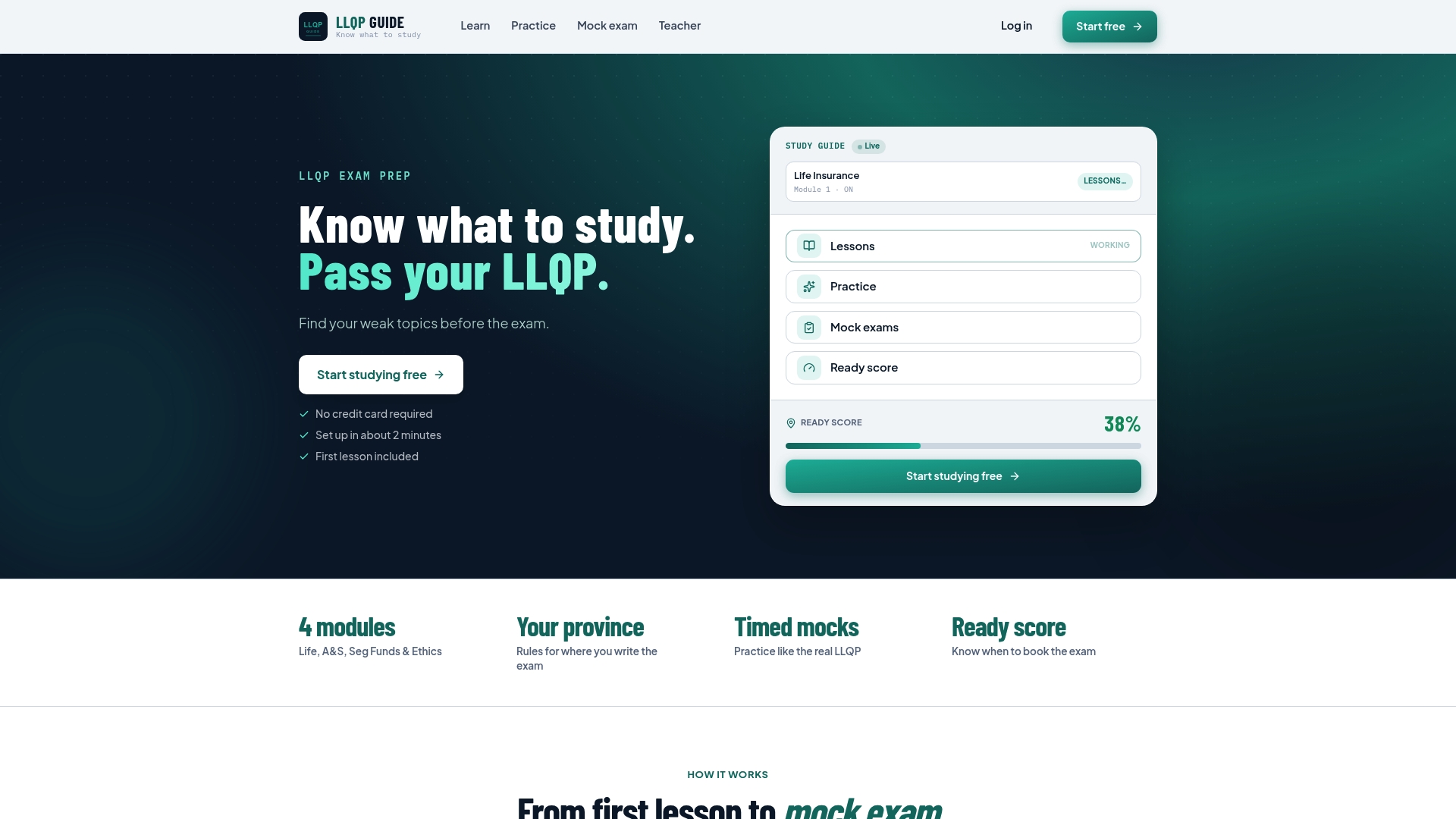
If English is your second language, translation tools in lessons can help you study the concepts instead of getting stuck on vocabulary. A readiness score tracks your progress across all four modules so you can see, module by module, whether you’re ready to sit the exam or need another week on Segregated Funds or Ethics. Plans are available with weekly, monthly, and yearly payment options, with details listed on the pricing page. If you’re heading into your first attempt, start with a module review on the life insurance prep page and book your mock exam before you lock in your Durham College sitting.
Sources
Keep these official pages on hand while you work through your application. Each one covers a different piece of the process, and none of them substitute for the others.
- Licensing Requirements - Life Licence Qualification Program | FCNB
- Applying for your insurance licence | FCNB
Recommended
Frequently asked questions
Is the LLQP exam worth it?
Yes, for anyone planning to sell life, accident and sickness, or segregated fund products in New Brunswick, since it's the only path to a licence. It's a moderate time investment. Most candidates spend a few months on study and application combined, and the credential opens work across every federally regulated insurer in the province.
What's the easiest insurance license to get?
Within the LLQP framework, the Accident and Sickness module alone is generally considered the lightest single module, since it covers a narrower set of products than Life or Segregated Funds and Annuities. Most agents in New Brunswick still need to combine it with Life and Ethics to get a practical, sellable licence.
What is the provincial exam requirement in other provinces, like Nova Scotia or Alberta?
Every province requires the same core LLQP modules and a comparable pass mark, but the exam administrator, sponsorship rules, and specific provincial add-ons (like New Brunswick's CIPR number) vary. If you're licensed in New Brunswick and want to add another province, check that province's regulator directly, since equivalency isn't automatic everywhere.
How long is a passing LLQP exam result valid in New Brunswick?
A passing result stays valid for 12 months for licensing purposes. If your sponsorship and application aren't finalized inside that window, you'll need to requalify by writing the exam again.
Does LLQP Guide cover the New Brunswick-specific rules?
Llqpguide's lessons cover all four LLQP modules with the practice quizzes and mock exams candidates need regardless of province, and current pricing is listed on the pricing page. For province-specific licensing steps like sponsorship and portal submission, always confirm directly with FCNB.