Pass Saskatchewan LLQP in 4–8 Weeks: Beat the 12 Month Clock
Pass Saskatchewan LLQP in 4–8 Weeks: Beat the 12 Month Clock ! Candidate completing timed LLQP practice exam Three things make you eligible to write Saskatchewan's provincial LLQP exams: completion of an approved LLQP course, a Canadian Insurance Participant Registry (CIPR) number tied to that course, and certification dated within the last 12 months.

Pass Saskatchewan LLQP in 4–8 Weeks: Beat the 12 Month Clock
Three things make you eligible to write Saskatchewan’s provincial LLQP exams: completion of an approved LLQP course, a Canadian Insurance Participant Registry (CIPR) number tied to that course, and certification dated within the last 12 months. Meet those, register through Durham College’s exam system, pass all four modules, then apply for your licence through the ICS Online Licensing Portal, which requires multi factor authentication, a criminal record check, and the applicable fee.
TL;DR:
- Passing all four modules within 12 months of course completion is essential, as certification lapses otherwise requiring recertification and a new course.
- Candidates should book exams early in their certification period, ideally within the first month of receiving their CIPR number, to avoid running out of time.
- Repeated failures beyond three attempts at the same module trigger a mandatory one-year wait and a full retake of the approved LLQP course.
- Completing full-length timed mock exams at least once before exam day highly improves the chances of passing and prevents pitfalls related to logistics.
- Maintaining up-to-date criminal record checks, setting up multi-factor authentication, and verifying portal access are critical logistical steps often overlooked but vital for smooth licensure.
Table of Contents
- The four LLQP provincial modules you must pass
- Approved LLQP course, your CIPR number, and the 12-month clock
- Registering with Durham College and what exam day looks like
- Applying for your Saskatchewan insurance licence
- Exam retakes, attempt limits, and waiting periods
- Continuing education and keeping your licence current
- A practical study plan mapped to Saskatchewan’s timeline
- Common pitfalls and practical shortcuts
- How LLQP Guide fits into your Saskatchewan prep
- Sources
- FAQ
The four LLQP provincial modules you must pass
Every Saskatchewan life insurance licence traces back to the same four provincial exam modules, and the Insurance Councils of Saskatchewan requires you to pass all of them before a licence gets issued. Skipping ahead to study only the topics you find interesting is a common mistake. Each module tests a distinct body of knowledge, and licence categories often bundle more than one together.
- Life Insurance: policy types, underwriting basics, needs analysis, and the products that fall under a standard life licence.
- Accident & Sickness Insurance: disability income, critical illness, and health benefit products, usually required alongside the life module for a combined licence.
- Segregated Funds & Annuities: investment-linked insurance products, the contracts that separate them from mutual funds, and the disclosure rules around them.
- Ethics & Professional Practice (Common Law Provinces): conduct standards, disclosure obligations, and the regulatory framework that governs how you deal with clients.
Most new agents pursue the life and accident & sickness combination first, since that pairing covers the bulk of retail insurance sales. Segregated funds sits apart because it touches investment regulation, and candidates who plan to sell that product line often treat it as a separate study block rather than cramming it in with the others.
Approved LLQP course, your CIPR number, and the 12-month clock
Before you can book a single provincial exam, your course provider needs to confirm two things to Durham College’s system: that you completed an approved LLQP course, and that the certification is current. Not every course on the market carries approval, so check your provider against the ICS list before you pay for anything.
Once you finish an approved course, the provider issues a CIPR number. Think of it as your exam passport. It links your identity to your course completion record and is what you’ll use to sign into the Durham College portal.
- Confirm provider approval before enrolling, not after.
- Save your CIPR number and confirmation email the moment you receive them.
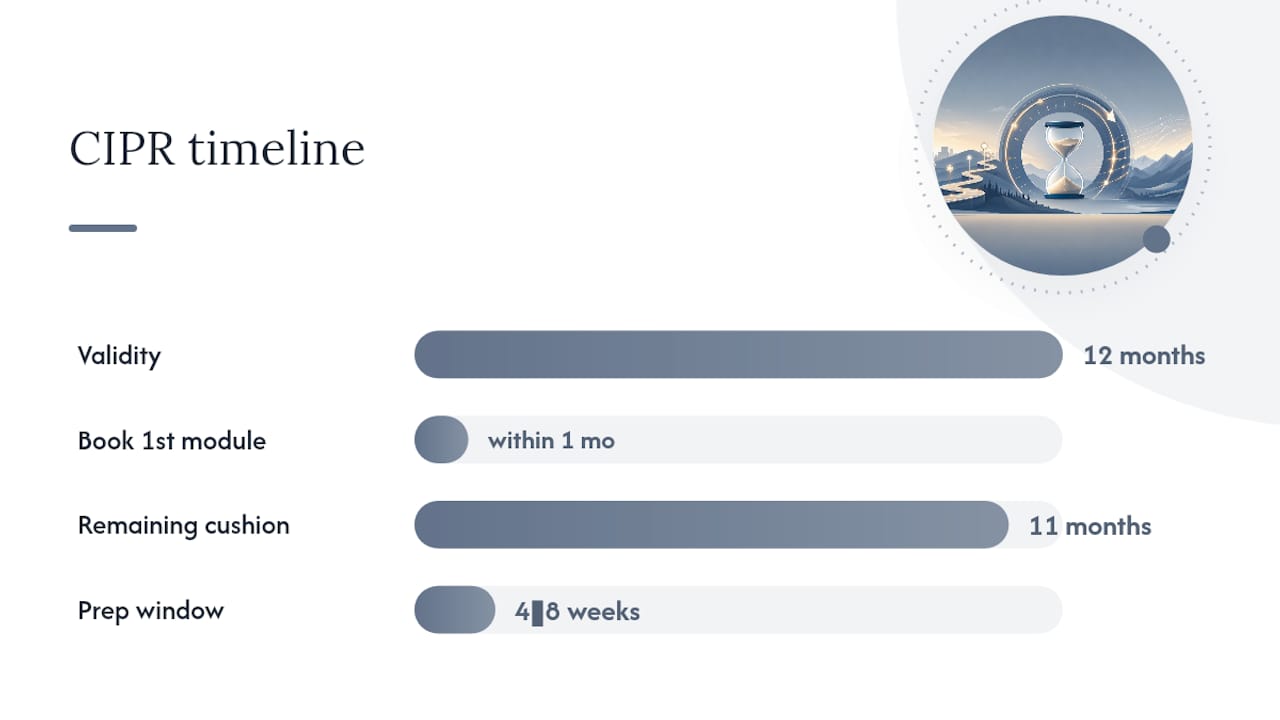
- Track the date your certification was issued. It’s only valid for 12 months.
That 12-month window catches more candidates off guard than any exam question. If your certification lapses before you’ve booked and passed all four modules, you’re back to square one on the course.
Pro Tip: Book your first exam module within the first month of getting your CIPR number. That leaves you a full 11 months of cushion instead of racing the clock at the end.
Registering with Durham College and what exam day looks like
Durham College administers the actual provincial exams on behalf of Saskatchewan’s regulator, and your CIPR number is the key that unlocks the system.
- Sign into the Durham College LLQP exam portal using your CIPR number and the credentials tied to your course completion.
- Choose which of the four modules you want to write first. You don’t need to take them in any fixed order, though most candidates start with Life Insurance.
- Schedule your exam date and location, keeping the 12-month certification deadline in mind for every module you haven’t yet passed.
- Bring valid government-issued ID that shows your residential address. A driver’s licence or passport works, but student cards and expired documents don’t.
- Arrive early. Exam centres run security checks, restrict personal items at the desk, and enforce strict timing once the module starts.
The address requirement on your ID trips people up more than expected, particularly candidates who’ve moved recently and haven’t updated their licence. Fix that before exam day, not at the check-in desk.
Applying for your Saskatchewan insurance licence
Passing all four modules doesn’t hand you a licence automatically. You still need to apply through the ICS Online Licensing Portal, and that process has its own set of requirements worth knowing in advance.
- Create your portal account early and set up Multi-Factor Authentication before you actually need to submit anything. Waiting until application day risks a delay if verification hiccups.
- Upload proof of your LLQP course completion and your passed exam results.
- Include a criminal record check dated no more than six months before submission.
- Pay the applicable licensing fee. ICS lists an example individual licensing fee, which you should confirm on the portal before applying.
- Expect a review period. The Council evaluates every application against The Insurance Act, Regulations, and Council Bylaws, so incomplete or inconsistent documentation can trigger follow-up requests and slow things down.
A recommender review sits inside this process, meaning someone at ICS actively checks your file rather than rubber-stamping it. Clean, complete documentation moves faster than a partial submission you plan to fix later.
Exam retakes, attempt limits, and waiting periods
Failing a module once isn’t a crisis. Failing it repeatedly changes your timeline in a way that’s hard to undo quickly.
- You get multiple attempts per module, but repeated failures carry consequences.
- After a fourth failed attempt at the same module, you face a mandatory one-year waiting period.
- Once that year passes, you’re required to retake the approved LLQP course itself before you can attempt the exam again, not just rebook the test.
That combination, a full year off plus a repeated course fee, is the outcome every candidate wants to avoid. The fix isn’t complicated: treat mock exams as a real diagnostic tool before you sit the provincial version, not an afterthought you skim through the night before.
Pro Tip: If you fail a module, don’t immediately rebook. Spend a week identifying exactly which topic areas cost you marks, then target those before your next attempt.
Continuing education and keeping your licence current
Getting licensed is the finish line for the exam process, but it’s the starting point for an ongoing obligation. Saskatchewan licensees must maintain continuing education (CE) credits to stay in good standing.
- ICS references a minimum of 15 CE credit hours required each reporting period for life licensees.
- Keep your own records of completed CE activities. Don’t rely solely on providers to report on your behalf.
- Check the ICS continuing education pages for the current list of accepted providers before you enrol in any course.
- Renewal cycles run on a set schedule, and missing CE requirements can put your licence status at risk.
Professional conduct matters just as much as credit hours. Complaints or conduct issues can trigger a Council review independent of your CE record, so treat licensing as an ongoing standard, not a box you check once and forget.
A practical study plan mapped to Saskatchewan’s timeline
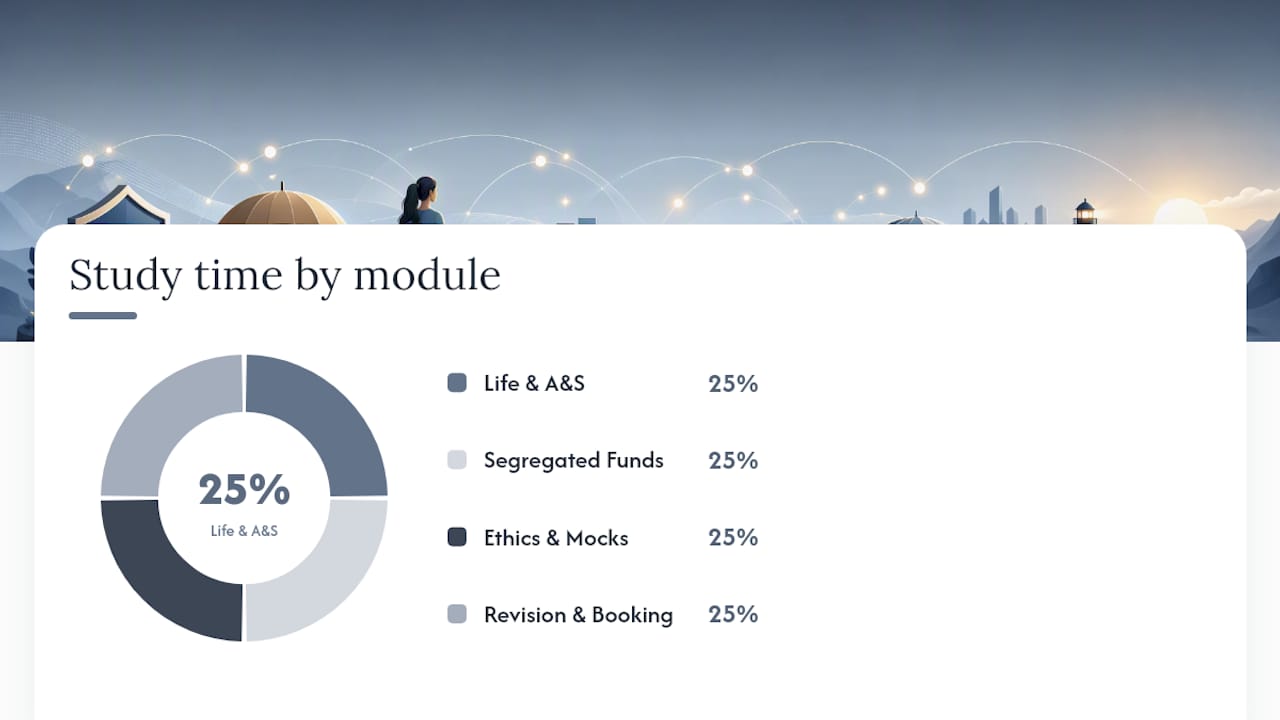
You don’t need six months to get exam-ready. A focused four to eight week plan, built around the four modules and the 12-month certification window, works for most candidates studying alongside a job.
- Weeks 1 to 2: Complete your approved course lessons and practice quizzes for Life Insurance and Accident & Sickness together, since they overlap heavily.
- Weeks 3 to 4: Move into Segregated Funds & Annuities, giving it dedicated time given the investment-regulation content.
- Weeks 5 to 6: Cover Ethics & Professional Practice, then start layering in full-length mock exams that mirror provincial timing.
- Weeks 7 to 8: Use targeted revision on weak areas flagged by your mock results, book your Durham College exam dates, and confirm your CIPR number and certification date are both current.
If English isn’t your first language, translation tools built into your study platform matter more than most candidates expect, particularly for the dense wording in the Ethics module. Combining module-specific practice with a readiness score before exam day catches gaps that generic flashcards miss.
Pro Tip: Sit at least one full timed mock exam under real exam conditions, no pausing, no notes, before you attempt any provincial module. It’s the single best predictor of whether you’re actually ready.
Common pitfalls and practical shortcuts
The candidates who stumble almost never fail because the material was too hard. They stumble on logistics: a lapsed CIPR certification, a forgotten MFA setup, or walking into a provincial module having never sat a full timed practice test.
Fix the boring stuff first. Book exams early inside your 12-month window, verify portal access weeks before you need it, and treat one complete mock exam as non-negotiable before module day.
— Reza
How LLQP Guide fits into your Saskatchewan prep
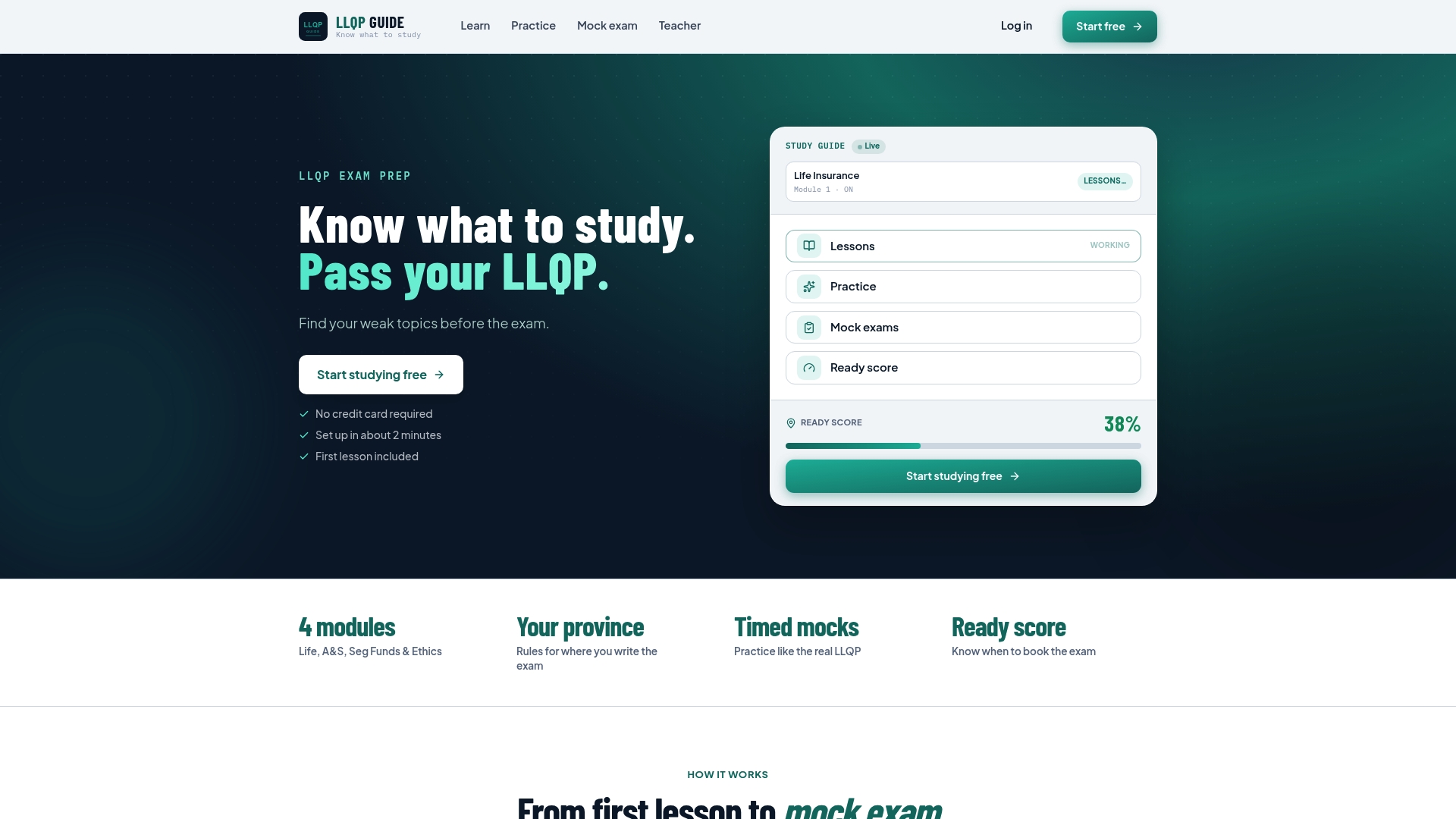
Meeting Saskatchewan’s requirements comes down to timing and preparation working together, and that’s exactly where a province-aligned study platform earns its keep. LLQP Guide combines lessons, unlimited practice quizzes, and full-length mock exams built around the same four modules Saskatchewan requires, with a readiness score that flags weak areas before you book your Durham College date.
For candidates studying in a second language, in-lesson translation tools cut down the time lost decoding dense exam wording, particularly in the Ethics module. Check the Life Insurance module and Segregated Funds & Annuities module pages to see what’s covered, or head straight to pricing to compare the Weekly plan at $40 per week, Monthly at $125 per month, or Yearly at $400 per year, and start practising before your certification clock starts running down.
Recommended
Frequently asked questions
How do I get a life insurance licence in Saskatchewan?
Complete an approved LLQP course, get your CIPR number, and pass all four provincial modules within your 12-month certification window through Durham College's exam system. Once you pass, apply through the ICS Online Licensing Portal with your criminal record check and licensing fee.
How difficult is the LLQP exam?
Difficulty varies by module, with Segregated Funds & Annuities and Ethics often flagged as the toughest because of their regulatory density. Candidates who sit a full-length timed mock exam beforehand, rather than only reviewing notes, tend to walk in far better prepared.
What is the LLQP certification and what are its requirements in Saskatchewan?
LLQP certification confirms you've completed an approved provider course and received a CIPR number, both required to sit Saskatchewan's provincial exams. That certification is only valid for 12 months, so all four modules need to be passed inside that window or you'll need to recertify.
What is the easiest insurance license to get?
There's no officially "easiest" licence category, since all four LLQP modules require passing marks regardless of which combination you're pursuing. Life Insurance and Accident & Sickness are commonly tackled first because their content overlaps, which can make studying them together feel more efficient than starting with Segregated Funds & Annuities.
What happens if I fail an LLQP module multiple times?
After a fourth failed attempt at the same module, Saskatchewan imposes a one-year waiting period, and you'll need to retake the approved LLQP course before attempting that exam again. Targeted revision and at least one timed mock exam before each attempt significantly lowers that risk.