Avoid Exam Day Rejections: Newfoundland and Labrador LLQP Requirements
Avoid Exam Day Rejections: Newfoundland and Labrador LLQP Requirements ! Candidate presenting photo ID for exam verification To meet Newfoundland and Labrador's LLQP requirements, you need to complete a provincially approved LLQP course, obtain a CIPR number that matches your government photo ID exactly, pass all four modular exams at 60% or better, and line up a sponsoring insurer before you submit your provincial licence application.

Avoid Exam Day Rejections: Newfoundland and Labrador LLQP Requirements
To meet Newfoundland and Labrador’s LLQP requirements, you need to complete a provincially approved LLQP course, obtain a CIPR number that matches your government photo ID exactly, pass all four modular exams at 60% or better, and line up a sponsoring insurer before you submit your provincial licence application. Miss any one of those four and Service NL will not process your file. The order matters too: course completion has to post to your CIPR profile before you can even book an exam sitting.
TL;DR:
- Candidates must verify that their course provider is provincially approved and ensure their CIPR name matches their government-issued ID exactly before booking exams or submitting applications.
- Passing all four modules at 60% or higher is necessary but not sufficient; securing a sponsoring insurer and submitting complete paperwork are also required for licensing.
- The exam involves four open-book modules, each with a strict 75-minute time limit and questions focused on applying rules to scenarios rather than memorization.
- Registration for exams must be done in person before the Friday 1:00 pm cutoff, with two modules possible per sitting, and ID matching is crucial to avoid exam disqualification.
- Budget approximately 140 dollars in exam fees, with additional costs for course tuition and rewrites, and allow several weeks for processing after passing all modules.
Table of Contents
- What are Newfoundland and Labrador’s LLQP requirements, step by step?
- What do the four modular exams actually test?
- How do you register for the exam in Newfoundland, and what do you bring?
- Passed your exams? Here’s how sponsorship and licensing work
- What should you budget, and how long does the whole process take?
- How should you actually study for a modular, open-book exam?
- Age and eligibility: who can actually write the LLQP in Newfoundland?
- What language can you write the LLQP exam in, in Newfoundland?
- Do you need a background check to write the LLQP or get licensed?
- Ready to study for Newfoundland’s modular exams? Here’s a faster route
- Sources
- FAQ
What are Newfoundland and Labrador’s LLQP requirements, step by step?
The path from “never studied insurance” to “licensed agent” runs through five checkpoints, and skipping the order costs people weeks.
- Confirm your course provider is provincially approved and register. Not every LLQP course counts. Check that the provider’s curriculum aligns with the harmonized CISRO framework before you pay for anything, since Newfoundland and Labrador accepts training built around that standard.
- Get your CIPR number and check the name match immediately. Register with the Canadian Insurance Participant Registry as soon as you start your course, and verify your legal name on that profile matches your driver’s licence or passport character for character. This single step causes more exam-day denials than anything else.
- Finish the course and confirm certification lands on your CIPR file. Your training provider reports completion directly to CIPR. Until that shows up, the College of the North Atlantic will not let you book a module.
- Line up a sponsoring insurer before you apply. Most insurers will sponsor a candidate who has passed exams, but some will discuss sponsorship earlier. Either way, you need a signed sponsor in hand before Service NL will issue anything.
- Submit your application to Service NL. Once you’ve passed your modules and secured sponsorship, the provincial insurance office reviews your CIPR record, sponsorship letter, and exam results together. Processing is not instant, so build in a buffer before you expect to write a policy.
A CIPR mismatch caught in week one is a five-minute fix. Caught at the exam room door, it means you’ve lost your sitting and your $35 fee.
What do the four modular exams actually test?
That structure matters because failing one module doesn’t wipe out a pass on another. You keep what you’ve earned and rewrite only the module you missed.
The four modules and how they combine:
- Life Insurance and Accident & Sickness together qualify you for a life and A&S licence, the most common combination for new agents.
- Segregated Funds & Annuities is required if you plan to sell seg fund products through an insurer.
- Ethics & Professional Practice is mandatory for every candidate regardless of which product lines you’re pursuing.
Each module runs on a strict 75 minute clock, and the exam is administered open-book on a tablet, with one exception: the only permitted reference is the official CISRO LLQP material loaded onto that tablet. No outside notes, no personal calculator, no phone.
Quick stat: first-time national pass rates for LLQP modules sat between roughly 69% and 78% in 2024 reporting, with ethics modules trending higher. That’s a passable exam for someone who studies properly, not a coin flip.
Because the format is open-book, the questions lean toward applying a rule to a scenario rather than recalling a definition. Memorizing terms gets you partway. Practising how to apply them under a clock gets you the pass.
How do you register for the exam in Newfoundland, and what do you bring?
Newfoundland and Labrador exams run through the College of the North Atlantic, and sittings are scheduled on an as-needed basis rather than a fixed weekly calendar, so campus capacity can fill up faster than candidates expect.
- Registration must happen in person, by 1:00 pm on the Friday before a scheduled Wednesday sitting. There’s no same-day walk-in option.
- You can write up to two modules in a single scheduled sitting, which lets you cluster related modules if you’re ready for both.
- The fee is a fee per module, payable through the methods the St. John’s CNA Continuing Education office accepts at the time of registration.
- Bring your CIPR number, valid government-issued photo ID, and a photocopy of that ID for the exam file. Your CIPR name has to match the ID exactly, no nicknames, no missing middle names.
- Exam-day conduct is enforced tightly: unauthorized materials, phone use, or leaving the room without approval can lead to immediate termination of your attempt and a zero score, per the exam administration rules.
Plan your CNA visit around that Friday cutoff. Missing it by even an hour pushes you to the next available sitting, which in a smaller province can mean a real wait.
Passed your exams? Here’s how sponsorship and licensing work
Passing all four modules doesn’t make you licensed. It makes you eligible to become licensed, and the next steps determine how fast you’re actually selling.
- Secure a sponsoring insurer. Insurers typically want to see your passed modules before formally sponsoring you, though some larger companies will start the conversation while you’re still studying. A sponsor agrees to supervise your early practice and vouches for you on the application.
- Confirm your CIPR record reflects your pass. The College of the North Atlantic updates your CIPR profile after each module result, and your licence application depends on that record being current and accurate.
- Submit your application to Service NL. You’ll need your CIPR number, proof of passed modules, and your signed sponsorship letter. The Government Services insurance office reviews all three together.
- Wait for confirmation before writing business. Processing isn’t instant, and new licensees often work under closer sponsor supervision for their first months on the job.
Keep copies of every exam result notice. If Service NL flags a discrepancy, you’ll want your own paper trail, not just CIPR’s.
What should you budget, and how long does the whole process take?
The province-specific number every candidate should know: a fee per module, paid through the College of the North Atlantic’s St. John’s Continuing Education office, per the official exam memo. Write all four modules and you’re looking at $140 in exam fees alone, before rewrites.
- Course tuition varies by provider and format (self-paced online versus instructor-led), so check current course cost ranges before committing to one program.
- Most candidates sit their first module within two to four weeks of finishing coursework, once CIPR reflects completion.
- If you fail a module, you can rewrite it, but you’ll pay the $35 fee again and need a new CNA booking. There’s no standard waiting period baked into provincial rules beyond simply scheduling your next available sitting.
- Licence processing after your final pass typically takes a few weeks, depending on how quickly your sponsor submits paperwork alongside you.
Budget for rewrites even if you don’t expect to need one. A second attempt at $35 is cheap insurance against overconfidence.
How should you actually study for a modular, open-book exam?
Open-book doesn’t mean easy. It means the exam expects you to apply concepts faster than you can look them up, since flipping through reference material burns your 75 minute clock. The smarter approach is to study as if it’s closed-book, then use the tablet reference only to confirm, not to learn on the fly.
Pro Tip: Time yourself on practice questions from day one, not just in the final week. If you consistently need more than 90 seconds per question in practice, you’ll run out of time in the real module before you finish the last ten questions.
A few tactics that actually move the needle:
- Drill scenario-based questions, not flashcard definitions. The exam tests judgment calls, not vocabulary recall.
- Simulate the tablet format under a strict clock so navigating a screen interface doesn’t cost you time on exam day.
- Build a pre-exam checklist: CIPR name matches ID, photocopy of ID in hand, registration confirmed before the Friday 1:00 pm cutoff.
- Review weak modules separately rather than restudying everything evenly. Ethics tends to click fast; Segregated Funds & Annuities usually needs more repetition.
LLQP Guide builds its lessons around each of these four modules specifically, with unlimited practice quizzes and mock exams designed to mirror real exam pacing. The platform’s readiness tracking flags which module is dragging your overall preparation down, and its translation tools help candidates working through the material in a second language keep pace without losing exam-specific terminology.
Age and eligibility: who can actually write the LLQP in Newfoundland?
There’s no minimum age set out in provincial LLQP rules beyond the general legal capacity to enter a contract, which in Newfoundland and Labrador means candidates are typically expected to be the age of majority. In practical terms, that covers virtually every candidate pursuing this as a career path.
Eligibility hinges less on age and more on documentation. You need valid government-issued photo ID that matches your CIPR profile, and you need to have completed an approved LLQP training course before CNA will let you book a sitting. There’s no requirement for prior insurance industry experience, a specific educational background, or Canadian citizenship. Permanent residents and work permit holders can pursue licensing, though your sponsoring insurer may have its own hiring criteria separate from the provincial exam rules.
One detail candidates often overlook: if you’ve had a licence suspended or revoked in another province, disclose it on your application. Service NL cross-checks CIPR records nationally, and an undisclosed issue elsewhere in Canada can delay or derail an otherwise clean application. If you’re unsure whether a past issue affects your eligibility, it’s worth a direct call to Service NL before you invest time and money in a course.
What language can you write the LLQP exam in, in Newfoundland?
Newfoundland and Labrador administers the LLQP modular exams in English. That’s the standard language of instruction and testing at College of the North Atlantic sittings across the province, and it applies to all four modules.
If English isn’t your first language, this is where preparation strategy matters more than exam-day accommodation. The exam itself doesn’t offer a French-language sitting in Newfoundland and Labrador the way some other provinces do, so non-native English speakers need to build fluency with insurance-specific vocabulary well before exam day, not figure it out mid-test. Terms like “rider”, “cede”, or “contestability period” carry precise legal meaning that a general English vocabulary won’t cover.
This is one area where the right study tool changes outcomes. LLQP Guide’s lesson content includes in-lesson word translation across more than a dozen languages, letting candidates confirm they understand a concept in their strongest language before applying it in English under exam conditions. That’s a meaningfully different approach than just handing someone an English glossary and hoping the terminology sticks under time pressure.
Do you need a background check to write the LLQP or get licensed?
Provincial licensing in Newfoundland and Labrador involves a level of scrutiny beyond just passing your exams, and background disclosure is part of the sponsorship and application stage rather than the exam registration stage itself.
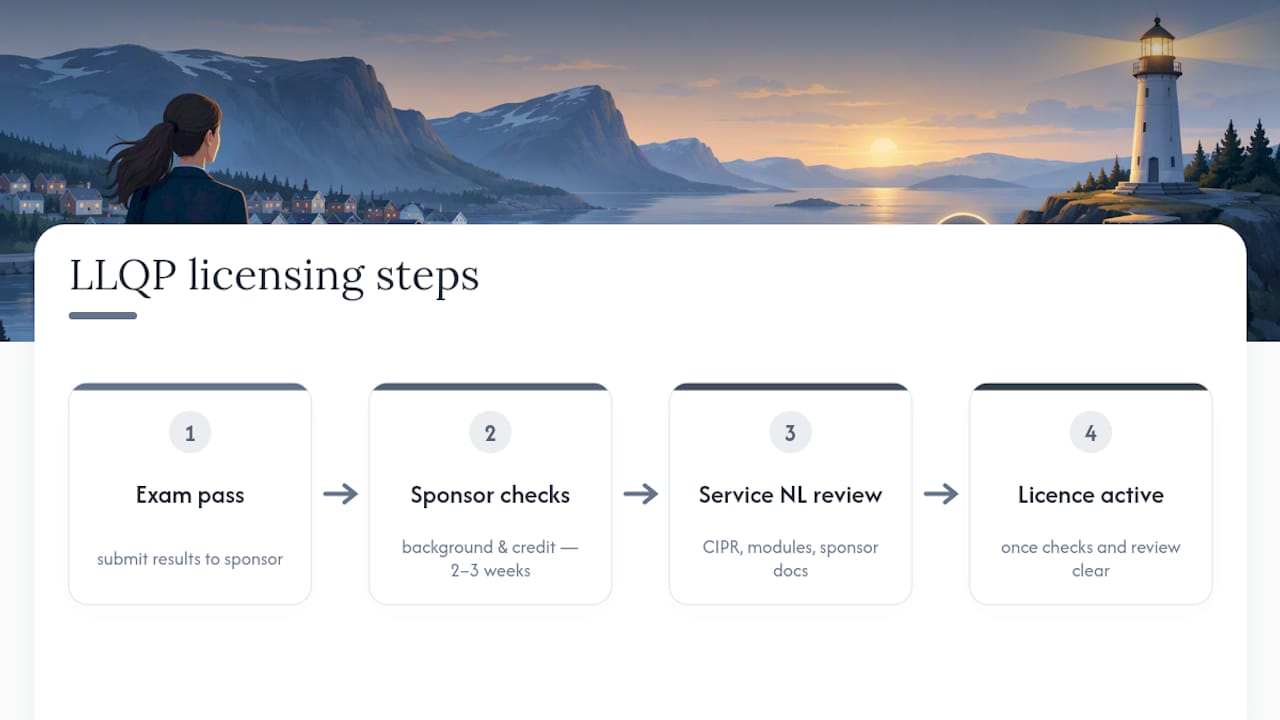
Your sponsoring insurer typically runs its own background and credit checks as part of onboarding, separate from anything Service NL requires directly. This is standard across the industry since insurers are extending trust (and often errors and omissions coverage) to a new licensee handling client funds and sensitive financial information. Timelines for this vary by insurer, but most complete their internal checks within a few weeks of receiving your passed exam results.
Service NL’s own application review focuses on your CIPR record, proof of passed modules, and sponsorship documentation rather than running a separate criminal record check as a distinct bureaucratic step. That said, any past regulatory action, licence suspension, or relevant criminal history should be disclosed proactively on your application. Withholding something that surfaces later is far more damaging to your licensing prospects than disclosing it upfront.
If you’re planning your timeline, build in two to three weeks after your final exam pass for your sponsor’s internal checks to clear before you expect your licence to be active. Candidates who line up sponsorship discussions early, before their last exam, often shave real time off this stage.
Author’s concise perspective for Newfoundland candidates
Most people who stall out on this path don’t fail an exam. They fail the paperwork: a CIPR name that doesn’t match a driver’s licence, a missed Friday registration cutoff. Get the administrative details locked down first, then practise under a real clock, tablet interface included, and build your CNA sitting into your calendar the moment your course wraps up.
— Reza
Ready to study for Newfoundland’s modular exams? Here’s a faster route
There are other ways to prepare: generic study guides, borrowed notes from a friend who passed years ago, or a course provider’s bundled practice questions.
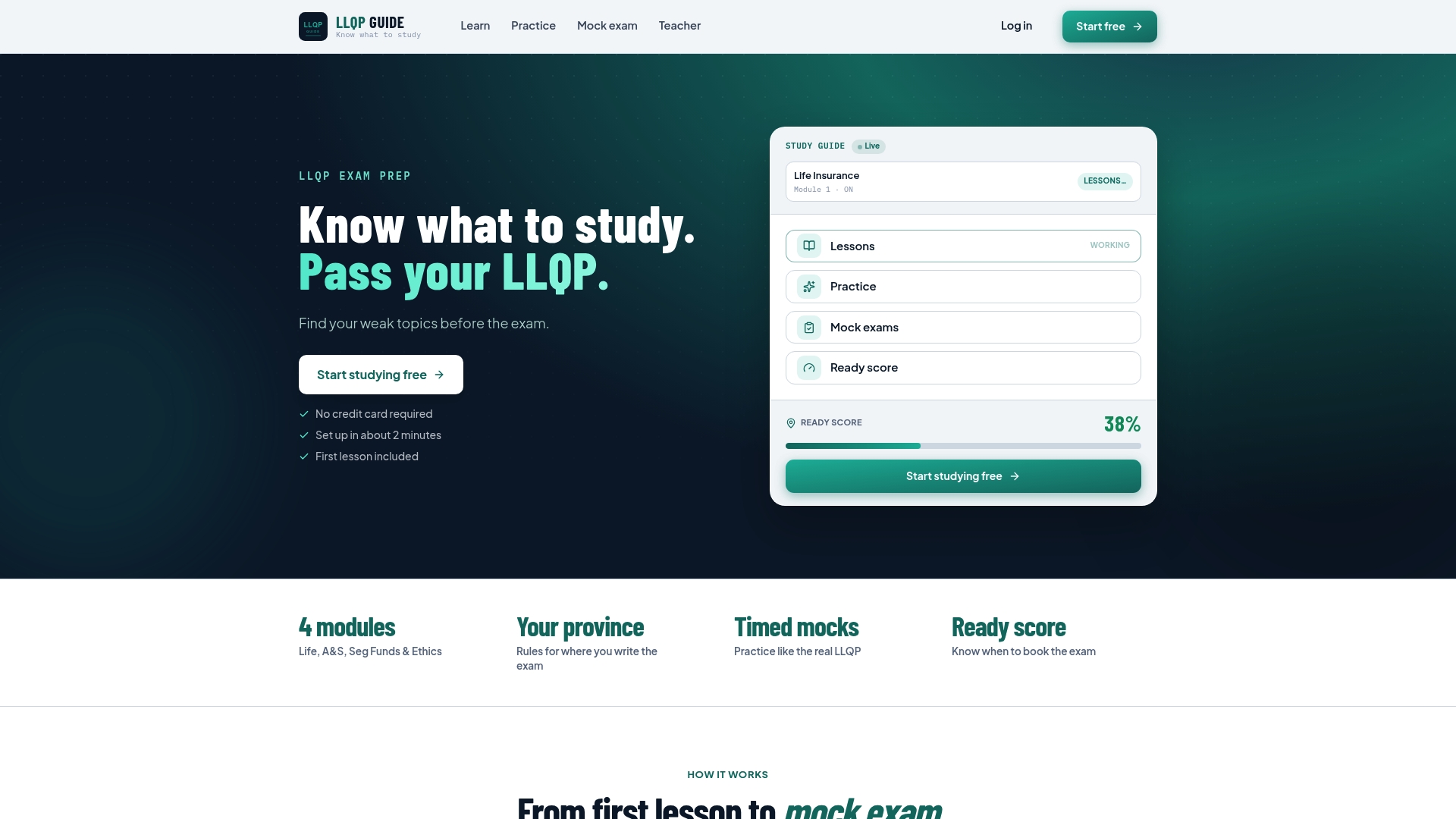
Some platforms build lessons, quizzes, and mock exams around the four modules: Life Insurance, Accident & Sickness, Segregated Funds & Annuities, and Ethics & Professional Practice. Mock exams may mirror real exam pacing, helping candidates prepare for the 75 minute time limit. Unlimited practice quizzes can enable focusing on weak modules multiple times. For non-native English speakers, some study tools include in-lesson translation to assist with terminology before applying it in English.
Check the pricing page for weekly, monthly, and yearly plans, or start by browsing the module breakdown to see exactly what each exam covers before you book your first CNA sitting.
Sources
Provincial rules change, and secondhand summaries (including this one) go stale. Bookmark the primary sources:
- Life Licence Qualification Program (LLQP) - Government Services
- LLQP modular exams memo (College of the North Atlantic) - December 16, 2025
- LLQP project overview and harmonization (CISRO)
- LLQP exam rules and administration guidance
Recommended
Frequently asked questions
Is the LLQP hard to pass?
It's demanding but passable with focused preparation. First-time national pass rates for LLQP modules ran roughly 69% to 78% in 2024 reporting, with ethics modules trending toward the higher end.
How do I apply for a life insurance licence in Newfoundland and Labrador?
You complete an approved LLQP course, pass all four modular exams at 60% or better, secure a sponsoring insurer, then submit your CIPR record and sponsorship documentation to Service NL. Processing takes a few weeks once everything is submitted correctly.
Is the LLQP an open-book exam?
Yes, but the only permitted reference is the official CISRO LLQP material loaded onto the exam tablet. No outside notes, personal calculators, or phones are allowed, and each module runs on a strict 75 minute clock that punishes candidates who rely too heavily on lookups instead of preparation.