Pass LLQP in Canada: Start Self Study With the Provider Certificate
Pass LLQP in Canada: Start Self Study With the Provider Certificate ! Candidate reviewing LLQP registration information Yes, you can prepare for the LLQP independently, but there's a mandatory gate first: you must complete a provincially approved LLQP course and get the provider's certificate of completion before you can book any provincial exam.

Pass LLQP in Canada: Start Self Study With the Provider Certificate
Yes, you can prepare for the LLQP independently, but there’s a mandatory gate first: you must complete a provincially approved LLQP course and get the provider’s certificate of completion before you can book any provincial exam. The self-directed part happens inside that approved course, not around it.
TL;DR:
- Failing to complete an approved provincially recognized LLQP course and obtain its certificate prevents registration for the licensing exam.
- Most candidates need around 100 hours of study, with practice questions and mock exams being more effective than rereading notes alone.
- Consistent, timed practice and targeted review of weak areas significantly improve first-time pass rates, especially for scenario-based ethics questions.
- Booking your exam depends on completing the course and certificate, with provincial pass marks set at 60% and exam validity typically limited to 12 months.
- Using platform tools for practice, translation support for ESL candidates, and province-specific guidance maximizes exam readiness and reduces delays.
Table of Contents
- What does llqp self study actually look like?
- How much time should you set aside to study?
- How does provider certification and exam registration actually work?
- Why do practice questions matter more than rereading notes?
- What should you expect on exam day and after?
- What tips actually move the needle on pass rates?
- A candidate’s-eye view: what actually derails self-study
- A self-study playbook that respects the regulatory reality
- How LLQP Guide fits into your self-study plan
- Sources
- FAQ
What does llqp self study actually look like?
“Self study” for the LLQP doesn’t mean skipping the official course. It means taking ownership of how you move through an approved provider’s course, rather than sitting in a scheduled classroom. That distinction trips up a lot of first-time candidates who assume they can study from a textbook and walk into a provincial exam. You can’t. The provincial regulator requires a certificate from a recognized provider before it will let you register.
Here’s the sequence that actually works, in order:
- Confirm your province’s approved provider list. Every province maintains its own registry of accepted LLQP course providers, and requirements differ slightly by jurisdiction (Ontario’s rules run through the Financial Services Regulatory Authority of Ontario, while New Brunswick’s process sits with the Financial and Consumer Services Commission). Check your provincial regulator’s site before enrolling anywhere.
- Enrol and choose your format. Providers offer online, correspondence, and occasionally in-person delivery, and fees vary by provider and format. Pick whatever matches how you actually learn, not what feels fastest on paper.
- Work through modules in a logical order. Most candidates do best starting with Life Insurance, then Accident & Sickness, since the terminology overlaps and builds momentum. Segregated Funds and Annuities comes next because it draws on concepts from both. Save Ethics & Professional Practice for last, close to your exam date, since its scenario-based questions test judgment that’s easier to apply when the technical material is fresh.
- Use translation tools early if English isn’t your first language. ESL candidates often lose time decoding exam phrasing rather than the insurance concepts themselves. Lessons and quizzes with built-in translation support cut that friction dramatically, and platforms offering unlimited practice quizzes with translation tools let you work through unfamiliar terms without pausing your study flow.
- Layer in progressively harder mock exams. Start with an early diagnostic mock to find your baseline, run a mid-course checkpoint mock once you’ve covered every module once, and finish with a full-length timed mock that mimics real exam conditions.
- Book your provincial exam once your mock scores clear 75 to 80% consistently across all four modules, not just on your best day.
Pro Tip: Don’t enrol with the first provider you find. Compare how each one structures ethics content specifically. Ethics questions are scenario-based and notoriously easy to misjudge, so a provider with strong applied ethics practice material will save you grief later.
How much time should you set aside to study?
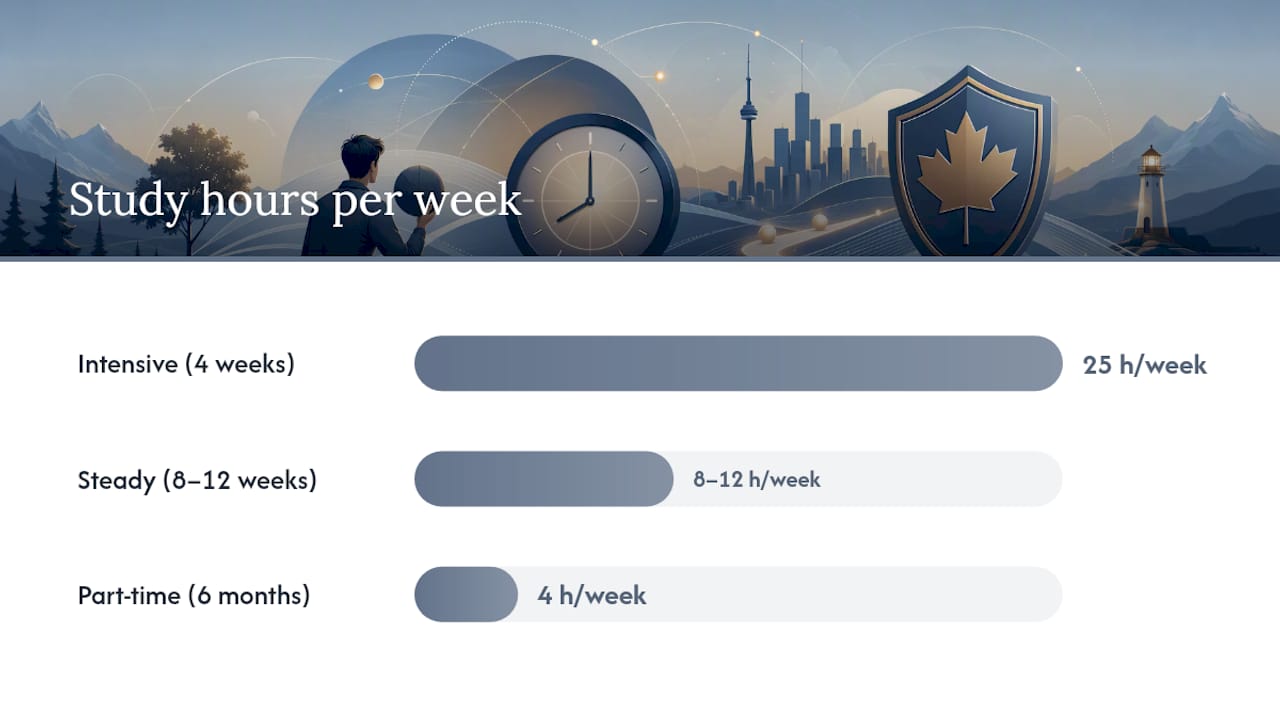
The 100 hour figure floating around isn’t a strict rule. It’s a reasonable planning guideline that assumes you’re starting with no insurance background. If you’ve worked in financial services, banking, or a related field, you might need less. If English is your second language or the material is entirely new, budget more.
Three schedules cover most situations:
- Intensive (4 weeks): About 25 hours per week. Works if you can study full days or have blocked off vacation time. Front-load lessons in week one and two, shift to mixed practice questions in week three, and run your mocks in week four.
- Steady (8 to 12 weeks): Roughly 8 to 12 hours per week, split across evenings and one weekend session. This is the most sustainable pace for someone working full-time.
- Part-time (6 months): Around 4 hours per week. Ideal if you’re juggling shift work, caregiving, or another course of study.
Book your provincial exam only once you’re hitting your target pass mark on back-to-back mocks, not a single lucky run.
How does provider certification and exam registration actually work?
You cannot register for a provincial LLQP exam without completing a course and receiving a certificate of completion from your approved provider. That certificate is the regulatory gate, and skipping it isn’t an option anyone gets around.
Once you have it, here’s what the provincial exam structure looks like:
- Four separate modules: Life Insurance, Accident & Sickness, Segregated Funds & Annuities, and Ethics & Professional Practice.
- Each exam is multiple-choice, and the pass mark is 60% per module.
- Certificate validity for licensing purposes is commonly 12 months, so don’t let a gap between finishing your course and booking your exam stretch too long.
- Rewrite rules limit how many attempts you get and impose waiting periods after repeated failures, which can push your licence application timeline back by weeks.
- Some provinces route exam bookings through third-party administrators, including online sittings managed by Durham College in certain jurisdictions.
Here’s a number worth sitting with: national first-time pass rates for LLQP modules in 2024 ranged from roughly 69% to 78%, depending on the module. Ethics and Segregated Funds tend to sit at the lower end of that range, which tells you where to concentrate extra practice time.
Once you’re certified and ready, provincial administrators like the Insurance Council of British Columbia publish exact registration steps, and Ontario and New Brunswick candidates can find province-specific booking guidance through their own regulator pages.
Why do practice questions matter more than rereading notes?
Practice volume correlates directly with pass likelihood, and that’s not a vague claim. It shows up in how pass rates track provider quality and practice intensity year over year. Rereading your course notes feels productive. It rarely translates into exam performance the way answering questions under pressure does.
Structure your practice sessions in three layers:
- Topic drills. Work through Life Insurance questions only, then Accident & Sickness only, and so on. This isolates weak spots by subject before you mix everything together.
- Mixed question sets. Once you’ve cleared 70% on topic drills consistently, switch to randomized sets pulling from all four modules. This mirrors how the actual exam jumps between concepts.
- Full-length timed mocks. Run these under real exam conditions, timer on, no notes, no pausing. Treat every mock as a pass or fail rehearsal, not a casual review.
Schedule mocks at three points: an early diagnostic before you’ve finished all four modules (to set a baseline), a mid-course checkpoint after your first full pass through the material, and a final readiness mock within a week of your target booking date.
The step candidates skip most often is the review. Every incorrect answer needs a reason attached. Did you misread the question, misunderstand a concept, or just guess? Log it, revisit that specific concept, and retest it a few days later until you get it right without hesitation.
Pro Tip: Keep a simple error log in a notebook or spreadsheet. Three columns: the question topic, why you got it wrong, and the date you retested it correctly. After two weeks, patterns jump out that you’d never notice otherwise.
For ESL candidates specifically, translation tools during practice sessions (not just lessons) help you distinguish between not knowing the concept and not understanding the phrasing. Those are two very different problems that need different fixes.
What should you expect on exam day and after?
Booking happens through your province’s exam administrator, and in some cases you’ll need a CIPR registration or account number set up before you can schedule a sitting. Do this step as soon as your provider certificate comes through. Delays here are one of the most common, and most avoidable, reasons candidates miss their intended exam window.
A few practical things to nail down before exam day:
- Confirm accepted ID types with your provincial administrator; requirements are published on sites like the Insurance Council of British Columbia.
- Check whether your province offers in-person or online sittings, and whether one suits your situation better.
- Arrive (or log in) early. Technical issues with online proctoring tools cost candidates real exam minutes if they’re not sorted in advance.
- Results are typically released within a defined window after your sitting; check your provider or provincial regulator for the exact turnaround in your jurisdiction.
- Marks remain valid for licensing for a set period, so don’t let a passed exam sit unused for too long before completing your licence application.
- If you fail a module, expect a mandatory waiting period before you can attempt a rewrite, and repeated failures can extend that wait further.
Administrative missteps, wrong ID, a missed booking deadline, an expired certificate, cause more licensing delays than actual exam difficulty does. Treat the paperwork with the same seriousness as the studying.
What tips actually move the needle on pass rates?
Volume of practice, done properly, beats almost everything else on this list. Candidates who answer hundreds of questions and genuinely review their mistakes outperform those who reread the course material a third time.
- Prioritize quality practice questions over passive review. Answering and correcting beats highlighting and rereading.
- Simulate timed conditions regularly, not just on your final mock. Time pressure changes how you think, so practise under it early.
- Learn elimination strategies for multiple-choice questions. Ruling out two obviously wrong answers turns a guess into a coin flip.
- Use readiness tracking to find where your mock errors cluster, then spend extra time there instead of restudying everything evenly.
- Build a simple exam-day routine: sleep properly the night before, eat something real, pace yourself through the modules, and flag tough questions to revisit rather than freezing on them.
Pro Tip: If you consistently miss the same question type in mocks, say scenario-based ethics questions, stop general review and drill that exact type for a focused session. Broad review rarely fixes a narrow, repeated weakness.
A candidate’s-eye view: what actually derails self-study
The most common failure point isn’t lack of effort. It’s uneven practice. Candidates cover every module once, feel confident, and book their exam too early. Ethics questions get misjudged because they’re scenario-based, not fact-recall, and pacing collapses when candidates run out of time on the last module.
The fix is targeted, not more of the same. Province-specific modules, unlimited practice quizzes, timed mock exams, and readiness tracking that shows exactly where you’re weak all address this directly.
A self-study playbook that respects the regulatory reality
Most advice on this topic treats “self-study” and “official course” as separate things, and that’s the core error. They’re not separate. The certificate requirement isn’t a bureaucratic hurdle bolted onto real studying, it’s the framework your self-directed effort has to live inside.
Where conventional advice falls short is time estimation. The 100 hour figure gets treated as gospel when it’s really a floor for someone with zero background. If ethics or segregated funds feel foreign to you, plan for more, not less.
What should you prioritize first? Not lessons. Get your provider certificate process moving immediately, then build your practice question routine around it from day one rather than treating quizzes as a final review step. The pass rate data backs this up: modules in the high 60s to high 70s percent range reward consistent, reviewed practice far more than they reward a second reading of the textbook.
— Reza
How LLQP Guide fits into your self-study plan
LLQP Guide is built for exactly the gap most self-study candidates fall into: finishing the required course, then walking into provincial exams without enough targeted practice behind them.
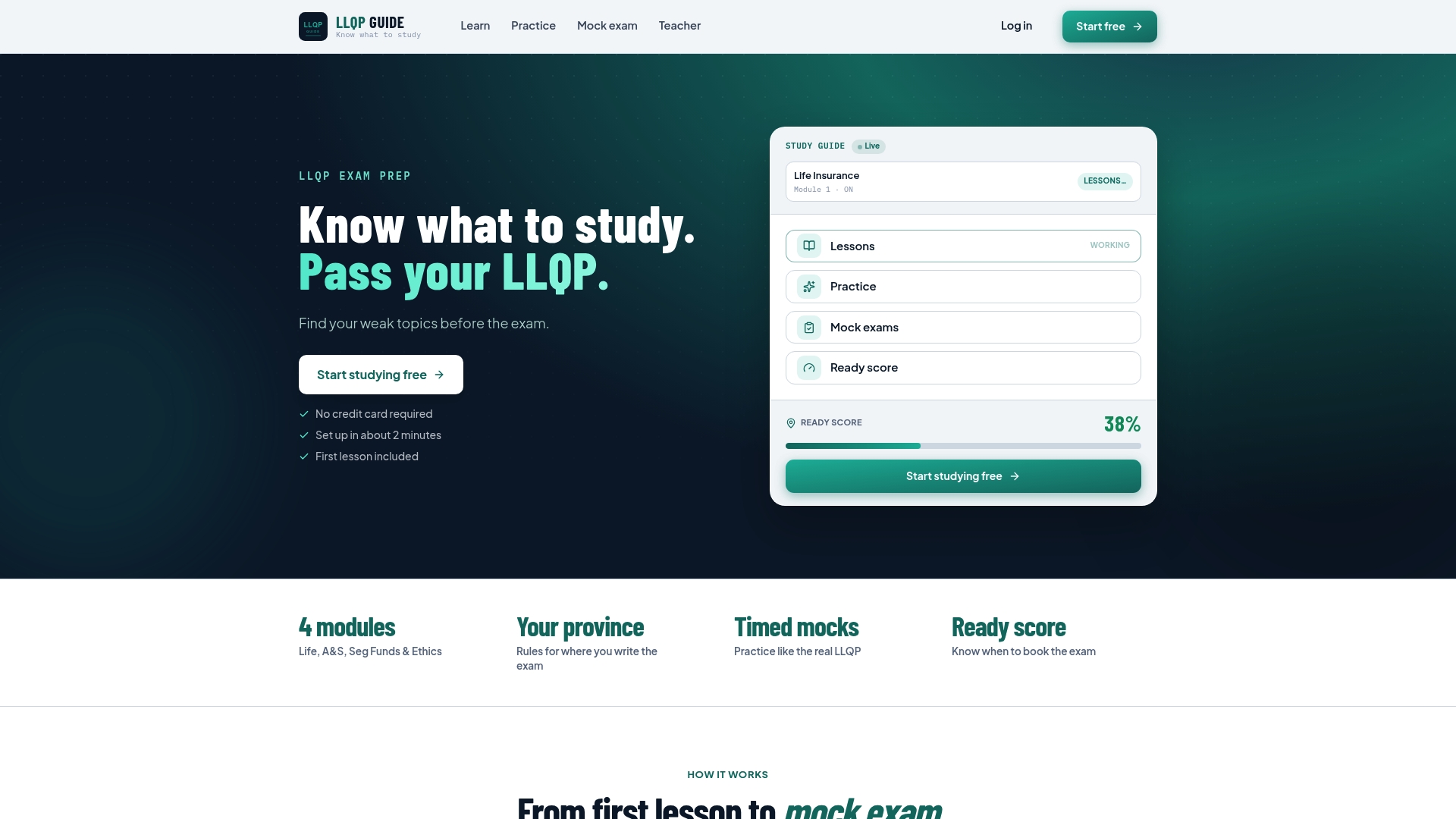
The platform covers all four modules, Life Insurance, Accident & Sickness, Segregated Funds & Annuities, and Ethics & Professional Practice, with province-specific lessons, unlimited practice quizzes, and full-length mock exams built to mirror real exam conditions. Readiness tracking shows you exactly where your mock scores are weak before you book, and in-lesson translation tools in 11 or more languages help ESL candidates work through dense insurance terminology without losing study momentum.
Access starts with a free trial, and paid plans unlock full modules, quizzes, mocks, and translation tools on a monthly, quarterly, or annual basis. Start with your province’s Life Insurance module or check full pricing details to see which plan matches your exam timeline. If you’re in Ontario or BC, the province-specific pages for Ontario and British Columbia walk through local booking steps too.
Sources
- Life Licence Qualification Program (LLQP) | Financial Services Regulatory Authority of Ontario
- Licensing Requirements - Life Licence Qualification Program | New Brunswick Financial and Consumer Services Commission
- LLQP first-time pass rates in 2024 released - Investment Executive
Recommended
Frequently asked questions
Is it easy to pass the LLQP exam?
It's manageable with consistent, question-driven practice, but it's not automatic. National first-time pass rates for 2024 ranged from about 69% to 78% depending on the module, meaning a meaningful share of candidates fail on their first attempt, usually from insufficient practice rather than the material being unreasonably hard.
How much does the LLQP course cost?
Course fees are set individually by each approved provider and vary by format (online, correspondence, or in-person), so there's no single fixed price across Canada. Check your chosen provider's site directly, and compare a few before enrolling since pricing and included materials differ.
How long does the LLQP course take?
Plan for roughly 100 hours of study across the four modules as a baseline guideline, though your actual time depends on prior insurance knowledge and how comfortable you are with the material. That can compress into an intensive four-week schedule or stretch across six months at a part-time pace.
Where can I find free study material for the LLQP exam?
Your approved provider's course materials are your primary resource and are included with enrolment. Beyond that, supplement with practice quizzes and mock exams from a dedicated platform like LLQP Guide rather than relying solely on scattered free content, since exam-format practice matters more than volume of notes.