Beat PEI's 24 Month Clock: LLQP Steps to Pass and Secure Sponsorship
Beat PEI's 24 Month Clock: LLQP Steps to Pass and Secure Sponsorship ! PEI licensing application prepared at counter Meeting PEI LLQP requirements comes down to three non-negotiable steps: complete the required LLQP modules and pass each exam with at least 60%, register through Durham College with a valid CIPR number, and secure sponsorship from an insurer licensed in PEI before paying the Certificate of Authority fee for a two-year term.

Beat PEI’s 24 Month Clock: LLQP Steps to Pass and Secure Sponsorship
Meeting PEI LLQP requirements comes down to three non-negotiable steps: complete the required LLQP modules and pass each exam with at least 60%, register through Durham College with a valid CIPR number, and secure sponsorship from an insurer licensed in PEI before paying the Certificate of Authority fee for a two-year term. Skip any one of these and your application stalls, no matter how well you scored on the exam.
TL;DR:
- Candidates must complete all LLQP modules and pass each exam with at least 60% before registering for the PEI licensing process.
- Residency in PEI and a valid CIPR number are required before booking exams, and documentation verification is the most common obstacle to registration.
- Failing one module requires retaking it with a mandatory 24-hour wait, and multiple failures can lead to a one-year delay and re-study of course material.
- A sponsor insurer licensed in PEI must be confirmed before submitting the Certificate of Authority application, which includes a fee and proof of exam completion.
- Passing modules within 24 months of course completion and securing sponsorship promptly is essential to avoid delays in licensing.
Table of Contents
- Who is eligible to write the PEI LLQP exams
- The four LLQP modules, the 60% pass mark, and what happens if you fail
- Applying for a PEI Certificate of Authority: sponsorship, fees, and paperwork
- The 24-month clock: timing your modules, exams, and application correctly
- Step-by-step: getting your CIPR number and booking exams through Durham College
- Study strategy: closing knowledge gaps before exam day
- What I’d tell a friend starting this process in PEI
- How Llqpguide fits into your PEI LLQP prep
- Sources
- FAQ
Who is eligible to write the PEI LLQP exams
You need to be a Prince Edward Island resident to register for PEI’s LLQP exams, as confirmed by Registry & Licensing Services confirms this residency status as part of the intake process, and it’s one of the first things checked before your exam booking goes anywhere. You can’t shop around for an easier testing jurisdiction in a neighbouring province. If PEI is home, PEI is where you write.
Before you can book anything, you’ll also need a CIPR number, the unique identifier that ties your exam records to your name across Canadian regulators. Getting one is straightforward, but it has to happen before Durham College will process your registration.
Here’s the pre-registration checklist worth working through before you spend a dollar on exam fees:
- Confirm PEI residency status matches what’s on file with Registry & Licensing Services
- Obtain a CIPR number through the national registry system
- Complete your LLQP course through a CISRO-accredited provider
- Verify your course completion falls inside the 24-month exam window
- Check that Durham College has received your completion record before booking
Durham College runs eligibility checks against these criteria every time someone tries to register. Missing documentation is the single most common reason candidates get bounced back a step.
The four LLQP modules, the 60% pass mark, and what happens if you fail
Prince Edward Island’s LLQP curriculum splits into four modules, and which ones you take depends on which licence you’re after:
- Life Insurance – required for a full life licence, covering policy types, underwriting basics, and product suitability
- Accident & Sickness – can be taken as a standalone module for an Accident & Sickness-only certificate, or combined with Life Insurance for broader authority
- Segregated Funds & Annuities – required if you plan to sell individual variable insurance contracts
- Ethics & Professional Practice – mandatory for every candidate regardless of which licence class you’re pursuing
Combine Life Insurance and Ethics and you’re on track for a full life licence. Take Accident & Sickness with Ethics on its own, and you’re limited to that narrower certificate class.
Every module exam carries the same passing mark of 60%, applied individually to each module rather than as an average across all four. Fail one module and pass the rest, and you only need to retake the one you missed.
Rewrite rules matter here. Candidates who fail get access to supplemental exam attempts, but there’s a mandatory 24-hour waiting period between attempts, so same-day retakes aren’t an option. Exhaust your allowable attempts, and you’re looking at a one-year waiting period plus a requirement to retake the approved course material before you’re eligible to try again. That’s a significant setback if you were counting on getting licensed by a certain date.
Applying for a PEI Certificate of Authority: sponsorship, fees, and paperwork
Passing your exams doesn’t get you licensed on its own. Prince Edward Island issues what’s called a Certificate of Authority rather than a standalone licence, and that certificate cannot be issued without a sponsoring insurer already lined up.
The sponsoring insurer has to be licensed to operate in PEI and authorized to sell the specific classes of insurance you’re applying to represent. This isn’t a formality. Without an active sponsorship in place, the regulator will not process your application, full stop, even with a perfect exam record sitting in front of them.
Once sponsorship is confirmed, here’s what the application requires:
- A completed Certificate of Authority application form submitted online through PEI’s service portal
- Payment of the fee, which covers a two-year certificate period
- A Letter of Good Standing from your home jurisdiction’s regulator if you’re a non-resident applicant transferring in
- Proof of your passed module exams and current CIPR standing
One detail candidates often overlook: if your sponsoring insurer ever terminates that sponsorship, they’re required to notify the regulator. Your certificate doesn’t survive that notification automatically, so switching employers mid-licence period means lining up new sponsorship before any gap opens.
The 24-month clock: timing your modules, exams, and application correctly
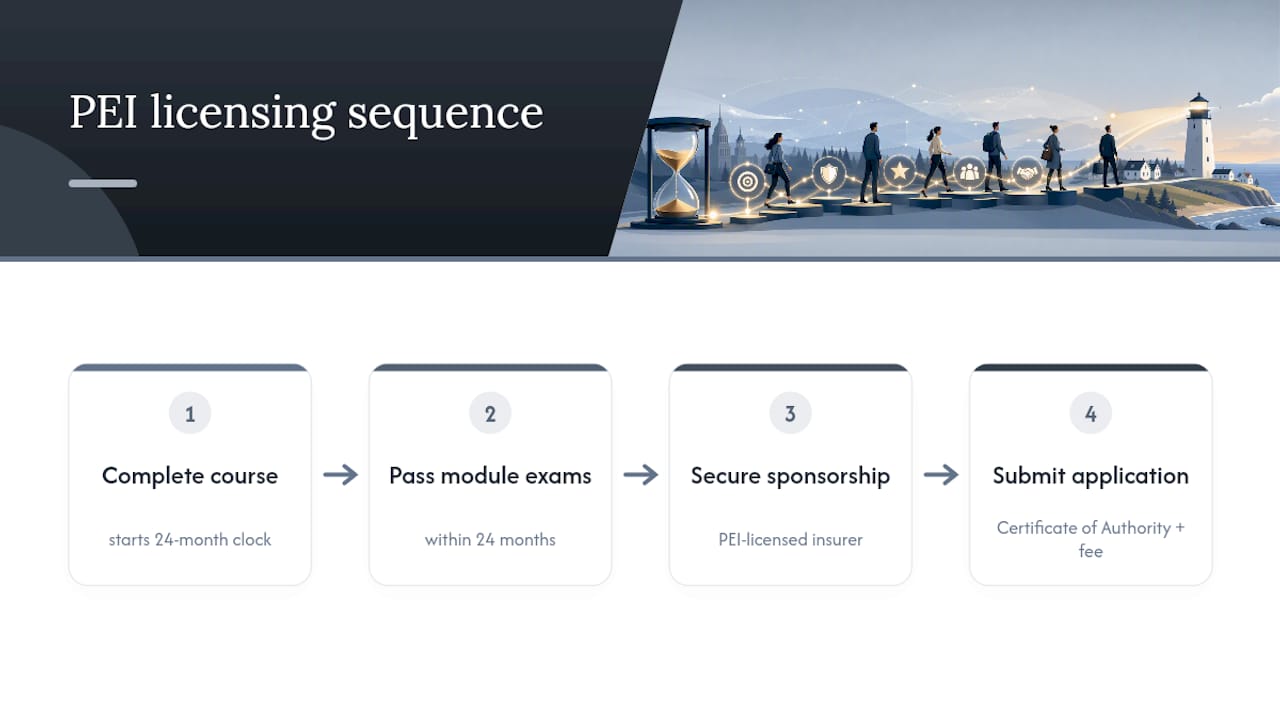
Every completed LLQP module comes with a 24-month validity window. Pass your module exam within that window and the credit holds. Let it lapse, and you’re back to retaking the course material from scratch, not just the exam.
The typical sequence looks like this: finish your course, write and pass all applicable module exams within 24 months of course completion, secure sponsorship from a PEI-licensed insurer, then submit your Certificate of Authority application with the fee attached.
Residency verification happens early, usually at the point you register with Durham College, so don’t wait until exam week to sort out where you legally live for licensing purposes. A candidate who finishes coursework in January and writes all four modules by June still has roughly eighteen months of runway before the clock becomes a real concern, but someone who delays sponsorship conversations until after exams risks burning weeks waiting on an insurer’s internal approval process.
Step-by-step: getting your CIPR number and booking exams through Durham College
The registration mechanics are simpler than the regulatory backdrop suggests. Here’s the sequence:
- Get your CIPR number first. You’ll need basic identification details and your course enrolment information. This number becomes your permanent exam-tracking identifier across every province you might work in later.
- Confirm your course provider has submitted your completion record. Some providers send this automatically; others require you to request a certificate of completion and forward it yourself. Don’t assume it’s been handled.
- Register with Durham College for the specific module exams you need. Expect an eligibility verification step here, where they cross-check your completion record, CIPR number, and residency status against PEI’s requirements.
- Bring acceptable government-issued photo ID to the exam itself. A driver’s licence or passport typically satisfies this; check current exam-day rules when you book, since ID requirements occasionally shift.
Candidates who confirm their completion record landed with Durham College before booking save themselves the frustration of a rejected exam slot.
Study strategy: closing knowledge gaps before exam day
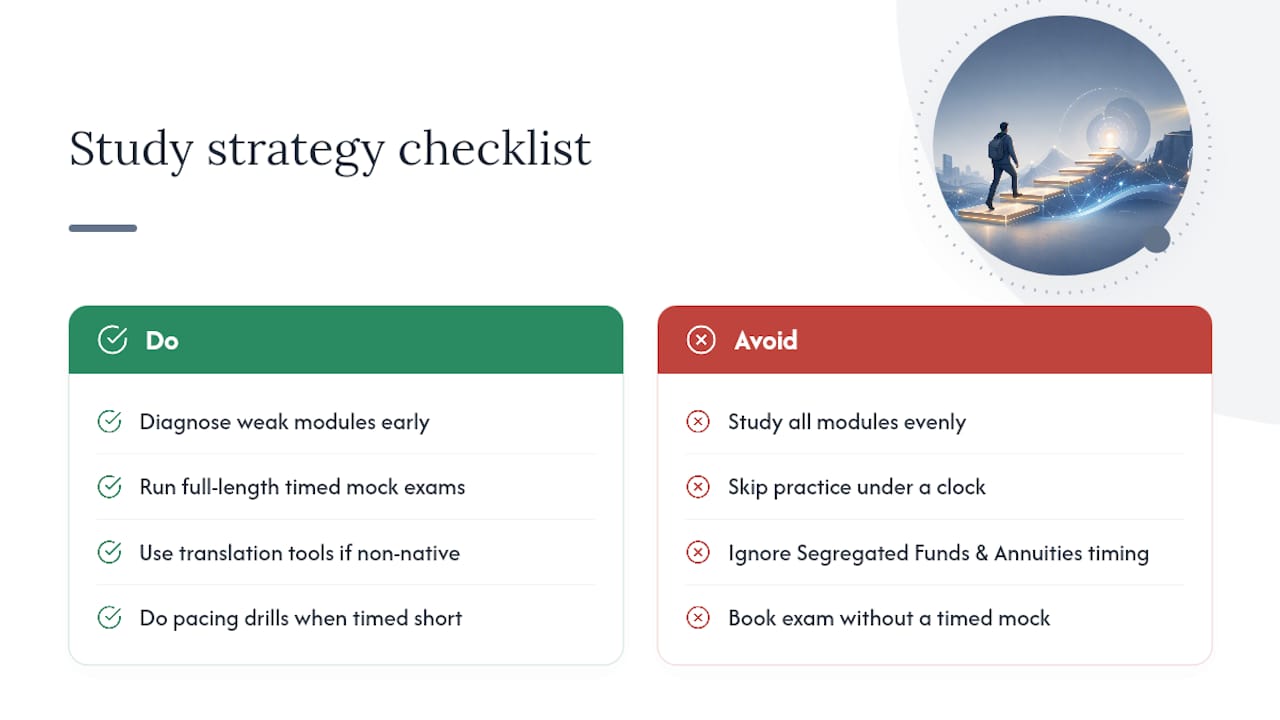
Sixty percent per module sounds achievable until you’re staring down four separate content areas with different terminology, calculation types, and ethical scenarios. The candidates who pass on their first attempt tend to do one thing consistently: they diagnose their weak modules early rather than studying everything evenly.
Running full-length, timed mock exams matters more than most candidates expect. The real LLQP exams have a pacing rhythm, and candidates who’ve never practised under a clock tend to run out of time on the Segregated Funds & Annuities module specifically, where calculation-heavy questions eat minutes fast.
For candidates whose first language isn’t English, in-lesson translation tools cut down the time spent decoding exam terminology rather than the actual insurance concepts. Llqpguide’s module-aligned lessons cover all four areas with practice quizzes built around real exam patterns.
Pro Tip: Run at least one full mock exam under strict timed conditions before booking your real Durham College exam date. If you’re consistently short on time in practice, that’s your signal to slow down on studying and speed up on pacing drills instead.
What I’d tell a friend starting this process in PEI
Sponsorship is the part people leave too late. You can pass every module on your first try and still sit stuck for weeks because no insurer has agreed to sponsor your certificate yet. Start those conversations before your exam results even come back.
Treat the 24-month window as a hard deadline, not a rough guideline, and confirm your residency status with Registry & Licensing Services early. That one step prevents a booking conflict nobody wants to discover the week of their exam.
— Reza
How Llqpguide fits into your PEI LLQP prep
Llqpguide is the alternative to generic, one-size-fits-all study guides for candidates working through PEI’s module requirements. Instead of guessing which of the four modules needs the most attention, you get lessons, unlimited practice quizzes, and full-length mock exams organized by module, so Life Insurance, Accident & Sickness, Segregated Funds & Annuities, and Ethics & Professional Practice each get dedicated, exam-aligned prep.
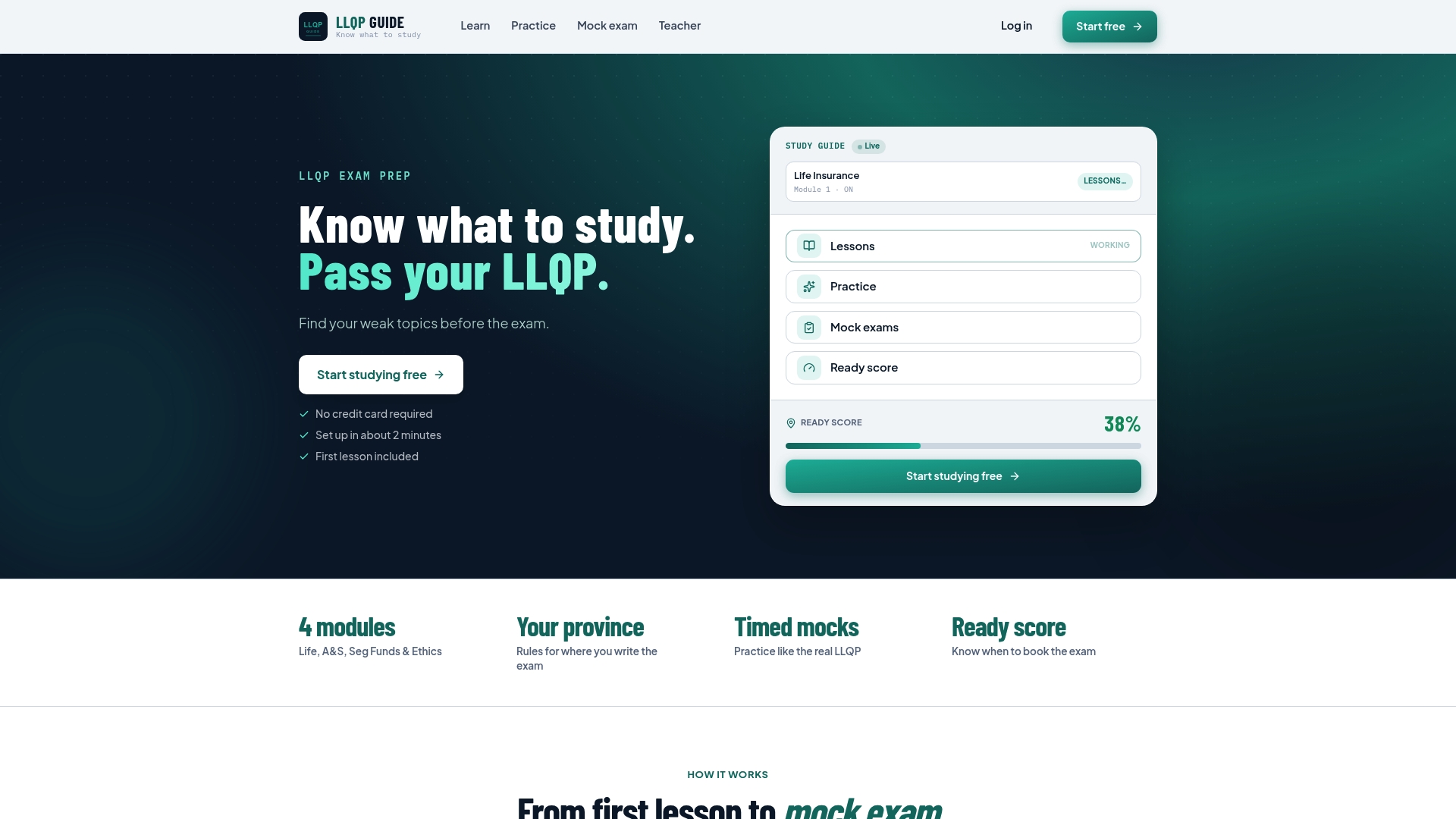
In-lesson translation tools support candidates studying in a second language, helping reduce time lost to terminology rather than concepts. None of this replaces the sponsorship or Certificate of Authority steps PEI requires. It’s exam preparation, not a substitute for the regulatory process. Check module pricing on the plans page, currently offered weekly at $40, monthly at $125, or yearly at $400, and start with the module you’re least confident about.
Sources
- Life License Qualification Program (LLQP) | Government of Prince Edward Island
- Life licence qualification program (LLQP) | FSRA
Recommended
Frequently asked questions
How hard is the LLQP exam?
The LLQP exam requires a 60% pass mark on each module, which is achievable with structured study but trips up candidates who treat all four modules as equally easy. Segregated Funds & Annuities and Ethics tend to surprise people the most, since they involve less intuitive, more rule-based content than straightforward life insurance concepts.
What is the minimum score to pass LLQP modules in PEI?
You need at least 60% on each individual module exam, not an average across all four. Passing three modules strongly doesn't offset failing the fourth. You'd simply retake that one module.
How much does the LLQP course cost?
Course fees are set by individual CISRO-accredited providers and vary by provider, so there's no single fixed price across Canada. Separately, exam prep platforms like Llqpguide list current subscription pricing on their pricing page.
How long does it take to finish the LLQP process in PEI?
Timing depends on your course provider's schedule, but candidates typically finish coursework, pass their module exams, and secure sponsorship within a few months if they move steadily. The hard limit is the 24-month validity window on completed modules, after which you'd need to retake the course.
Do I need a sponsoring insurer before I write the LLQP exams?
No, sponsorship isn't required to write the exams themselves, only to obtain your Certificate of Authority afterward. Many candidates line up sponsorship discussions while still studying, since insurers can take time to confirm.