Tied selling in the LLQP: what candidates must know
Tied selling in the LLQP: what candidates must know ! Hands arranging insurance brochures on desk Tied selling is generally illegal in Canada when an agent forces a client to buy one product to get another.

Tied selling in the LLQP: what candidates must know
Tied selling is generally illegal in Canada when an agent forces a client to buy one product to get another. That single rule sits at the heart of the LLQP Ethics & Professional Practice module, and getting it wrong on the exam usually means confusing illegal coercion with lawful bundling. Three authorities matter here: the Competition Bureau under the federal Competition Act, provincial insurance regulators such as FSRA in Ontario and the AMF in Québec, and the LLQP Ethics module itself, where you need a 60% pass mark on each module to get licensed.
Here’s what you need to hold onto before we go further:
- Tied selling that conditions one sale on another, or uses pressure, is prohibited in most insurance contexts.
- Federal competition law only intervenes when a major supplier’s tied selling substantially lessens competition.
- Provincial insurance acts are usually stricter and apply regardless of market size.
- The LLQP tests your ability to tell illegal tying apart from ordinary bundled discounts.
Pro Tip: If an exam question mentions “must” or “only if,” treat it as a red flag for tied selling. If it mentions “option” or “discount for both,” it’s probably lawful bundling.
Key Takeaways
Tied selling is prohibited in Canadian insurance sales whenever a client is coerced into buying one product to obtain another, and the LLQP Ethics module tests your ability to tell that apart from lawful bundling.
| Point | Details |
|---|---|
| Core rule | Tied selling conditions one sale on another; lawful bundling always allows separate purchase. |
| Federal threshold | The Competition Bureau acts on tied selling only when a major supplier substantially lessens competition. |
| Provincial rules stricter | Regulators like Alberta’s Superintendent can penalize agents up to $25,000 per contravention regardless of market size. |
| Documentation is defence | Recording client choice, alternatives offered, and timestamps protects agents from complaints. |
| Exam prep | LLQPGuide’s Ethics module offers scenario-based quizzes matching the LLQP’s tied selling question style. |
This article is general information, not a substitute for advice from a qualified lawyer. Consult a qualified legal professional about your own circumstances before acting on anything here.
Table of Contents
- What is tied selling and how does it differ from bundling?
- How does Canadian law treat tied selling?
- Real insurance scenarios candidates should recognize
- What happens if tied selling is reported?
- How agents can avoid tied selling allegations
- Where tied selling shows up on the LLQP exam
- Study tied selling and the rest of ethics with LLQPGuide
- Sources
- FAQ
What is tied selling and how does it differ from bundling?
Tied selling happens when a seller makes the purchase of one product conditional on buying another, leaving the client no real choice. An agent who tells a client, “I’ll only issue this critical illness rider if you also buy segregated funds through me,” is engaging in tied selling. The client can’t get the rider any other way through that agent.
Coupled selling, sometimes called bundled or promotional selling, looks similar on the surface but works differently. A client gets a discount for buying two products together, but can still buy either one separately at the regular price. According to industry guidance on coupled selling versus tied selling, the deciding factor is whether the client retains a genuine standalone option.
- Lawful bundle: “Buy life insurance and accident and sickness coverage together and save 10%, or purchase either one alone at full price.”
- Illegal tying: “I can’t sell you the life policy unless you also sign up for the segregated fund.”
The exam almost always tests this distinction through a client scenario, not a definition question.
How does Canadian law treat tied selling?
Federal and provincial rules overlap here, and the LLQP expects you to know both layers. The Competition Bureau treats tied selling as a possible competition offence only when a major supplier engages in it, the practice is widespread, and it substantially lessens competition in a market. That’s a fairly high bar, aimed at large-scale conduct rather than a single agent’s sales pitch.
Section 77 of the Competition Act defines tied selling and carves out limited exceptions, including arrangements that are reasonable because of a technological relationship between products, or temporary measures that help a new competitor enter a market. Banks face an even sharper rule: section 459.1 of the Bank Act bans undue pressure or coercion to obtain one product as a condition of getting another, and requires plain-language notices posted in branches saying so.
Provincial insurance regulators don’t wait for a competition threshold to be met. Alberta’s Superintendent of Insurance issued a bulletin reminding licensed insurers that tied selling breaches the Insurance Act and Fair Practices Regulation, with administrative penalties reaching up to $25,000 per contravention. Ontario’s FSRA and Québec’s AMF apply comparable prohibitions under their own insurance acts.
- Federal law: intervenes at scale, tied to market power.
- Bank Act: bans coercion specifically, with mandatory disclosure.
- Provincial acts: apply to individual agent conduct, no market-share test required.
When these layers conflict or overlap, follow the strictest one that applies to your situation. In practice, that’s almost always the provincial insurance act.
Real insurance scenarios candidates should recognize
Exam questions rarely ask you to define tied selling in the abstract. They give you a scenario and ask you to classify it.
- Clearly illegal: An agent refuses to renew a client’s auto policy unless the client also purchases a life insurance policy through the same office. There’s no separate purchase path, and the client feels cornered.
- Lawful bundle: An agency advertises a discount for clients who hold both a home and life policy with them, but confirms in writing that either policy is available on its own at standard rates.
- Borderline: An agent recommends segregated funds “to go along with” a new annuity, mentions a fee reduction, but never explicitly says the annuity requires the funds. Context, tone, and documentation decide this one.
The deciding factors are consistent across all three: was there coercion, could the client have said no and still gotten the first product, and does the file show disclosure of that choice?
Pro Tip: A quick examiner-style clue list: look for words like “condition,” “must,” or “only if” (coercion) versus “option,” “may also,” or “separate pricing available” (informed choice).
What happens if tied selling is reported?
Consumers and competitors both have paths to pursue a complaint, and the consequences for agents range from a warning letter to licence suspension.
- Provincial regulators (FSRA, AMF, and equivalents) can investigate agent conduct directly and impose administrative penalties, following the pattern set out in Alberta’s bulletin on tied selling.
- Parties directly affected by tied selling can apply to the Competition Tribunal for a remedy, or the Competition Bureau can pursue the matter itself where the federal threshold is met.
- To report suspected tied selling, gather the date and time of the conversation, the exact products offered, any written or verbal conditioning language, and copies of quotes or applications. Send the file to the provincial regulator first, since most cases fall under provincial jurisdiction.
How agents can avoid tied selling allegations
Good habits here cost nothing and protect both the client and your licence.
- Always offer the base product on its own terms before mentioning any bundle or discount.
- Confirm out loud, and note in the file, that the client understands the products are independent.
- Avoid conditional phrasing like “you’ll need” or “this comes with.” Use “you have the option to add” instead.
- Sample wording that stays clean: “You can purchase the life policy on its own, or save 8% by adding accident and sickness coverage. Either way works.”
- Document the client’s decision path: what was offered, what was declined, and when they confirmed their choice, ideally with initials or a timestamp.
Regulators consistently point to file notes as the strongest defence against a tied selling complaint. An agent with a paper trail showing separate pricing and a documented client choice rarely faces discipline, even if a client later complains.
Where tied selling shows up on the LLQP exam
Tied selling lives inside the Ethics & Professional Practice module, usually framed as a scenario question rather than a straight definition. You’ll be asked to judge whether a described sales interaction crosses the line, not to recite section numbers.
Before exam day, make sure you can do three things without hesitation: define tied selling and contrast it with coupled selling, name the Competition Bureau, provincial regulators, and the Bank Act as the relevant authorities, and spot the coercion clue in a written scenario. The LLQP licensing structure requires a 60% pass on each of the four modules, and ethics scenarios like this one are where marks get lost through overthinking rather than lack of knowledge.
- Review the definition and one lawful/unlawful example pair until you can explain both from memory.
- Practise scenario-based questions rather than pure recall questions.
- Use targeted ethics module practice questions to build pattern recognition before test day.
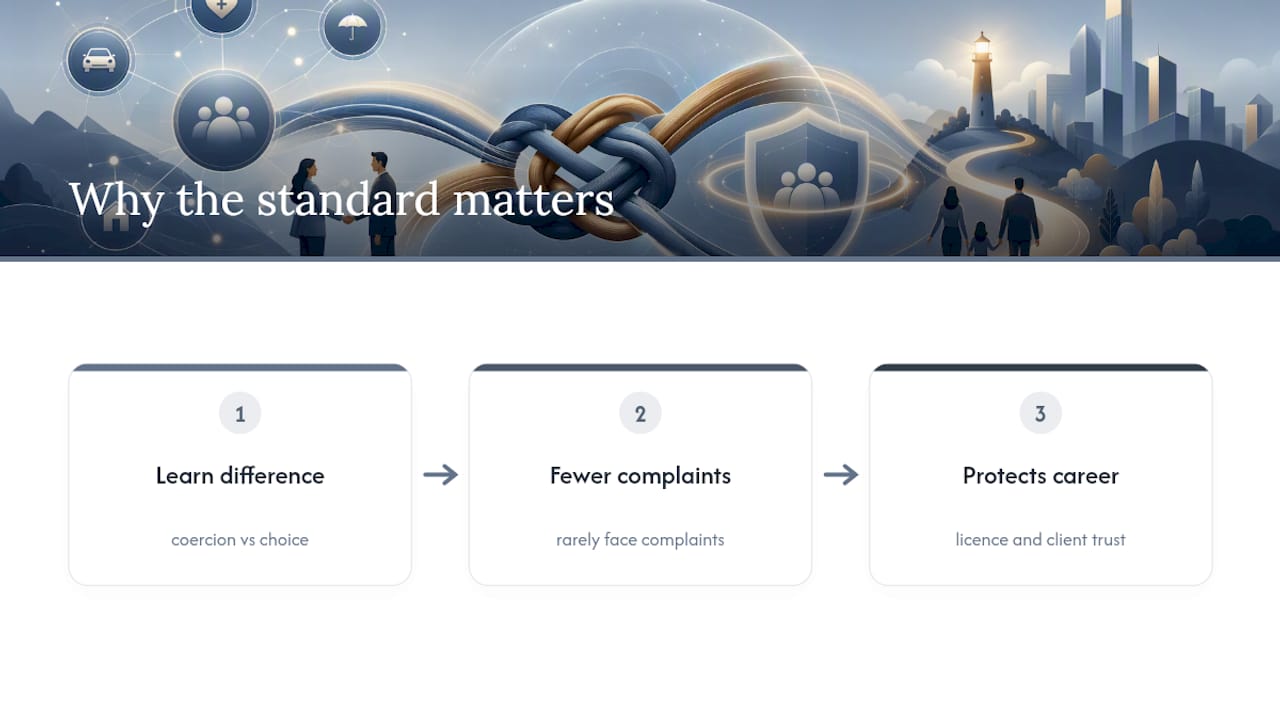
A note on why this standard matters beyond the exam
Passing this section isn’t just about clearing a hurdle. Agents who internalize the difference between coercion and choice rarely face complaints later, and that habit protects both their licence and their client relationships for the length of their career.
Study tied selling and the rest of ethics with LLQPGuide
Getting tied selling right on exam day comes down to recognizing patterns fast, not memorizing a legal definition word for word. LLQPGuide’s Ethics & Professional Practice module builds scenario-based practice questions specifically around situations like coercive bundling, so you’re training on the exact question style the exam uses rather than guessing from a textbook definition.

The platform gives you unlimited quizzes on ethics scenarios, full-length mock exams that mirror real exam conditions, and province-specific content if you’re writing in Ontario, British Columbia, or elsewhere. For candidates working through English as a second language, in-lesson translation tools cover 11 languages, which matters most in a module like ethics where precise wording changes the right answer. Start a free trial and run through the ethics module’s practice quizzes at LLQPGuide to see exactly where your understanding of tied selling and the rest of the module needs work before test day.
Sources
- Licensing Requirements - Life Licence Qualification Program | New Brunswick Financial and Consumer Services Commission
- Exclusive dealing, tied selling and market restrictions | Competition Bureau Canada
- Competition Act — section 77 (tied selling)
- Superintendent of Insurance Bulletin 04-2012 - Tied Selling - June 1, 2012
Recommended
Frequently asked questions
Is tied selling legal in Canada?
No, not when it conditions one insurance sale on another or involves coercion. Lawful bundling remains legal as long as each product stays available for separate purchase.
Is LLQP certification worth it?
Yes. It's the mandatory credential to sell life insurance and related products in Canada, and provinces require a 60% pass mark on each of the four modules before licensing.
Do you need a licence to sell life insurance in Canada?
Yes, every province requires completion of an approved LLQP course, a passing exam score, and a licence application through the provincial regulator before you can sell life insurance.
Which LLQP module is hardest to pass?
Difficulty varies by candidate, but many find Ethics & Professional Practice challenging because it relies on scenario judgment rather than memorized facts. Practising with scenario-based questions rather than flashcards tends to help most.