LLQP sample questions: your official practice guide
LLQP sample questions: your official practice guide ! Study timer and tools for LLQP practice The fastest path to LLQP readiness starts with CISRO's official sample exam question sets, which you can download free by module.

LLQP sample questions: your official practice guide
The fastest path to LLQP readiness starts with CISRO’s official sample exam question sets, which you can download free by module. Download the PDFs, set a timer for the Life Insurance module, and work through every question before checking answers.
Three things to do right now:
- Download the official CISRO sample PDFs for each module you are writing
- Run one timed module mock under real conditions (no notes, no phone)
- Review every wrong answer with a written rationale before moving on
Key takeaways
Passing the LLQP comes down to one thing: consistent, timed practice with worked rationales, not passive reading.
| Point | Details |
|---|---|
| Start with official sources | Download CISRO’s free sample PDFs for each module before using any third-party material. |
| Simulate real conditions | Run every practice session closed-book and timed; the exam rewards recall, not recognition. |
| Log and revisit errors | Record each wrong answer with the rule you missed; revisit flagged items using spaced repetition. |
| Confirm provincial rules | Check your province’s regulator page for current question counts, timing, and application windows. |
| Use Llqpguide for full mocks | Llqpguide provides province-specific timed mocks and a readiness tracker across all four modules. |
Table of Contents
- Where do you find official LLQP sample questions?
- How is the LLQP exam structured?
- Sample questions by LLQP module, with answers and rationales
- How to use sample questions to improve fastest
- Where to get full-length mocks and large question banks
- Why worked answers matter more than the score
- The study approach that actually works
- Llqpguide gives you everything in one place
- Sources
- FAQ
Where do you find official LLQP sample questions?
CISRO (Canadian Insurance Services Regulatory Organizations) is the authoritative source. Its curriculum and sample exam questions page hosts downloadable PDFs for all four modules: Life Insurance, Accident & Sickness, Segregated Funds & Annuities, and Ethics & Professional Practice. Each PDF contains sample multiple-choice items that reflect the style, phrasing, and difficulty of actual exam questions. The finalized curriculum documents sit on the same page and outline every tested competency by chapter.
Provincial regulators add a second layer of official guidance. FSRA Ontario confirms that Durham College administers the exam in Ontario and that a course completion certificate is valid for one year from the date of completion. The Alberta Insurance Council publishes module structure and exam preparation guidance specific to Alberta. The Insurance Council of BC covers registration and delivery details for that province.
For exam administration questions in Ontario, contact Durham College directly. For every other province, go to your provincial regulator’s website first. CISRO maintains the curriculum; the provincial bodies set the local rules.
How is the LLQP exam structured?
The LLQP is a modular exam. FSRA confirms four modules: Life Insurance, Accident & Sickness, Segregated Funds & Annuities, and Ethics & Professional Practice. You write each module as a separate exam, which means you can focus your preparation one competency at a time rather than cramming everything at once.
A few structural details that catch candidates off guard:
- Pilot questions appear on the exam and count toward your time but not your score. They exist so regulators can evaluate new items before adding them to the scored pool. If you hit a question that feels unusually unfamiliar, it may be a pilot item. Stay calm and move on.
- In-person delivery is standard. The Insurance Council of BC confirms in-person administration, and most provinces follow the same format. You cannot write the LLQP remotely.
- Provincial timing and question counts vary. Ontario, Alberta, and BC each publish their own per-module details. Never assume one province’s rules apply to another.
- Licence application window: once you pass, you have one year from the date your course completion certificate was issued to apply for your licence.
Pro Tip: Before booking your exam, go directly to your provincial regulator’s website and confirm the current question count, timing, and application window for each module. These details do change, and relying on a third-party summary can cost you.
Sample questions by LLQP module, with answers and rationales
The questions below reflect the style and difficulty of real exam items. They are representative examples, not official CISRO items. Download the official CISRO sample sets for the authoritative versions.
Life insurance
The Life Insurance module curriculum covers term, whole life, universal life, riders, underwriting, and taxation. Expect scenario-based questions that ask you to recommend a product or explain a policy feature.
Question 1: A 35-year-old client wants the lowest possible premium for a $500,000 death benefit and does not need permanent coverage. Which product best meets this need?
- A) Whole life insurance
- B) Universal life insurance
- C) Term life insurance
- D) Participating life insurance
Correct answer: C Rationale: Term life provides a pure death benefit for a defined period at the lowest cost. The client’s stated priority is affordability with no permanent need, ruling out whole life and universal life, which carry higher premiums for their cash-value components.
Question 2: Which of the following is NOT a feature of a universal life policy?
- A) Flexible premium payments
- B) A guaranteed level premium for life
- C) A cash surrender value
- D) Investment account options
Correct answer: B Rationale: Universal life is defined by its flexibility. A guaranteed level premium is a feature of traditional whole life, not universal life.
Accident & Sickness
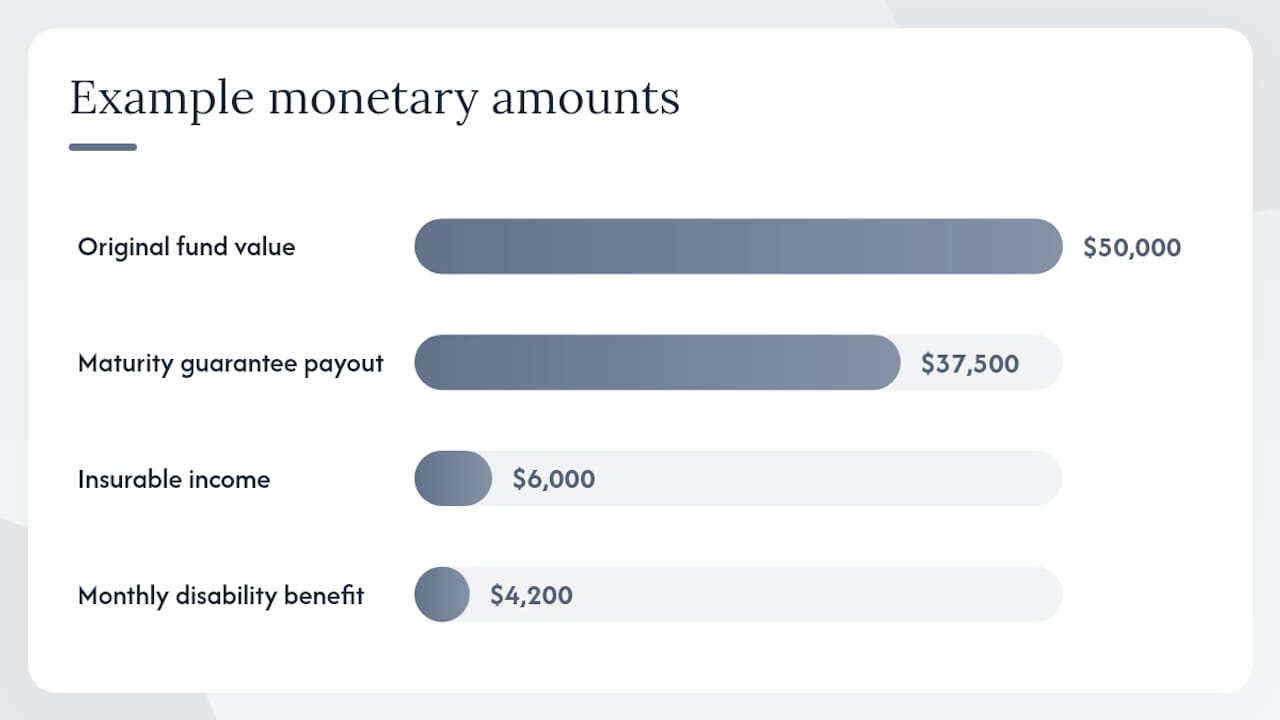
The client earns $6,000 per month. What is the monthly benefit once payments begin?
- A) $4,200
- B) $4,500
- C) $5,400
- D) $6,000
Correct answer: A Rationale: $6,000 × 0.70 = $4,200. The elimination period determines when payments start, not the amount. This is a standard LLQP math question type.
Question 4: Which definition of disability is most favourable to the insured?
- A) Any occupation
- B) Own occupation
- C) Regular occupation
- D) Indexed occupation
Correct answer: B Rationale: “Own occupation” pays benefits if the insured cannot perform the duties of their specific job, regardless of whether they could work in another capacity. It is the broadest and most favourable definition.
Segregated funds & annuities
The fund value at maturity is $30,000. What is the guaranteed maturity benefit?
- A) $22,500
- B) $30,000
- C) $37,500
- D) $50,000
Correct answer: C Rationale: $50,000 × 0.75 = $37,500. Because the fund value ($30,000) is below the guarantee, the insurer pays the guaranteed amount. This is one of the most common segregated funds practice question types.
Question 6: Which feature of a segregated fund contract allows a beneficiary to bypass probate?
- A) Maturity guarantee
- B) Named beneficiary designation
- C) Reset provision
- D) Death benefit guarantee
Correct answer: B Rationale: A named beneficiary designation allows proceeds to pass directly to the beneficiary outside the estate, bypassing probate entirely.
Ethics & professional practice
Question 7: An agent recommends a product that pays a higher commission but does not best meet the client’s needs. This is an example of:
- A) Misrepresentation
- B) Conflict of interest
- C) Churning
- D) Twisting
Correct answer: B Rationale: Placing personal financial gain ahead of the client’s interest is a conflict of interest. Agents have a duty to recommend suitable products regardless of compensation. Targeted Ethics practice questions consistently test this principle.
Question 8: A client asks an agent to explain a policy exclusion. The agent downplays its significance to close the sale. This conduct most likely violates:
- A) The duty to disclose
- B) The duty to account
- C) The duty of confidentiality
- D) The duty to follow instructions
Correct answer: A Rationale: Agents must disclose all material information, including exclusions, so clients can make informed decisions. Minimising an exclusion to close a sale is a breach of the duty to disclose.
| Module | Question topic | Correct answer | Rationale (one line) |
|---|---|---|---|
| Life Insurance | Lowest-cost death benefit product | C — Term life | Pure death benefit at the lowest premium; no cash-value component |
| Accident & Sickness | Monthly disability benefit calculation | A — $4,200 | $6,000 × 0.70 = $4,200; elimination period affects timing, not amount |
| Segregated Funds | Maturity guarantee payout | C — $37,500 | $50,000 × 0.75 = $37,500; guarantee applies when fund value falls below it |
| Ethics | Commission-driven recommendation | B — Conflict of interest | Prioritising personal gain over client suitability is a conflict of interest |
How to use sample questions to improve fastest
Working through questions randomly is the slowest way to prepare. A structured routine produces better results in less time.
- Start with one module at a time. Complete all official CISRO sample questions for a single module before moving to the next. This builds a clean baseline for each competency.
- Simulate exam conditions. Set a timer, close your notes, and answer every question before checking anything. Closed-book recall is what the exam tests.
- Log every error immediately. For each wrong answer, write three things: the question topic, why you chose the wrong option, and the rule or calculation you need to remember. A simple spreadsheet works fine.
- Review rationales for correct answers too. Knowing why the right answer is right matters as much as knowing why the wrong ones are wrong. If you guessed correctly, the rationale still closes the gap.
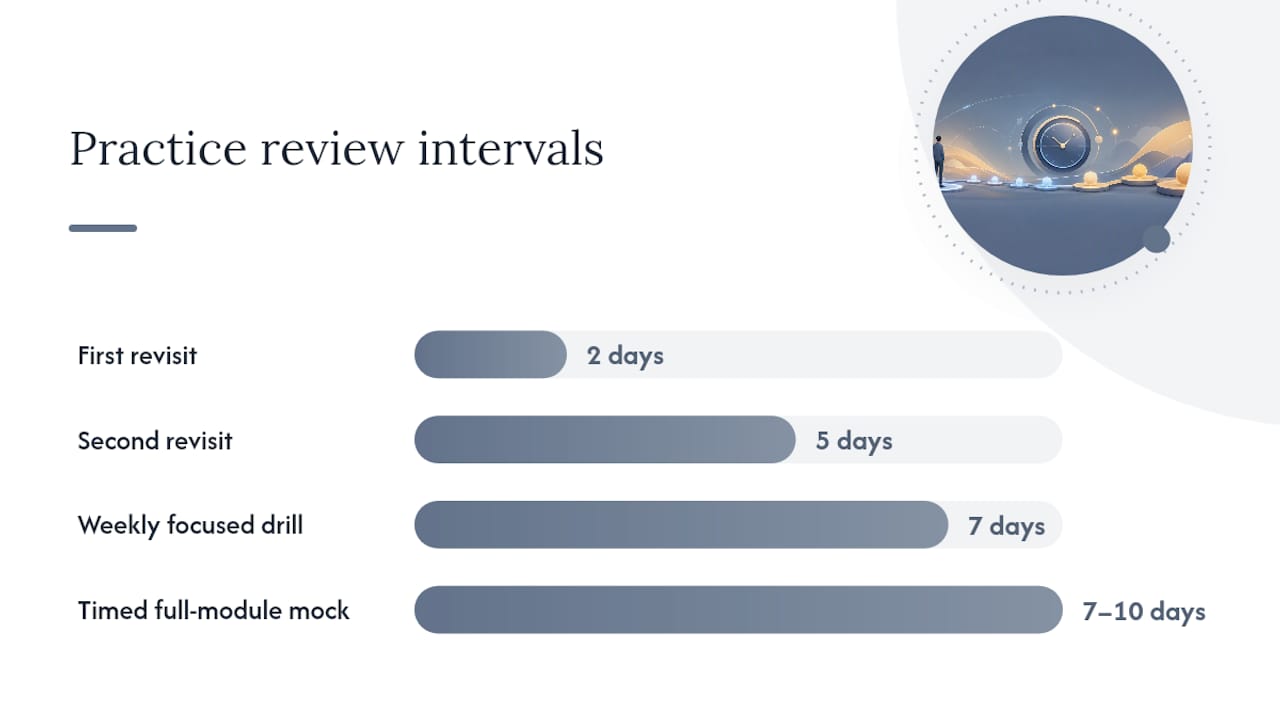
- Run a timed full-module mock every 7–10 days in the final month before your exam. Speed and endurance are skills. One focused drill per week builds both.
- Use spaced repetition on your error log. Revisit flagged questions two days later, then five days later. If you still miss the same item, escalate it to a longer content review before your next mock.
Pro Tip: When your error log shows the same topic appearing three or more times, stop drilling questions on it and go back to the curriculum chapter. Question practice reveals gaps; content review fills them. Mixing both is what moves the needle.
Open-book checking has one legitimate use: after a timed mock, use your curriculum to verify your rationale for each wrong answer. Never use open-book mode during the mock itself. The exam is closed-book, and training your brain to recall without aids is the entire point.
Where to get full-length mocks and large question banks
Official CISRO sample PDFs are the right starting point, but they contain a limited number of items per module. Passing the exam requires both accuracy and speed, which means you need a larger question pool and timed, full-length mocks.
When choosing a practice option, look for these features:
- Realistic timing and scoring that mirrors the actual per-module exam format
- Modular coverage across all four LLQP modules, not just Life Insurance
- Worked rationales for every question, including the ones you got right
- Readiness tracking so you can see your score trend over time and identify which modules still need work
- Province-specific content that reflects the rules and examples relevant to where you are writing
- Translation tools if English is not your first language
Broadly, candidates encounter three types of practice options. Official regulator sample PDFs are free and authoritative but limited in volume. Large question banks from course providers offer more items but vary in quality and may not include readiness tracking. Subscription platforms like Llqpguide combine province-specific modules, unlimited quizzes, full-length timed mocks, and a readiness tracker in one place, which removes the need to stitch together multiple sources.
The practical difference between a PDF bank and a tracked platform shows up in the final two weeks before your exam. Knowing your score trend by module tells you exactly where to spend your remaining study hours.
Why worked answers matter more than the score
A score tells you where you stand. A rationale tells you why you are there and what to do about it.
When you review a wrong answer, the rationale should do three things: name the rule or concept being tested, show how to apply it to the specific scenario, and give you a phrase or principle to carry forward. Without that structure, you are likely to make the same mistake on a differently worded version of the same question.
Here is a worked example using the segregated fund maturity guarantee question above:
The fund value at maturity is $30,000. What is the guaranteed maturity benefit?
Correct answer: $37,500
Step-by-step reasoning: Multiply the original deposit by the guarantee percentage: $50,000 × 0.75 = $37,500. Compare that to the actual fund value ($30,000). Because the fund value is below the guarantee, the insurer pays the guaranteed amount, not the fund value.
Rule to remember: The maturity guarantee is calculated on the original deposit, not the current fund value. The guarantee only pays out when the fund value falls below it.
Use this template for every error in your log:
That three-part structure is what converts a one-time mistake into a durable memory.
The study approach that actually works
Most candidates who struggle with the LLQP are not struggling because the content is too hard. They are struggling because they are studying passively: reading notes, highlighting text, and hoping it sticks. The exam tests application, not recognition.
The candidates who improve fastest treat every practice session as a diagnostic. They are not trying to finish questions; they are trying to find out what they do not know yet. That shift in mindset changes everything about how you use sample questions.
A realistic study week in the final month before your exam might look like this: two evenings of focused module drills (30–40 questions per session, timed, closed-book), one evening reviewing your error log and revisiting the curriculum chapters flagged by it, and one full-length timed mock on the weekend with a complete rationale review the following morning.
The Ethics module deserves specific attention. Candidates consistently underestimate it because it feels like common sense. It is not. Ethics questions are scenario-based and often hinge on a single word: “must,” “should,” “may.” Practising Ethics scenarios under timed conditions is the only reliable way to get comfortable with that precision.
One more thing: do not wait until you feel ready to run a full mock. Run one early, even if the score is low. A bad early mock score is information. It tells you exactly where to focus, which is worth more than another week of passive reading.
Llqpguide gives you everything in one place
If you are piecing together official PDFs, a spreadsheet error log, and a separate timer, you are spending study time on logistics instead of learning. Llqpguide is built specifically for LLQP candidates in Canada and puts every tool you need under one login.
Here is what you get with a Llqpguide subscription:
- Province-specific lessons and quizzes matched to where you are writing
- Unlimited practice questions across all four LLQP modules
- Full-length timed mock exams that replicate real exam conditions
- A readiness tracker that shows your score trend by module so you know exactly when you are ready
- Flashcards, video lessons, and podcast-style content for different learning styles
- In-lesson word translation for 11+ languages, which is particularly useful if English is your second language
Start with a free trial, run one full timed mock, and check your readiness score by module. If a gap shows up, you will know exactly where to focus before exam day. See the full plan options to move from free access to unlimited practice.
Sources
- Curriculum & Sample Exam Questions
- Life Licence Qualification Program (LLQP) | Financial Services Regulatory Authority of Ontario
- Life License Qualification Program (LLQP) - Alberta Insurance Council
- In-person exams –
- Life Licence Qualification Program Insurance Course (LLQP) Curriculum | Canadian Securities Institute
Recommended
Frequently asked questions
How difficult is the LLQP exam?
The LLQP is considered moderately challenging. The content is manageable, but the scenario-based format requires applying rules under time pressure, which trips up candidates who study passively rather than practising with timed questions.
How many questions are in each LLQP module?
Question counts vary by province and are confirmed by each provincial regulator. Check your province's regulator page or the exam administrator for the current per-module count before you book.
How do you pass the LLQP?
Complete your approved course, download the official CISRO sample questions, run timed module mocks, and log every wrong answer with a rationale. Candidates who combine timed practice with consistent error review tend to reach a passing score faster than those who rely on reading alone.
What is the hardest insurance exam to pass in Canada?
Difficulty varies by individual background, but many candidates find the Life Insurance module the most content-heavy given the breadth of topics: term, whole life, universal life, riders, underwriting, and taxation. The Ethics module surprises candidates who underestimate its scenario-based precision.