Waiting periods for the LLQP: rules for exam rewrites in Canada
Waiting periods for the LLQP: rules for exam rewrites in Canada ! Candidate marking calendar for LLQP exam retake If you fail an LLQP module, you're generally entitled to three supplemental exams, four attempts in total, while your course certification stays valid.

Waiting periods for the LLQP: rules for exam rewrites in Canada
If you fail an LLQP module, you’re generally entitled to three supplemental exams, four attempts in total, while your course certification stays valid. A mandatory 24 hour waiting period usually applies between those initial rewrites. Fail the fourth attempt and most provinces impose a one year waiting period, after which you have to retake the prerequisite LLQP course before you can register again.
That’s the pattern most Canadian candidates will hit. But the exact timing, and whether any transitional exceptions apply, depends on which provincial regulator is administering your sitting. Before you rebook, confirm the specifics with the province where you plan to write.
- Three supplemental exams allowed (four attempts total) while course certification is valid
- 24 hour mandatory wait between immediate rewrite attempts in most jurisdictions
- One year wait after a fourth failed attempt, plus mandatory course retake
- Provincial rules vary, so always check the regulator for your sitting location
Key Takeaways
Waiting periods in the LLQP process are regulator-enforced pauses, ranging from 24 hours between early rewrites to a full year after a fourth fail, that force candidates to retake the prerequisite course once certification lapses.
| Point | Details |
|---|---|
| Four attempts per module | You get one original attempt plus three supplemental exams while course certification stays valid. |
| Short wait between early fails | Most provinces enforce a 24 hour minimum before you can rebook after a first or second failed attempt. |
| One year wall after fourth fail | Failing your fourth attempt typically triggers a one year wait and a mandatory course retake. |
| Course cert has its own clock | Prerequisite course certification is commonly valid for 12 months, independent of your exam attempts. |
| Rules vary by province | Confirm timing with the regulator for the specific province where you plan to write, not where you studied. |
Table of Contents
- Waiting periods LLQP candidates face across Canada
- Provincial variations you need to confirm before rebooking
- How long your course certification and passed modules stay valid
- What a one-year wait actually costs you
- Building a retake plan that actually works
- Checking rules, registering, and keeping your own paper trail
- How waiting periods change the way you prepare
- Exceptions and special cases worth knowing about
- Waiting periods and your path to getting licensed
- Sources
- FAQ
Waiting periods LLQP candidates face across Canada
Every provincial insurance regulator runs its own version of the LLQP exam process, but the underlying structure is remarkably consistent. Understanding the common pattern first makes the provincial exceptions easier to spot later.
- Four total attempts per module. You get one original attempt plus three supplemental exams, provided your prerequisite course certification hasn’t expired. FSRA’s LLQP page confirms this structure for Ontario, and it’s echoed in most other provinces’ policies.
- 24 hour minimum between early rewrites. After a first or second fail, exam administrators typically require a full day before you can sit again. This isn’t a suggestion. Exam booking systems in most provinces won’t let you schedule a slot inside that window.
- One year wait after the fourth fail. Exhaust all three supplemental attempts and you’re locked out for a full year. There’s no way to shorten this by paying a rush fee or appealing to an administrator.
- Mandatory course retake before you can try again. Once the one year clock resets, you don’t just rebook the exam. You have to complete the entire prerequisite LLQP course over again, because course certification doesn’t survive a year of dormancy.
The reasoning behind these waits isn’t bureaucratic friction for its own sake. Regulators want the exam to actually measure competence, not memory of yesterday’s wrong answers. A candidate who fails on Tuesday and walks in Wednesday having only reviewed the specific questions they missed hasn’t necessarily learned the material. They’ve learned the test.
24 hours between attempts, one year after the fourth fail. That’s the FSRA-documented rhythm behind Ontario’s LLQP retake structure, and FSRA’s licensing insight treats even the short 24-hour gap as a deliberate check against cram-and-retake behaviour, not an administrative afterthought.
Provincial variations you need to confirm before rebooking
The pan-Canadian pattern holds up reasonably well, but the fine print changes depending on where you sit the exam. Since LLQP waiting periods are enforced by the provincial regulator overseeing your specific sitting, not some national body, you need to check the right document for your location.
- Ontario (FSRA): Follows the standard three-supplemental, 24 hour, one-year structure. FSRA’s LLQP page also notes candidates have one year from their first pass to apply for a licence.
- British Columbia (Insurance Council of BC): The examinee information guide spells out the waiting-period schedule in detail and confirms course certification is valid for one year. Fail your fourth attempt and you’re back to square one on the course.
- Manitoba (Insurance Council of Manitoba): Manitoba’s exam process page describes a graduated approach, with a three month wait kicking in after the third attempt in some sequences, rather than jumping straight to a year. This is one of the clearest examples of a province deviating from the simpler pattern.
- Newfoundland and Labrador: Provincial guidance also references graduated waits in certain circumstances, reinforcing that “check locally” isn’t just boilerplate advice, it changes your actual timeline.
- New Brunswick, PEI, and Saskatchewan: Rules broadly track the national pattern, though PEI’s LLQP guidance highlights that licence-application windows are commonly set at 12 months from your pass date, a detail that trips up candidates who assume they have more runway.
If you passed under an earlier version of a province’s rules, ask the regulator directly whether any grandfathering applies to your file. Some transitional policies exist for candidates who passed modules before a rule change took effect, but they aren’t advertised prominently, and you won’t find them by guessing.
The safest move is to pull up the examinee information guide and examination administration policy for the specific province where you intend to write, not the province where you studied or where you first attempted the exam. The Insurance Council of BC is explicit that its waiting periods apply to sittings booked in BC, even if your earlier attempts happened somewhere else.
How long your course certification and passed modules stay valid
Passing an LLQP module doesn’t buy you unlimited time to finish the rest or apply for your licence. Two separate clocks are running, and mixing them up is one of the more expensive mistakes candidates make.
- Course certification validity: Typically 12 months from completion. If your waiting period drags past that mark, the certification itself expires, not just your exam eligibility.
- Licence-application window: Commonly 12 months from your first pass, though some provinces reference related rules running up to 24 months for specific circumstances. PEI’s guidance frames the standard licensing window around the 12 month mark.
- Consequence of expiry: You don’t get a grace period. Once course certification lapses, you retake the course in full, and depending on timing, you may need to redo modules you’d already passed if your application window closed first.
- Financial and time cost: Course fees again, plus the study hours you already invested effectively reset to zero for that module.
A practical order of operations looks like this: pass all four modules within your course certification window, apply for your licence promptly once you’ve cleared the modules you need, and don’t let a rewrite wait push you past either deadline. The BC examination administration policy is blunt about this: waiting periods do not extend course validity. The clock keeps running whether you’re actively testing or not.
What a one-year wait actually costs you
Hitting the one year wall after a fourth failed attempt isn’t just a scheduling inconvenience. It resets your progress in ways that surprise a lot of candidates.
- Full course retake required. You can’t simply rebook the exam once the year passes. FSRA and the BC Insurance Council both confirm you must complete the prerequisite course again before registering for another attempt.
- Your next try counts as attempt one. The three-supplemental allowance resets along with the course certification, so you’re starting the four-attempt cycle over.
- Real cost, not just inconvenience. Course fees apply again, and most candidates need roughly 100 hours of study to prepare properly the second time around, similar to the first.
- Risk of losing already-passed modules. If your licence-application window lapses while you’re stuck on one module, you could be required to redo modules you’d previously cleared.
- Check for transitional relief. Some provinces have offered temporary policies reducing repeat costs or timing for candidates caught in rule transitions. It’s worth a direct call to the regulator rather than assuming none applies.
Building a retake plan that actually works
A failed attempt is data, not a verdict on whether you belong in this career. The candidates who pass on the second try usually change their approach, not just their effort level.
- Diagnose weak topics first. Run module-specific quizzes before you touch a full mock exam. Guessing at what went wrong wastes the limited time your course certification gives you.
- Build a focused study schedule around the gaps. Once you know whether Life Insurance concepts or Ethics scenarios are your weak spot, structure study blocks around those specific areas instead of rereading everything from the start.
- Take timed, full-length mock exams that vary form and module order. Regulators assign different exam forms to different sittings, so memorizing last time’s questions won’t help. Practice under conditions that mimic real unpredictability.
- Track your readiness against your certification clock. Don’t wait until you feel confident in the abstract. Use a readiness score to decide when to book, so you’re not burning course-cert validity on additional prep once you’re already exam-ready.
LLQPGuide is built around this exact retake logic. The platform offers province-specific lessons, unlimited practice quizzes, and full-length mock exams that vary form and sequencing, so you’re training for the actual exam experience rather than a fixed question bank. Readiness tracking flags which modules need more time, and in-lesson translation tools support candidates working through material in a second language.
Pro Tip: Book your retake as soon as your readiness tracker shows consistent passing scores across at least two full mock exams, not just one strong practice run. One good session can be luck; two in a row usually isn’t.
Checking rules, registering, and keeping your own paper trail
Before you rebook anything, pull the actual regulator documents for your sitting province rather than relying on secondhand summaries. Look specifically for the examinee information guide and the examination administration policy, since these are the documents that spell out waiting periods, course validity, and what counts as an attempt.
- Confirm the current rules directly on your provincial regulator’s website, not a course provider’s summary page.
- Keep a personal record of every attempt date, along with your course completion certificate and its issue date.
- Note any transitional or grandfathering references that might apply to your specific pass history.
- If a waiting-period calculation seems wrong, contact the regulator or your course provider directly rather than guessing, since misapplied waits are usually fixable with the right documentation.
How waiting periods change the way you prepare
A hard 24 hour minimum after a first fail doesn’t leave much room for a full study overhaul, and that’s the point. It pushes candidates to fix specific gaps rather than cram broadly. A one year wait, by contrast, changes the entire calculus. Candidates facing that wall often shift from “review weak spots” to “relearn the material from scratch,” because a year is long enough for foundational knowledge to genuinely fade.
This has a practical planning consequence: the closer you are to your third supplemental attempt, the more seriously you should treat that sitting. Many candidates treat the first three attempts as a buffer and only get serious before the fourth, but that approach backfires if the fourth attempt also fails, since the one year reset is unforgiving regardless of how close you came.
Smart preparation treats every attempt as if it were the last one available before a forced pause. That mindset shift, more than any single study technique, tends to separate candidates who clear their modules within a few months from those who end up caught in a full year delay.
Exceptions and special cases worth knowing about
Waiting periods aren’t applied with zero flexibility everywhere, though the exceptions are narrower than most candidates hope. Some provinces have offered transitional or grandfathering provisions for candidates who passed modules before a policy change took effect, which can affect how their remaining attempts or licence-application windows are counted.
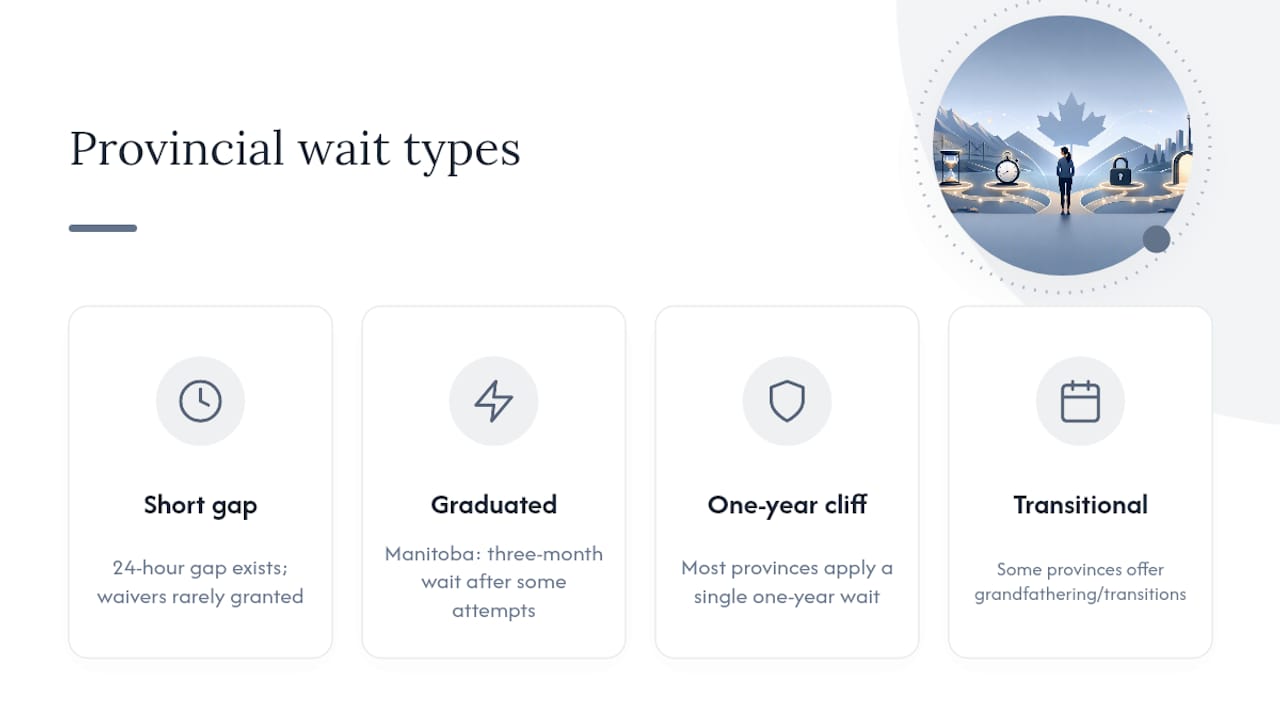
Graduated waiting-period structures, like the one Manitoba applies with a three month wait after certain attempts rather than jumping straight to a full year, function as a built-in softer landing compared to provinces with a single hard one-year cliff. That’s a meaningful difference if you’re choosing where to write and you have any flexibility in location.
Beyond that, most provinces don’t offer discretionary waivers for the standard waiting periods. Requests to shorten a 24 hour or one year wait for personal circumstances are rarely granted, since the policy exists precisely to be applied consistently. Your best lever isn’t seeking an exception. It’s confirming, in advance, which provincial framework you’ll be subject to and planning around its specific timing.
Waiting periods and your path to getting licensed
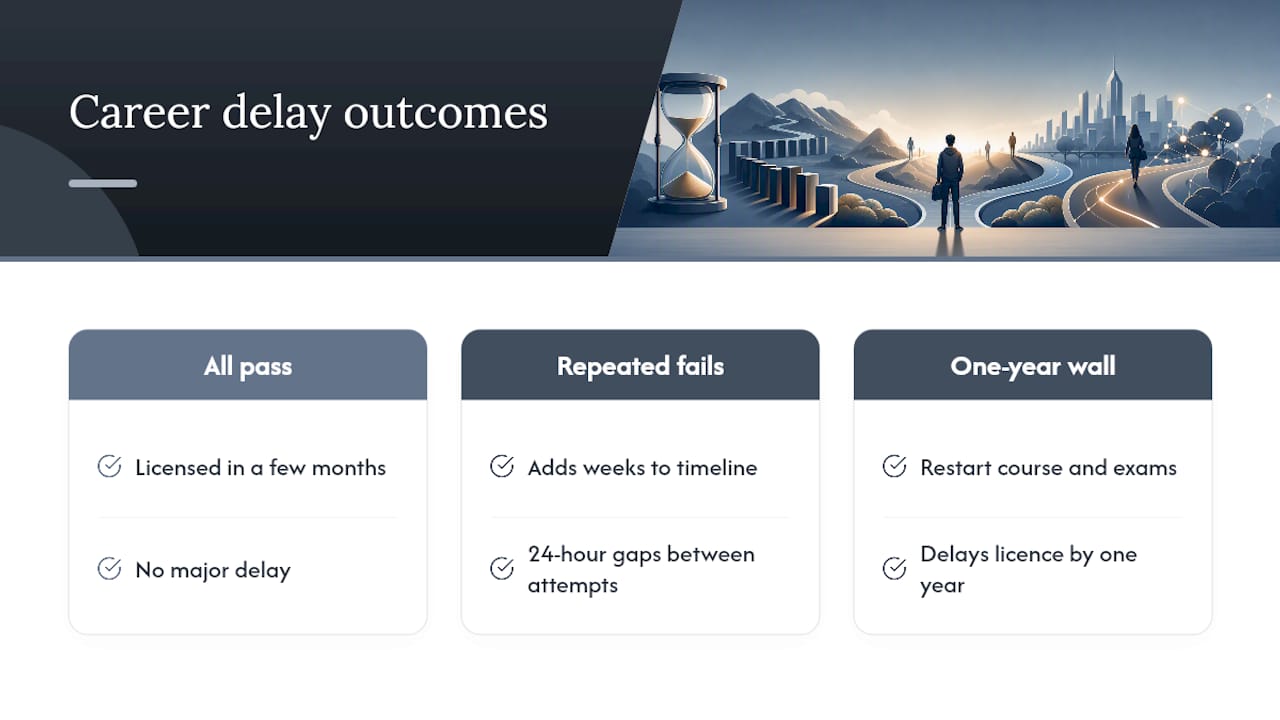
Every wait you hit adds real time to your career timeline, not just to your exam calendar. A candidate who clears all four modules on the first attempt might be licensed and working within a few months of starting their course. A candidate who fails one module twice, waits out a 24 hour gap each time, and still needs a third supplemental attempt adds weeks, not months, if they pass on that try.
The real risk to career progression isn’t the short waits. It’s the one year wall. Hitting it means restarting the course, redoing the exam cycle, and potentially delaying a licence application, job offer, or contract start by a full year rather than a few weeks. For someone counting on an insurance licence to start a new role or transition careers, that’s the difference between a minor delay and a serious setback.
This is why treating early attempts seriously matters more than most candidates initially assume. The gap between “pass by attempt two” and “fail all four and wait a year” isn’t a matter of degree. It’s the difference between a short detour and a full year off your timeline.
Normalizing setbacks and staying disciplined
Failing a module feels awful in the moment, and pretending otherwise helps no one. But your first attempt genuinely matters more than any attempt after it, since it’s the one with the most runway before waits start compounding. Use tools built around your province’s actual rules, study the gaps honestly, and treat the retake as a fresh shot, not a punishment.
— Reza
Sources
- Life Licence Qualification Program (LLQP) | FSRA
- In-Person Harmonized LLQP Examinee Information Guide (Insurance Council of BC)
- The ICM exam process for life and/or accident & sickness applicants | Insurance Council of Manitoba
Recommended
Frequently asked questions
How long does it take to pass the LLQP?
Many candidates who study consistently pass all four modules within a few months, though this depends heavily on how much time you can dedicate weekly and whether you need a supplemental attempt on any module.
Is the LLQP exam hard to pass?
The exam is challenging enough that first-attempt failure is common, largely because it tests applied scenarios rather than simple recall, which is why targeted practice with varied mock exam formats matters more than rereading course material.
How many attempts are allowed for the LLQP?
Most provinces allow four total attempts per module, one original plus three supplemental exams, while your course certification remains valid, with waiting periods like the FSRA-documented 24 hour gap applying between the earlier attempts.
Is getting an LLQP licence worth the effort?
For anyone pursuing a career selling life insurance, accident and sickness coverage, or segregated funds in Canada, the licence is a mandatory entry requirement, so the relevant question isn't whether it's worth it but how efficiently you can pass without hitting a costly waiting period.