LLQP Module Breakdown: Study Map for Canada’s Four Exams
LLQP Module Breakdown: Study Map for Canada’s Four Exams ! Hands flipping through sample insurance policy pages The LLQP is four modular exams, not one long test: Life Insurance, Accident and Sickness, Segregated Funds and Annuities, and Ethics and Professional Practice.

LLQP Module Breakdown: Study Map for Canada’s Four Exams
The LLQP is four modular exams, not one long test: Life Insurance, Accident and Sickness, Segregated Funds and Annuities, and Ethics and Professional Practice. You only sit the modules your licence requires, a full life licence needs all four, an accident and sickness licence needs A&S plus Ethics. Each module carries its own pass mark of 60%, its own timer, and a handful of unscored pilot questions mixed in.
TL;DR:
- Passing the LLQP requires mastering each module’s unique skills, with a focus on scenario application and legal provisions, not just memorization of definitions.
- The life insurance module emphasizes needs analysis and detailed review of policy clauses, especially riders, while accident and sickness tests clause interpretation and claim scenarios.
- Segregated funds and annuities demand strong numerical skills, calculation speed, and understanding of guarantees, suitability, and product features.
- Ethics testing varies by province, highlighting legal frameworks, fiduciary duties, and disclosure rules; practicing scenario-based questions improves comprehension.
- Each module has 75-minute exams with 30 or 20 questions plus unscored pilot questions, requiring at least 60% to pass independently, with study timelines of six to eight weeks per module.
Table of Contents
- Why the LLQP module breakdown exists in the first place
- Life insurance: chapters, exam focus and how to prepare
- Accident and sickness insurance: scope, common exam traps and study focus
- Segregated funds and annuities: concepts to master for the exam
- Ethics and professional practice: legal framework and provincial differences
- Concrete exam facts: question counts, timing, pass mark and re-writes
- Practical study plan mapped to modules and exam format
- What actually separates candidates who pass from those who don’t
- Why LLQP Guide fits how the exam is actually structured
- Where to verify the rules for your province
- Sources
- FAQ
Why the LLQP module breakdown exists in the first place
The LLQP isn’t split into four modules by accident. Provincial regulators, working through the Canadian Insurance Services Regulatory Organizations (CISRO), built the curriculum around a competency profile. Each module tests a distinct set of skills an agent needs before they’re allowed to sell that product category to the public.
That matters for how you study. A candidate who treats the exam as one giant trivia dump misses the point: the regulators want proof you can apply life insurance concepts to a life insurance problem, and annuity math to an annuity problem, separately.
- Each module maps to a specific licensing outcome (life, A&S, or both)
- Individual and group products are tested together within the same module, not split out
- Course content must come from a provider approved by your provincial regulator before you’re eligible to write the exam
Life insurance: chapters, exam focus and how to prepare
This module tests whether you can match a policy to a person’s actual situation, not just recite definitions. Course-provider curriculum pages, including CSI’s LLQP outline, break the content into recognizable chapters:
- Term, whole, and universal life insurance structures
- Riders and supplementary benefits
- Group life insurance basics
- Taxation of life insurance proceeds and policy transfers
- Underwriting and risk classification
- Needs analysis and product recommendation
Needs analysis carries disproportionate weight on exam day. Expect scenario questions where you calculate a coverage gap, then pick the product that actually fits the client’s budget and stage of life, not just the “correct” textbook answer.
Pro Tip: Work through sample policy wordings, not just chapter summaries. Exam questions often hinge on a single clause buried in a rider, and skimming the plain-English chapter recap won’t catch it.
Accident and sickness insurance: scope, common exam traps and study focus
This module trips up candidates who assume it’s a shorter, easier version of the life module. It isn’t. The traps are in the fine print of policy provisions:
- Elimination periods and how they interact with benefit start dates
- Definitions of total disability versus partial disability, and how insurers apply each
- Renewal guarantees and incontestability clauses
- Group versus individual A&S distinctions, especially around portability and conversion rights
- Common claims scenarios: pre-existing condition exclusions, waiting periods, benefit offsets
Exam writers love clause comparisons. You’ll see two policies side by side and have to identify which one pays out in a specific claim scenario. Drill this format directly rather than just reviewing definitions in isolation, since recognizing a definition is not the same skill as applying it under a time limit.
Segregated funds and annuities: concepts to master for the exam
This module blends investment mechanics with insurance guarantees, which is exactly why candidates find it the most math-heavy of the four. You need to know both the contract features and the numbers behind them:
- Segregated fund maturity and death benefit guarantees
- Creditor protection features tied to seg fund beneficiary designations
- Annuity types: life annuities, term-certain annuities, registered versus non-registered
- Basic annuity payment calculations and settlement options
- Suitability: matching a client’s risk tolerance and income needs to the right contract
Numerical practice pays off here more than memorization does. Build a habit of running the settlement-option math by hand until it’s automatic, then use a suitability checklist to double-check your product choice against the client profile in the question.
Ethics and professional practice: legal framework and provincial differences
Ethics is the one module every candidate needs, regardless of licence type, and it’s also the one most likely to catch you off guard. The competency components cover the legal framework governing agents, fiduciary duties owed to clients, beneficiary designation rules, and claims handling obligations.
Here’s where it gets province-specific: some jurisdictions test Common Law principles, others test Quebec Civil Code material, and depending on where you’re licensed, you may need familiarity with both legal systems. Quebec candidates in particular should not assume the Common Law framework taught in generic study guides covers what their exam actually tests.
- Agent duties: disclosure, suitability, conflict of interest
- Beneficiary rules and how they differ by contract type
- Claims handling and complaint-resolution obligations
- The applicable legal framework for your specific province
Pro Tip: Don’t memorize ethics rules as abstract principles. Practise applying them to disclosure scenarios: “the client didn’t ask, do you still have to tell them?” is the kind of question that actually shows up.
Concrete exam facts: question counts, timing, pass mark and re-writes
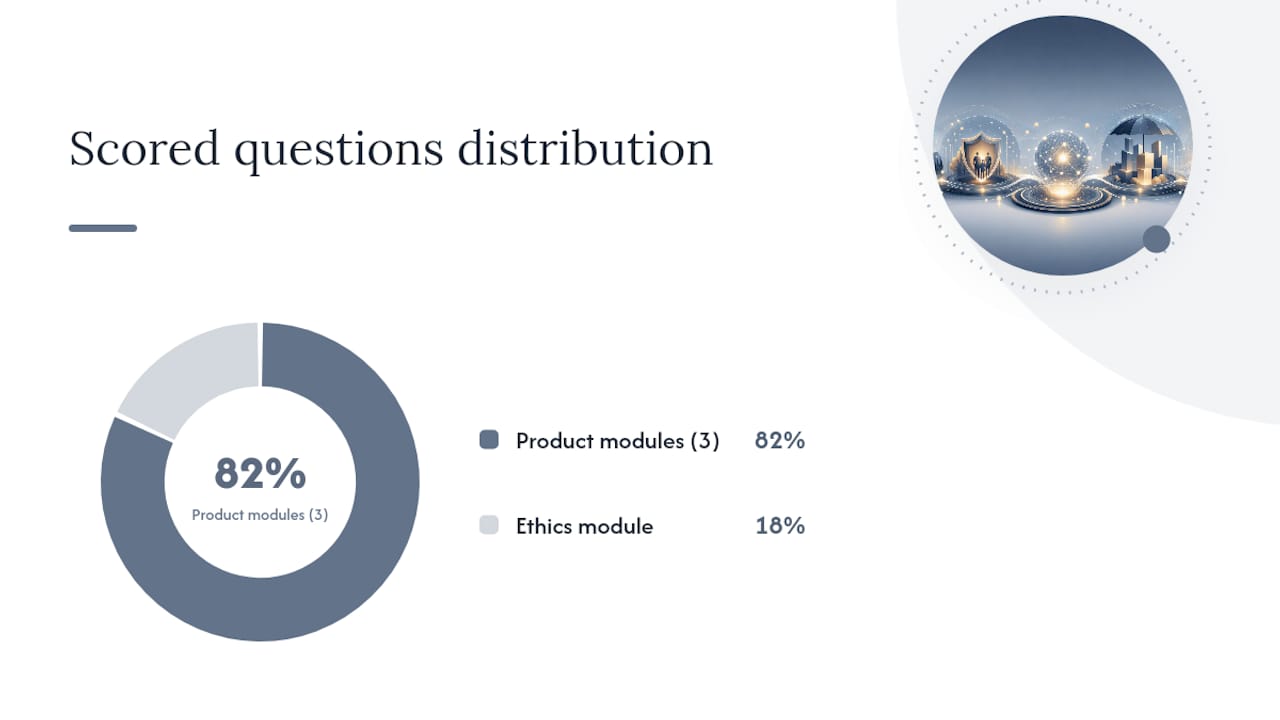
Here’s the exam mechanics in one place, because pacing depends on knowing them cold.
Statistic Callout: Each of the three product modules runs 75 minutes for 30 scored questions, plus five unscored pilot questions mixed in without warning. The Ethics module runs shorter: 20 scored questions plus five pilot questions.
- Pass mark: 60% on every module, scored independently
- A full Life Insurance Agent licence requires passing all four modules
- An Accident & Sickness Agent licence requires only the A&S module plus Ethics
- Pilot questions look identical to scored ones. Treat every question as if it counts
Rewrite rules, waiting periods, and booking procedures vary by province. The Insurance Council of British Columbia publishes its own exam-day rules, and Ontario candidates should check province-specific booking guidance before assuming another jurisdiction’s timeline applies to them.
Practical study plan mapped to modules and exam format
A module-by-module exam deserves a module-by-module study plan, not one long undifferentiated slog through a textbook.
- Block your study calendar by module, not by chapter. Give Life Insurance and Segregated Funds the most hours since they carry the heaviest calculation load.
- Run a timed mock exam for each module before you touch the real one. Timing pressure changes how you read a question, and you want that shock to happen in practice, not on exam day.
- Use module-specific quiz results to find your weak spots. If you’re consistently missing A&S claims scenarios, that’s where the next study block goes, not back to reviewing life insurance definitions you’ve already nailed.
- If English is your second language, lean on in-lesson translation tools for terminology rather than translating whole passages. Insurance vocabulary is specific, and mistranslating one term (like “incontestability”) can cost you a question you’d otherwise get right.
Pro Tip: Book your module exams in the order you feel weakest to strongest. Passing your toughest module early removes the temptation to keep delaying it.
What actually separates candidates who pass from those who don’t

Most failed attempts share the same root cause: candidates cram all four modules together the week before, treating Life Insurance and Segregated Funds as interchangeable financial-products trivia instead of distinct competency tests. Ethics gets the least respect and does the most damage, since candidates assume it’s common sense rather than a module with its own legal detail to memorize.
A realistic prep timeline runs six to eight weeks per module for a first-time candidate working part-time hours, less if you’re studying full-time. Practising with module-specific mock exams before booking the real one is the single biggest lever against a rewrite, because it exposes exactly which competency area is weak before it costs you a fee and a waiting period.
— Reza
Why LLQP Guide fits how the exam is actually structured
Studying for four separate modules calls for study tools built the same way the exam is built, not one generic question bank. LLQPGuide organizes lessons, unlimited practice quizzes, and full-length timed mock exams around each of the four modules, so you can drill Segregated Funds calculations one week and switch to Ethics disclosure scenarios the next without losing track of where you’re weak.
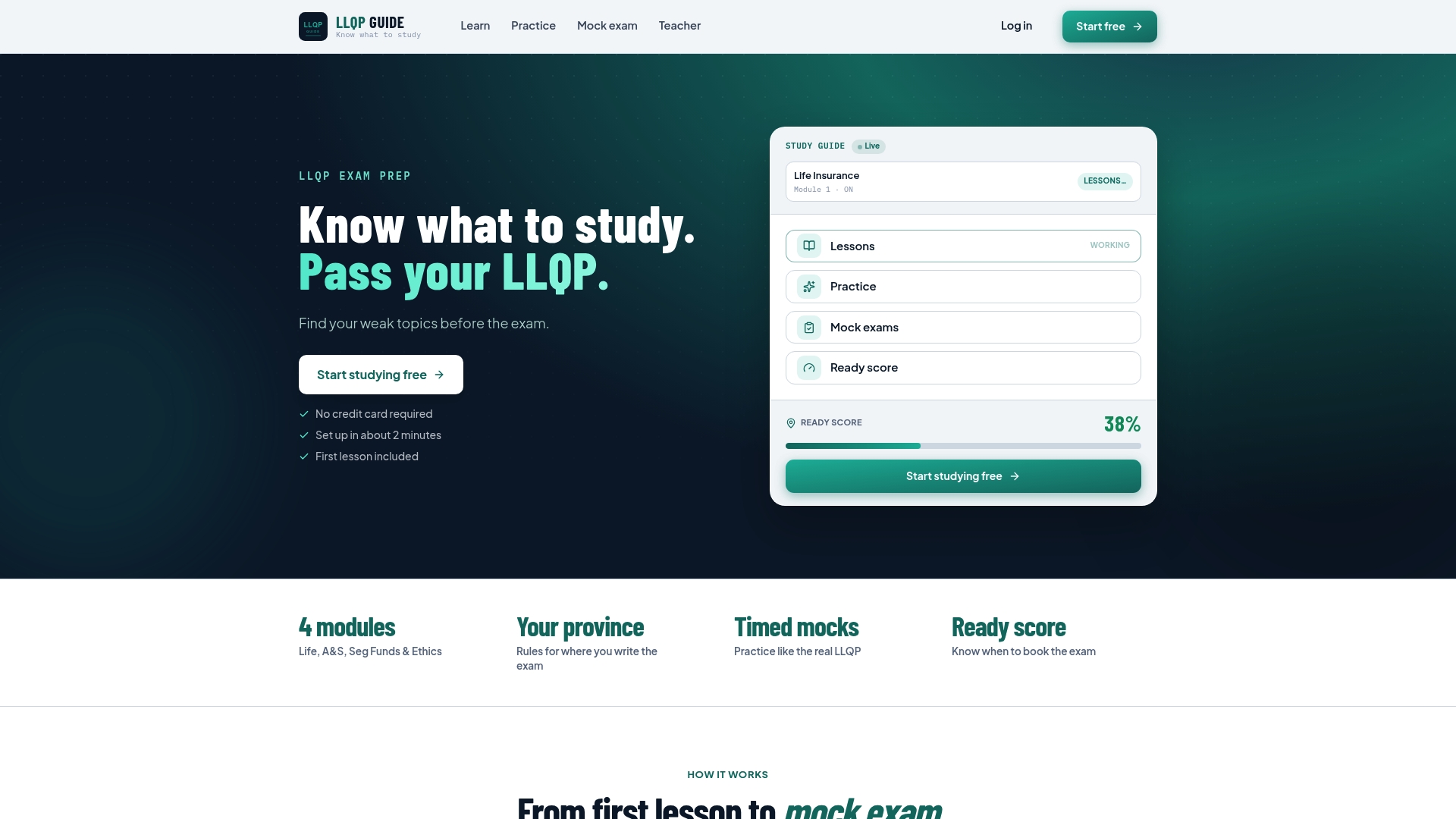
If English is your second language, the in-lesson translation tools cover terminology across 11 or more languages, which matters most in a module like Ethics where a single mistranslated term can flip the meaning of a question. Candidates who want to see the module structure before committing can review the full module breakdown, including dedicated pages for Life Insurance, Accident & Sickness, and Ethics & Professional Practice. Check the pricing page to start a trial and get access to module-specific quizzes before you book your first exam.
Where to verify the rules for your province
Confirm exam timing, fees, and rewrite policy directly with your regulator before booking:
- CISRO’s curriculum and competency profile for the official module design
- FSRA’s LLQP page for Ontario-specific administration rules
- The Insurance Council of British Columbia for BC exam-day requirements
Sources
- Life License Qualification Program (LLQP) - Alberta Insurance Council
- Life License Qualification Program (LLQP) | Government of Prince Edward Island
- Life Licence Qualification Program (LLQP) - Government Services Newfoundland and Labrador (exam info)
- LLQP project overview and curriculum design (CISRO)
- Life License Qualification Program Insurance Course (LLQP) - Canadian Securities Institute
Recommended
Frequently asked questions
What is the breakdown of the LLQP exam?
The LLQP has four modules: Life Insurance, Accident and Sickness, Segregated Funds and Annuities, and Ethics and Professional Practice. Each product module has 30 scored questions in 75 minutes, while Ethics has 20, and every module adds five unscored pilot questions.
Is it hard to pass the LLQP exam?
It's manageable with module-specific preparation, but candidates who study all four modules as one undifferentiated block tend to struggle, particularly with the numerical demands of Segregated Funds and the legal detail in Ethics. The pass mark is 60% per module, scored independently.
How long does it take to pass LLQP?
Most first-time candidates studying part-time need roughly six to eight weeks per module, though full-time study can compress that timeline. Using module-specific mock exams to confirm readiness before booking reduces the chance of needing a rewrite.
What happens if I fail my LLQP exam?
You'll need to follow your provincial regulator's rewrite policy, which typically includes a waiting period before you can book that module again. Rewrite timelines and any additional fees vary by province, so check your regulator's exam page, such as the BC Insurance Council's registration rules, before rebooking.