LLQP Passing Score in Canada: Why You Must Clear 60% on Each Module
LLQP Passing Score in Canada: Why You Must Clear 60% on Each Module ! Candidate completing a proctored insurance exam All four modules, life insurance, accident & sickness, segregated funds & annuities, and ethics & professional practice, must clear that 60% bar independently before you can apply for a licence anywhere in Canada.

LLQP Passing Score in Canada: Why You Must Clear 60% on Each Module
All four modules, life insurance, accident & sickness, segregated funds & annuities, and ethics & professional practice, must clear that 60% bar independently before you can apply for a licence anywhere in Canada.
TL;DR:
- Each of the four LLQP modules must be passed independently with a score of at least 60%, no matter how well you do on the others.
- Pilot questions are mixed into each exam, do not count toward your score, and can make questions seem harder or more confusing than they are.
- You can retake each exam up to three times over a year, with a mandatory 24-hour wait between attempts, and must recertify your course before retaking if it expires.
- Results are generally available within 5 to 7 business days, with a pass remaining valid for one year for licensing purposes.
- Preparing with timed, full-length practice exams under real conditions improves chances of passing comfortably rather than relying on chance.
Table of Contents
- How module scoring works (and why pilot questions confuse people)
- LLQP exam structure across the four modules
- Retakes, waiting periods, and what happens if you fail
- How results are reported and how long a pass stays valid
- How to actually hit 60% without leaving it to chance
- How LLQP scores stack up against other licensing exams
- What a borderline score actually means
- What your score actually reflects out of total questions
- Why 60% feels low, and why that’s the wrong way to think about it
- How LLQPGuide helps you clear 60% with room to spare
- Sources
- FAQ
How module scoring works (and why pilot questions confuse people)
Each of the four LLQP modules gets graded on its own. You don’t get a combined score across all four exams, and a strong result on one module never offsets a weak one on another. Regulators treat every module as a separate pass/fail decision, which means your study plan should treat them the same way.
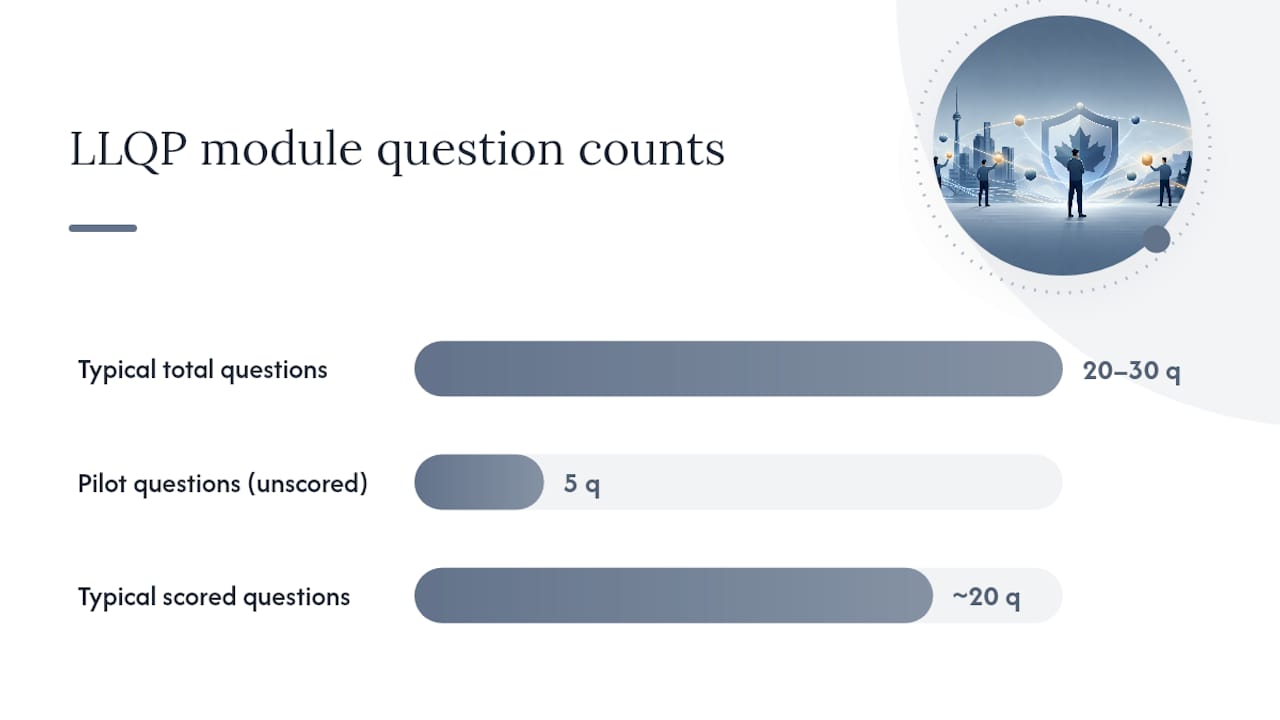
Here’s where candidates get thrown off: every modular exam includes pilot questions mixed in with the scored ones. These are test items regulators are trying out for future exams, and they do not count toward your final score. You won’t know which questions are pilot items and which ones are live, so every question deserves your full attention. British Columbia’s exam administration policy notes five pilot questions per modular exam, folded in without any label.
This matters practically in two ways:
- You’ll likely see a couple of oddly worded or unusually specific questions that feel harder than the rest, some of those are simply being field-tested.
- Your actual scored question count is slightly lower than the total questions on screen, so a module that looks like it has 25 questions might only score you on 20 of them.
Most modules run somewhere in the 20 to 30 multiple-choice question range, though the exact count and mix of scored versus pilot items can shift depending on which exam form you draw. Pilot questions exist for a reason beyond testing new content. They let the exam developer refine future item banks without disrupting the pass/fail stakes for candidates writing today, which is a fairly standard psychometric practice for standardized licensing exams generally.
LLQP exam structure across the four modules
The LLQP isn’t one long exam. It’s four separate modules, each with its own content, its own timing, and its own pass requirement. Understanding the shape of each one helps you plan study blocks instead of trying to cram everything into one marathon session.
- Life Insurance — covers policy types, underwriting basics, and the fundamentals every licensed agent needs regardless of specialty.
- Accident & Sickness — focuses on disability, critical illness, and health-related insurance products.
- Segregated Funds & Annuities — deals with investment-linked insurance products, a module many candidates find the most technical.
- Ethics & Professional Practice — covers regulatory obligations, disclosure requirements, and professional conduct standards.
Timing follows a fairly consistent pattern across providers: most modules run around 75 minutes for roughly 20 to 30 multiple-choice questions, though you should treat that as a general benchmark rather than a guarantee for your specific sitting. Some candidates choose to write all four modules close together; others space them out over weeks. Either approach works as long as you’re not letting certification windows lapse between attempts.
Format details vary more by province than most candidates expect. Some jurisdictions run exams strictly online through a proctoring portal, others still administer in person at designated testing centres, and registration platforms differ too. Ontario candidates typically register and write through channels tied to their approved course provider, while British Columbia candidates work through the Insurance Council of BC’s own exam administration process. If you’re studying for a specific province, check that regulator’s exam page directly before assuming your friend’s experience in another province matches yours.
Retakes, waiting periods, and what happens if you fail
Failing a module isn’t the end of the road, but it does come with rules worth knowing before exam day, not after.
You get three retake attempts per module, for a total of four tries including your original write. Between attempts, there’s a mandatory 24 hour waiting period, so you can’t fail in the morning and rewrite that same afternoon. If you fail your fourth attempt, you’re blocked from writing that module again for a full year.
There’s a second clock running in the background too: your prerequisite course certification. That certification is typically valid for one year, and if it expires before you’ve passed the module, you’ll need to recertify before you can attempt the exam again, regardless of how many retakes you have left.
- Three retakes allowed (four total attempts per module)
- 24 hour minimum wait between attempts
- One year block after failing the fourth attempt
- Course certification must stay valid, typically a one year window
Pro Tip: Don’t wait until your certification is about to expire to schedule a retake. Book your next attempt as soon as you get your results back so the 24 hour wait doesn’t collide with a certification deadline you didn’t see coming.
How results are reported and how long a pass stays valid
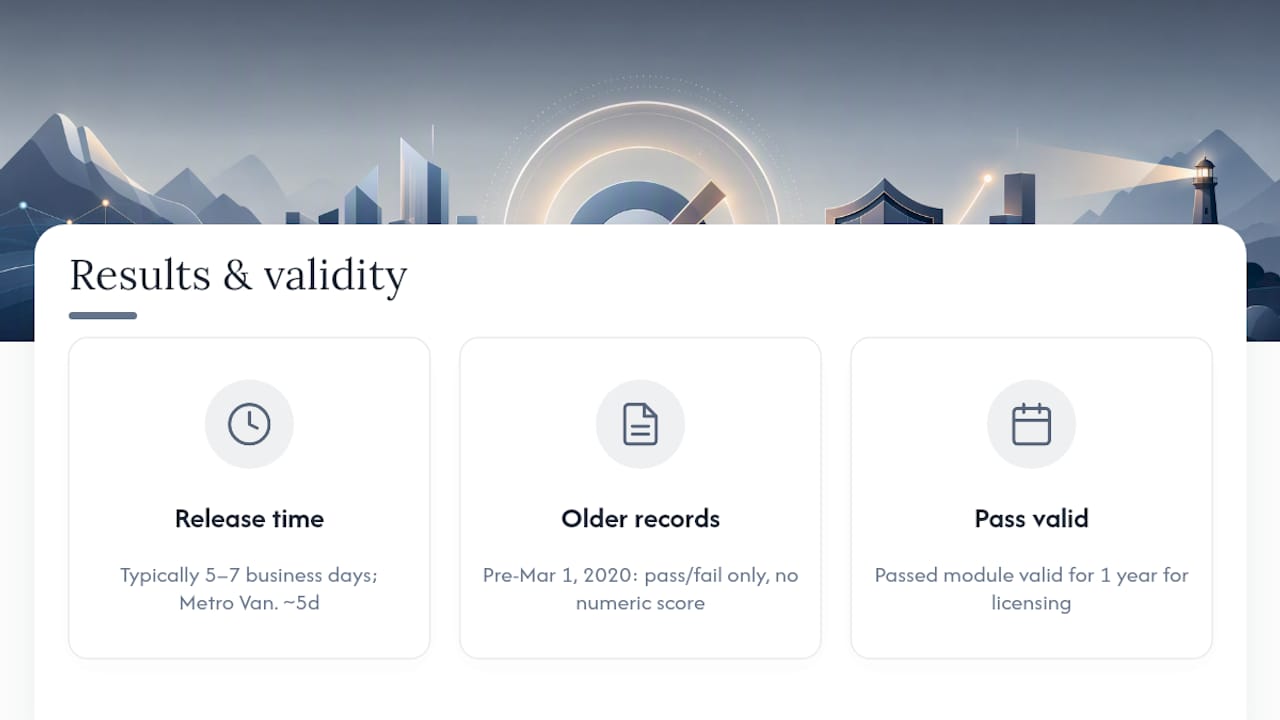
Most candidates get results faster than they expect. Depending on your province and whether you wrote in person or online, results are typically released within 5 to 7 business days through your exam portal. In-person writers in Metro Vancouver, for example, often see results in as few as 5 business days, while other regions and online sittings can take closer to 7.
Older exam records worked differently. Exams written before March 1, 2020 in some jurisdictions only reported pass or fail, with no numeric score attached. Current practice generally gives you an actual score, which is useful for spotting how close you were to the line if you fail.
Once you pass a module, that pass is valid for one year for licensing purposes. Miss that window without applying, and you may need to rewrite. Check your provincial regulator’s page for the exact rules that apply to your licence application.
How to actually hit 60% without leaving it to chance
The candidates who clear the bar comfortably tend to do one thing consistently: they practise under conditions that match the real exam, not just review notes passively.
Full-length mock exams that mirror your province’s actual module length and timing do more than build familiarity. They surface exactly which competency areas are dragging your score down before it costs you a real attempt. If you’re consistently missing questions on policy riders but acing underwriting basics, that’s a study allocation decision, not a guessing game.
A few habits worth building into your prep:
- Take timed mock exams that match your module’s real length and question count.
- Review every missed question immediately, not just the ones you got wrong, but why.
- Use spaced repetition over cramming, especially for terminology-heavy modules like Ethics.
- If English is your second language, lean on translation tools during practice so language isn’t costing you comprehension points on exam day.
How LLQP scores stack up against other licensing exams
Candidates sometimes search for “the easiest insurance exam” hoping the LLQP is somehow softer than the alternative. It isn’t particularly easier or harder, it’s just structured differently.
What sets the LLQP apart isn’t the number itself, it’s the modular structure. Exams like general securities licensing tests often combine everything into one pass/fail score. The LLQP forces you to clear four separate thresholds, which means there’s no hiding a weak module behind a strong one. That can feel less forgiving in one sense (you can’t average your way through), but it also means a bad day on one module doesn’t torpedo your entire result, you retake just that module, not all four.
The takeaway for context-seekers: don’t chase the exam with the lowest reported pass mark. Chase the one relevant to the licence you actually need, and prepare for the LLQP’s specific format rather than assuming general exam experience will carry you.
What a borderline score actually means
There’s no partial credit for a “close enough” answer on the LLQP.
That’s precisely why a borderline fail stings more than it should. The fix isn’t to restart your studying from scratch. It’s to identify exactly which competency areas cost you those points and drill them specifically before your retake.
Pilot questions complicate this picture slightly. Since you don’t know which questions are pilot items, a borderline score can feel like a mystery, you genuinely can’t tell whether a tricky question that “felt wrong” was even scored. That uncertainty is normal and doesn’t mean the exam is arbitrary. It means your retake strategy should focus on strengthening your weakest content area broadly rather than trying to reverse-engineer which specific questions tripped you up.
What your score actually reflects out of total questions
This is a meaningful distinction because it means the exam isn’t testing you on every single question equally in terms of stakes. You can’t identify pilot questions in real time, so the practical guidance stays the same regardless: treat every question as if it counts, because you genuinely don’t know which ones don’t.
The math itself is straightforward once you know the scored count. If it scores 25, you need 15. The exact scored total can vary slightly by module and exam form, which is one more reason mock exams that replicate real question counts matter more than generic multiple-choice drilling from unrelated sources.
Why 60% feels low, and why that’s the wrong way to think about it
That’s a misread. The pass mark reflects what regulators consider minimum entry-level competence, not a ceiling on difficulty. Ongoing harmonization work through CISRO has specifically examined how that standard gets set, precisely because a flat percentage doesn’t automatically capture whether someone is ready to sell insurance products responsibly.
That buffer accounts for factors like exam-day nerves, pilot questions, and natural differences between practice and the real testing environment.
The “easiest insurance exam” framing misses the point entirely. Passability here comes down to preparation, not luck or provincial leniency. And if you fail, that’s not a verdict on your competence, it’s information about which module and which topics need another pass before your next attempt.
— Reza
How LLQPGuide helps you clear 60% with room to spare
The exam mechanics above point to one clear conclusion: candidates who pass comfortably practise under real conditions, not just from a textbook. That’s exactly what LLQPGuide is built around.
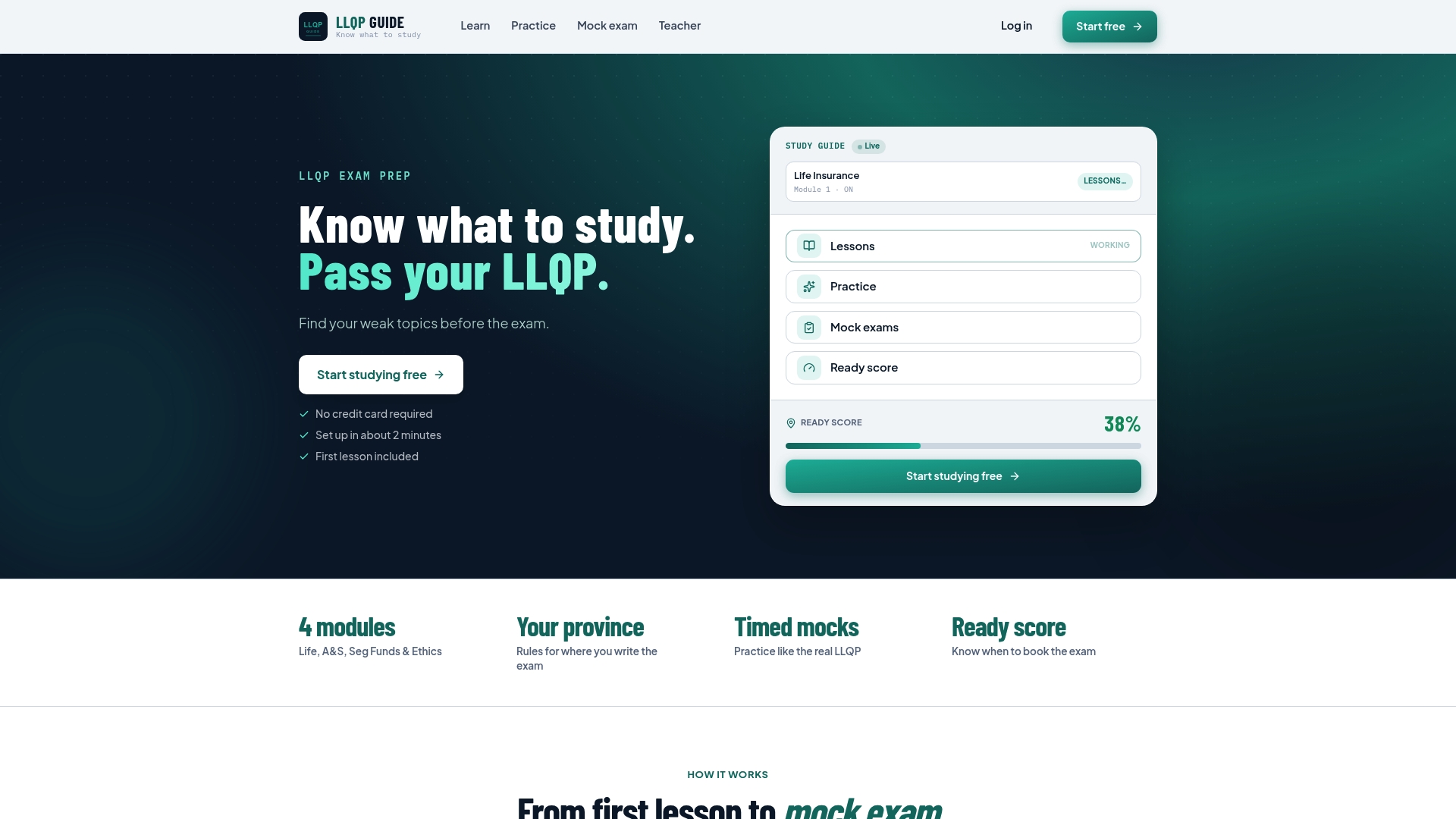
LLQPGuide gives you province-specific lessons for all four modules, unlimited practice quizzes to expose weak spots before they cost you a retake, and full-length mock exams timed to match real module lengths, so the pacing feels familiar on exam day instead of foreign. If English is your second language, in-lesson translation tools across 11 languages mean you’re losing points to unfamiliar content, not unfamiliar wording.
Plans are available on a monthly, quarterly, or annual basis after a free trial. Check the pricing page to see which option fits your timeline before you book your exam.
Sources
- Life Licence Qualification Program (LLQP) | Financial Services Regulatory Authority of Ontario
- LLQP Examination Administration Policy (Insurance Council of British Columbia)
Recommended
Frequently asked questions
What is the passing grade for LLQP?
You need 60% on each of the four LLQP modules, life insurance, accident & sickness, segregated funds & annuities, and ethics & professional practice, to pass.
What happens if I fail my LLQP exam?
You get three retake attempts per module (four total including your first try), with a mandatory 24 hour wait between attempts and a one-year block if you fail the fourth attempt.
What is the easiest insurance exam to pass?
There's no single "easiest" licensing exam since pass marks and formats vary by credential and jurisdiction. The LLQP's 60% threshold is comparable to, or slightly more forgiving than, many other Canadian professional licensing exams, and success depends on targeted preparation like full-length mock exams rather than the exam being inherently easy.