LLQP for newcomers: study plan and how to get licensed
LLQP for newcomers: study plan and how to get licensed ! Person starting stopwatch for exam practice To become a licensed life insurance agent in Canada as a newcomer, you need to complete an approved LLQP course requiring approximately 100 hours of study, pass all four Durham College LLQP modules in person, secure a sponsoring insurer, and submit your licence application to your provincial regulator within one year of passing your first module.

LLQP for newcomers: study plan and how to get licensed
To become a licensed life insurance agent in Canada as a newcomer, you need to complete an approved LLQP course requiring approximately 100 hours of study, pass all four Durham College LLQP modules in person, secure a sponsoring insurer, and submit your licence application to your provincial regulator within one year of passing your first module. That sequence is non-negotiable, and the one-year clock starts the moment you pass any module. Here is what to do in the next 48–72 hours:
- Find an FSRA-approved course provider and register for the LLQP course.
- If your education was completed outside Canada, start a foreign credential assessment now — it takes time.
- Check whether your chosen provider offers English or French delivery and any translation or language supports.
- Note your province’s licensing application page and bookmark it so you are ready to apply the moment you pass.
Key takeaways
Newcomers who pass the LLQP on their first attempt complete an approved course, practise all four modules under timed conditions, secure a sponsor early, and submit their licence application within one year of passing their first module.
| Point | Details |
|---|---|
| Complete an approved course first | Register with an FSRA-approved provider; the course takes approximately 80–100 hours and a completion certificate is required to sit the exam. |
| Pass all four modules | Life Insurance, Accident & Sickness, Segregated Funds & Annuities, and Ethics each require separate booking through Durham College. |
| One-year exam validity | Licence applications must reach your provincial regulator within one year of passing the first module or results expire. |
| Start sponsor search early | Finding a sponsoring insurer takes 4–6 weeks on average; begin outreach during your study period, not after results arrive. |
| Llqpguide for newcomer prep | Province-specific modules, unlimited mock exams, and 11+ language translation tools help newcomers study efficiently and track readiness before booking. |
Table of Contents
- What is the LLQP course and how do you choose a provider?
- How does the LLQP exam work?
- How do you get licensed after passing the LLQP?
- How should you structure your LLQP study plan?
- What newcomers specifically need to know before starting
- What actually works for newcomers studying for the LLQP
- Llqpguide gives newcomers a faster path to exam-ready
- Sources
- FAQ
What is the LLQP course and how do you choose a provider?
The LLQP course is a mandatory prerequisite. You cannot register for the Durham College exam without a completion certificate from an FSRA-approved provider. Providers set their own fees and delivery formats, so the cost and experience vary considerably from one to the next.
Delivery formats and who each suits
- Classroom (in-person instructor-led): Best if you learn through discussion and want a fixed schedule to keep you accountable. Suits newcomers who benefit from face-to-face clarification of Canadian insurance concepts.
- Online instructor-led: Live sessions delivered remotely. Offers flexibility while preserving real-time interaction with an instructor.
- Self-paced correspondence/online: Work through materials on your own schedule. Best for candidates with irregular work hours, but requires strong self-discipline. Many newcomers find this format harder without built-in deadlines.
Duration and completion requirements
Expect to invest approximately 80–100 hours to complete the course. That figure covers reading, assignments, and any assessments the provider includes. Once you finish, the provider issues a course completion certificate. Hold onto it — Durham College requires you to present it when you register for the exam.
The official approved-provider list is published on the FSRA website and on the CISRO (Canadian Insurance Services Regulatory Organizations) page. Both English and French delivery options exist across providers. If you need additional language support, look specifically for providers that offer bilingual materials, glossaries, or extended deadline policies.
Pro Tip: Ask providers directly whether they have newcomer-specific supports before you register. Some offer flexible submission deadlines, bilingual glossaries, or study groups. A provider that understands newcomer challenges can make a real difference when you hit unfamiliar Canadian regulatory terminology.
How does the LLQP exam work?
Durham College administers the harmonized LLQP exam across Canada. All sittings are in person, and you must bring your course completion certificate to register. The exam is divided into four separate modules, each of which you book and write independently.
The four modules at a glance
| Module | Focus | Common weak spot |
|---|---|---|
| Life Insurance | Policy types, underwriting, beneficiary rules, tax treatment of life products | Confusing term vs. permanent structures; tax implications |
| Accident & Sickness | Disability income, critical illness, group benefits, claims | Benefit calculation and exclusion clauses |
| Segregated Funds & Annuities | Seg fund guarantees, annuity types, RRSP/RRIF rules | Guarantee reset rules and payout mechanics |
The Ethics module deserves special attention. Candidates routinely underestimate how deeply it tests professional conduct scenarios rather than simple rule memorization. Knowing the rule is not enough — you need to apply it to ambiguous client situations under time pressure.
Exam practicalities
- Book each module separately through the Durham College SSBP portal.
- Bring valid government-issued photo ID and your course completion certificate.
- Exams are in person; no remote or online option is currently available.
- You may write modules in any order, though most candidates start with Life Insurance.
Exam policy callout: FSRA’s licensing FAQ confirms that repeated failures on the same module trigger progressively longer waiting periods. After a third unsuccessful attempt on any module, you must wait three months before re-writing it. Waiting periods grow after the fourth and subsequent failures. Plan your attempt schedule carefully — a failed attempt followed by a mandatory wait can push your licensing timeline back by months.
Exam results are valid for one year from the date you first pass a module. If you do not submit your licence application within that window, your results expire and you must retake the exam. Do not let administrative delays eat into that year.
How do you get licensed after passing the LLQP?
Passing the exam is the midpoint, not the finish line. Licensing requires a sponsor, a provincial application, and Errors & Omissions (E&O) insurance before you can legally sell.
Step-by-step licensing checklist
- Secure a sponsoring insurer. A licensed insurer or managing general agent (MGA) must sponsor your application. Without a sponsor, the provincial regulator will not process it.
- Gather your documents. Prepare government-issued ID, proof of address, employment history, and any character or suitability disclosures your province requires.
- Submit your licence application to your provincial regulator (e.g., FSRA in Ontario) within one year of passing your first module.
- Arrange E&O insurance. Most provinces require proof of E&O coverage before the licence is issued. Coverage typically runs $1,000,000 per occurrence and $2,000,000 aggregate, though requirements vary by province.
- Receive your licence and begin contracting with your sponsor.
Typical timeline from exam pass to active licence
| Stage | Best case | Typical | Longer scenario |
|---|---|---|---|
| Finding a sponsor | 1–2 weeks | 4–6 weeks | 2–3 months |
| Application processing (regulator) | 2–3 weeks | 4–6 weeks | 8+ weeks |
| E&O insurance setup | 1–3 days | 1 week | 2 weeks |
| Total | ~6 weeks | ~3 months | 5+ months |
Finding a sponsor is often the longest variable for newcomers. Start that search before you finish the exam, not after.
Cost range to expect
- LLQP course fees: Vary by provider and format. Providers set their own pricing; budget roughly $500–$1,500 depending on the provider and whether you choose classroom or self-paced delivery.
- Exam fees: Durham College charges a fee per module sitting. Check the current fee schedule on the Durham College SSBP portal, as fees are updated periodically.
- Provincial licence application fee: Varies by province. Ontario’s FSRA publishes its current fee schedule on the FSRA website.
- E&O insurance: Annual premiums for new agents typically range from $400–$900 depending on coverage level and insurer.
Provincial differences worth knowing
Provincial regulators require you to hold a licence in the province where you work, and processes differ meaningfully by jurisdiction. Ontario uses FSRA; British Columbia uses the BC Financial Services Authority; Alberta uses the Alberta Insurance Council. Quebec has its own regulatory body (AMF) and may require additional coursework beyond the standard LLQP for some candidates.

If you already hold a life and A&S licence from another Canadian province, you may be able to apply for an Ontario licence without repeating the education requirements. Quebec licence holders are a notable exception and may need to complete additional courses before a reciprocal application is accepted.
How should you structure your LLQP study plan?
Most candidates who pass on their first attempt spend 80–100 hours on structured study, not passive reading. The difference is deliberate practice: timed quizzes, module-by-module review cycles, and full mock exams under real conditions.
6-week intensive plan (for candidates studying full-time or near full-time)
- Week 1: Life Insurance module — complete all lessons, take untimed quizzes to identify gaps.
- Week 2: Life Insurance — timed quizzes, review weak areas, write a practice module exam.
- Week 3: Accident & Sickness and Segregated Funds & Annuities — lessons and untimed quizzes for both.
- Week 4: A&S and Seg Funds — timed quizzes, targeted review, practice exams for each.
- Week 5: Ethics & Professional Practice — deep dive into conduct scenarios; this module needs more time than its apparent simplicity suggests.
- Week 6: Full mock exams across all four modules, timed under exam conditions. Review every wrong answer. Book Durham College exams for the following week.
12-week steady-pace plan (for candidates working or studying part-time)
- Weeks 1–3: Life Insurance — lessons, quizzes, one practice exam by end of week 3.
- Weeks 4–5: Accident & Sickness — lessons and timed quizzes.
- Weeks 6–7: Segregated Funds & Annuities — lessons, quizzes, practice exam.
- Weeks 8–10: Ethics & Professional Practice — scenario-based practice, regulatory conduct cases, timed quizzes.
- Weeks 11–12: Full mock exams for all four modules, gap review, and exam booking.
Pro Tip: Schedule your Durham College exam dates before you finish studying, not after. Having a fixed exam date creates a real deadline that prevents indefinite “I’ll write it when I feel ready” delays. Most candidates who pass on the first attempt book their exams during week 5 of a 6-week plan.
Common pitfalls and how to avoid them
- Underestimating Ethics. Treat it as a full module requiring as much time as Life Insurance. Use Ethics & Professional Practice practice resources that present scenario-based questions, not just definitions.
- Uneven module practice. Candidates who ace Life Insurance but barely touch Seg Funds often fail that module. Allocate time proportionally across all four.
- Poor exam stamina. Writing four separate exams over days or weeks is tiring. Full-length timed mock exams build the mental endurance you need.
- Skipping mock exams. Reading notes is not the same as answering questions under pressure. Mock exams reveal the gap between what you think you know and what you can actually recall in 90 seconds per question.
Llqpguide’s platform covers all four modules with province-specific lessons, unlimited practice quizzes, full-length mock exams, readiness tracking, and in-lesson word translation tools for 11+ languages. For newcomers who are studying in a second language, the translation feature alone can cut the time spent decoding unfamiliar terminology in half.
What newcomers specifically need to know before starting
The LLQP process assumes you are already familiar with the Canadian regulatory environment. Most newcomers are not, and that gap shows up in unexpected places.
Newcomer task checklist
- Foreign credential assessment: If your post-secondary education was completed outside Canada, check whether your province requires a formal assessment. Government of Canada designated-school resources and settlement agencies can point you to recognized assessment bodies.
- Identity documentation: Prepare two pieces of government-issued ID. If your primary ID is from another country, confirm with your provincial regulator whether it is acceptable for the licence application.
- Address documentation: Proof of Canadian address is required for most provincial applications. A utility bill or bank statement in your name works in most provinces.
- Suitability and background disclosure: Provincial regulators conduct suitability checks. Be prepared to disclose criminal history, prior regulatory actions, and financial history. Undisclosed issues delay applications significantly.
- Language supports: Confirm your course provider offers materials in your preferred language. The LLQP course is available in English and French; for other languages, look for providers or prep platforms with translation tools.
Finding a sponsor as a newcomer
This is the step most newcomers underestimate. Sponsorship is not automatic — you need an insurer or MGA to vouch for you before the regulator will issue your licence. Industry guidance consistently advises treating the licence as a regulated professional credential from day one, which means approaching sponsorship with the same preparation you would bring to a job interview.
Practical approaches that work:
- Attend insurance industry networking events and career fairs, including those organized by settlement agencies with financial-sector connections.
- Contact MGAs directly. Many actively recruit new agents and are more flexible on experience requirements than direct insurers.
- Prepare a short pitch that highlights your language skills, cultural community connections, and motivation. Insurers value agents who can serve underserved communities.
- Ask your LLQP course provider whether they have relationships with sponsoring insurers. Some providers facilitate introductions.
Pro Tip: Start your sponsor search during week 4 or 5 of your study plan, not after you pass. Many newcomers wait until they have results in hand, then discover the sponsor search takes 6–8 weeks. Starting early means your licence application goes in the moment your results arrive.
Suitability checks: what to prepare
Provincial regulators review your background before issuing a licence. Prepare a clear, honest account of your employment history going back at least five years, any criminal record (including matters resolved abroad), and any prior regulatory or financial-conduct issues. Proactive disclosure is always better than a regulator discovering an omission.
What actually works for newcomers studying for the LLQP
Most newcomers who pass the LLQP on their first attempt share one habit: they practise under exam conditions before they feel ready. That sounds obvious, but the temptation to keep reviewing notes instead of writing timed practice exams is strong, especially when you are still building confidence in a second language.

The routine that consistently produces results is straightforward. Study one module at a time, quiz yourself daily with timed questions, and write a full mock exam before booking the real thing. Ethics is where this discipline matters most. Candidates who treat it as a quick read through a code of conduct almost always find the scenario-based questions harder than expected on exam day. Spend at least as much time on Ethics as on any other module.
On exam day itself, read every question twice before answering. The LLQP exam tests application, not recall, so the question’s scenario often contains the clue you need. If a question stumps you, mark it, move on, and return with fresh eyes. Running out of time because you stalled on two questions is a preventable mistake.
After you pass, the work is not over. Continuing education requirements kick in at renewal, and your contracting relationship with your sponsor will shape which products you can sell and how quickly you build a book of business. Treat the licence as the starting point, not the destination.
Pro Tip: The night before your exam, stop studying. Review your notes for 20 minutes, then rest. Candidates who cram until midnight consistently report higher anxiety and lower recall the next morning. Sleep is the most underrated exam-prep tool.
Llqpguide gives newcomers a faster path to exam-ready
Studying for the LLQP in a second language while navigating a new regulatory system is genuinely hard. Llqpguide is built for exactly that situation: province-specific lessons that reflect the rules where you will actually be licensed, unlimited practice quizzes you can repeat until the concepts stick, full-length mock exams that replicate real exam conditions, and in-lesson word translation tools covering 11+ languages so unfamiliar terminology never stops your progress.
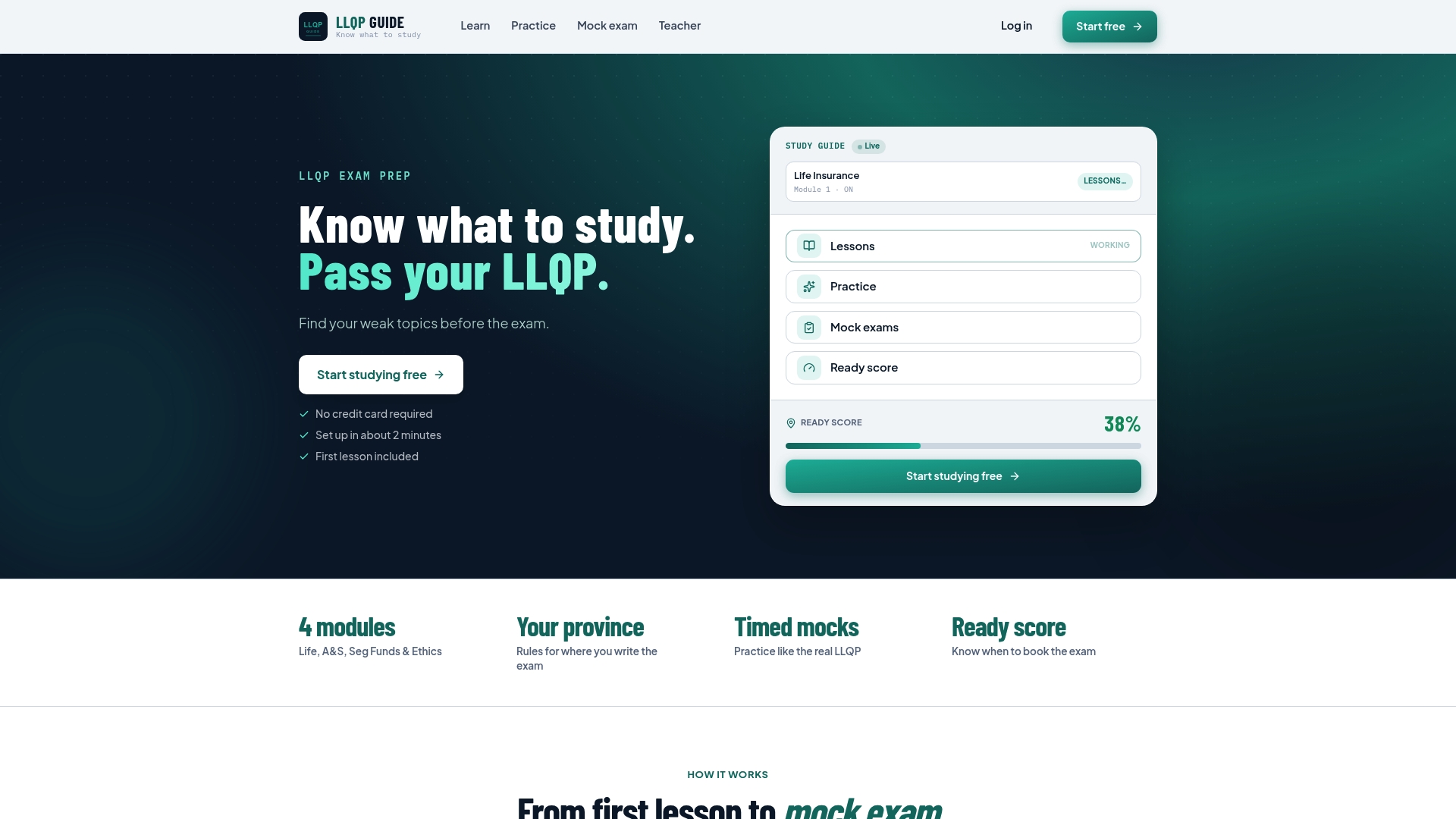
The readiness tracker shows you, module by module, where you are strong and where you need more work before booking your Durham College exam. That matters because writing the exam before you are ready costs you time and money, and a third failed attempt on any module means a three-month wait. Pair Llqpguide with your approved course provider’s materials and the official FSRA and Durham College resources for exam booking and licence applications.
Start with a free trial at Llqpguide and see your readiness score before you commit to a subscription. When you are ready to go deeper, view the full module library or check pricing options for monthly, quarterly, and annual access.
Sources
Bookmark these official resources before you start. Each one serves a specific task in your licensing journey.
- Life Licence Qualification Program (LLQP) | Financial Services Regulatory Authority of Ontario
- Durham College LLQP exam booking (Durham College SSBP)
- How to become a life insurance agent in Canada | Insurance Business
Always verify province-specific rules directly with your provincial regulator before submitting any application. Requirements change, and the regulator’s published page is the authoritative source.
Recommended
Frequently asked questions
How long does it take to study for the LLQP?
Most candidates need 80–100 hours of structured study across all four modules. A focused 6-week intensive plan or a 12-week part-time schedule both work, provided you include timed practice exams and do not skip Ethics.
How much does the LLQP course cost?
Course fees are set by individual providers and vary by format and province. Budget roughly $500–$1,500 for the course, plus Durham College exam fees per module, a provincial application fee, and E&O insurance (typically $400–$900 annually for new agents).
Is the LLQP hard to pass?
The exam is manageable with structured preparation, but the Ethics module catches many candidates off guard because it tests scenario-based judgment rather than simple rule recall. Candidates who use timed mock exams and targeted Ethics practice before booking their real exam consistently report better results.
Which providers offer LLQP courses in Canada?
The FSRA website publishes the current list of approved course providers. REMIC is one example of an approved provider that appears frequently in search results. Providers offer classroom, online instructor-led, and self-paced formats in English and French; fees and newcomer supports vary, so compare options before registering.
What happens if I fail an LLQP module multiple times?
After a third unsuccessful attempt on the same module, FSRA rules require a three-month waiting period before you can re-write it. Waiting periods increase after the fourth and subsequent failures. Factor this into your study timeline and do not book an exam module until your mock exam scores consistently show readiness.