LLQP mock exams: realistic practice for Canadian candidates
LLQP mock exams: realistic practice for Canadian candidates ! Hands starting timer for LLQP mock exam The best way to prepare for the LLQP is to combine official CISRO sample questions with timed, full-length, province-specific mock exams that replicate actual proctoring conditions.

LLQP mock exams: realistic practice for Canadian candidates
The best way to prepare for the LLQP is to combine official CISRO sample questions with timed, full-length, province-specific mock exams that replicate actual proctoring conditions. That combination does two things nothing else can: it confirms your study materials match the regulator’s curriculum, and it trains your brain to perform under the exact pressure of test day.
To replicate the real exam in your mocks, every practice session should mirror:
- Timing: 75 minutes per module, no extensions
- Question count: 20–30 multiple-choice questions per module
- Proctoring setup: camera on, government-issued ID ready, quiet room
- Open-book rules: the LLQP is open-book on electronic devices, so practise with your notes exactly as you will use them on exam day
- Province match: question framing and regulatory references vary by province, so use mocks built for your jurisdiction
Pro Tip: Run a diagnostic mock in your first week before you study anything. A cold score tells you exactly which modules need the most time, so you stop guessing and start planning.
Key takeaways
Combining official CISRO sample questions with timed, province-specific full-length mocks is the most reliable preparation strategy for passing the LLQP on the first attempt.
| Point | Details |
|---|---|
| Run a diagnostic mock first | A cold first mock reveals your weakest modules before you waste study time on strong ones. |
| Match the real exam format | Each module is 75 minutes, 20–30 MCQs, open-book, with a 69% to 78% passing threshold. |
| Use official CISRO samples | Mix official sample questions into every mock rotation to confirm curriculum alignment. |
| Simulate proctoring conditions | Camera, ID, and timed silence in your final mocks remove test-day surprises. |
| Use Llqpguide for full preparation | Province-specific mocks, unlimited quizzes, and readiness tracking in one Canadian platform. |
Table of Contents
- What CISRO official sample questions are and how to use them
- Where to find realistic full-length mock exams and practice banks in Canada
- What the LLQP exam format looks like and what your mocks must replicate
- How to use mock exams effectively: an 8–12 week study plan
- What mock questions look like by LLQP module
- Which practice formats work best at each stage of your preparation
- Why realistic mocks improve pass rates: the evidence
- A practical perspective on what actually goes wrong
- Llqpguide gives you the full mock experience in one place
- Sources
- FAQ
What CISRO official sample questions are and how to use them
CISRO, the Canadian Insurance Services Regulatory Organizations, publishes official sample exam questions for every LLQP module: Life Insurance, Accident & Sickness, Segregated Funds & Annuities, and Ethics & Professional Practice. These are not approximations. They are the closest public benchmark to what the actual exam looks like, written by the same body that sets the curriculum.
The practical value of the official samples is calibration. When you work through them, you learn the exact question style, the level of specificity expected, and which topics the regulator considers testable. A third-party mock that diverges sharply from this style is a red flag, regardless of how polished it looks.
Here is how to fold the official samples into your practice rotation:
- Use them first as a curriculum audit: map each sample question to a topic in your study notes. Any topic that appears in the samples but not in your notes is a gap.
- Mix official sample questions into your timed sets rather than saving them for a single sitting. Treating them as warm-up questions before a full-length mock keeps them fresh and contextual.
- After completing a timed set, compare your error patterns on official samples versus third-party questions. A higher error rate on official samples signals a curriculum alignment problem, not just a knowledge gap.
- Revisit the samples after each study phase, not just at the start. The questions that confused you in week one often reveal something different in week six.
Where to find realistic full-length mock exams and practice banks in Canada
Not all practice resources are equal, and the gap between a well-built mock and a poorly curated one can cost you a pass. Here is how the main source categories break down:
Official CISRO sample PDFs are free and authoritative but limited in volume. They confirm curriculum alignment; they do not give you the volume of repetitions needed to build fluency.
Provincial exam administration pages such as FSRA for Ontario and the Insurance Council of BC do not publish practice questions, but they do publish the rules your mock must replicate: timing, proctoring, ID requirements, and pilot question policies. Read these before you design your mock schedule.
Subscription platforms like Llqpguide offer the most complete simulation: province-specific lessons, unlimited practice quizzes, full-length timed mocks, readiness tracking, and in-lesson translation tools for 11+ languages. The key advantage over free resources is that the content is maintained against the current curriculum and structured around the actual exam format.
User-generated flashcard sets on platforms like Quizlet can be useful for quick drilling and spaced repetition, but quality varies significantly. Some sets contain outdated terminology or province-incorrect regulatory references. Use them for recall drills, not as a primary mock source.
Pro Tip: Before paying for any mock resource, check the publication or last-updated date against the current CISRO curriculum revision. An outdated mock can actively mislead you on regulatory details that the exam tests directly.
What the LLQP exam format looks like and what your mocks must replicate
Every mock you run should be built around the actual exam structure. The LLQP first-time pass rates for 2024 ranged from 69% to 78% across the five modules, which means between one in four and one in three first-time candidates did not pass. The format details below are what separate candidates who pass from those who need a second attempt.
A few details that most candidates miss until they read the Insurance Council of BC’s examination administration policy:
- Pilot questions are embedded in the exam and do not count toward your score. You cannot identify them during the exam, so do not try. Your mock should train you to answer every question at full effort.
- Open-book delivery: the LLQP is open-book, with your approved study materials accessible on an electronic device. Practise with your notes open in the same format you will use on exam day, or you are not simulating the real thing.
- Online vs. in-person proctoring: both options exist, and the ID and setup requirements differ. Check your provincial administration page before booking. Ontario candidates should consult FSRA’s licensing page; BC candidates should check the Insurance Council of BC.
- Results timing varies by province. Do not assume you will know your score immediately.
National first-time pass rates for the LLQP modules ranged from 69% to 78% in 2024, meaning a significant share of candidates sit the exam again. Timed, proctored mock practice is the most direct lever candidates control.
How to use mock exams effectively: an 8–12 week study plan
A mock exam you run without a review process is just a quiz. The score improvement comes from what you do after each attempt.
Step 1: Diagnostic mock (Week 1). Sit a full-length timed mock cold, before any structured study. Record your score per module. This is your baseline.
Step 2: Targeted module study (Weeks 2–6). Use your diagnostic scores to rank modules by weakness. Study the weakest module first. Run short timed sets of 20–30 questions per module after each study block to confirm retention. The Life Insurance and Accident & Sickness modules typically carry the most content weight, so budget more time there.
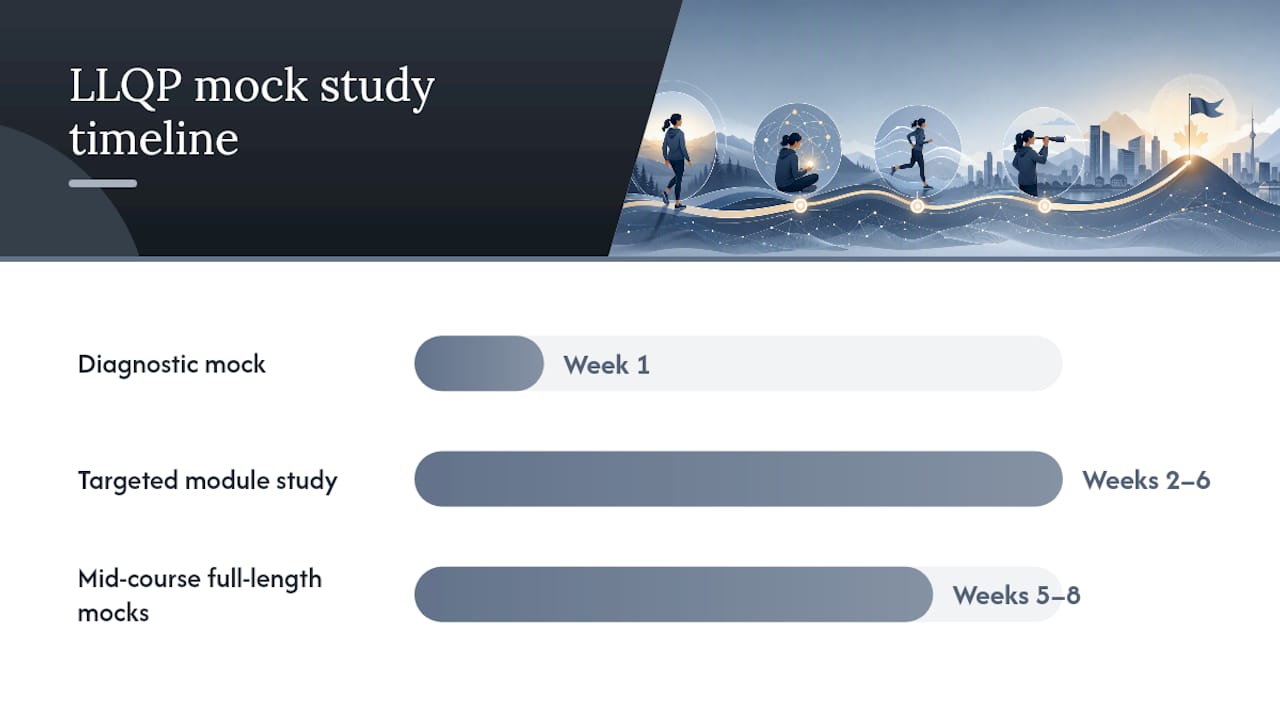
Step 3: Mid-course full-length mocks (Weeks 5–8). Run at least two full-length timed mocks during this phase, one module at a time. Compare scores to your diagnostic baseline.
Step 4: Error log and spaced repetition (ongoing). After every mock, tag each wrong answer by topic. Build a short list of your ten most-missed topics and run focused mini-quizzes on those topics every three days. Spaced repetition on your actual weak spots is more efficient than re-reading entire chapters.
Step 5: Final simulation week (Week 11–12). Run a full multi-module mock under exam conditions: camera on, ID visible, notes open on a device, 75 minutes per module, no interruptions. This is not about the score. It is about removing every logistical surprise before the real day.
- Aim for at least three full-length mocks total across your study period
- Short timed sets (20–30 questions) work best for mid-course pacing practice
- Review every wrong answer, not just the ones you flagged as uncertain
Pro Tip: During your final simulation, set up your space exactly as you will on exam day: same device, same notes format, same room if possible. Candidates who have done this once arrive at the real exam with a familiar routine rather than a new experience.
What mock questions look like by LLQP module
Understanding the question style for each module helps you practise more efficiently. The CSI LLQP curriculum describes the composition and weighting of each module, which should directly shape how you allocate mock time.
-
Life Insurance: Questions focus on needs analysis, policy types (term, whole life, universal life), beneficiary designations, and replacement rules. Expect scenario-based stems where a client’s situation is described and you must identify the most suitable product or action. Common distractors present technically correct facts that do not apply to the specific scenario.
-
Accident & Sickness: Questions cover disability definitions, group vs. individual benefits, underwriting principles, and claims handling. The reasoning approach here is to read the policy definition in the question carefully. Many wrong answers are correct in a different policy context.
-
Segregated Funds & Annuities: Contract features, maturity and death benefit guarantees, creditor protection, and basic taxation of annuity income are the core topics. Questions often test whether you understand the difference between a segregated fund and a mutual fund from a regulatory and client-protection standpoint. The Segregated Funds module page on Llqpguide covers these distinctions with targeted practice questions.
-
Ethics & Professional Practice: This module trips up more candidates than any other because the questions are not about memorising rules. They test your judgment about what a licensed agent should do in a specific situation. Provincial regulatory references matter here. Practise with province-specific ethics questions, not generic ones. The Ethics module on Llqpguide is built around provincial variations for exactly this reason.
Allocate study time roughly in proportion to module weighting and your diagnostic scores. Ethics is often underweighted by candidates who assume it is the “easy” module.
Which practice formats work best at each stage of your preparation
Different formats serve different purposes, and using the wrong one at the wrong stage wastes time.
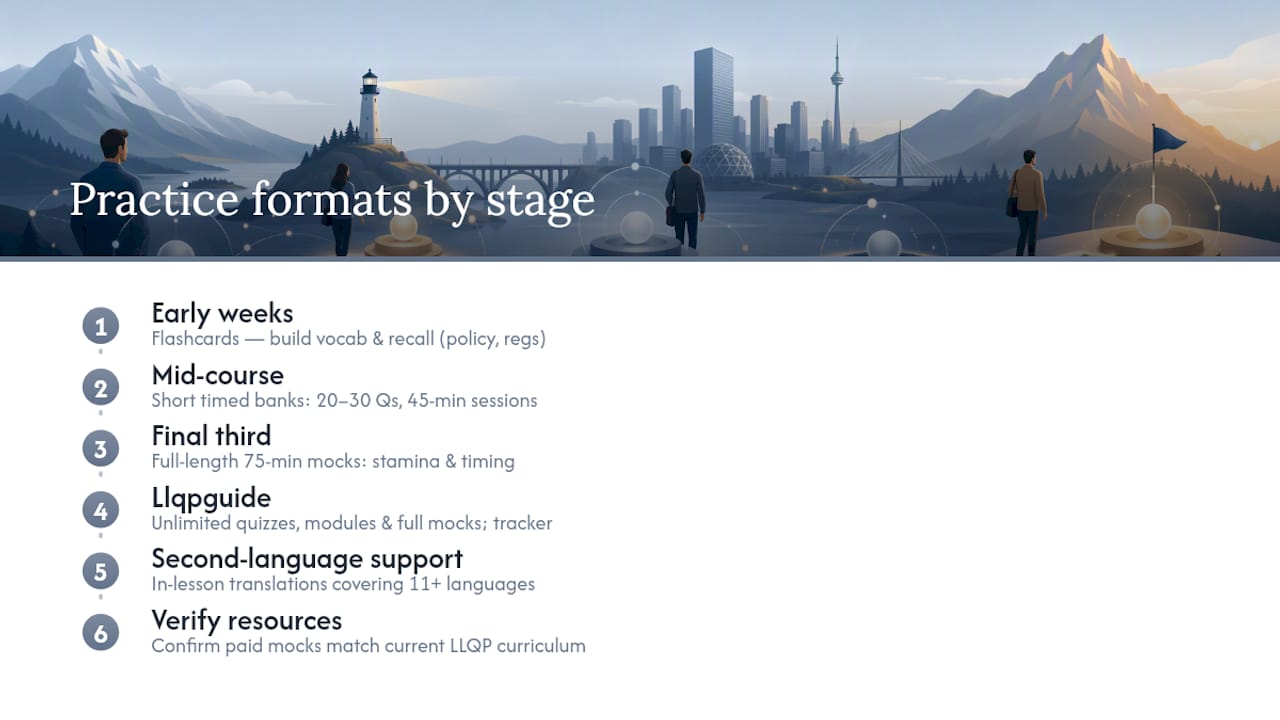
Flashcards (Quizlet, physical cards) are best in the early weeks for building vocabulary and recall on definitions: policy types, regulatory terms, benefit structures. They are not a substitute for scenario-based practice.
Short timed question banks (20–30 questions per session) are the workhorse of mid-course study. They build pacing, expose topic gaps quickly, and fit into a 45-minute study block. Run these after each study chapter.
Full-length timed mocks are for the final third of your preparation. They test stamina, time management across a full 75-minute module, and your ability to maintain focus when the questions get harder toward the end of the set.
Llqpguide combines all three formats in one platform: unlimited practice quizzes for drilling, full module resources for structured study, and full-length timed mocks that mirror the actual exam. The readiness tracker shows you which modules are exam-ready and which need more work, so you are not guessing about where to spend your final study hours. For candidates studying in a second language, the in-lesson translation tools cover 11+ languages, which removes a layer of cognitive load that can otherwise distort your practice scores.
Verify that any paid resource you use is current. The LLQP curriculum is updated periodically, and a mock built on an older version can test content that no longer appears on the exam or miss content that does.
Why realistic mocks improve pass rates: the evidence
The 2024 national first-time pass rates of 69%–78% across LLQP modules tell a clear story: a meaningful share of candidates sit the exam underprepared. The candidates who pass on the first attempt tend to share one habit: they practised under conditions that matched the real exam, not just the content.
The Insurance Council of BC’s administration policy details the proctoring environment candidates face: identity verification, camera monitoring, and strict timing. Candidates who have never experienced those constraints during practice often lose time managing the setup rather than answering questions.
Official CISRO sample questions are the best free benchmark for confirming your mock materials match the regulator’s expectations. Mixing them into your rotation, as described in the CISRO curriculum page, keeps your practice anchored to what the exam actually tests rather than what a third-party author assumed it tests.
A practical perspective on what actually goes wrong
The most common mistake candidates make is treating the LLQP like a reading comprehension test. They study the textbook, feel confident, and then underperform because they have never practised retrieving information under time pressure with a proctor watching.
A few patterns worth naming:
- Overreliance on untimed question banks. Answering 200 questions at your own pace builds familiarity, not exam readiness. Pacing is a skill, and it only develops under timed conditions.
- Skipping the Ethics module. Candidates consistently underestimate it. The questions are judgment-based and province-specific, which means generic study materials often miss the mark.
- Ignoring the open-book format. Practising with your notes closed is harder than the real exam, but it also trains the wrong skill. On exam day, you need to know how to find information quickly in your notes, not memorise it cold.
- Waiting too long to run a full-length mock. Candidates who run their first full mock in the final week have no time to act on what it reveals.
Progress on the LLQP is not linear. Your score on mock three will likely be lower than mock two if you just studied a hard module. That is normal. Deliberate practice, with honest review, compounds over weeks, not days.
Llqpguide gives you the full mock experience in one place
Passing the LLQP on your first attempt comes down to practising under real conditions, not just reading the material. Llqpguide is built specifically for Canadian LLQP candidates who want to walk into the exam knowing exactly what to expect.
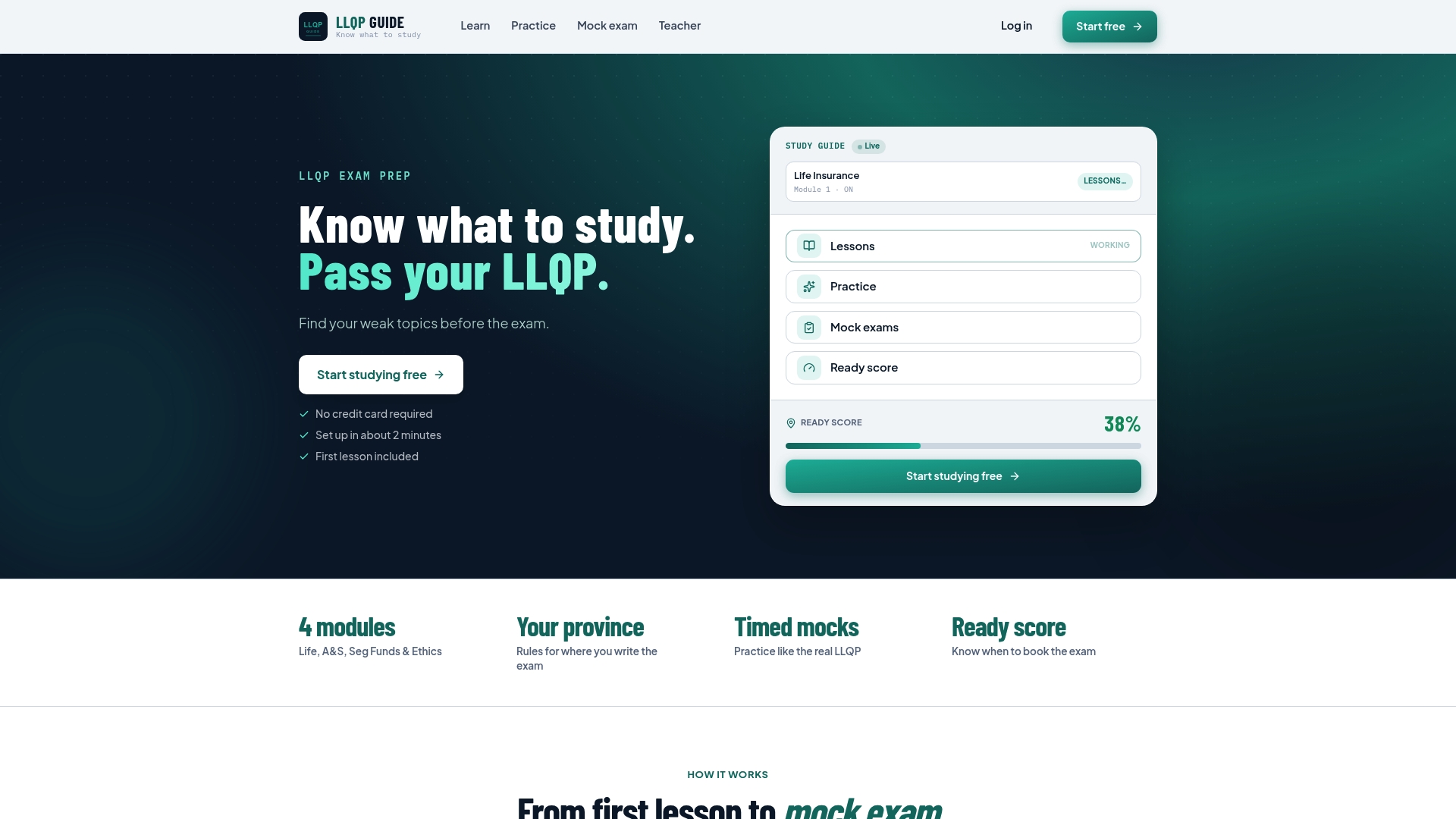
The platform covers all four modules with province-specific lessons, unlimited practice quizzes, and full-length timed mocks that mirror the actual exam format. The readiness tracker shows your score by module so you always know where to focus next. Translation tools in 11+ languages mean non-native English speakers can study the concepts without language barriers distorting their results. Candidates who have used Llqpguide report substantial score improvements between their first diagnostic mock and their final pre-exam simulation.
Start with a free trial at Llqpguide and run your first diagnostic mock today. Paid tiers unlock full access to all modules, quizzes, mocks, and study tools, with monthly, quarterly, or annual billing options to fit your timeline.
Sources
Official pages to bookmark before you register:
- LLQP first-time pass rates in 2024 released - Investment Executive
- Curriculum & Sample Exam Questions
- LLQP Examination Administration Policy (Insurance Council of BC)
- Life licence qualification program (LLQP) - FSRA
- Life Licence Qualification Program (LLQP) Curriculum | Canadian Securities Institute
Regulatory pages are updated periodically. Check the revision date on any official document before your exam date, particularly for provincial-specific rules that can change between sittings.
Recommended
Frequently asked questions
Is the LLQP exam hard to pass?
Consistent timed mock practice is the most direct way to improve those odds.
Is the LLQP exam proctored?
Yes. The LLQP is available as both an in-person and an online proctored exam, depending on your province. Online sittings require identity verification and camera monitoring throughout; check your provincial administration page for the specific requirements before booking.
How long does it take to study for the LLQP?
Most candidates prepare over 8–12 weeks, studying one module at a time. The timeline depends on your starting knowledge and how many modules you are sitting, but running a diagnostic mock in week one gives you a personalised baseline to plan from.
How many attempts are allowed for the LLQP exam?
Attempt limits and waiting periods between sittings are set by provincial regulators, not a single national rule. Check your province's exam administration policy (for example, the Insurance Council of BC or FSRA for Ontario) for the specific limits that apply to you.
How do LLQP mock exams differ from the real exam?
The real exam includes unscored pilot questions you cannot identify, is delivered open-book on an electronic device, and is administered under proctored conditions. A well-built mock from a platform like Llqpguide replicates timing, question style, and province-specific content; the main difference is the proctoring environment, which you can simulate yourself in your final preparation week.