Term certain annuity: what it is and how it works in Canada
Term certain annuity: what it is and how it works in Canada ! Hands exchanging sealed bank draft on desk A term certain annuity pays you a guaranteed, fixed income for a set number of years.

Term certain annuity: what it is and how it works in Canada
A term certain annuity pays you a guaranteed, fixed income for a set number of years. If you die before the term ends, a named beneficiary or your estate receives the remaining payments. The Financial Consumer Agency of Canada is explicit: once the term expires, payments stop entirely, which means you bear the risk of outliving your income.
- Unlike a life annuity, payments are not tied to how long you live. The contract runs for a fixed period regardless of your age or health.
- Common terms range from a few years to age 90, with 5, 10, and 20-year contracts being typical in the Canadian market.
- Main trade-offs: predictable payments and beneficiary protection on the upside; longevity risk and no inflation guarantee on the downside unless you add indexing.
Major Canadian insurers such as RBC Insurance and Sun Life offer term certain products, and the product category is covered in the Segregated Funds & Annuities module of the LLQP exam. If you are studying for that exam, Llqpguide’s annuities module covers the mechanics in exam-ready detail.
Key takeaways
A term certain annuity guarantees fixed payments for a set number of years and passes remaining payments to a named beneficiary if the annuitant dies before the term ends.
| Point | Details |
|---|---|
| Payments are fixed and guaranteed | The insurer locks in your payment at purchase; market changes do not affect it. |
| Longevity risk is the primary gap | Payments stop at term end, so you need a separate income plan for after the term. |
| Beneficiary protection is built in | A named beneficiary receives remaining payments or a lump sum, bypassing probate. |
| Tax treatment depends on funding source | RRSP/RRIF-funded annuities are fully taxable; non-registered annuities may qualify for prescribed tax treatment. |
| Llqpguide covers annuity exam content | The Segregated Funds & Annuities module prepares LLQP candidates on product mechanics, taxation, and suitability. |
Table of Contents
- What is a term certain annuity, and how does it differ from a life annuity?
- How payments, pricing, and funding work
- What options can you add, and what happens if you die mid-term?
- Advantages and disadvantages of a term certain annuity
- Who typically uses term certain annuities?
- How to buy a term certain annuity in Canada
- How are term certain annuity payments taxed in Canada?
- A worked example: 10-year term certain annuity
- Red flags, insurer solvency, and what to check in the contract
- A perspective on term certain annuities worth considering
- Preparing to advise on annuities? Llqpguide covers the exam content
- Sources
- FAQ
What is a term certain annuity, and how does it differ from a life annuity?
A term certain annuity is a contract between you and a life insurance company. You hand over a lump sum (the premium), and the insurer pays you a fixed income for a chosen number of years. The FCAC’s definition is precise: income is guaranteed for the fixed period, and if you die mid-term, the remaining payments pass to your named beneficiary or estate.
A life annuity works differently. Payments continue for as long as you live, no matter how long that is. That longevity protection comes at a cost: RBC Insurance notes that term certain structures generally produce higher periodic payments than lifetime annuities for the same premium, precisely because the insurer’s obligation ends at a defined date.
| Feature | Term certain annuity | Life annuity |
|---|---|---|
| Duration | Fixed number of years | Annuitant’s lifetime |
| Beneficiary outcome | Remaining payments or lump sum to beneficiary | Payments stop at death (unless joint or guaranteed period added) |
| Typical payout size | Higher per period for same premium (short term) | Lower per period; insurer absorbs longevity risk |
| Primary risk | Longevity risk (outliving the term) | Inflation risk over a long life |
The core decision comes down to one question: do you need income for a defined window, or do you need it for life? Term certain products suit the former; life annuities suit the latter.
How payments, pricing, and funding work
The insurer sets your payment amount at the time of purchase, and it does not change unless you add indexing. Several factors drive the calculation:
- Purchase price (premium): a larger lump sum produces larger payments.
- Term length: spreading the same premium over more years lowers each payment.
- Prevailing interest rates: higher rates at purchase mean higher payments; you lock in whatever rate applies on the day you buy.
- Indexing: adding cost-of-living protection reduces the initial payment in exchange for increases over time.
- Refund or guarantee options: adding a death benefit or refund feature slightly reduces the base payment.
BMO Insurance explains that each payment is a blend of principal return and interest, and the total remains fixed throughout the term. You can receive payments monthly, quarterly, or annually depending on the contract.
Funding sources in Canada include non-registered lump sums, RRSP or RRIF transfers, and in some cases TFSA funds. Transferring RRSP or RRIF money directly to an annuity is a registered rollover; the insurer handles the paperwork with your financial institution, and no tax is withheld at transfer provided the funds move directly. Non-registered money can also fund an annuity, but the tax treatment differs (covered in the tax section below).
What options can you add, and what happens if you die mid-term?
Term length and standard options
Most Canadian insurers let you choose a term in whole years, a term to a specific age (commonly age 90), or a fixed period such as 5, 10, 15, or 20 years. Sun Life, for example, presents these choices alongside optional indexing tied to the Consumer Price Index, which protects purchasing power at the cost of a lower starting payment. RBC Insurance similarly offers guaranteed-period structures that can be layered onto a life annuity or used as a standalone term certain contract.
Common add-on options include:
- Indexing: payments increase annually by a fixed percentage or CPI, reducing inflation risk.
- Joint-and-survivor extension: payments continue to a spouse after your death for the remainder of the term.
- Refund or guaranteed-period feature: if you die early, the estate or beneficiary receives a lump sum equal to the remaining balance.
- Conversion option: some contracts allow conversion to a life annuity at term end, though this is not universal.
Beneficiary mechanics
If you die before the term ends, the contract does not simply terminate. A named beneficiary receives either the remaining scheduled payments or, if the contract allows, a lump sum equal to the discounted present value of those payments. Equitable’s annuity settlement option materials document a related strategy: death benefit proceeds can be used to purchase an annuity that pays beneficiaries over a chosen number of years rather than as a single lump sum, which helps beneficiaries manage a large inheritance gradually.

Pro Tip: Name a contingent beneficiary as well as a primary one. If the primary beneficiary predeceases you, an unnamed contingency means the balance flows through your estate and loses the probate bypass that a direct beneficiary designation provides.
| Option | Effect on payment | Best for |
|---|---|---|
| Indexing (CPI-linked) | Lower starting payment; increases annually | Long terms where inflation is a concern |
| Joint-and-survivor | Slightly lower payment; continues to spouse | Couples with shared income needs |
| Guaranteed refund | Slightly lower payment; estate gets balance | Buyers concerned about early death |
| No options (plain term) | Highest starting payment | Short-term bridging with named beneficiary |
Advantages and disadvantages of a term certain annuity
Pros
- Payments are guaranteed and predictable, regardless of market conditions.
- Named beneficiaries receive the balance if you die early, bypassing probate in most cases.
- Useful for time-limited goals: bridging income, funding education, or covering a defined expense window.
- Higher per-period payments than a life annuity for the same premium when the term is short.
Cons
- Payments stop at term end. The FCAC is direct about this: if you outlive the term, you have no income from this contract.
- No inflation protection unless you pay for indexing, which reduces the initial payment.
- You give up access to your principal once you purchase; there is no cash surrender value in most contracts.
- Not suitable as a sole retirement income source for someone with a long life expectancy.
A term certain annuity makes the most sense when you have a specific income window in mind and a separate plan for income after the term. For open-ended retirement income, a life annuity or a RRIF drawdown strategy usually fits better. A GIC offers similar predictability but does not provide the same beneficiary-bypass or structured payout features.
Who typically uses term certain annuities?
The product suits people with a defined income gap rather than a lifetime income need. Common use cases:
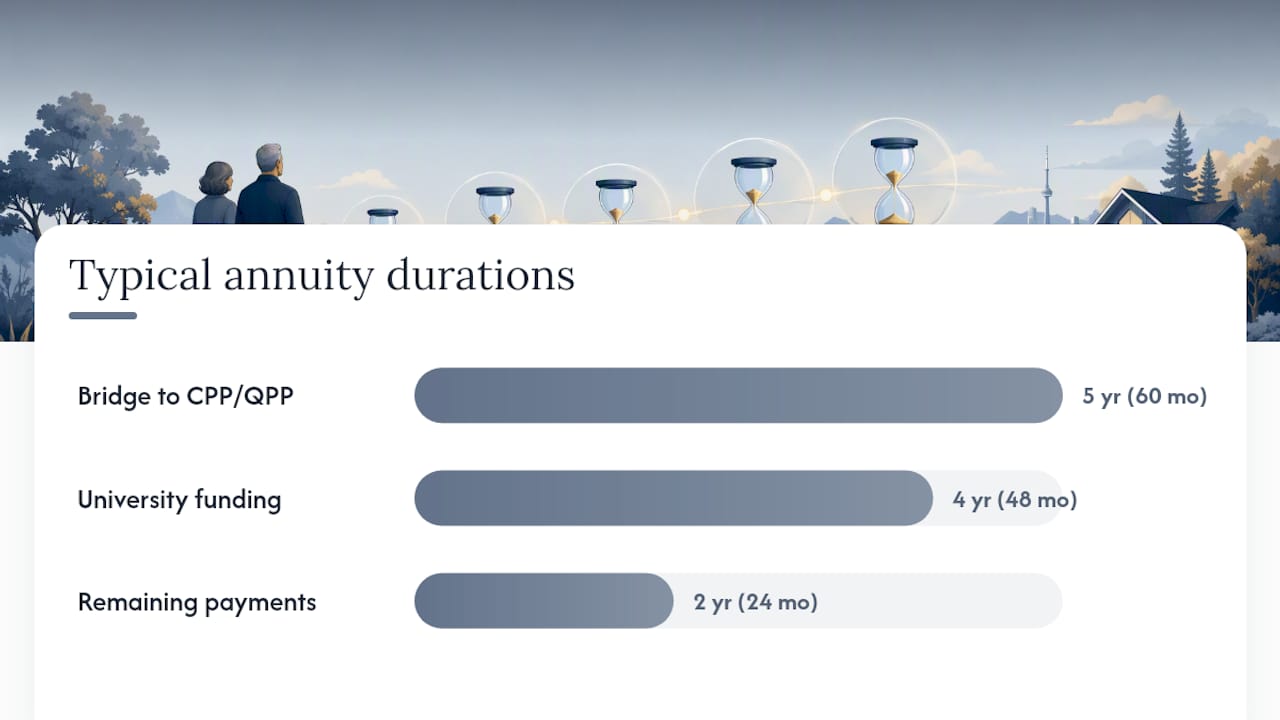
- Bridging income: retiring at 60 but CPP/QPP does not start until 65. A 5-year term certain annuity fills that gap cleanly.
- Education funding: a parent or grandparent buys a 4-year annuity to cover undergraduate tuition and living costs. The payments arrive on a predictable schedule, matching the academic calendar.
- Gradual inheritance: using an annuity settlement option to spread a death benefit over several years for a beneficiary who may not be equipped to manage a large lump sum.
- Fixed short-term expenses: covering mortgage payments, a care facility cost, or a business transition over a known number of years.
Consider a practical scenario: a parent purchases a term certain annuity with a $60,000 premium to fund four years of university costs for their child. The contract pays approximately $1,400 per month for 48 months. The child receives predictable monthly support; if the parent dies in year two, the remaining 24 months of payments continue to the named beneficiary.
Statistics Canada’s demographic data shows Canada’s population is ageing, which makes bridging products increasingly relevant for households managing the gap between early retirement and government benefit eligibility. For advisors working with clients in this demographic, understanding individual insurance planning alongside annuity options helps frame the full picture.
How to buy a term certain annuity in Canada
Step-by-step buying checklist
- Define your income need: how much per month, for how many years, and when payments must start.
- Choose your funding source: non-registered savings, RRSP/RRIF transfer, or TFSA (if permitted by the insurer).
- Get quotes from at least two or three insurers: rates vary meaningfully by insurer and by the day’s interest rate environment.
- Compare the quote assumptions: ask each insurer what interest rate and mortality table they used. A quote is only as reliable as its assumptions.
- Confirm beneficiary designation: name a primary and contingent beneficiary in writing.
- Review the contract for refund and surrender provisions: some contracts have no surrender value; others allow a commuted value payout under specific conditions.
- Complete the transfer documentation: for RRSP/RRIF funds, your financial institution and the insurer coordinate the direct transfer to avoid tax withholding.
- Confirm regulatory protections: verify the insurer is licensed in your province and check Assuris coverage (see the risks section below).
Questions to ask your advisor or insurer
- How is my monthly payment calculated, and what assumptions drive that number?
- What fees, if any, reduce the quoted payment?
- What happens to my payments if I die in year three of a ten-year term?
- Is indexing available, and what does it cost in terms of the starting payment?
- Is this quote guaranteed, and for how long?
Licensed advisors selling annuities in Canada must hold an LLQP licence. If you are working with an advisor, confirm their licence status through your provincial regulator. Llqpguide’s life insurance module covers the regulatory framework advisors must understand before recommending these products.
How are term certain annuity payments taxed in Canada?
Tax treatment depends on how you funded the annuity.
| Funding source | Tax treatment of payments |
|---|---|
| Non-registered (personal savings) | Only the interest portion is taxable; principal return is tax-free. Prescribed annuity rules can spread the taxable portion evenly over the term. |
| RRSP or RRIF transfer | Fully taxable as income in the year received; no return-of-capital component since contributions were pre-tax. |
| TFSA | Payments are generally tax-free, provided the annuity is a qualifying arrangement under the TFSA rules. |
Prescribed vs non-prescribed annuities: a prescribed annuity (funded with non-registered money) blends the taxable and non-taxable portions evenly across all payments, which smooths the tax hit. A non-prescribed annuity front-loads the interest (taxable) portion in early years, which can push you into a higher bracket early in the term. For most retirees using non-registered funds, the prescribed treatment is more tax-efficient.
CRA guidance on line 31400 explains when annuity income qualifies for the pension income amount, which can reduce federal tax owing. Annuity payments from an RRSP or RRIF typically qualify; non-registered annuity payments may qualify depending on the annuitant’s age and the contract type.
Consult a tax professional before purchasing. The prescribed annuity rules involve specific eligibility conditions, and the interaction with OAS clawback thresholds or provincial credits can affect your net income meaningfully.
A worked example: 10-year term certain annuity
This example uses fictional numbers for illustration only. Get insurer quotes for actual figures.
Assumptions
- Premium (lump sum): $100,000
- Term: 10 years (120 months)
- Assumed annual interest rate: 4.5%
- No indexing; no refund option; payments monthly
Calculated monthly payment (illustrative): approximately $1,036 per month.
Total payments over 10 years: approximately $124,320, of which roughly $24,320 represents interest and $100,000 is return of principal (non-registered funding scenario).
Sensitivity
- If the term shortens to 5 years at the same rate: monthly payment rises to approximately $1,862 (same premium, fewer months).
- If the assumed rate drops to 3.0%: the 10-year monthly payment falls to roughly $966.
- Adding 2% annual indexing: starting payment drops to approximately $940 per month, but by year 10 the monthly payment has grown to roughly $1,145.
The indexing trade-off is worth noting: you give up roughly $96 per month at the start to gain inflation protection over the full term. Whether that is worth it depends on how long the term is and your other income sources.
These figures are illustrative only. Actual payments depend on the insurer’s rate, mortality assumptions, and contract terms. Always request a formal quote.
Red flags, insurer solvency, and what to check in the contract
Most term certain annuity contracts are straightforward, but a few contract features deserve close scrutiny before you sign.
Watch for these red flags:
- Vague beneficiary language that does not clearly name who receives payments and in what form (lump sum vs. continued payments).
- Indexing promises with hidden caps (e.g., “up to CPI” with a 2% ceiling that is buried in the fine print).
- No written disclosure of the interest rate and mortality table used to calculate your quote.
- Surrender provisions that impose steep penalties or offer no commuted value if your circumstances change.
- Fees or administration charges that are not itemised in the quote.
Insurer solvency: annuities are long-term contracts, so the insurer’s financial stability matters. In Canada, Assuris is the industry-funded protection body that covers policyholders if a member life insurer fails. Verify that your insurer is an Assuris member before purchasing.
Provincial insurance regulators (such as FSRA in Ontario or AMF in Québec) maintain public registers of licensed insurers. Checking that register takes two minutes and confirms the company is authorised to sell in your province.
Before signing any annuity contract, ask the insurer for an illustrative payoff table showing your scheduled payments, the interest component, and the remaining balance for each year of the term. If they cannot or will not provide it, that is a signal to keep shopping.
A perspective on term certain annuities worth considering
The conventional framing of term certain annuities as a “safe, boring” product undersells one of their most practical features: certainty of delivery to a beneficiary. Most retirement income tools are designed around the annuitant’s life. A term certain annuity is one of the few that explicitly plans for the possibility of early death and keeps the income flowing to someone else without probate delay.
Where people go wrong is treating it as a complete retirement income solution. It is not. The longevity risk is real: Statistics Canada’s life expectancy tables show that a 65-year-old Canadian can expect to live well into their 80s on average. A 10-year term certain annuity purchased at 65 runs out at 75, which is still a decade or more short of a realistic planning horizon for many people.
The smarter use is pairing it with something else: a life annuity for baseline income, a RRIF for flexibility, or CPP/OAS as the longevity backstop. The term certain product fills a defined gap; it does not replace a full income plan.
Three things to do before you commit:
- Match the term length to a specific, named income need, not a vague “I might need money for a while.”
- Confirm exactly what your beneficiary receives and in what form, in writing, before signing.
- Compare the after-tax payout against a GIC ladder or RRIF drawdown for the same period. The annuity wins on simplicity and beneficiary mechanics; the alternatives sometimes win on flexibility and tax efficiency.
For advisors or LLQP students who want to understand annuity mechanics at the exam level, Llqpguide’s segregated funds and annuities module covers the product rules, taxation, and suitability questions you will encounter on the exam.
Preparing to advise on annuities? Llqpguide covers the exam content
Advisors who recommend term certain annuities in Canada must hold an LLQP licence, and the product knowledge required goes beyond a basic definition. Llqpguide’s exam prep platform covers the Segregated Funds & Annuities module in full, alongside Life Insurance, Accident & Sickness, and Ethics & Professional Practice.

The platform combines structured lessons, unlimited practice quizzes, and full-length mock exams designed to match real LLQP exam conditions. If English is not your first language, built-in word translation tools cover 11+ languages so the product concepts land clearly. Candidates who use Llqpguide consistently report meaningful score improvements before test day.
If you are preparing to advise clients on annuities, GICs, or segregated funds, start your LLQP prep at Llqpguide and work through the modules at your own pace.
Sources
- Canada
- Teach students to budget with a term certain annuity - BMO Insurance
- What is an Annuity and How Does it Work? | RBC Insurance
- 1514 Gradual inheritance strategy
This article is general information, not a substitute for advice from a qualified financial advisor. Consult a qualified financial professional about your own circumstances before acting on anything here.
Recommended
Frequently asked questions
What is a term certain annuity in Canada?
A term certain annuity is a contract where an insurer pays you a guaranteed fixed income for a chosen number of years. If you die before the term ends, remaining payments go to your named beneficiary or estate.
How is a term certain annuity different from a life annuity?
A life annuity pays for as long as you live; a term certain annuity pays only for the fixed term. Term certain contracts typically produce higher per-period payments for the same premium when the term is short, but they expose you to longevity risk once the term ends.
Are term certain annuity payments taxable in Canada?
It depends on the funding source. Payments from RRSP or RRIF transfers are fully taxable as income. Payments from non-registered funds are only partially taxable (the interest portion), and a prescribed annuity arrangement spreads that taxable portion evenly over the term.
What happens to my annuity if I die before the term ends?
Your named beneficiary receives the remaining payments on schedule or, if the contract allows, a lump sum equal to the discounted value of those payments. Naming a beneficiary directly also bypasses probate in most provinces.
How long can a term certain annuity term be?
Terms typically range from a few years up to age 90, with several-year contracts being common in the Canadian market. The right term depends on the specific income gap you are trying to fill.