Policy riders on the LLQP exam: what candidates must know
Policy riders on the LLQP exam: what candidates must know ! Hands arranging insurance rider option cards A rider is an optional provision added to a life insurance policy that modifies, expands, or targets coverage for a specific client need, and it usually costs extra.

Policy riders on the LLQP exam: what candidates must know
A rider is an optional provision added to a life insurance policy that modifies, expands, or targets coverage for a specific client need, and it usually costs extra. On the LLQP exam, the winning strategy is simple: read the scenario, pull out the client’s need and timeframe, then pick the rider that solves that exact need without adding coverage nobody asked for.
Two examples make this concrete. If a client wants their policy to stay in force even if they become disabled and can’t work, that’s a waiver of premium rider, not a bigger death benefit. If a young client wants the right to buy more coverage later without a medical exam, that’s guaranteed insurability, not a new policy altogether.
- Waiver of premium → solves an income/disability problem, not a death benefit problem
- Guaranteed insurability → solves a future underwriting problem, not an immediate coverage gap
- Accidental death benefit → solves a specific-cause-of-death payout, not general mortality risk
Pro Tip: Exam writers love pairing a rider name with the wrong client need. If the scenario mentions disability, waiver of premium is almost always the answer, even when three other rider names appear in the choices.
Key Takeaways
Matching a client’s stated need and timeframe to the rider that solves it precisely, without duplicating existing coverage, is the core skill the LLQP tests on this topic.
| Point | Details |
|---|---|
| Define riders correctly | A rider is an optional, paid provision that modifies or expands base life coverage for a specific need. |
| Know the core six | Waiver of premium, guaranteed insurability, accidental death benefit, term riders, accelerated death benefit, and paid-up additions cover most exam content. |
| Read the wording, not the label | Exam distractors hide in waiting periods, definitions of disability, and exclusion clauses, not in the rider’s name. |
| Use the elimination method | Extract the need, note underwriting constraints, match the mechanism, then eliminate any option that over-insures. |
| Practise with LLQPGuide | The Life Insurance module pairs rider lessons with unlimited quizzes and readiness tracking to target this exact topic. |
Table of Contents
- What are the common life insurance riders tested on the LLQP?
- How do you match a scenario to the correct rider on the exam?
- Sample LLQP practice questions on policy riders
- Rider vs endorsement: the wording trap that catches candidates
- How LLQPGuide helps you master rider questions
- What conventional LLQP study advice gets wrong about riders
- Start with the module that covers riders directly
- Sources
- FAQ
What are the common life insurance riders tested on the LLQP?
The LLQP draws its rider content from a fairly predictable list, and Canada Life’s own explainer of common riders covers most of what shows up on the exam. Knowing what each rider does, and where the exam likes to trip you up, is most of the battle.
- Waiver of premium. This rider waives premium payments if the policyholder becomes totally disabled, according to the policy’s specific definition. Watch for two things: a waiting period (often 90 or 180 days) before the waiver kicks in, and the exact definition of “total disability” used in the contract. Exam questions often test whether the disability meets the policy’s threshold, not just whether the person is unwell.
- Guaranteed insurability option (GIO). This lets the insured buy additional coverage at specified future dates or life events, such as marriage or the birth of a child, without new medical underwriting. The exam commonly tests age limits (coverage options often stop by a certain age) and the specific triggering events listed in the contract.
- Accidental death benefit (ADB). This pays an additional death benefit if death results from an accident, as defined by the policy. The trap here is causation language: most contracts exclude deaths connected to pre-existing conditions, certain high-risk activities, or a death that occurs outside a stated time window after the accident.
- Term rider (and spousal/child term riders). A term rider adds temporary coverage, often on a spouse or child, under the parent policy rather than requiring a separate contract. These riders usually carry conversion rights, letting the insured switch to permanent coverage without new underwriting, and they typically expire at a stated age or policy anniversary. Exam questions frequently test whether the conversion privilege still applies after a stated cutoff.
- Accelerated death benefit / critical illness rider. This allows early access to a portion of the death benefit if the insured is diagnosed with a qualifying critical or terminal illness. The distractor here is scope: these riders pay out early against the same death benefit, they don’t add a separate lump sum on top of it.
- Paid-up additions rider. Common on permanent policies, this uses dividends or extra payments to buy small amounts of additional paid-up coverage, increasing both the death benefit and cash value over time.
Term riders tend to attach to term policies for cost-effective temporary needs, while paid-up additions and some accelerated benefit riders show up more on permanent, participating policies. Rider premiums add to the base cost, and most riders require some form of underwriting, even a simplified version, at the time they’re added.
How do you match a scenario to the correct rider on the exam?
Under time pressure, guessing rider names from memory fails. A repeatable method beats memorization every time.
- Extract the need and the timeframe. Is the client worried about disability, premature death, a future insurability gap, or paying for coverage they’ll only need for a set number of years? Underline the need in your head before you look at the answer choices.
- Note any underwriting or age/event constraints in the stem. If the question mentions “without new medical evidence” or “at a specific life event,” that’s pointing you toward guaranteed insurability, not a generic add-on.
- Match the rider’s actual mechanism to the need. Does the correct answer waive a premium, pay an extra benefit, or grant a future purchase option? The mechanism has to line up exactly with what the client wants, not just sound related.
- Eliminate any answer that duplicates existing coverage. If the base policy already covers the stated risk, adding a rider that does the same thing is over-insurance, and the LLQP exam blueprint from Mastery Exam Prep specifically flags this as a tested skill: picking the rider that solves the stated need without over-insuring.
Pro Tip: Build a two-column mental table before you answer: “what the client fears” on one side, “what the rider actually does” on the other. If they don’t match word for word, keep scanning the other choices.
A fast checklist for multiple-choice elimination: cross out any option naming a rider tied to the wrong risk category (disability rider for a death-benefit question), cross out any option that requires new underwriting when the stem says “guaranteed,” and cross out anything that adds permanent coverage when the client explicitly asked for something temporary.
Sample LLQP practice questions on policy riders
Try these before reading the rationale. They mirror the phrasing and distractor patterns you’ll see on exam day, informed by how LLQP-style question banks structure their distractors around waiting periods, conversion rights, and exclusions.
-
A 32-year-old client wants her life insurance premiums covered automatically if she becomes unable to work due to illness. Which rider addresses this need? A) Guaranteed insurability B) Waiver of premium C) Accidental death benefit D) Paid-up additions
The correct answer is B. The client’s stated need is continued coverage during a period of disability, which is exactly what waiver of premium solves. Guaranteed insurability solves a future purchase problem, not an income interruption problem, and that’s the distractor most candidates fall for.
-
A client wants the right to buy additional coverage at age 30 without a new medical exam. This rider was added when the policy was issued at age 25. Which best describes this provision? A) An endorsement added mid-term B) A guaranteed insurability option added at issue C) A term rider requiring conversion D) A waiver added after underwriting
The answer is B. Guaranteed insurability options are set at issue with pre-defined future purchase dates, and no new underwriting applies at exercise.
-
A policyholder’s insurer adds a rider two years after issue, following new underwriting. Which statement is most accurate? A) Riders can never be added after issue B) Most riders are added at issue, but some can be added later subject to insurability C) All riders require identical underwriting at any time D) Adding a rider later voids the base policy
The answer is B. Most riders attach at issue, but certain riders can be added later if the insurer agrees and new underwriting is satisfied, a nuance the exam likes to test directly.
-
A term insurance policy already provides a $250,000 death benefit. The client adds a rider that pays an extra $50,000 if death results from a car accident. Which rider is this? A) Waiver of premium B) Accelerated death benefit C) Accidental death benefit D) Guaranteed insurability
The answer is C. The mechanism (extra payout tied to accidental cause of death) matches accidental death benefit exactly, while the other three riders solve entirely different problems.
Rider vs endorsement: the wording trap that catches candidates
Canadian insurance terminology splits the word “rider” from “endorsement” by product line more than by function. Rates notes that “rider” is the common term in life and health insurance, while “endorsement” dominates property and casualty policies, yet both perform the same job: formally amending the base contract.
- Both a rider and an endorsement change what the base policy covers, when it pays, or how much it pays.
- The LLQP tests the life and health side almost exclusively, so “rider” is the term you’ll see in nearly every scenario.
- Exam writers rarely test the label itself. They test the wording inside the provision, things like waiting periods, definitions of disability, or exclusion clauses.
- Always scan the stem for limiting language: “after a waiting period of,” “excluding self-inflicted,” “only if diagnosed before age,” and similar phrases usually point straight to the correct or incorrect answer.
Most riders attach to a policy at issue, but a smaller set can be added later if the insurer agrees and new underwriting is satisfied. When a question describes a rider added after the policy has been in force for years, don’t assume that’s automatically wrong. Read whether new evidence of insurability was mentioned. If it was, the scenario is describing a legitimate, if less common, path.
How LLQPGuide helps you master rider questions
Riders reward structured repetition more than raw memorization, and that’s exactly what a study platform should be built around. The Life Insurance module on LLQPGuide breaks riders into short lessons paired with unlimited practice quizzes, so you’re not rereading a static list, you’re actively applying it to new scenarios until the pattern sticks.
- Short video and podcast lessons cover each rider’s mechanism and its most common exam distractor.
- Unlimited quizzes let you drill rider scenarios repeatedly until the need-to-rider match becomes automatic.
- Readiness tracking flags whether riders specifically are a weak area before you sit the real exam.
- In-lesson translation tools support candidates studying in a second language, useful given how much of this topic hinges on precise wording.
Pro Tip: If your quiz results show you missing waiver of premium and guaranteed insurability questions specifically, don’t just retake the same quiz. Reread the provision wording for each, then attempt a fresh set of practice questions before moving on.
What conventional LLQP study advice gets wrong about riders
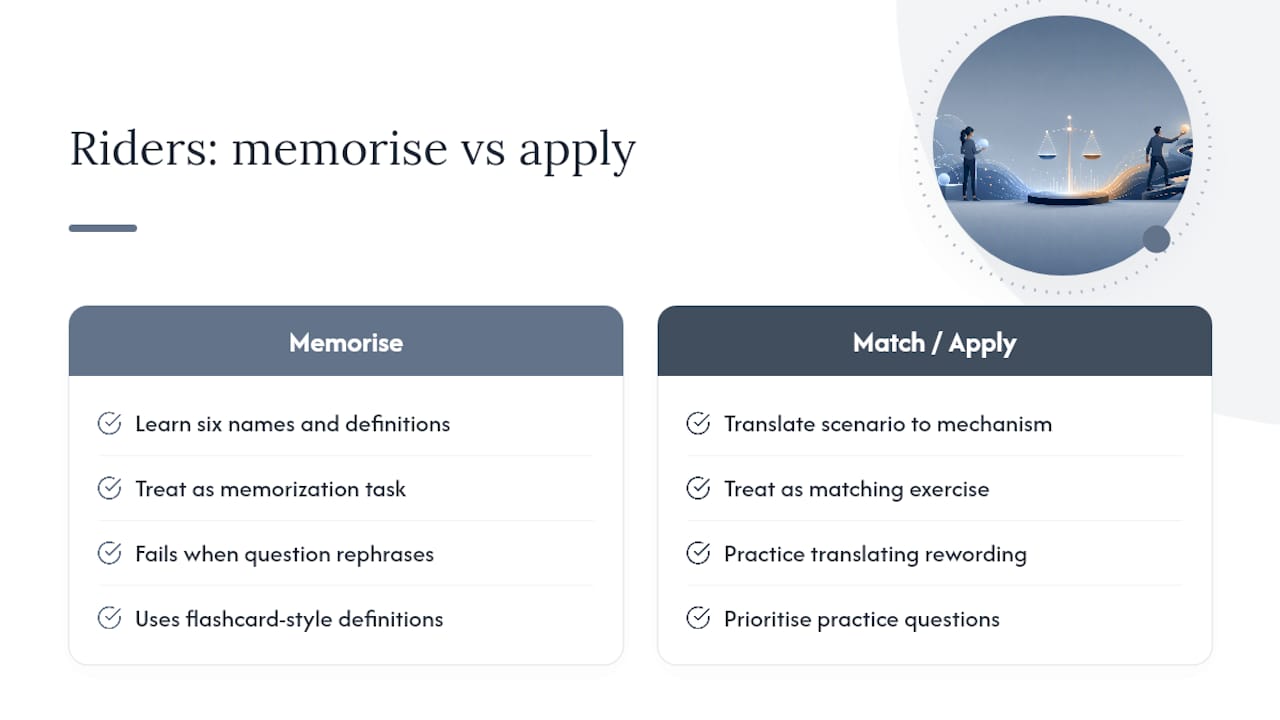
Most study guides treat riders as a memorization task: learn six names, learn six definitions, done. That approach falls apart the moment a question rephrases a rider’s mechanism instead of naming it outright, which is exactly how the LLQP tends to test this topic.
The better approach treats riders as a matching exercise between a stated client need and a specific contractual mechanism. Candidates who drill definitions in isolation freeze when a question describes “a provision that lets the insured purchase more coverage at a future date without new medical evidence” instead of just saying “guaranteed insurability.” Candidates who practise translating scenarios into mechanisms first read straight through that kind of rewording.
If you take one thing from this article, prioritize practice questions over flashcard-style definitions. Definitions get you partway there, but application under exam conditions is what actually separates a pass from a retake. Riders are a small slice of the exam blueprint, but they’re a slice examiners use specifically to test whether you can apply knowledge, not just recall it.
Start with the module that covers riders directly
You don’t need to relearn every module to fix a rider weak spot. Start with the Life Insurance module, where riders and supplementary benefits get their own lessons paired with unlimited practice quizzes built around exactly the kind of need-to-rider matching this exam rewards.

A practical routine looks like this: work through the rider lessons first, then hit the targeted quizzes until your accuracy on rider questions climbs past your average across other topics, then sit a full mock exam under timed conditions to see how rider questions perform when mixed with everything else. LLQPGuide offers a free starter trial, so you can test this routine on the main platform before committing to a paid plan. If your quiz analytics show riders as a consistent weak point, that’s your cue to loop back through the lesson content rather than pushing forward blind. Candidates studying for a provincial sitting can also check the Ontario-specific guidance or the British Columbia guidance for any regional booking details. Sign up, run the diagnostic, and let the readiness tracker tell you exactly where riders sit in your study plan.
Sources
For wording you can trust and practice you can repeat, these sources cover the ground this article draws from:
Recommended
Frequently asked questions
Is the LLQP hard to pass?
The LLQP is challenging because it covers four distinct modules with dense terminology, but candidates who practise scenario-based questions, especially on nuanced topics like riders, tend to perform far better than those who rely on passive reading alone.
Which insurance licence is hardest to get in Canada?
Difficulty varies by province and by how much time a candidate dedicates to practice questions rather than passive study; the LLQP's four-module structure, covering life insurance, accident and sickness, segregated funds and annuities, and ethics, makes it one of the more demanding entry-level licences to prepare for properly.
How long does it take to prepare for and pass the LLQP?
Preparation time depends on your study routine and prior exposure to insurance concepts, but candidates who combine lesson review with unlimited practice quizzes and a full mock exam typically build exam-ready confidence faster than those studying from static notes alone.
What is the difference between a policy rider and a policy endorsement?
Both formally amend a base insurance contract, but "rider" is the term commonly used in life and health insurance, while "endorsement" is more typical in property and casualty policies, according to Rates.ca.
Can a rider be added after a policy is already in force?
Most riders are added when the policy is issued, but some insurers allow certain riders to be added later if the policyholder satisfies new underwriting requirements at that time.