Beat the 12 Month LLQP Clock in Canada for ESL Candidates
Beat the 12 Month LLQP Clock in Canada for ESL Candidates ! Candidate planning LLQP modules within deadline Yes, English as a Second Language candidates can write the LLQP anywhere in Canada, and language background changes nothing about eligibility.

Beat the 12 Month LLQP Clock in Canada for ESL Candidates
Yes, English as a Second Language candidates can write the LLQP anywhere in Canada, and language background changes nothing about eligibility. Before booking a date, finish an approved LLQP course, secure your Canadian Insurance Participant Registry (CIPR) number, and file any accommodation request the moment you register rather than after. Rules and deadlines differ by province, so confirm specifics with your provincial exam office before you lock in a test date.
TL;DR:
- ESL candidates must complete an approved LLQP course, obtain a CIPR number, and submit accommodation requests during registration to meet exam requirements.
- Each province has different registration processes, fees, and deadlines, so candidates should confirm specifics with their local exam office before scheduling.
- The exam duration is 75 minutes per module with unmarked pilot questions, and name mismatches between ID and record frequently cause exam cancellations.
- Accommodation requests need documentation and must be submitted at least 30 days in advance, with all confirmation emails kept as proof in case of issues on test day.
- Preparation should focus on building insurance vocabulary, practicing full-length timed exams, and using translation tools to improve understanding and pacing for ESL candidates.
Table of Contents
- What the LLQP covers: modules, pass mark and the 12-month rule
- How do you register for the LLQP and book an exam?
- What happens on exam day, and what trips people up?
- Getting accommodations approved: what to submit and when
- Study tactics that actually help ESL candidates
- A publisher’s take on what actually moves the needle for ESL candidates
- Start your LLQP prep with translation-enabled lessons
- Sources
- FAQ
What the LLQP covers: modules, pass mark and the 12-month rule
The LLQP has four modules, and which ones you need depends on the licence you’re after:
- Life Insurance — required for a life licence
- Accident & Sickness — required for an A&S licence
- Segregated Funds & Annuities — needed if you plan to sell segregated fund products
- Ethics & Professional Practice — mandatory for every LLQP candidate, regardless of licence type
Each module is scored separately, and you need 60% to pass each one. Some questions on every exam are pilot questions being tested for future use. They look identical to scored questions, so there’s no way to spot and skip them, and no reason to try.
The clock matters more than most candidates expect. Once you complete your course, you have a limited period to pass all required modules. Missing that window can cause previously passed modules to expire, requiring some or all retakes. For ESL candidates who want extra runway for accommodations paperwork or repeat attempts, that 12 month clock is the single deadline to plan around from day one.
How do you register for the LLQP and book an exam?
Registration runs through your province, not through a single national portal. The one constant across the country is the CIPR number, a Canadian Insurance Participant Registry identifier that you must obtain after finishing your approved course and before you can book any module. No CIPR number means no exam booking, full stop.
From there, the process typically looks like this:
- Complete your approved course and receive your completion certificate
- Register for a CIPR number through the national registry
- Create or log into your provincial exam account and pay module fees
- Watch for a confirmation email and save it, since you’ll need those details later
Provinces vary more than candidates assume. British Columbia runs its scheduling through an online portal with rescheduling handled digitally, while Newfoundland and Labrador publishes per-module fees and runs in-person registration through the College of the North Atlantic, with campus-specific booking deadlines. Fees expire after a certain period post-payment, so candidates should avoid paying too far in advance to prevent fees lapsing before exam readiness. Our guide to LLQP exam costs by province breaks down what each region charges, and if you fail a module, rewrite waiting periods kick in before you can attempt it again.
What happens on exam day, and what trips people up?
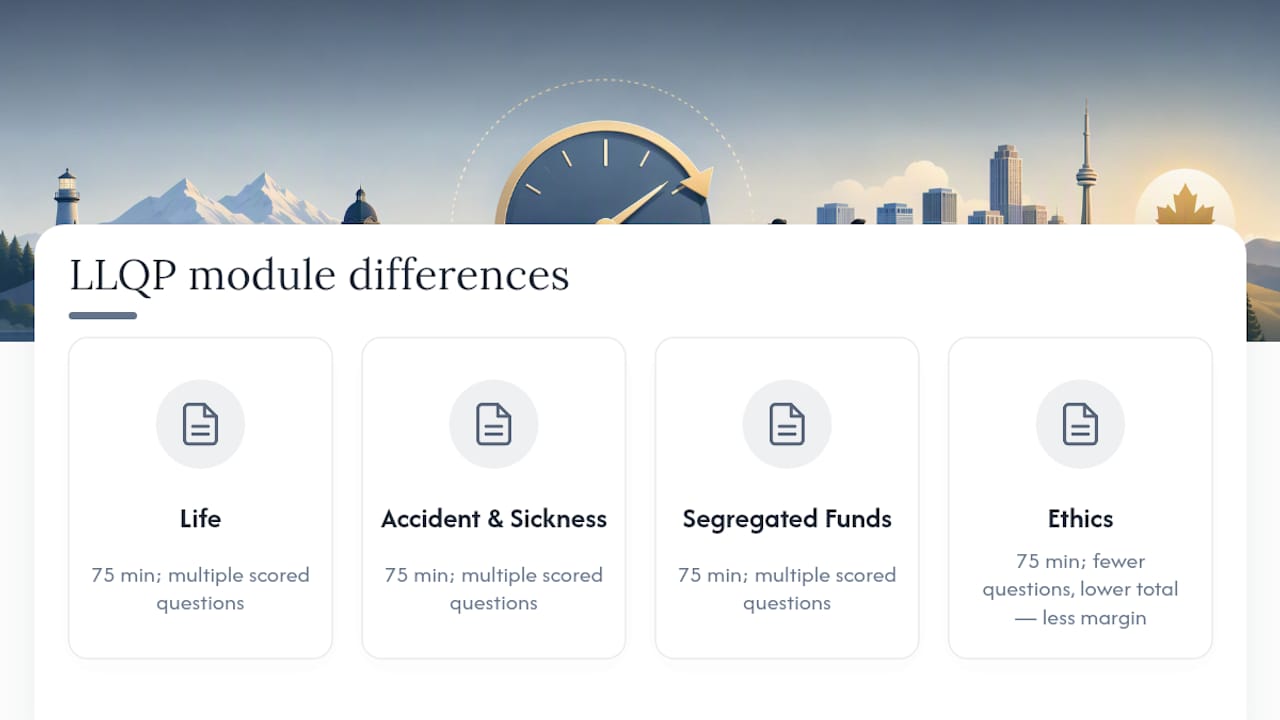
Each module runs 75 minutes, multiple choice only, with pilot questions mixed in unmarked. Life, Accident & Sickness, and Segregated Funds modules have multiple questions scored out of a set total; Ethics modules have fewer questions with a correspondingly lower total score. That means Ethics has less room for error per question than the other three modules, worth remembering if your English reading speed is still building up.
Proctoring rules apply whether you sit the exam in person or online. In-person candidates need valid government-issued photo ID matching their registration exactly. Online candidates must stay visible on camera throughout, show ID to the proctor before starting, and follow examiner instructions for any technical hiccup rather than troubleshooting alone.
Here’s the pitfall that catches more candidates than the content itself: a name mismatch between your CIPR record and your photo ID can get you turned away at the door, no exceptions for a missing middle name or a mistyped accent. Alberta’s insurance council confirms this is one of the most common reasons a prepared candidate fails to write at all. Check your CIPR spelling against your ID the day you register, not the morning of your exam.

Results typically post within a set window after your sitting, and a pass on a module stays valid as long as you complete all four within that 12 month course completion period.
Getting accommodations approved: what to submit and when
Accommodations for documented needs, such as extra time, a separate testing room, or alternate formats, are available across Canada, but approval isn’t automatic. You need documentation on file and a formal request submitted through your provincial regulator before your exam date, not after you’ve already struggled through a sitting.
Here’s the process most provinces follow:
- Gather documentation — a note from a qualified professional describing the need and the recommended accommodation
- Submit during registration — attach your request when you register, not as a follow-up email weeks later
- Wait for acknowledgement — regulators typically confirm receipt within about five business days
- Expect a decision within roughly 30 calendar days of the regulator receiving your complete documentation
- Confirm the accommodation is applied to your specific exam booking, whether in person or online
The 30 day decision window means you should apply at least a month before your target exam date, earlier if you’re also juggling course completion and CIPR registration at the same time.
Pro Tip: Keep every confirmation email from your accommodation request, your CIPR registration, and your exam booking in one folder. If anything goes sideways on test day, having proof of what you requested and when saves you a frustrating argument with a proctor who has no context.
If English isn’t your first language but you don’t have a formal documented condition, accommodations aren’t the right tool. That’s a study and preparation issue, and it’s worth solving with practice rather than paperwork.
Study tactics that actually help ESL candidates
Language friction shows up in two places: unfamiliar insurance vocabulary and the time pressure of a 75-minute clock. Both are fixable with the right practice habits.
- Build a running list of insurance-specific terms as you hit them (irrevocable beneficiary, rider, exclusion) and drill them with flashcards using spaced repetition instead of rereading notes passively
- Sit full-length, timed mock modules well before your real exam date to build pacing under actual pressure, not just familiarity with the content
- Use translation tools while you study to confirm you understand a concept, but always answer practice questions in English so exam day isn’t the first time you’ve reasoned through a scenario without a translation crutch
- For Ethics and scenario questions, train yourself to scan the stem for the key legal or numerical term first, then eliminate obviously wrong answers before reading every option in full
That last point matters more than it sounds. Reading strategies that focus on distractor elimination rather than full translation cut down decision time significantly on long, jargon-heavy stems, which is exactly where ESL candidates lose the most time.
Pro Tip: Time yourself on Ethics questions specifically. They’re shorter (25 questions, scored out of 20) but often carry denser legal phrasing, so a slow start there eats into time you’ll want for the other modules.
A publisher’s take on what actually moves the needle for ESL candidates
Most LLQP advice treats ESL candidates as needing the same prep as everyone else, just slower. That’s the wrong frame. The real gap isn’t comprehension speed, it’s vocabulary depth in a very specific register: legal and financial English that rarely shows up outside insurance contracts. A candidate can be fluent in conversational English and still stumble on “irrevocable designation” under a 75-minute clock.
This gap can be closed with tools offering in-lesson translation across multiple languages, unlimited practice quizzes, and full-length mock exams to build timed pacing. Readiness tracking can help identify which modules still need improvement before booking a test date.
— Reza
Start your LLQP prep with translation-enabled lessons
There’s no single “best” way to prep for the LLQP, and plenty of ESL candidates get through with a mix of provincial study guides and their own vocabulary lists. What LLQP Guide adds is speed: you get province-specific lessons, unlimited quizzes, and full mock exams with in-lesson translation across 11-plus languages, so you’re not stopping to look up a term mid-practice.
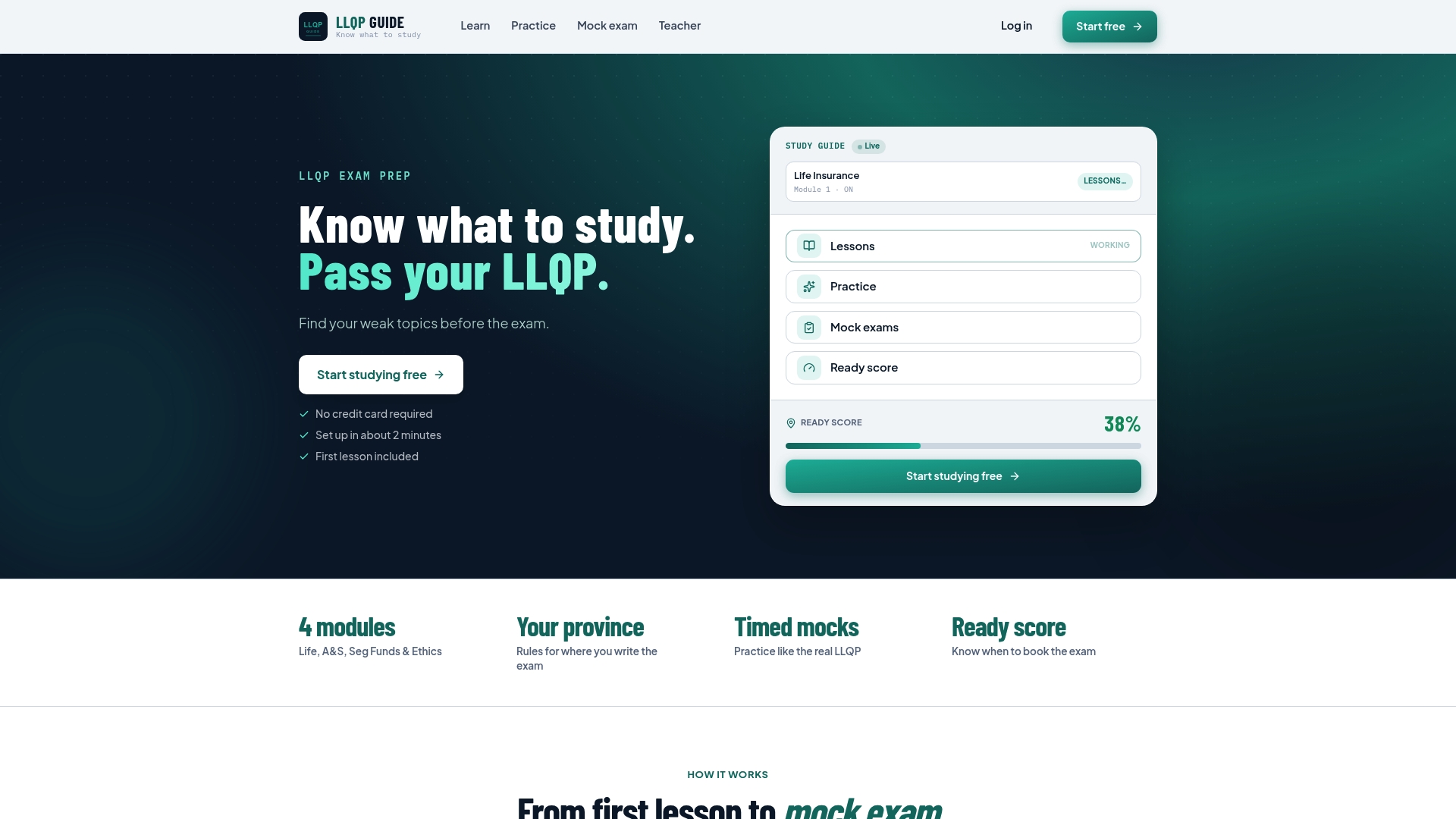
Every module from Life Insurance through Ethics & Professional Practice is covered, and readiness tracking flags weak spots before they cost you a rewrite. Start with the free trial to see how the translation tools and mock exams fit your study style, then check the pricing page or jump straight to your province’s module page to begin.
Sources
- Life Licence Qualification Program (LLQP) Examination Administration Policy
- CNA Exams memo: LLQP modular exams (Newfoundland & Labrador)
Recommended
Frequently asked questions
How much does the LLQP course cost?
Course and exam fees vary by province and provider, with exam fees charged per module. Check our province-by-province cost breakdown for current figures where they're published.
Is the LLQP an open-book exam?
No. The LLQP is a closed-book, timed multiple-choice exam, with 75 minutes allotted per module and no reference materials permitted during the sitting.
Can I take the LLQP exam through WFG?
World Financial Group (WFG) is a distribution and recruiting organization, not an exam administrator. You still register through your provincial regulator or an approved test centre, regardless of which company sponsors your course.
Are accommodations available for ESL candidates specifically?
Formal accommodations are reserved for documented conditions, not language background alone. If English fluency is your only barrier, focus on structured study using ESL-adapted resources and timed mock exams instead of an accommodation request.