Misrepresentation on the LLQP exam: the rule and your one job
Misrepresentation on the LLQP exam: the rule and your one job ! Hands sorting ethics scenario cards Misrepresentation is giving an insurer false, incomplete, or misleading information that would have changed how it assessed, priced, or accepted a risk.

Misrepresentation on the LLQP exam: the rule and your one job
Misrepresentation is giving an insurer false, incomplete, or misleading information that would have changed how it assessed, priced, or accepted a risk. If a fact is material and it is not disclosed accurately, that is misrepresentation, full stop. On the LLQP exam and in real practice, your one job is the same: refuse to help a client shade the truth, fix any error the moment you spot it, and write down what happened and when.
That third part, documentation, is what separates a defensible advisor from one facing discipline. Regulators and insurers both look at paper trails first.
- Ask yourself: would this fact change the insurer’s decision to accept, price, or set terms on the policy?
- If yes, disclose it, correct it, or pause the application until it’s fixed.
- Never sign, alter, or backdate anything on a client’s behalf.
Key takeaways
Misrepresentation on the LLQP hinges on materiality, not intent, and the correct answer almost always favours disclosure, correction, and documentation over speed.
| Point | Details |
|---|---|
| Materiality decides everything | A fact only counts as misrepresentation if it would have changed the insurer’s decision on acceptance, pricing, or terms. |
| Half-truths count | A technically true but incomplete answer can still be ruled a misrepresentation under Statutory Condition 1. |
| Timing affects insurer remedies | Insurers who delay acting on a known misrepresentation risk waiving their right to void the policy. |
| Never sign for a client | Signing, backdating, or altering an application are automatic exam fails and licensing red flags. |
| Document every correction | Written, dated records of disclosures and corrections protect both the client and the advisor’s licence. |
Table of Contents
- Understanding misrepresentation under Canadian insurance law
- LLQP exam traps: how misrepresentation questions are actually written
- What happens to the policy or claim once misrepresentation is discovered
- Regulatory and licensing fallout for advisors
- A practical checklist for exam scenarios and real client files
- Studying misrepresentation for the LLQP: what actually works
- Why one habit fixes most Ethics module mistakes
- Sources
- FAQ
Understanding misrepresentation under Canadian insurance law
The legal test for misrepresentation in Canada centres on materiality: would the fact, if known, have changed the insurer’s decision to accept the risk, at what price, or on what terms? It does not matter whether the client meant to deceive anyone. Courts and insurers look at effect, not intent.
Three ideas show up constantly on the exam and in real files:
- Materiality determines whether an inaccurate answer even counts as misrepresentation. A minor detail an insurer would have ignored anyway usually will not void a policy.
- Half-truths and omissions can be just as damaging as an outright lie. A technically accurate answer that leaves out context can still mislead the insurer, and Canadian courts have treated it that way under Statutory Condition 1.
- The wording of the question matters. Courts and insurers weigh how the application phrased its question against what the applicant actually knew and said.
Memorize this: materiality plus a false, incomplete, or misleading answer equals misrepresentation. Intent is not required for the finding to stick.
LLQP exam traps: how misrepresentation questions are actually written
Exam writers love scenarios where the “right” answer isn’t obvious unless you slow down. The four traps below cover almost every version you’ll see on a Life Insurance, Accident & Sickness, or Ethics module question.
- Selective disclosure of prior claims. The client mentions one past claim and “forgets” a second. The advisor’s job is to ask directly, not accept the first answer at face value.
- Signing for the client. Even with verbal permission, an advisor signing an application on a client’s behalf is treated as falsification, not convenience.
- Altering dates. Backdating a policy or an application to secure better pricing or avoid a waiting period is misrepresentation regardless of who benefits.
- Downplaying exclusions. Telling a client “it’s basically covered” when a condition is explicitly excluded misleads them and can expose the advisor separately from any insurer issue.
When you read an exam question, separate a positive false statement (a definite wrong answer, like stating “no prior claims” when there were two) from an omission (leaving a box blank or giving a vague non-answer). Both can count as misrepresentation, but the reasoning path differs slightly, and exam writers test whether you can tell them apart.
Use this three-step process on every scenario: state the governing rule, identify which facts are material, then pick the answer that discloses, documents, or escalates rather than the one that closes the sale fastest.
Pro Tip: If two answer choices both sound “reasonable,” pick the one that generates a paper trail. Exam writers reward disclosure and documentation over speed almost every time.
What happens to the policy or claim once misrepresentation is discovered

Insurers have two broad options once material misrepresentation surfaces: treat the policy as void from the start (void ab initio), or treat it as voidable, meaning the insurer can choose to rescind it or deny a specific claim while otherwise leaving the contract standing. Which path applies depends on the facts, the province, and how the misrepresentation was framed on the application, an area legal commentary treats as fact-specific rather than automatic.
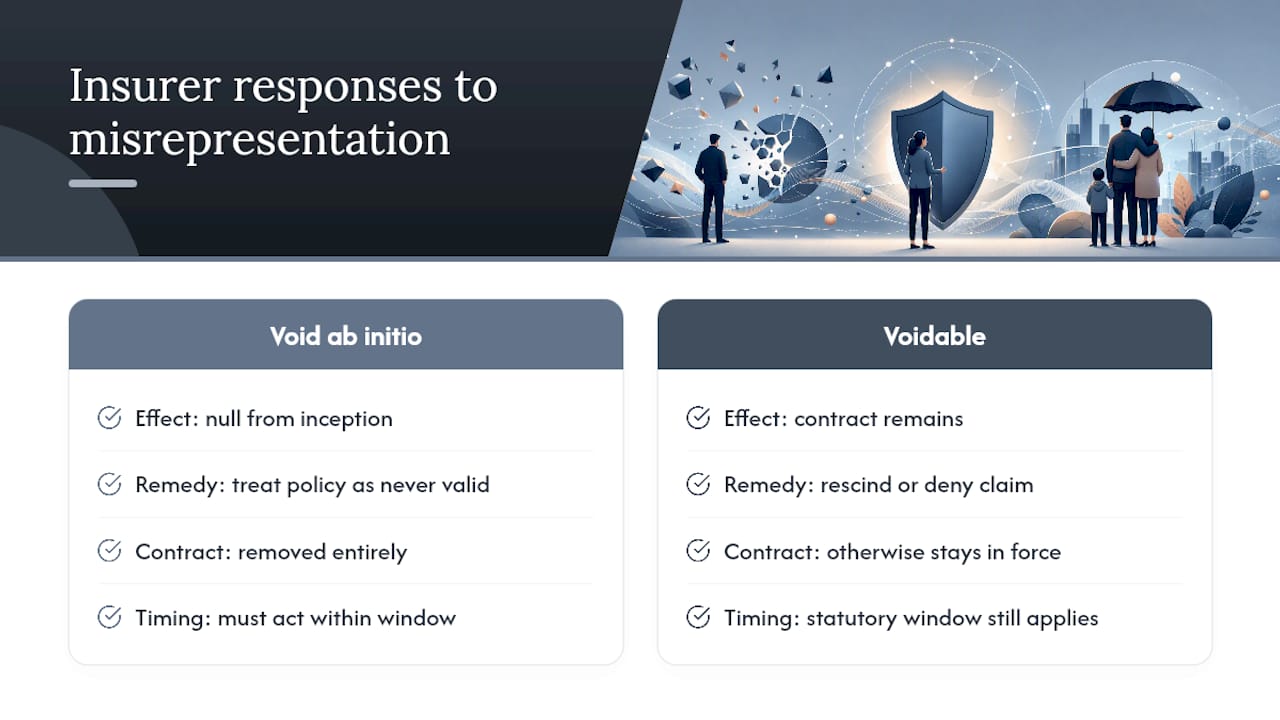
Timing matters more than most candidates expect. Under Statutory Condition 1, insurers generally must act within a defined window once they discover a misrepresentation; wait too long, and courts may find the insurer waived its right to void the policy at all.
The Nagy v. BCAA case is the go-to precedent here: a partial or evasive answer to a direct question was treated as a positive misrepresentation, not a harmless gap. The lesson for exam purposes is blunt: courts read the full context of the question and answer together, not the literal words in isolation. An applicant who answers “no” to a question that should reasonably have been “yes, but” can end up on the wrong side of a rescission.
Regulatory and licensing fallout for advisors
Insurers aren’t the only ones watching. Provincial regulators treat advisor participation in misrepresentation as serious misconduct, and the exam expects you to know why “helping the client a little” is never a defence.
Behaviours that reliably trigger discipline include:
- Forging a client’s signature or signing on their behalf, even with informal permission.
- Backdating applications or altering answers after the client has signed.
- Coaching a client on how to phrase an answer to avoid disclosure.
- Mishandling premiums, including delayed remittance or commingling client funds.
Outcomes range from a reprimand or fine to suspension or outright licence revocation, and conduct that crosses into fraud can bring criminal exposure on top of the licensing penalty. New advisors often underestimate how quickly a “minor” shortcut, like signing for a client who was in a rush, escalates once a regulator sees it as part of a pattern rather than a one off. A single incident with a documented trail is defensible; a repeated habit is not.
A practical checklist for exam scenarios and real client files
Whether you’re answering an Ethics module question or sitting across from a real client, the same sequence keeps you on the right side of both the exam key and your licence.
- Before submission, read every answer back to the client and confirm it in their own words rather than paraphrasing for them.
- Get dated signatures on every material change, never a blanket signature collected in advance.
- Leave no field blank. An empty box invites an assumption; a filled box with “N/A” or a specific answer does not.
- Use the client’s exact wording where a question is open ended, especially on health or claims history.
- If a new material fact surfaces after signing but before the policy is delivered, pause delivery immediately.
- Correct the application in writing, notify the insurer of the update, and keep a copy of the correction with a timestamp.
- Keep records of every client communication tied to the application for at least the period your provincial regulator requires, and longer if the file involves a correction or dispute.
Pro Tip: Build a one-line script you say out loud with every client: “I need your exact answer, not your best guess, because this affects whether the policy pays out later.” It protects the client and gives you a documented moment of disclosure if anyone ever asks what you told them.
Studying misrepresentation for the LLQP: what actually works
Reading the rule once is not enough. Misrepresentation questions test judgment under pressure, so the fastest way to get reliably fast is repetition on realistic scenarios rather than more passive review.
- Run scenario drills that force you to apply the materiality test to a new fact pattern every time, not just memorize the definition.
- Use spaced repetition on the statutory tests (Statutory Condition 1, the void versus voidable distinction) so they’re automatic by exam day.
- Sit timed mock exams focused on the Ethics module to build the speed you’ll need for scenario-heavy questions.
Llqpguide’s Ethics & Professional Practice module is built around exactly this kind of scenario practice, with unlimited quizzes and translation tools for candidates working through the material in a second language. If you’re studying province-specific rules alongside ethics, the Ontario and British Columbia module pages cover the regional variations that show up in applied questions.
Why one habit fixes most Ethics module mistakes
The single biggest score booster is a habit, not a fact: say your answer out loud, then justify it in one sentence before you commit to it. If the justification requires excusing a shortcut, that’s your signal you picked wrong. Client protection outranks a faster sale, on the exam and at the kitchen table. Document everything, and don’t let empathy for a nervous client talk you into an omission you’d have to explain later.
Sources
For deeper study, read the Statutory Condition 1 analysis covering Nagy, the Blaney McMurtry overview of application wording, and your provincial regulator’s LLQP examination notices.
This article is general information, not a substitute for advice from a qualified lawyer. Consult a qualified legal professional about your own circumstances before acting on anything here.
- Insurance glossary: misrepresentation — Square One Insurance
- Statutory Condition 1 — the truth, the half-truth and the outright lie — Mondaq
- Misrepresentation and non-disclosure on applications for insurance — Blaney McMurtry LLP (PDF)
- Insurance Notice – LLQP Examination Administration Policy — FCNB
Recommended
Frequently asked questions
Is the LLQP exam hard to pass?
Most candidates find the Ethics and Professional Practice module the trickiest section because it relies on scenario judgment rather than memorized facts, but consistent scenario practice closes that gap quickly.
How many attempts do you get on the LLQP exam?
Attempt limits and waiting periods between rewrites are set provincially, so check your specific regulator's current policy, such as FCNB's examination administration notice, before booking a resit.
What can you sell once you pass the LLQP?
Passing the LLQP and getting licensed lets you sell life insurance, accident and sickness insurance, and segregated funds and annuities, depending on which modules your licence covers.
What does misrepresentation actually mean on the LLQP exam?
It means giving an insurer false, incomplete, or misleading information material to its decision, whether through a direct false statement or an omission that leaves out something the insurer needed to know.
How much does LLQP exam preparation cost?
Costs vary by province and provider; check Llqpguide's pricing page for current subscription tiers alongside your province's own exam registration fee.