LLQP syllabus changes 2026: what candidates need to know
LLQP syllabus changes 2026: what candidates need to know ! LLQP study materials and timer on desk The core update for 2026 is regulatory, not curricular chaos: CISRO and the provincial regulators have refreshed exam administration policy and course-provider accreditation documents, but the four LLQP modules, Life Insurance, Accident & Sickness, Segregated Funds & Annuities, and Ethics & Professional Practice, remain structurally intact.

LLQP syllabus changes 2026: what candidates need to know
The core update for 2026 is regulatory, not curricular chaos: CISRO and the provincial regulators have refreshed exam administration policy and course-provider accreditation documents, but the four LLQP modules, Life Insurance, Accident & Sickness, Segregated Funds & Annuities, and Ethics & Professional Practice, remain structurally intact. Your single most important move right now is confirming your course provider’s accreditation status matches what your regulator currently lists, because that’s where most 2026 confusion actually starts.
Here’s who published what:
- CISRO posted updated notices covering exam administration policy and letters to course providers.
- Provincial bodies, AIC (Alberta), FSRA (Ontario), BCFSA (British Columbia), and the AMF (Quebec), each administer the harmonized curriculum locally and can add scheduling or logistics wrinkles.
- All four modules remain in scope; the changes centre on accreditation clarity and administration rules, not a wholesale content rewrite.
Pro Tip: Log into your course provider’s portal today and check the accreditation date listed against CISRO’s notice page. A mismatch there is the fastest early warning sign that your materials might lag behind the current syllabus mapping.
Key Takeaways
Passing the LLQP in 2026 depends less on chasing every syllabus tweak and more on confirming your provider’s accreditation and module mapping against official regulator documents.
| Point | Details |
|---|---|
| Verify provider accreditation | Check your course provider’s accreditation status against CISRO’s notice page before trusting their materials. |
| Module structure stays stable | Life, Accident & Sickness, Segregated Funds & Annuities, and Ethics remain the four core modules for 2026. |
| Confirm your province’s rules | Exam timing, format, and registration windows are set provincially through AIC, FSRA, BCFSA, or the AMF. |
| Watch for pilot questions | Every exam includes five unscored pilot questions mixed in, so pace for the full question count. |
| Use a syllabus-mapped platform | Llqpguide aligns lessons, quizzes, and mock exams to the official LLQP module structure for targeted review. |
Table of Contents
- What the LLQP syllabus changes for 2026 actually say
- Where to verify the official 2026 LLQP notices yourself
- When do the 2026 changes take effect?
- Which LLQP modules are affected by the 2026 update?
- What should candidates actually do about the changes?
- How should you adjust your study plan for the 2026 syllabus?
- Get syllabus-mapped LLQP prep instead of guessing at PDFs
- Sources
- FAQ
What the LLQP syllabus changes for 2026 actually say
CISRO’s notice page functions as the paper trail for everything else in this article. It hosts the exam administration policy, curriculum documents, and formal letters sent to course providers when accreditation terms shift. Reading it directly beats relying on secondhand summaries from prep companies, because CISRO’s recent notices are the primary record regulators point to when disputes arise.
The regulator language tends to be dry and procedural: scope of change, effective dates, and which provider obligations are affected. Three things worth extracting from that language:
- Which documents were revised (administration policy versus curriculum versus provider letters).
- Whether any course provider’s accreditation status was flagged, renewed, or set to expire.
- Whether continuing education (CE) accreditation criteria shifted alongside exam content.
CISRO’s curriculum and sample exam question page is the companion document. It’s where finalized module content and sample items live, and it’s the best way to verify a provider’s claim that their materials are “fully updated” against the regulator’s own text.
Where to verify the official 2026 LLQP notices yourself
Don’t take a provider’s word for accreditation status. Regulators publish it directly, and checking takes a few minutes.
- CISRO: the recent notices page and the curriculum and sample exam questions page cover national-level policy and content.
- Insurance Council of BC: details in-person exam procedures, including what to bring and how sittings are run.
- FSRA (Ontario) and the AMF (Quebec) maintain their own provincial exam administration pages, which govern registration windows in those jurisdictions.
Cross-reference your provider’s accreditation claim against whichever of these pages applies to your province before you commit to a study package.
When do the 2026 changes take effect?
Regulators rarely announce a single flip-the-switch date for the whole country. Instead, CISRO and each province coordinate rollout through provider letters and administration policy updates that take effect on dates specified in those documents. That means your actual deadline depends on your province and your provider’s accreditation renewal cycle, not a universal calendar date you can assume applies everywhere.
Work through this order:
- Check CISRO’s notice page for the effective date tied to any administration policy or curriculum document.
- Confirm with your provider whether their accreditation letter references that same effective date or a separate provincial cutoff.
- Ask directly whether a transition or grandfathering period applies if you’re mid-course when a change lands.
- Confirm your exam registration window with your provincial regulator, since scheduling rules can shift independently of curriculum updates.
- Bookmark the CISRO notice page and check it monthly while you’re actively studying.
- Save any provider correspondence that references an accreditation date, in case a dispute comes up later.
Which LLQP modules are affected by the 2026 update?
The four-module structure itself, Life Insurance, Accident & Sickness, Segregated Funds & Annuities, and Ethics & Professional Practice, hasn’t changed. What can shift within a syllabus update is emphasis: which topics get more weight, which get trimmed, and how chapter-level content is organized. The Canadian Securities Institute’s module breakdown mirrors the official chapter structure and is a useful reference for spotting where a provider’s materials diverge from the regulator’s own outline.
- Life Insurance: core underwriting and policy mechanics tend to stay stable; watch for updated case-study framing.
- Accident & Sickness: definitions and claims processes are the areas most likely to see wording refinements.
- Segregated Funds & Annuities: regulatory disclosure requirements are the most common source of periodic updates.
- Ethics & Professional Practice: professional conduct standards get revisited most often across syllabus cycles.
Compare your provider’s module outline directly against CISRO’s curriculum and sample exam questions. If a topic in their outline doesn’t map to anything in the regulator’s document, ask why before you spend hours studying it.
What should candidates actually do about the changes?
Turn the regulatory detail into a short list you can act on this week.
- Confirm your provider’s accreditation is current with your provincial regulator, not just with CISRO.
- Ask your provider which syllabus version their course materials are built on, and request the date.
- Check whether your exam format, timing, or number of questions changed for your province.
- Verify whether your CE credits (if applicable) still align with the updated accreditation criteria.
Exam-day logistics matter here too. The Insurance Council of BC’s guidance on in-person exam procedures covers identification requirements and what you can bring into the testing room, and similar rules apply in other provinces through their own regulators.
Pro Tip: Keep a simple folder, digital or paper, with your provider’s accreditation confirmation, any regulator notice you referenced, and your exam registration confirmation. If a scheduling or content dispute comes up, that paper trail settles it fast.
How should you adjust your study plan for the 2026 syllabus?
A syllabus refresh is a reason to rebalance study time, not scrap your plan. Follow this sequence:
- Re-read the module chapter list from CSI’s curriculum summary and flag any section your notes don’t cover.
- Prioritize Ethics and Segregated Funds content first, since these tend to shift most often across cycles.
- Run a full mock exam early to establish a baseline before making changes to your study rotation.
- Retest weak modules weekly using targeted quizzes rather than rereading the same notes.
Llqpguide’s Life Insurance, Accident & Sickness, Segregated Funds & Annuities, and Ethics lesson pages break down each module separately, so you can target whichever area your regulator notice flagged instead of restudying everything from scratch.
- Use mock exams under timed conditions to build pacing, not just knowledge recall.
- Lean on translation tools if English isn’t your first language. Losing time to vocabulary, not concepts, is a common and avoidable failure point.
Pro Tip: During open-book components, the Alberta Insurance Council notes that candidates who try to look up every answer rarely finish in time. Use the electronic reader only to confirm something you already mostly know.
How candidates typically handle a syllabus transition
Confusion during a syllabus update usually comes from one habit: sticking with old notes because rewriting them feels wasteful. It’s the wrong instinct. A quick module comparison against the regulator’s own curriculum document takes less time than the anxiety of wondering if you studied the wrong thing.
- Relying on last year’s practice questions without checking if the emphasis shifted.
- Assuming a provider’s accreditation is automatic and permanent.
- Waiting until exam week to confirm registration and administration details.
Most candidates catch up within a week or two of focused review once they know exactly what shifted.
Get syllabus-mapped LLQP prep instead of guessing at PDFs
Reading regulator notices tells you what changed. Turning that into a study plan is the harder part, and it’s the part Llqpguide was built to handle. The platform maps its lessons, quizzes, and mock exams directly to the official LLQP module structure, so when a regulator updates emphasis on a topic, your practice questions reflect it instead of leaving you to guess.
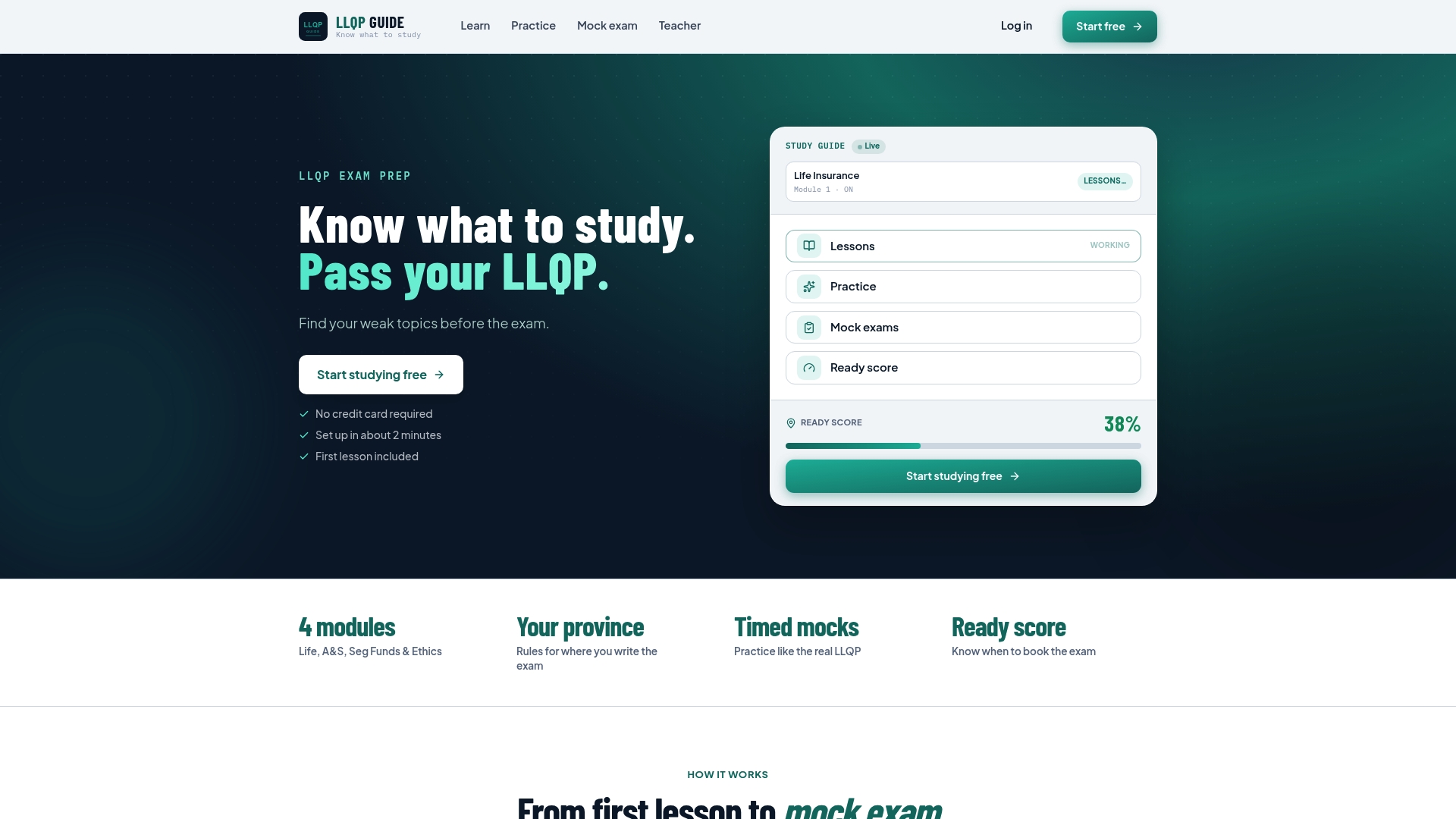
Start with the module most relevant to your regulator notice: Life Insurance, Accident & Sickness, Segregated Funds & Annuities, or Ethics & Professional Practice. If you’re registering in Ontario or British Columbia, the province-specific guides for Ontario and BC walk through registration steps alongside the study content. Unlimited practice quizzes and full mock exams let you find weak spots before test day rather than during it, and built-in translation tools help candidates working through the material in a second language. Check the pricing page to see subscription options, or visit the main platform to start with a free trial today.
Sources
- Recent notices about the LLQP
- Life License Qualification Program (LLQP) - Alberta Insurance Council
- In-person exams — Insurance Council of British Columbia
- Curriculum & Sample Exam Questions
- Life Licence Qualification Program Insurance Course (LLQP) Curriculum | Canadian Securities Institute
Recommended
Frequently asked questions
Is it hard to pass the LLQP exam?
The LLQP is manageable with focused preparation, but the application-style questions trip up candidates who memorize rather than understand concepts. Mock exams that mirror real conditions, like those on Llqpguide, help expose that gap before test day.
How many times can you take the LLQP exam?
Rewrite policies and waiting periods are set by your provincial regulator, so check your province's exam administration page, such as FSRA in Ontario or the Insurance Council of BC, for exact rules.
How long does it take to pass the LLQP?
Timelines vary by how much time you can dedicate weekly, but most candidates need several weeks of consistent study across all four modules, with extra time on Ethics and Segregated Funds if those areas feel unfamiliar.
How many questions are in each LLQP module?
Question counts and exam timing vary by module and province, and every exam includes five unscored pilot questions mixed in with scored items. Check CISRO's curriculum and sample exam questions for the current breakdown by module.
Do I need to redo my course if my provider's accreditation changed?
Not necessarily, but confirm directly with your provider whether their updated accreditation affects the content you've already studied or just their administrative status with the regulator.