LLQP cheat sheet: quick module notes and exam tips
LLQP cheat sheet: quick module notes and exam tips ! Study nook with LLQP exam prep tools Your LLQP cheat sheet delivers module-by-module summaries, must-know definitions, official sample question links, exam logistics, and a study workflow you can start today.

LLQP cheat sheet: quick module notes and exam tips
Your LLQP cheat sheet delivers module-by-module summaries, must-know definitions, official sample question links, exam logistics, and a study workflow you can start today. Before anything else, open the CISRO curriculum and sample exam questions page — it is the single most authoritative source for question style and curriculum coverage.
Three things to do right now:
- Skim the module notes below and flag any concept you cannot define from memory.
- Run a 30-question timed practice set on one module before you read further.
- Bookmark the CISRO sample questions and your provincial registrar’s exam page.
Course syllabi from accredited providers commonly estimate 100–145 hours of study across all four modules. That range tells you this is not a weekend sprint. The cheat sheet below is your filter: it cuts to what actually shows up on the exam and tells you where to look fast when you are stuck.
Key takeaways
The most reliable path to passing the LLQP is combining module-focused cheat notes with official CISRO sample questions, timed mock exams, and a licence application submitted before the one-year certificate validity window closes.
| Point | Details |
|---|---|
| A pass mark is required on each module | Every module requires a passing grade; there is no averaging across modules. |
| Open-book means fast lookup, not open study | Memorise the e-book structure before exam day; use it only to confirm, not to learn. |
| The certificate is valid for a limited time, typically about one year | Apply for your licence immediately after passing — the window closes faster than expected. |
| CISRO sample questions first | Official sample questions calibrate question style better than any third-party bank. |
| Llqpguide executes the plan | Flashcards, unlimited quizzes, mock exams, and readiness tracking map directly to this cheat-sheet workflow. |
Table of Contents
- What does an LLQP cheat sheet cover for each module?
- What are the official LLQP exam rules and prerequisites?
- Where can you find official LLQP practice materials?
- How do you study efficiently with a cheat sheet?
- What mistakes do LLQP candidates make most often?
- How does Llqpguide support the cheat-sheet study routine?
- The honest truth about LLQP cheat sheets
- Ready to put this plan into practice?
- Sources
- FAQ
What does an LLQP cheat sheet cover for each module?
Each block below is a one-page-equivalent summary. Read it, then convert it to flashcards — one concept per card, one fact on the back.
Life insurance
- Insurable interest: must exist at policy inception; the policyholder must have a financial or personal stake in the insured’s life.
- Grace period: typically 30 days after a missed premium before the policy lapses; the insured is still covered during this window.
- Incontestability clause: after two years (in most provinces), the insurer cannot void the policy for misrepresentation, except for fraud.
- Free-look period: the policyholder has a set number of days (often 10) to cancel a new policy for a full refund.
- Beneficiary types: revocable (can be changed by the policyholder) vs. irrevocable (requires beneficiary consent to change).
- Term vs. permanent: term covers a fixed period with no cash value; permanent (whole, universal) builds cash value and stays in force as long as premiums are paid.
- Waiver of premium: a rider that keeps the policy active if the insured becomes totally disabled.
- Assignment: absolute (transfers all rights) vs. collateral (used as loan security; rights revert when debt is repaid).
- Non-forfeiture options: reduced paid-up, extended term, or cash surrender value — what the policyholder can take if they stop paying.
- Participating vs. non-participating policies: participating policies may pay dividends; non-participating do not.
Pro Tip: For the open-book e-reference, create a two-column index on your cheat sheet mapping each of these terms to the section heading where it appears in the e-book. Finding “incontestability” in 15 seconds beats re-reading the whole chapter.
Accident and sickness (A&S)
- Disability income: own-occupation vs. any-occupation definitions; the distinction drives most exam scenarios.
- Elimination period: the waiting period before benefits begin; longer elimination = lower premium.
- Benefit period: how long benefits are paid (2 years, 5 years, to age 65, lifetime).
- Coordination of benefits (COB): when a claimant has two group plans, the birthday rule determines which plan pays first.
- Pre-existing condition exclusions: conditions present before coverage begins may be excluded for a defined period.
- Critical illness vs. disability: critical illness pays a lump sum on diagnosis; disability replaces income over time.
- Group vs. individual A&S: group plans are employer-sponsored, not portable; individual plans follow the insured.
- Guaranteed renewability vs. non-cancellable: non-cancellable locks in both the premium and the benefit; guaranteed renewable keeps the benefit but the insurer can raise premiums.
Segregated funds and annuities
- Segregated fund guarantee: at maturity or death, the insurer guarantees a minimum percentage (typically 75% or 100%) of deposits, regardless of market performance.
- Reset feature: locks in a higher market value as the new guarantee base; resets the maturity date.
- Creditor protection: because segregated funds are insurance contracts, they may be protected from creditors if a preferred beneficiary is named.
- Annuity types: life annuity (payments for life), term-certain (fixed period), joint-and-survivor (continues to surviving spouse).
- Deferred vs. immediate annuity: deferred accumulates before payout; immediate begins payments almost at once.
- MER (Management Expense Ratio): the annual cost expressed as a percentage of the fund’s assets; higher than comparable mutual funds due to the insurance guarantee.
- Segregated fund vs. mutual fund: segregated funds are insurance products, carry guarantees, bypass probate, and allow direct beneficiary designation.
Pro Tip: The guarantee percentage and the reset feature are the two concepts that appear most often in segregated fund questions.
Ethics and professional practice
- Duty of disclosure: the client must disclose all material facts; the advisor must explain what is material.
- Know Your Client (KYC): advisors must collect and document client financial information, risk tolerance, and needs before recommending any product.
- Needs analysis: a structured process to identify coverage gaps; required before making a recommendation.
- Conflict of interest: must be disclosed to the client; the advisor’s interest cannot override the client’s best interest.
- Privacy obligations: PIPEDA (and provincial equivalents) govern how client information is collected, used, and stored.
- Replacement insurance: replacing an existing policy requires specific disclosure forms and a cooling-off period to protect the client.
- Errors and omissions (E&O) insurance: advisors carry E&O to cover professional liability; most provincial regulators require it.
- Regulatory bodies: FSRAO (Ontario), ICBC (British Columbia), FCNB (New Brunswick) — know which body governs your province.
For Ethics and Professional Practice questions, the answer almost always comes back to one principle: the client’s interest comes first. When in doubt, choose the option that protects the client.
What are the official LLQP exam rules and prerequisites?
Exam structure at a glance
The LLQP exam is modular, multiple-choice, and open-book with an approved e-reference supplied. Each question has one correct answer. The pass mark is a passing grade on every module. Below are the standard parameters most provinces follow, though exact question counts can vary slightly by jurisdiction.
You can write modules separately or in combination, depending on your province and the licence type you are pursuing.
Prerequisites and certificate validity
Before you can register for any provincial exam, you must hold a valid LLQP Certificate of Completion from an accredited course provider. That certificate is typically valid for one year. Pass your exams and apply for your licence within that window — waiting past it can force re-qualification.
Once you pass the provincial exams, apply for your licence promptly through your provincial regulator’s portal. The licensing application process varies by province, but the general pathway is: complete an accredited course, pass the modular exams, then submit your application online.
Rewrite rules
Rewrite waiting periods differ by province. Some allow a short wait between attempts; others impose longer waits or require course re-qualification after repeated failures. Check your provincial regulator’s page before scheduling a rewrite — the consequences of a third or fourth failed attempt can be significant.
Where can you find official LLQP practice materials?
The single best starting point is the CISRO curriculum and sample exam questions. CISRO (Canadian Insurance Services Regulatory Organizations) publishes the official curriculum documents and sample questions that all provincial exams are built from. These are not approximations — they are the actual style and difficulty benchmark.
Beyond CISRO, here is how the main resource types compare:
- Official sample questions (CISRO): the gold standard. Use them to calibrate timing and to see exactly how questions are worded. Do these before any third-party bank.
- Provincial registrar pages: each province lists exam rules, acceptable ID, accommodation options, and sometimes additional sample materials. The Insurance Council of BC page, for example, details misconduct rules and appeals.
- Durham College: an accredited LLQP course provider in Ontario; their course materials follow the CISRO curriculum and include module-end assessments.
- Question banks and practice platforms: useful for volume repetition once you understand the question style. The value is in the quantity of attempts, not in replacing official materials.
- Flashcard apps (Anki, Quizlet): effective for high-frequency term recall. Build your own cards from the module cheat notes above rather than downloading pre-made decks of uncertain accuracy.
- Full-length mock exams: run at least two full timed mocks before exam day. They reveal time-management gaps that short quiz sets never expose.
Pro Tip: Use the official CISRO sample questions in your first study week, not your last. Seeing the question format early shapes how you read your course materials — you start noticing what the exam actually tests rather than what the textbook emphasises.
How do you study efficiently with a cheat sheet?
Course providers estimate 100–145 hours of total study. A two-week sprint before the exam is not a plan — it is a gamble. Here is a realistic framework.
Two-week study template
Week 1: build and test
- Days 1–2: Life Insurance module. Read cheat notes, make flashcards, run 20 practice questions.
- Days 3–4: Accident & Sickness. Same process.
- Day 5: Segregated Funds & Annuities. Focus on guarantee features and annuity types.
- Day 6: Ethics & Professional Practice. Focus on KYC, needs analysis, and replacement rules.
- Day 7: First full mock exam (all modules, timed). Score and flag weak areas.
Week 2: target and consolidate
- Days 8–10: Targeted review of flagged weak areas only. Daily 30–45 minute spaced-repetition sessions beat marathon re-reads.
- Days 11–12: Second full mock exam. Compare scores to Week 1.
- Day 13: Light review of your cheat sheet only. No new material.
- Day 14: Exam day.
Study techniques that work
Active recall beats passive reading every time. Cover your cheat sheet and try to write out the key points from memory. Spaced repetition means reviewing a concept just before you would forget it — flashcard apps automate this. Mixed practice (switching between modules in a single session) builds the retrieval strength that a single-module marathon does not.
The week-before checklist
- Confirm your exam date, location (in-person or online), and required ID with your provincial registrar.
- Review your cheat sheet for each module once per day — no new material.
- Run one timed mock exam and review every wrong answer.
- Build your e-book index: note the section headings for the 10 terms you find hardest to remember.
- Prepare your exam-day kit: valid ID, confirmation email, water, and a quiet space if writing online.
- Sleep. Seriously — fatigue costs more marks than any last-minute review gains.
What mistakes do LLQP candidates make most often?
Most failures come from a short list of repeatable errors. Here is what to watch for and how to fix each one fast.
- Passive reading without testing: reading course notes without answering questions creates the illusion of preparation. Fix: after every module section, close the book and answer five questions from memory.
- Misusing the open-book e-reference: candidates who plan to “look everything up” run out of time. Fix: memorise the structure and page locations of the e-book; use it only for confirmation, not discovery.
- Ignoring module weightings: not all topics carry equal weight. Fix: use the CISRO curriculum document to see which learning objectives are most heavily represented and prioritise those.
- Skipping full mock exams: short quizzes do not replicate the cognitive load of a full timed session. Fix: run at least two full mocks before exam day.
- Misreading scenario questions: LLQP questions often describe a client situation and ask what the advisor should do. Fix: identify the client’s need first, then eliminate answers that prioritise the advisor’s interest.
- Confusing similar terms: “guaranteed renewable” vs. “non-cancellable,” “revocable” vs. “irrevocable” — these pairs appear in distractors. Fix: write both terms on one flashcard with the key difference on the back.
- Delaying the licence application: passing the exam is not the finish line. Fix: apply for your licence immediately after passing; the one-year validity window closes faster than candidates expect.
- Not checking provincial rules: rewrite waiting periods, exam delivery options, and ID requirements vary. Fix: read your provincial registrar’s exam page before you register.
Night-before and morning-of checklist:
- Confirm exam time, location, and login details (if online).
- Review your e-book index one more time.
- Lay out your ID and confirmation email.
- Get eight hours of sleep.
- Eat before the exam. Hunger is a real cognitive drag.
- Arrive (or log in) 15 minutes early.
How does Llqpguide support the cheat-sheet study routine?
Llqpguide is built around exactly the workflow this cheat sheet describes. Every feature maps to a step in the plan:
- Module lessons: structured content for all four LLQP modules, organised by the same learning objectives the CISRO curriculum uses.
- Unlimited practice quizzes: run as many question sets as you need, per module, without hitting a cap.
- Full-length mock exams: timed, full-module simulations that replicate actual exam conditions.
- Flashcards: built into the platform so you can review high-yield terms without switching apps.
- Readiness tracking: the platform shows you which modules and topics need more work, so you are not guessing about weak areas.
- In-lesson word translation: available in 11+ languages, which is a genuine advantage for candidates whose first language is not English.
- Province-specific guidance: content is tailored to your province, covering local registration steps and exam delivery options for places like Ontario and British Columbia.
The workflow looks like this: use the cheat sheet above to identify your weak concepts, convert those concepts into flashcards inside the platform, run spaced-repetition quizzes on those cards, then take a timed mock exam to confirm readiness.
Candidates who use Llqpguide’s mock exams and readiness tracking report going into exam day knowing exactly which topics they have covered and which ones still need attention — the kind of confidence that comes from testing yourself, not just reading.
The honest truth about LLQP cheat sheets
A cheat sheet is a filter, not a shortcut. The candidates who use one well treat it as a retrieval cue: they already know the material and the cheat sheet helps them confirm it. The candidates who use it as a substitute for studying discover on exam day that recognition is not the same as recall.

The open-book format is the most misunderstood part of the LLQP. Candidates assume it means they do not need to memorise anything. What it actually means is that the exam is designed so that looking everything up takes too long. The e-reference is there for confirmation, not for learning the material during the exam. Candidates who walk in without knowing the core concepts will spend most of their 75 minutes flipping through the e-book and still not finish.
The other thing worth saying plainly: the Ethics module is not the easy one. Many candidates under-prepare for it because it seems like common sense. The questions are scenario-based and they test whether you can apply regulatory principles under pressure, not whether you can recite them. Spend real time on KYC, needs analysis, and replacement rules.
Use this cheat sheet the way it is intended: as a daily review tool in the two weeks before your exam, not as a last-minute cram session the night before.
Ready to put this plan into practice?
Passing the LLQP is straightforward when you have the right tools working together. Llqpguide gives you everything this cheat sheet points to: module lessons aligned to the CISRO curriculum, unlimited quizzes, full-length timed mock exams, built-in flashcards, and readiness tracking that shows you exactly where to focus next.
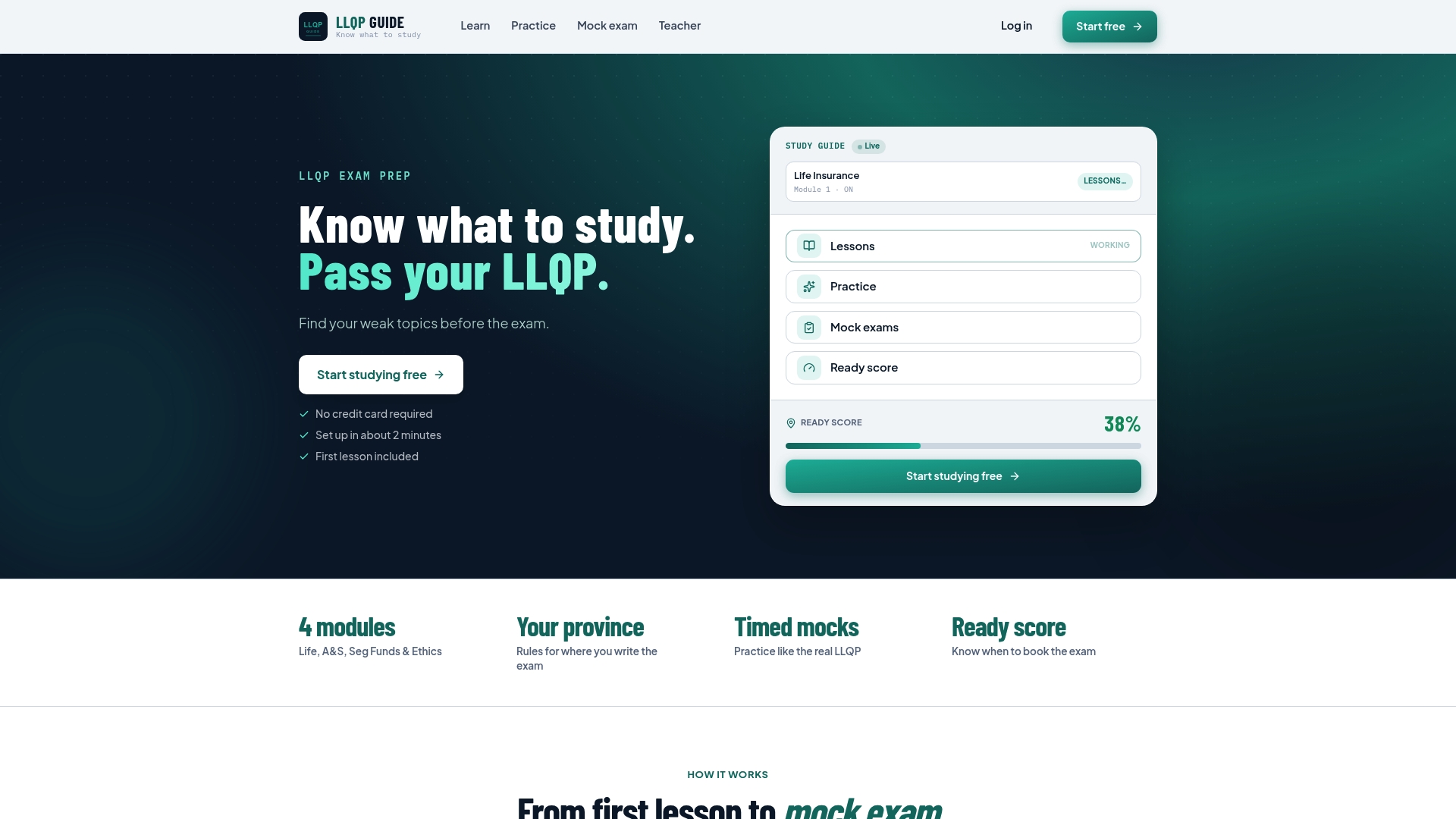
Start with a free trial at Llqpguide and run through one module’s quiz set today. If your score is where you want it, move on. If it is not, the platform shows you which concepts to revisit. Check the pricing page for subscription options, including monthly, quarterly, and annual plans. The free starter trial requires no credit card and gives you enough access to know whether the platform fits your study style before you commit.
Disclosure: this article is published by Llqpguide, the exam-prep platform recommended above.
Sources
Bookmark these pages before you register for your exam:
- About the Exam | Insurance Council of British Columbia
- Licensing Requirements - Life Licence Qualification Program | Financial and Consumer Services Commission (New Brunswick)
- Curriculum & Sample Exam Questions
- Life Licence Qualification Program Insurance Course (LLQP) Curriculum | Canadian Securities Institute
For rewrite rules and exam delivery options (in-person vs. remote), always check your own provincial registrar’s page directly — these details change and vary meaningfully across Canada.
Recommended
Frequently asked questions
Is the LLQP exam open book?
Yes. Most provinces supply an approved e-reference for the exam, but the questions are designed so that looking up every answer takes too long. Knowing the material before you sit down is still required.
How many questions are in each LLQP module?
Life Insurance and Accident & Sickness modules typically have around thirty questions each; Segregated Funds & Annuities and Ethics & Professional Practice have fewer questions. Each module typically allows about 75 minutes for completion.
How hard is it to pass the LLQP exam?
Scenario-based questions in Ethics and A&S trip up candidates who rely on passive reading; active recall and timed mock exams are the most effective preparation methods.
Where can I find free LLQP exam questions?
CISRO publishes official sample exam questions at no cost at cisro-ocra.com. These are the most accurate representation of actual exam question style and difficulty.
How do I pass the LLQP efficiently?
Complete your accredited course, use the CISRO sample questions to calibrate your preparation, run at least two full timed mock exams, and apply for your licence within one year of receiving your Certificate of Completion. Llqpguide's platform covers all of these steps with module lessons, unlimited quizzes, and readiness tracking.