LLQP pass rates in Canada: 2026 official data explained
LLQP pass rates in Canada: 2026 official data explained ! LLQP study nook with tablet and lamp Canada's national first-time LLQP pass rates ranged from 69% to 78% across all five modules in 2024, according to CISRO's Examination Results by Provider data summarised by Investment Executive.

LLQP pass rates in Canada: 2026 official data explained
Canada’s national first-time LLQP pass rates ranged from 69% to 78% across all five modules in 2024, according to CISRO’s Examination Results by Provider data summarised by Investment Executive. That spread looks manageable until you see how far individual providers diverge from those national figures — some clearing 90%, others sitting in the mid-50s for the same module in the same period.
Key takeaways
| Point | Details |
|---|---|
| National pass-rate range | First-time pass rates across the five LLQP modules ran from 69% to 78% in 2024. |
| Hardest module | Segregated Funds & Annuities had the lowest national first-time pass rate at 69%. |
| Provider variability | Some providers cleared 90%+ while others sat in the mid-50s for the same period; always check sample size (N). |
| Exam pass mark | The pass mark is 60%, with 75 minutes and 20–30 questions per module; passing marks are valid 12 months for licensing. |
| Where to verify data | Download perioded PDFs directly from the CISRO Examination Results by Provider page and cross-reference N before comparing providers. |
| Llqpguide | Covers all four modules with province-specific content, unlimited quizzes, mock exams, and readiness tracking to target the modules where national pass rates are lowest. |
Table of Contents
- What are the LLQP pass rates by module?
- How do training providers compare on first-time pass rates?
- How to read LLQP pass-rate data without being misled
- Exam format, pass mark, and retake rules
- Steps that improve your first-time pass probability
- Where the LLQP pass-rate data comes from
- What the pass-rate data actually means for you
- Llqpguide covers every module the CISRO data flags as difficult
- Sources
- FAQ
What are the LLQP pass rates by module?
The Canadian Insurance Services Regulatory Organizations (CISRO) tracks first-time pass rates for each of the five LLQP modules separately. The figures below reflect the 2024 calendar year, as reported by Investment Executive from CISRO data.
Segregated Funds & Annuities is the hardest module by this measure, with the lowest national first-time pass rate at 69%. Ethics (common law) sits at the top end at 78%. The gap between them is nine percentage points — not trivial when you are planning your study time.
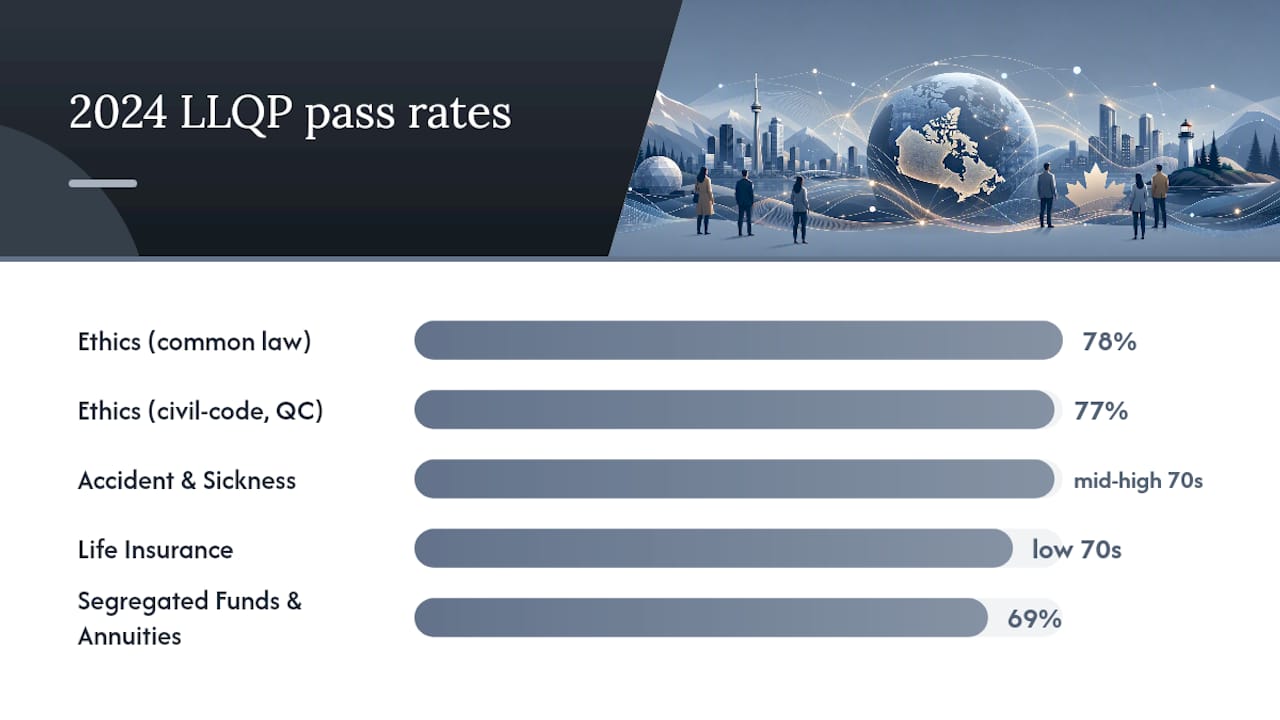
Quebec vs. the rest of Canada on ethics: The LLQP uses two distinct ethics modules. Candidates outside Quebec write the common-law version; Quebec candidates write the civil-code version. Their 2024 pass rates (78% and 77% respectively) are close, but they cover different legal frameworks, so prep materials must match the correct version. If you are writing in Quebec, ethics module prep that covers civil-code content specifically is worth seeking out.
A few year-over-year notes worth flagging:
- Segregated Funds & Annuities has consistently been the lowest-performing module across multiple reporting periods, not just 2024.
- Accident & Sickness and the ethics modules have held relatively stable in the mid-to-high 70s.
- Life Insurance sits in the low 70s, placing it in the middle of the difficulty range.
How do training providers compare on first-time pass rates?
Provider-level data is where the picture gets genuinely interesting. CISRO’s provider tables show wide dispersion: some providers report first-time pass rates at or above 90% for substantial candidate pools, while others sit in the mid-50s to low 70s for large cohorts in the same period.

The table below draws on CISRO reporting and Investment Executive’s coverage of the 2024 data. Note that exact per-module figures for every provider are not always publicly broken out in media summaries; the pass rates shown reflect overall or reported figures qualitatively where available.
On CSI: Investment Executive’s coverage specifically named the Canadian Securities Institute as a standout, with very high first-time pass rates across roughly 400 candidates — a sample large enough to take seriously. On Primerica and WFG: Both reported lower first-time pass rates across thousands of students. That large N makes those figures reliable, but context matters: both organisations recruit heavily and put many first-time candidates through the exam, which naturally pulls the aggregate rate down.
The CISRO statistical-significance rule: CISRO explicitly flags that data relating to fewer than 30 students should not be considered statistically significant. A provider reporting a 95% pass rate from 12 candidates tells you almost nothing useful.
Pro Tip: When a provider advertises a high pass rate, check the N before you trust the number. A 90% rate from 25 students is noise; a 90% rate from 400 students is a signal worth paying attention to.
How to read LLQP pass-rate data without being misled
Pass-rate figures are easy to misread, and providers have every incentive to present their best numbers. A few things to check before drawing conclusions:
- Sample size first. Any N below 30 is flagged by CISRO as not statistically significant. Treat those rows as anecdotal.
- Match the reporting period. CISRO publishes perioded PDFs (for example, August–July or June–May windows). Comparing a provider’s rate from one period against a national figure from a different period produces a meaningless comparison.
- Check which module the rate covers. A provider might report a high rate for Ethics but a much lower one for Segregated Funds. Aggregate rates can mask module-level weakness.
- Look for multi-period consistency. A single strong period could be a fluke. CISRO’s archived PDFs let you compare the same provider across multiple windows. Consistent performance across two or three periods is a far better indicator of quality than a single-period spike.
- Understand the candidate pool. Providers that recruit aggressively and put large numbers of first-time candidates through the exam will naturally show lower aggregate rates than providers whose students self-select into the course.
Pro Tip: *Rather than relying on a single reporting period, pull two or three consecutive CISRO PDFs for the same provider and calculate an informal average.
Exam format, pass mark, and retake rules
Knowing the mechanics of the exam shapes how you prepare. According to the New Brunswick Financial and Consumer Services Commission, which administers LLQP licensing requirements consistent with the harmonized national framework:
- Time per module: 75 minutes
- Questions per module: 20–30 multiple-choice questions
- Pass mark: 60%
- Certificate validity: A passing mark is valid for 12 months for licensing purposes
On retakes: failing a module requires a rewrite, and staged waiting periods apply after multiple failures. The exact waiting windows vary slightly by province, but the pass mark and module structure are consistent across the harmonized LLQP framework. Planning to pass each module on the first attempt is not just about confidence — it is about avoiding the waiting periods that can delay your licensing timeline by weeks or months.
That nine-point gap above the minimum suggests most candidates who pass are not scraping by — they are clearing the bar with room to spare. Candidates who fail are typically not close; they are underprepared.
Steps that improve your first-time pass probability
The CISRO data, combined with industry reporting on what separates high- and low-performing providers, points to a consistent pattern: thorough practice and realistic mock-exam exposure correlate with better first-attempt outcomes. Here is how to put that into practice:
- Build a module-specific study schedule. Treat each of the four modules as a separate exam. Segregated Funds & Annuities deserves the most time given its 69% national pass rate.
- Do high volumes of practice questions. Passive reading does not prepare you for multiple-choice under time pressure. Aim for hundreds of practice questions per module, not dozens.
- Take full-length mock exams under timed conditions. Seventy-five minutes for 20–30 questions sounds generous until you are second-guessing yourself on question 18. Timed practice builds the pacing instinct you need.
- Track your weak topics and revisit them. A readiness tracker that shows you where you are dropping marks is worth more than a second read-through of a chapter you already understand.
- Use province-specific content. LLQP exam rules and module emphasis can vary by province. Prep materials calibrated to your province reduce the risk of studying content that does not appear on your version of the exam.
- Choose a provider with a large N and consistent multi-period results. The CISRO tables make this checkable. A provider that holds strong pass rates across multiple periods and large candidate pools is doing something right structurally, not just getting lucky.
Pro Tip: Use the CISRO provider tables as a shortlist tool, not a final verdict. Find providers with N above 100 and consistent rates across two or more periods, then evaluate their actual course content before committing.
Where the LLQP pass-rate data comes from
CISRO is the authoritative source. The Examination Results by Provider page hosts downloadable PDFs for multiple reporting periods, each containing provider names, sample sizes, and first-time pass rates by module.
To access the raw data:
- Go to cisro-ocra.com/ExaminationResultsbyProvider.
- Select the reporting period that aligns with your planned exam date (periods are labelled by month ranges, such as August–July).
- Download the PDF and locate the harmonized LLQP table.
- Cross-reference the provider column with the N column before reading the pass-rate column.
- For archived comparisons, download two or three consecutive period PDFs and compare the same provider row across them.
For exam rules and retake logistics, the FCNB licensing requirements page is the clearest plain-language source. Investment Executive’s coverage of the 2024 CISRO release is a useful starting point for interpreting the numbers in context before you dig into the raw PDFs.
What the pass-rate data actually means for you
The numbers from CISRO tell a clear story, but candidates often read them the wrong way.
What stands out to me in the provider data is the sheer spread. It is explained by preparation quality. Candidates who go through structured, practice-heavy programmes with realistic mock exams consistently outperform those who rely on reading materials alone.
Candidates sometimes underestimate the exam because the bar sounds easy to clear. The national data says otherwise. Focused, module-specific preparation — especially for that module — is where the effort pays off most.
Llqpguide covers every module the CISRO data flags as difficult
The CISRO data points to a specific preparation gap: candidates who fail are not failing because the exam is unfair — they are failing because they have not done enough structured practice under realistic conditions. Llqpguide is built around exactly that gap.
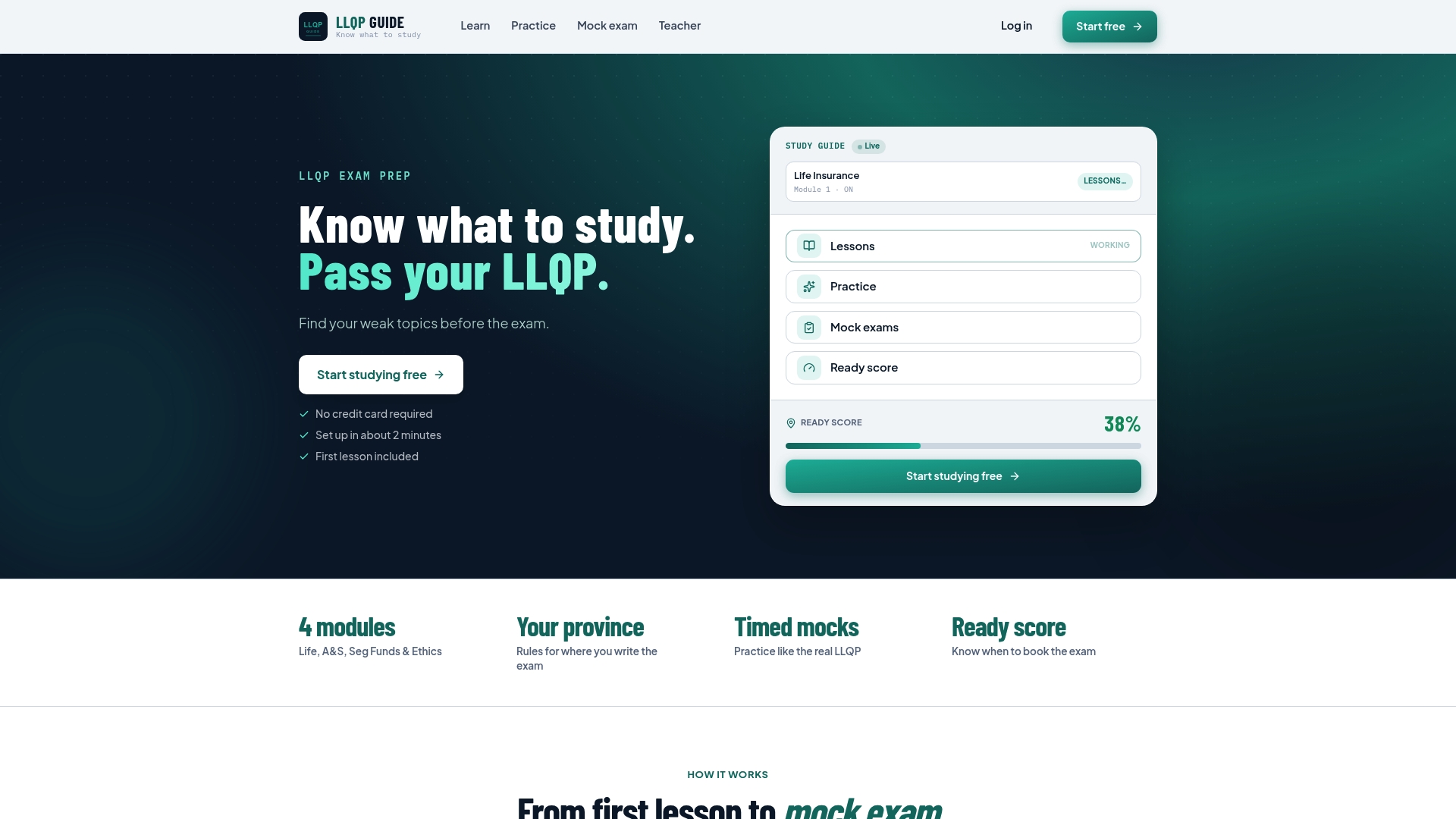
The platform covers all four LLQP modules with province-specific lessons, unlimited practice quizzes, and full-length mock exams timed to match real exam conditions. A built-in readiness tracker shows you where you are dropping marks before test day, so you can fix weak spots rather than discover them mid-exam. For candidates whose first language is not English, in-lesson word translation tools cover 11+ languages — a feature that matters when the difference between passing and failing comes down to understanding a single term under time pressure.
Start your free trial at Llqpguide and see where you stand before you book your exam date. If you want to check module-specific content or review pricing before committing, both are available on the site.
Sources
- Licensing Requirements - Life Licence Qualification Program | New Brunswick Financial and Consumer Services Commission
- Examination Results by Provider - CISRO
- LLQP first-time pass rates in 2024 released - Investment Executive
- CISRO guidance on statistical significance - document
Recommended
Frequently asked questions
Is the LLQP hard to pass?
The exam is manageable with structured preparation, but underestimating it — particularly for Segregated Funds & Annuities — is the most common reason candidates need a rewrite.
How long does it take to pass the LLQP?
Most candidates complete preparation over several weeks to a few months, depending on the number of modules they are writing and their prior knowledge. Each module is a separate 75-minute exam, and passing marks are valid for 12 months for licensing purposes, so candidates can space modules out if needed.
What is the LLQP passing score?
Each module contains 20–30 multiple-choice questions and must be passed independently.
Is the LLQP a good career path?
The LLQP is the mandatory licensing qualification for life insurance agents in Canada, so it is a required step rather than an optional credential. Completing it opens access to a regulated, commission-based career in life and health insurance — a field with consistent demand across all provinces.
Which LLQP module has the lowest pass rate?
Llqpguide's Segregated Funds & Annuities module covers this content with province-specific quizzes and mock exams.