Pass LLQP complaint scenarios with the graders' five step script
Pass LLQP complaint scenarios with the graders' five step script ! Hands documenting insurance complaint details A complaint, for LLQP purposes, is any expression of dissatisfaction about an insurer's or agent's product or service, distinct from a routine request for information.

Pass LLQP complaint scenarios with the graders’ five step script
A complaint, for LLQP purposes, is any expression of dissatisfaction about an insurer’s or agent’s product or service, distinct from a routine request for information. The exam expects one sequence every time: acknowledge the complaint promptly, fact‑find and record what happened, document it in a complaint log, escalate to the insurer’s formal process if it stays unresolved, and tell the client about independent dispute resolution. CISRO and CCIR guidance frames all five steps as the backbone of fair treatment of customers, and LLQP Guide’s Ethics module drills exactly this sequence.
TL;DR:
- Complaints are expressions of dissatisfaction that trigger a specific handling process, unlike routine questions seeking information.
- Proper complaint handling requires prompt acknowledgment, detailed fact-finding, accurate documentation, escalation if unresolved, and informing clients about dispute resolution options.
- Regulators expect firms to analyze complaint patterns for systemic issues and respond within days, not weeks, to demonstrate fair treatment.
- Exam scenarios prioritize judgment over memorization, requiring candidates to follow the sequence of fair treatment, transparency, and proper documentation.
- Practicing timed, scenario-based quizzes and mock exams enhances the ability to apply complaint handling procedures under exam conditions.
Table of Contents
- What counts as a complaint under LLQP rules?
- How does the LLQP exam test complaint handling?
- What do CCIR and CISRO expect from agents handling complaints?
- Three exam-style complaint scenarios with model answers
- What belongs in a complaint log entry?
- Which LLQP Guide tools build complaint-handling skill?
- What new agents get wrong about complaints
- Practise complaint scenarios before exam day
- Sources
- FAQ
What counts as a complaint under LLQP rules?
The line between a complaint and a simple question trips up more candidates than any other definitional issue on the Ethics & Professional Practice module. A client asking “what does my policy cover?” is seeking information. A client saying “you never told me this rider would cost extra, and now I’ve lost money” is complaining, because there’s dissatisfaction tied to a potential financial or service harm. The CCIR guidance on complaints handling defines a complaint as an expression of dissatisfaction about the product or service provided by an insurer or intermediary, and that framing matters because it triggers a different procedural duty than a general inquiry does.
Here’s the stepwise sequence candidates need cold, with language you can actually use:
- Acknowledge promptly. Something like “Thank you for raising this. I want to understand exactly what happened before we go further” sets the right tone and stops the client feeling dismissed.
- Fact‑find with precision. Ask what happened, when, who was involved, what documentation exists, and whether financial loss occurred. Examiners want to see you separate fact from assumption.
- Document the complaint log entry. Keep it factual: date received, complainant name, summary of the issue, facts gathered, and next steps. No editorializing.
- Escalate if unresolved. If you can’t resolve it at your level, use wording like “I’ll be forwarding this to our formal complaints department for a full review within their standard timeline.”
- Inform about independent dispute resolution. Tell the client an ombudsman or independent resolution service exists if the insurer’s internal process doesn’t resolve things, without promising a specific outcome.
Each step exists because a gap anywhere in that chain, especially skipping the ombudsman disclosure, is precisely what regulators flag as unfair treatment.
How does the LLQP exam test complaint handling?
The Ethics & Professional Practice module doesn’t ask you to recite a definition and move on. It tests judgment under a process: fact‑finding first, then identifying the legal or ethical risk in the scenario, then determining what you’re obligated to document or disclose, and finally choosing the safest professional action available. That sequence comes straight from the CISRO LLQP curriculum, and it’s why two candidates can read the same scenario and land on different answers depending on where they stop thinking.
The LLQP runs as an open‑book, modular exam with end‑of‑module tests feeding into a final exam, a structure the Canadian Securities Institute’s curriculum overview confirms is built around applying procedure under time pressure rather than pure recall. That’s good news if you’ve internalized the sequence, and bad news if you’re relying on memorized facts instead of a repeatable process.
When a scenario feels ambiguous, and several will, fall back on the fair treatment of customers principle: act in good faith, stay transparent, and facilitate resolution rather than protect yourself. That single lens resolves more borderline exam questions than any specific rule you could memorize.
What do CCIR and CISRO expect from agents handling complaints?
Canadian insurance regulation treats complaint handling as a measurable indicator of how fairly a firm and its agents treat customers, not a box to check after the fact. The CISRO and CCIR guidance on complaints handling sets out concrete expectations: complaints must be examined diligently and fairly through a process that’s simple and accessible to the client, firms need a documented policy and a running register of every complaint and the action taken, responses can’t sit indefinitely, and complainants should be kept informed as things progress.
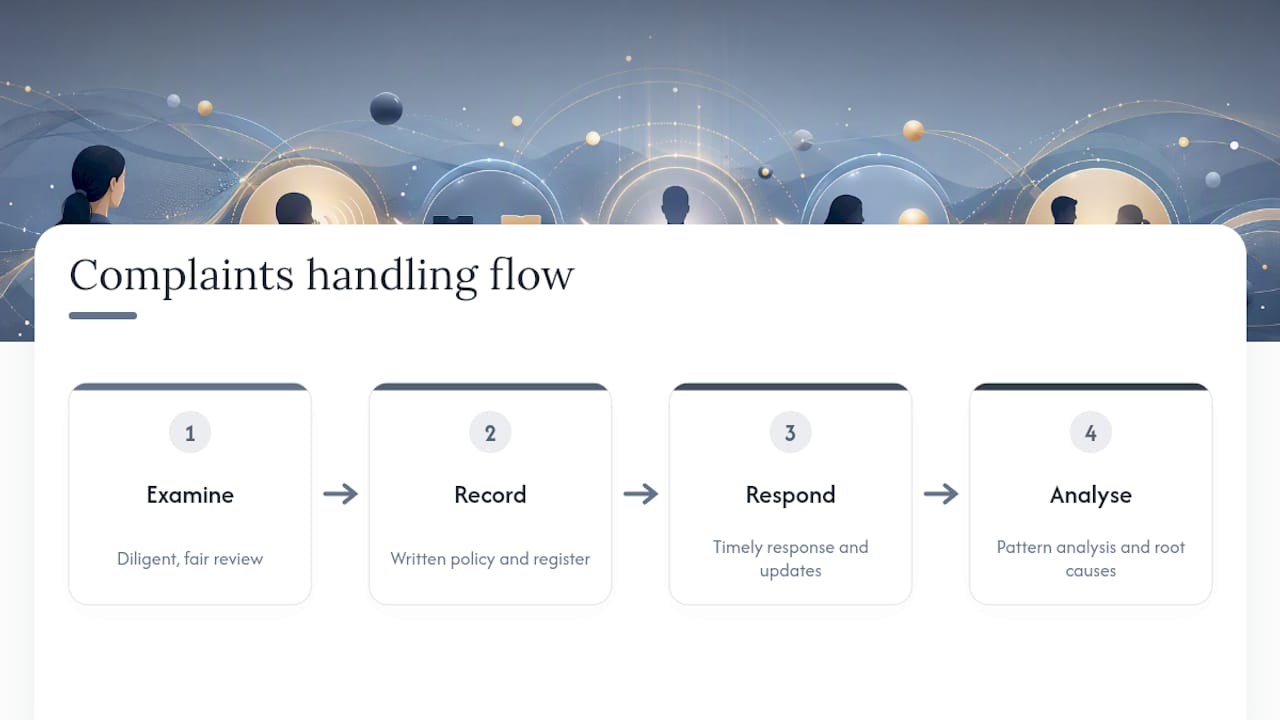
There’s a second layer that candidates often miss on the exam. Regulators expect firms to analyse complaint patterns, not just log them individually, looking for recurring issues that point to a training gap or a product disclosure problem. That’s a risk‑management function as much as a compliance one, and documenting root causes helps a firm correct errors before they repeat across dozens of clients.
In practice, this means an agent should have a written complaint policy to point to, respond to a dissatisfied client within days rather than weeks, and never let a complaint file go stale without an update to the person who filed it. On the exam, naming CCIR or CISRO briefly in an answer, even a phrase like “consistent with CCIR’s fair treatment guidance,” signals you understand where the obligation comes from rather than just what it is.
Three exam-style complaint scenarios with model answers
Reading the theory is one thing. Applying it under a 90 second exam clock is another. Here’s how three common scenario types break down.
Scenario A: You made a disclosure error. A client discovers you didn’t clearly explain a policy exclusion before they bought coverage. The safest first move is to acknowledge the client’s concern directly and confirm you’ll review exactly what was disclosed at the point of sale. Fact‑find before you defend yourself: pull the application, check what materials were provided, and document the timeline. If the client remains dissatisfied after your review, escalate to the insurer’s formal complaints channel and mention the ombudsman option.

Scenario B: A client is upset about how their claim was handled. Here the priority is communication, not resolution speed. Acknowledge the delay or the outcome, explain what you can about the claims process without overstepping into the insurer’s adjudication role, and give a realistic timeline for a response. Log every interaction date.
Scenario C: You suspect a colleague acted unethically. This one tests duty, not diplomacy. You’re obligated to investigate what you can within your authority, document what you find, and inform the affected client about independent dispute resolution options even if the misconduct isn’t confirmed yet.
Pro Tip: Lead every exam answer with the safest professional action first, then justify it with the facts and the regulation behind it. Graders are scanning for that order, and burying your conclusion under three paragraphs of scenario analysis costs you marks even when your reasoning is sound.
What belongs in a complaint log entry?
A complaint log isn’t paperwork for its own sake. It’s the evidence trail that proves an agent followed a fair process, and it’s what regulators pull first if a dispute escalates. The exam expects you to know what belongs in one:
- Date the complaint was received and the complainant’s name and contact details
- A factual summary of the issue in the client’s own words where possible
- The facts you gathered during fact‑finding, kept separate from opinion
- Actions taken and by whom, with dates attached to each
- Escalation details if the complaint moved to a formal channel
- Final outcome and the date it was communicated back to the client
Timely updates matter as much as the record itself. A client left waiting three weeks without a word interprets silence as indifference, regardless of how much work is happening behind the scenes. And as the CISRO/CCIR guidance makes clear, individual logs feed a bigger picture: patterns across multiple complaints often reveal a training gap or a systemic disclosure issue long before a regulator would find it independently.
Which LLQP Guide tools build complaint-handling skill?
Complaint handling shows up disproportionately in Ethics & Professional Practice content, which means targeted practice on that module pays off more than general review. LLQP Guide’s Ethics & Professional Practice module walks through the definitions, the stepwise procedure, and the regulatory framework in the same sequence examiners test, with unlimited quiz questions built around scenario judgment rather than fact recall.
Mock exams matter here specifically because complaint scenarios are timed‑pressure questions. Practising under simulated exam conditions trains you to reach for the acknowledge, fact‑find, document, escalate, disclose sequence automatically instead of reasoning it out from scratch each time. If English isn’t your first language, the platform’s in‑lesson translation tools help you parse dense regulatory phrasing without losing exam time to vocabulary.
A workable routine: run daily quiz drills on Ethics topics for a week, then move to full timed mock exams that mix complaint scenarios with other module content, then go back to CCIR and CISRO source guidance to fill any gaps the mocks exposed.
What new agents get wrong about complaints
The most common mistake I see in how candidates think about complaint handling isn’t a knowledge gap, it’s a sequencing gap. People know the individual steps but reach for policy clauses first, trying to figure out who’s contractually right before they’ve even acknowledged the client’s frustration. That instinct fails both the exam and real client relationships, because fairness in process comes before correctness on the merits.
The mindset that actually works is simpler than most study guides make it sound: be fair, be transparent, document everything, and don’t skip the disclosure about independent dispute resolution just because you think the insurer will resolve things internally. On the exam specifically, build the habit of stating your safest action in your first sentence, then backing it with facts and the regulatory principle behind it. Graders reward that order every time.
— Reza
Practise complaint scenarios before exam day
Reading about the acknowledge, fact‑find, document, escalate, disclose sequence only gets you so far. What separates candidates who nail these questions from those who freeze is repetition under conditions that mirror the real exam clock. LLQP Guide’s Ethics & Professional Practice module is built around exactly that: scenario‑based quiz questions and full mock exams that force you to apply the checklist in seconds, not minutes.
You get unlimited practice attempts rather than a fixed question bank you’ll exhaust in a week, and translation tools built into every lesson if English terminology is slowing you down. Check the pricing page for current plans, or start with the free trial to run through a set of Ethics module questions and see how your complaint‑handling instincts hold up before you commit to a full plan.
Sources
Recommended
Frequently asked questions
What is the difference between a complaint and a request for information?
A request for information is a neutral question about a product or policy, while a complaint expresses dissatisfaction about service or product that caused, or could cause, harm or financial loss, per CCIR guidance.
What five steps must an agent follow when handling a complaint?
Acknowledge the complaint promptly, fact‑find and record the details, document it in a complaint log, escalate to the insurer's formal process if unresolved, and inform the client about independent dispute resolution options.
Does the LLQP exam test memorization or judgment on complaint scenarios?
It tests judgment. The Ethics & Professional Practice module evaluates whether you can sequence fact‑finding, risk identification, documentation duty, and safe action selection correctly.
What should I do when an exam scenario feels ambiguous?
Fall back on the fair treatment of customers principle: choose the answer that reflects good faith, transparency, and facilitating resolution rather than the option that protects the agent.
How can I practise complaint‑handling scenarios before the exam?
Timed mock exams and scenario‑based quizzes, like those in LLQP Guide's Ethics module, train you to apply the acknowledge, fact‑find, escalate sequence automatically under exam time pressure.