Can you take the LLQP exam in Chinese?
Can you take the LLQP exam in Chinese? !

Can you take the LLQP exam in Chinese?
No. The LLQP exam in Canada is administered in English and French, not Chinese, in every province. That surprises a lot of candidates who assume a licensing exam this widely written should come in more languages, but the fix isn’t complicated: finish an approved LLQP pre-licensing course, get your Canadian Insurance Participant Registry (CIPR) number, and register through Durham College or your provincial regulator’s process. That’s the whole path, regardless of what language you think in.
What Chinese-language support actually looks like right now:
- No jurisdiction offers a Chinese-language exam form, because provincial regulators require validated language equivalence before offering any translated exam.
- Some course providers, including Llqpguide, build in Chinese translation tools and bilingual explanations to help you study, even though the final test stays in English.
- Community study groups and glossaries can bridge terminology gaps, but they’re supplements, not substitutes for practising in the exam’s actual language.
Key Takeaways
Passing the LLQP in Canada depends on English-language exam fluency, disciplined registration timing, and mock-exam practice, regardless of your first language.
| Point | Details |
|---|---|
| Exam language | The LLQP is administered in English and French only; no province offers a Chinese-language exam form. |
| Pass requirement | Score at least 60% on each of the four modules, with a pass typically valid for one year. |
| Registration order | Finish an approved course, obtain a CIPR number, then register through Durham College or your provincial portal. |
| Retake limits | Most regulators allow three retake attempts before a longer mandatory waiting period applies. |
| Chinese-language support | Use translation tools and glossaries to study concepts, but practise heavily in English since that’s the exam’s actual language. |
Table of Contents
- What does the LLQP exam in Chinese actually require you to know?
- How do you register for the LLQP if you’re a Chinese speaker in Canada?
- What should you expect on exam day, and how do retakes work?
- How should you prepare for the LLQP as a Chinese speaker?
- What test-day mistakes trip up candidates most often?
- What bilingual jobs open up once you pass the LLQP?
- How Llqpguide supports Chinese-speaking LLQP candidates
- What actually matters most for Chinese-speaking LLQP candidates?
- Sources
- FAQ
What does the LLQP exam in Chinese actually require you to know?
The LLQP tests four modules: Life Insurance, Accident & Sickness, Segregated Funds & Annuities, and Ethics & Professional Practice. Each one covers a distinct slice of the job. Life Insurance deals with policy types, underwriting, and beneficiary rules. Accident & Sickness covers disability and critical illness products. Segregated Funds & Annuities gets into investment guarantees and maturity calculations. Ethics tests judgment through client scenarios, not memorization.
You need a minimum score of 60% on each module to pass, and a pass result is generally valid for one year to apply for a licence. Miss that window and you may have to rewrite.
- CISRO (Canadian Insurance Services Regulatory Organizations) sets the national framework and psychometric standards behind the exam.
- FSRA administers licensing in Ontario.
- The Insurance Council of British Columbia handles licensing and exam policy in BC.
Each regulator runs its own licensing process on top of the shared national exam structure, so a pass in one province doesn’t automatically transfer without provincial paperwork.
How do you register for the LLQP if you’re a Chinese speaker in Canada?
Registration follows the same sequence no matter what language you’re most comfortable in. The one place Chinese speakers sometimes stumble is assuming a translated study course changes the registration process. It doesn’t.
- Complete an approved pre-licensing course. Providers issue a certificate once you finish, and this certificate is what proves you’re eligible to sit the exam.
- Obtain your CIPR number. The Canadian Insurance Participant Registry number is a prerequisite for exam registration in every province, and your course provider typically helps generate it.
- Register and schedule through Durham College or your provincial regulator’s designated portal. Durham College runs the national LLQP exam booking system that most provinces rely on for scheduling.
Course certificates are usually valid for 12 to 24 months depending on the regulator, and Durham College performs eligibility checks before confirming your exam booking. Some provinces, like Saskatchewan, route candidates directly through Durham College with minimal extra steps; others add residency or documentation checks. If you’re studying in Ontario or BC specifically, the provincial process is worth reading in detail before you book, since Ontario’s steps and BC’s steps differ slightly in how eligibility gets confirmed.
What should you expect on exam day, and how do retakes work?
Each module has a set duration standardized by the exam administrators, and some exams include unscored pilot questions used to test future exam content, so don’t panic if a question feels oddly worded or unfamiliar.
Delivery varies by province. Durham College handles online scheduling in most jurisdictions now, though some provinces still require in-person sittings at approved test centres depending on regulator rules. Either way, expect live proctoring and identity verification before the exam starts.
- Results for in-person exams in areas like Metro Vancouver typically arrive within 5 business days.
- Online exam results usually take up to 7 business days.
- A pass is generally valid for one year, giving you a window to apply for your provincial licence.
- Most regulators allow multiple retake attempts, after which a mandatory waiting period applies before you can try again.
That retake structure matters more than it looks. Burning through three attempts on avoidable mistakes, like showing up with an expired course certificate, costs you months, not days.
How should you prepare for the LLQP as a Chinese speaker?
Start with a diagnostic. Before you commit hours to any single module, run a baseline quiz across all four to find out where you’re actually weak, not where you assume you’re weak. Most candidates guess wrong.
- Ethics first. This module trips up more people than any technical one, because it tests judgment through scenarios rather than fact recall. Practise with real case-style questions, not flashcard definitions.
- Segregated Funds & Annuities second. The math around guarantees and maturity dates is unforgiving if you skip practice calculations.
- Life Insurance and Accident & Sickness third. These modules reward straightforward repetition once the terminology is locked in.
- Full-length timed mocks last, and repeatedly. Multiple passes through a realistic mock exam build the stamina and pacing that a single study session never will.
Chinese-language study aids narrow the gap without replacing English fluency. Bilingual glossaries for regulatory terms, flashcards with Chinese-language notes, and Chinese explanation threads for confusing wording all help you understand a concept faster. Community forums where Chinese-speaking candidates share preparation notes echo this pattern: people who lean on glossaries built around actual Canadian regulatory phrasing outperform those who translate exam terms literally.
Llqpguide’s platform is built around this exact sequence: province-specific lessons, unlimited practice quizzes to isolate weak spots, full-length mock exams under realistic timing, and in-lesson translation tools covering Chinese among 11-plus languages.
Pro Tip: Study the English phrasing of key regulatory terms side by side with the Chinese translation, not instead of it. Literal translation can flatten legal nuance, and the exam tests you on the English wording, so your brain needs to recognize both versions on sight.
Candidates who treat translation as a study aid rather than a shortcut consistently report fewer surprises on exam day, because the exam never stops being in English no matter how well you understand the concept in Chinese.
What test-day mistakes trip up candidates most often?
Regulators are consistent on this point: a lot of failed attempts come down to avoidable process errors, not weak subject knowledge.
- Bring valid government-issued photo ID that exactly matches the name on your course completion confirmation.
- Confirm your calculator is a non-programmable scientific model; anything else can be confiscated at the door.
- Arrive early, especially for in-person sittings where check-in lines can eat into your start time.
- Double-check your course certificate hasn’t expired before you schedule, since an expired certificate blocks registration outright.
- For online proctoring, complete identity verification well before your slot; last-minute technical issues have failed candidates before the exam even starts.
Pro Tip: If you have a documented learning disability or medical condition affecting exam performance, request accommodations directly through your provincial regulator well ahead of your test date. Most require supporting documentation, and processing takes time you don’t want to lose the week before your exam.
What bilingual jobs open up once you pass the LLQP?
A passed LLQP with Chinese fluency is a specific, marketable combination in Canada’s insurance sector, where client bases in cities like Vancouver, Toronto, and Richmond Hill often include large Mandarin and Cantonese-speaking communities.
- Life insurance advisor or sales agent roles at firms actively recruiting bilingual staff to serve Chinese-speaking clients.
- New business associate positions processing applications where bilingual client communication is a daily requirement.
- Customer service representative roles at insurers and brokerages needing Chinese-language phone and email support.
- Bilingual claims or client service positions where you’re the bridge between English-language paperwork and Chinese-speaking policyholders.
When you apply, lead with concrete evidence: client-facing experience, any translated materials you’ve produced, or measurable outcomes like the number of clients you’ve supported. From there, finish your licensing paperwork, register with your provincial broker registry, build a bilingual resume and LinkedIn profile, and network directly in Chinese-speaking business associations, since many bilingual roles get filled through referral before they’re ever posted.
How Llqpguide supports Chinese-speaking LLQP candidates
If the biggest risk for Chinese-speaking candidates is losing nuance in translation, the fix is studying with tools built for exactly that problem. Llqpguide combines province-specific lessons, unlimited practice quizzes, and full-length mock exams with in-lesson translation support across Chinese and 10 other languages, so you can check your understanding of a concept without ever losing sight of how it’s actually phrased in English on exam day.
The platform’s mock exams are built to mirror real exam conditions, including timing and question style, which matters most for the Ethics module where scenario-based judgment questions catch unprepared candidates off guard. Readiness tracking flags which modules need more attention before you burn a real attempt on a weak area.
Explore the full pricing options to find a plan that fits your timeline, or start with the Ethics module prep if scenario questions are your biggest concern. For a full walkthrough of what the platform covers, visit the Llqpguide homepage.
What actually matters most for Chinese-speaking LLQP candidates?
Here’s the take: too much advice aimed at Chinese-speaking candidates treats language as the whole problem, when it’s really only half of it. The other half is process discipline, and regulators say this outright: failed attempts often trace back to expired certificates, mismatched ID, or missed proctoring verification rather than weak subject knowledge.
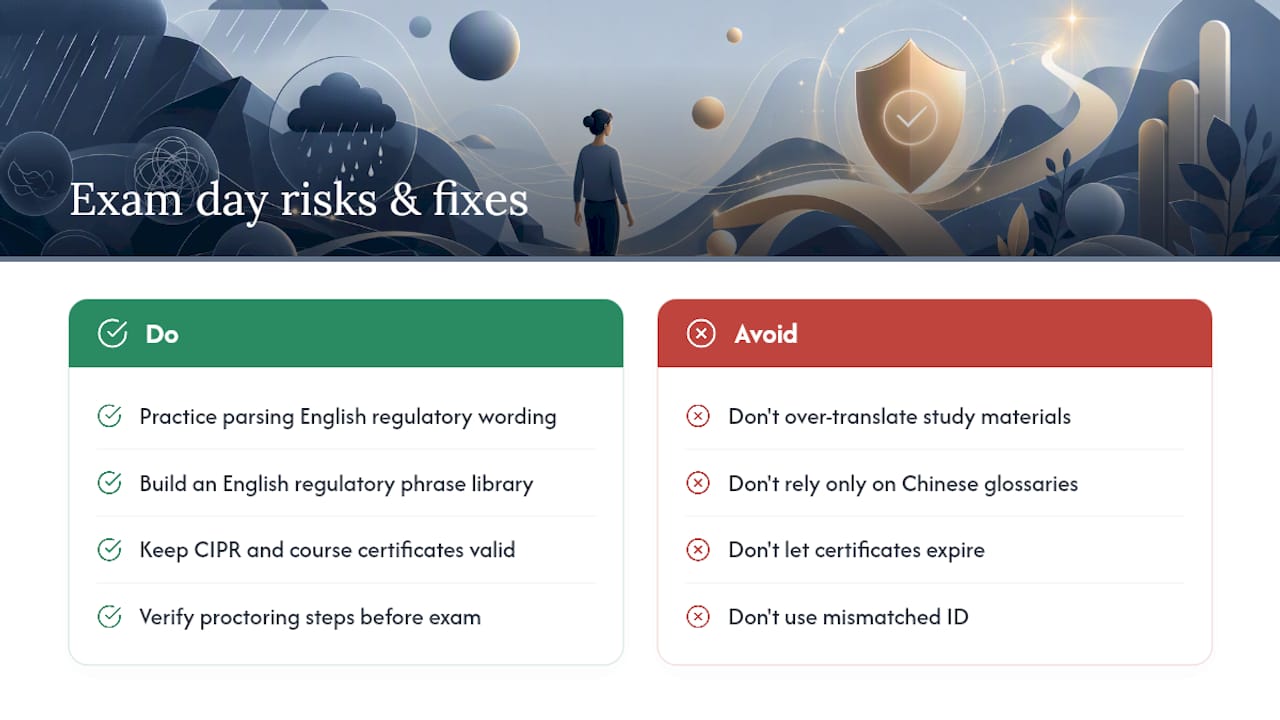
I’d push back on the instinct to over-translate. Building a mental library of English regulatory phrasing, even while studying primarily in Chinese, pays off more than any glossary alone. The exam doesn’t test your Chinese comprehension of insurance concepts. It tests your ability to parse English legal and regulatory wording under time pressure, and that’s a specific skill you have to practise deliberately, not something that transfers automatically from understanding the underlying concept.
If you take one thing from this: treat your CIPR registration and course certificate deadlines with the same seriousness you give the Ethics module. Both can end an exam attempt before you’ve answered a single question.
— Reza
Sources
- LLQP exam information and registration | Insurance Council of British Columbia
- Life Licence Qualification Program (LLQP) | Financial Services Regulatory Authority of Ontario
- LLQP Examination Administration Policy | Insurance Council of British Columbia
Recommended
Frequently asked questions
Is it easy to pass the LLQP exam?
Consistent mock-exam practice makes the biggest measurable difference.
How much does LLQP cost?
Costs vary by province and provider, covering the pre-licensing course, exam registration fees, and any study materials you choose, so check your provincial regulator's current fee schedule directly.
How long does it take to pass LLQP?
Timelines depend on your course pace and study habits, but most candidates complete the pre-licensing course and pass all four modules within a few months of consistent study.
Is the LLQP an open-book exam?
No, the LLQP is a closed-book exam. You're permitted a non-programmable scientific calculator and valid photo ID, but no reference materials or notes.