Life insurance LLQP: guide for Canadian exam candidates
Life insurance LLQP: guide for Canadian exam candidates ! Hands adjusting timer during life insurance LLQP study The LLQP (Life License Qualification Program) is Canada's nationally standardised pre-licensing program for anyone who wants to sell life insurance or related products.

Life insurance LLQP: guide for Canadian exam candidates
The LLQP (Life License Qualification Program) is Canada’s nationally standardised pre-licensing program for anyone who wants to sell life insurance or related products. To get started, enrol with a regulator-approved course provider, complete the required modules, then book your provincial exam through Durham College and apply for your licence within 12 months of your first pass.
At a glance:
- Four modules: Life Insurance; Accident & Sickness; Segregated Funds & Annuities; Ethics & Professional Practice
- Pass mark: 60% per module
- Exam provider: Durham College (external administrator for most provinces)
- Licence application window: Apply within 12 months of your first module pass
- Québec exception: Uses a civil-code variant with distinct training and exam requirements
Key takeaways
Passing the LLQP requires completing four modules with a 60% pass mark per exam, applying for your provincial licence within 12 months of your first pass, and confirming home-province rules on E&O insurance and sponsorship before you sit.
| Point | Details |
|---|---|
| Four modules, one exam each | Life Insurance, Accident & Sickness, Segregated Funds & Annuities, and Ethics each have a separate exam at 60% to pass. |
| Plan for ~100 hours of study | Budget roughly 30 hours per module; candidates who rush below this threshold tend to underperform on first attempt. |
| The one-year rule is a hard deadline | Apply for your provincial licence within 12 months of your first module pass or risk losing pass validity. |
| Ethics is the surprise failure point | It tests regulatory frameworks and conduct rules, not intuition; treat it as a separate, law-focused study block. |
| Llqpguide offers province-specific prep | Unlimited mock exams, timed drills, and readiness tracking help candidates identify weak areas before exam day. |
Table of Contents
- What does the life insurance LLQP cover, and who needs it?
- What each LLQP module tests
- Who can register, and what are the prerequisites?
- How are LLQP exams delivered, and what are the retake rules?
- How long does the LLQP take, and what does it cost?
- Where can you study? Finding regulator-approved providers
- A practical 6–8 week study plan
- What happens after you pass the LLQP?
- Why the LLQP matters more than most candidates realise
- Llqpguide gives you the practice tools to pass on your first attempt
- Sources
- FAQ
What does the life insurance LLQP cover, and who needs it?
The LLQP is mandatory across most of Canada for anyone who will solicit or sell life insurance, accident and sickness products, segregated funds, or annuities. That includes life insurance agents, brokers, and financial advisers whose practice involves these product lines. Completing the LLQP modules and passing the provincial exams is the legal gateway to those activities in most provinces.
Who typically needs the LLQP:
- Individuals entering the life insurance industry as agents or brokers
- Financial advisers adding life or A&S products to their practice
- Mortgage brokers or mutual fund dealers who want to offer life coverage
- Existing advisers seeking to expand into segregated funds or annuities
The curriculum and licensing standards are set by CISRO (Canadian Insurance Services Regulatory Organizations) in coordination with provincial regulators such as FSRA (Ontario), the Insurance Council of British Columbia, and their counterparts in every other province. Québec is the notable exception: the Autorité des marchés financiers (AMF) administers a civil-code variant with its own authorised training routes and exams, so candidates based in Québec should go directly to the AMF for their requirements.
What each LLQP module tests
The four modules each have their own exam and their own content focus. Here is what you are actually studying in each one.
Life insurance
This is the core module for most candidates. Topics include term, whole, and universal life products; how life insurance is taxed; underwriting principles; needs analysis; business uses of life insurance (key-person coverage, buy-sell agreements); and ongoing policy service obligations. You can find module-specific lessons and practice questions to work through these topics systematically.
Accident & sickness
Covers individual and group A&S policy types, benefit structures, elimination periods, disability definitions, and the basics of group coverage. Not every candidate needs this module for their licence, but many provincial licences bundle it with life insurance, so confirm your home-province requirements before skipping it.
Segregated funds & annuities
Focuses on the investment features of segregated fund contracts, annuity mechanics, maturity and death benefit guarantees, investor suitability, and how these products fit into a client recommendation. Dedicated study materials for this module help candidates distinguish the insurance-contract features from comparable mutual fund concepts.
Ethics & professional practice
Candidates consistently underestimate this module. It is not about intuitive ethics. It tests the regulatory framework (CISRO standards, provincial conduct rules), consumer protection legislation, complaint-handling procedures, and the distinction between common-law obligations and Québec’s civil-code framework. It is a frequent failure point for candidates who focus only on product knowledge. Targeted Ethics prep is worth treating as a separate study block, not an afterthought.
Who can register, and what are the prerequisites?
Basic eligibility
Most provinces require candidates to be at least 18 years old and hold a high-school diploma or equivalent (some provinces accept a Canadian Adult Education Certificate). A clean criminal record is not a formal prerequisite for writing the exam, but it is typically required when applying for the licence itself, so address any record issues before you invest study time.
What you need before booking the exam
FSRA confirms that candidates must present a valid course completion certificate from a regulator-approved provider before they can register for a provincial exam. You also need a CIPR (Canadian Insurance Participant Registry) number. Course completion certificates carry a validity window, so do not finish your course and then wait months before booking.
Provincial differences matter more than most candidates expect:
- Home-province rules govern which exam sittings you can attend and whether online delivery is available
- Québec’s AMF requirements are entirely separate from the common-law LLQP stream
- Some provinces restrict exam eligibility to residents; confirm this before booking in another province
- Sponsorship and employer-registration rules vary; independent candidates face different requirements than those hired by an insurer
Pro Tip: Confirm your home-province licensing rules — including E&O insurance requirements and whether you need a sponsoring insurer before or after passing — before you even enrol in a course. Discovering a sponsorship requirement after you pass can delay your licence by weeks.
How are LLQP exams delivered, and what are the retake rules?
Exam delivery
Durham College is the designated external exam administrator for LLQP module exams in most provinces. Exams are available online, though some provinces impose residency restrictions on which candidates can use online delivery. Each module is examined separately, so you book and write each one individually.
Format and pass mark
Each module exam consists of multiple-choice questions. The standard passing grade is 60%. Time limits apply per module; check your provincial regulator’s current exam guide for the exact question count and timing for each module, as these can vary slightly by jurisdiction.
60% is the pass mark for every LLQP module exam. It sounds achievable, but candidates who skip full-length mock exams under timed conditions often find the real exam harder than their practice scores suggested.
Retake rules
FSRA documents a structured supplemental-exam system: you get a limited number of attempts before mandatory waiting periods kick in. After three failed attempts at a module, a cooling-off period applies before you can write again, and in some cases you may need to re-enrol in the course. The practical implication: treat every attempt as if it is your last. Reaching the cooling-off threshold adds months to your timeline and costs you additional course and exam fees.
Steps before booking your exam:
- Confirm your CIPR number is active
- Obtain your course completion certificate and check its expiry date
- Verify your province’s residency and eligibility rules with your provincial regulator
- Book through Durham College’s exam portal for your module(s)
How long does the LLQP take, and what does it cost?
Study time
Industry guidance estimates roughly 30 hours per module and about 100 hours total for candidates completing all four modules. That is a planning baseline, not a guarantee. Candidates with a financial services background often move faster through the product modules; those newer to insurance tend to need more time on Life Insurance and Ethics.
Plan for approximately 100 hours of study across all four modules, or roughly 30 hours per module. Candidates who compress this into less than four weeks without prior industry knowledge tend to underperform on their first attempt.
Course formats and timeline
Most approved providers offer self-paced online courses, which let you work through modules on your own schedule. Instructor-led classroom options exist but are less common. Some insurers run in-house cohorts for new hires. A self-paced candidate who studies consistently can complete the course content in six to ten weeks; a classroom cohort typically runs on a fixed schedule of similar length.
Costs
Prerequisite course fees vary by provider and by the number of modules you need. Courses covering all four modules generally range from a few hundred dollars to over a thousand, depending on the provider and whether study materials, practice exams, and the completion certificate are bundled. Exam fees are charged separately by Durham College per module sitting. Budget for E&O insurance and provincial licence application fees on top of course and exam costs.
Where can you study? Finding regulator-approved providers
Only courses from regulator-approved providers satisfy the completion-certificate requirement. Writing the exam without one is not possible. Provincial regulators publish lists of accredited providers on their licensing pages; CISRO also maintains curriculum references that approved providers must align with.
What to look for in a provider:
- Explicit approval from your home province’s regulator (not just a general claim of being “LLQP-approved”)
- A clear certificate of completion issued with a date, so you can track your validity window
- Study materials that map directly to the CISRO curriculum for each module
- Practice questions and, ideally, full-length mock exams under timed conditions
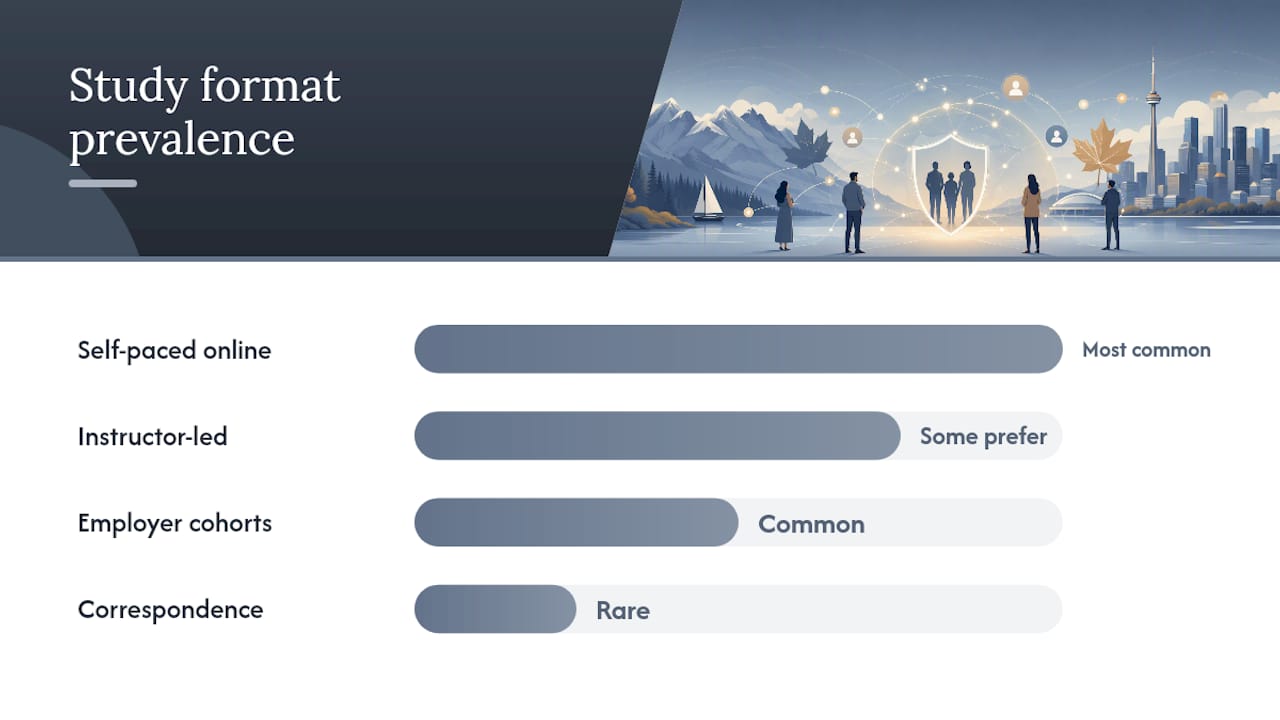
Study formats vary: self-paced online is the most common and the most flexible. Some candidates prefer instructor-led delivery for the structure and the ability to ask questions in real time. Employer-run cohorts are common at large insurers and banks. Correspondence-based options exist but are rare.
Pro Tip: Choose a provider that includes high-fidelity mock exams, not just chapter quizzes. A mock exam that mirrors the real exam’s question style, timing, and difficulty is the single most reliable predictor of first-attempt success. A certificate with a clear issue date is equally non-negotiable.
Approved provider lists are available through FSRA (Ontario), the Insurance Council of British Columbia, and equivalent bodies in every other province. The Llqpguide modules overview also includes province-specific guidance as a starting point.
A practical 6–8 week study plan
A structured plan beats cramming. Here is a realistic week-by-week approach for a candidate completing all four modules.
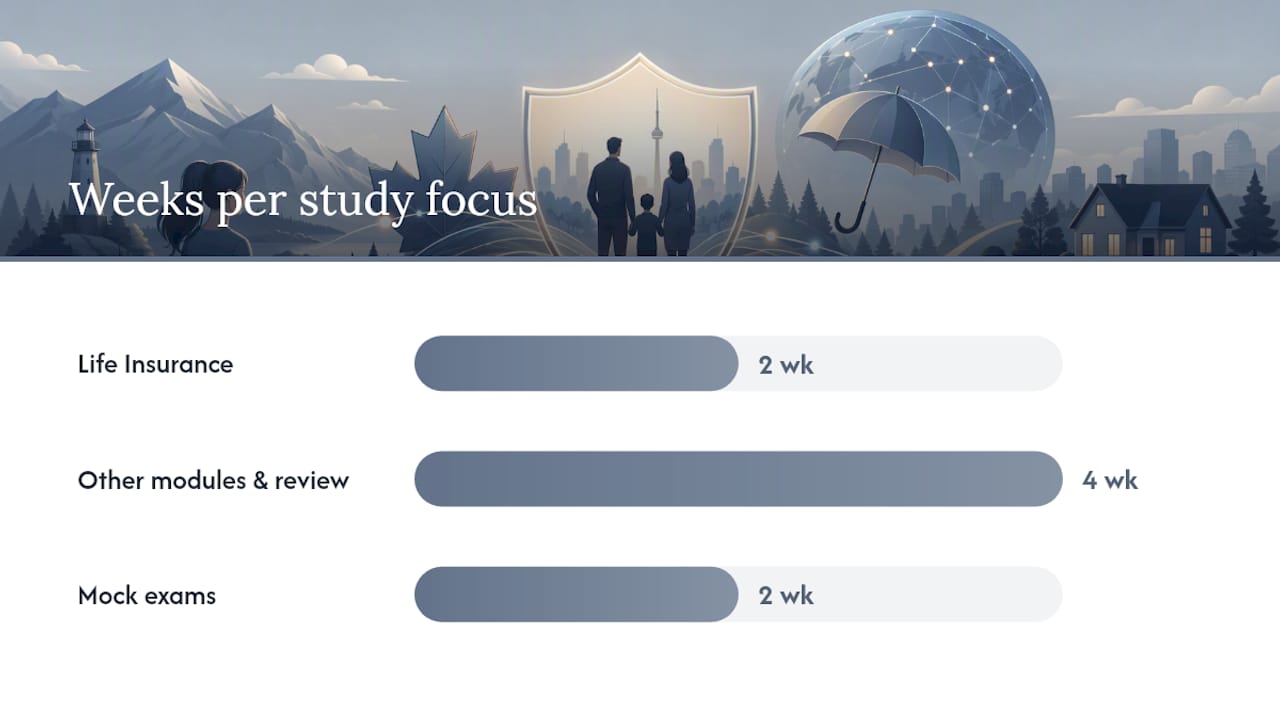
- Week 1: Life Insurance module, chapters 1–3 (product types, policy structure, taxation basics). Read actively, take notes, do chapter-end questions.
- Week 2: Life Insurance, chapters 4–6 (underwriting, needs analysis, business uses). Complete a timed module quiz at the end of the week to benchmark.
- Week 3: Accident & Sickness module in full. It is shorter than Life Insurance; aim to finish content and do a full timed drill by Friday.
- Week 4: Segregated Funds & Annuities module. Focus on contract mechanics and suitability rules, which are the most exam-heavy topics.
- Week 5: Ethics & Professional Practice. Treat this as a regulatory law course, not a values exercise. Map out the CISRO framework, provincial conduct rules, and consumer protection provisions explicitly.
- Week 6: First full-length mock exam covering all modules. Review every wrong answer before touching new material. Identify your two weakest modules.
- Week 7: Targeted review of weak modules. Do timed drills on specific topic areas, not passive re-reading.
- Week 8: Second full-length mock exam, then a final light review of flagged topics. Book your exam if mock scores are consistently above 70%.
Practice strategy:
- Start with untimed chapter questions to build understanding
- Move to timed module drills once you have covered the content
- Use full-length mock exams in weeks 6 and 8 to simulate real exam pressure
- Review every wrong answer with the explanation, not just the correct option
Test-day checklist:
- Valid government-issued photo ID
- CIPR number confirmed and accessible
- Exam confirmation from Durham College
- Quiet, distraction-free environment if writing online
- Read each question fully before selecting an answer; flag uncertain ones and return
Pro Tip: The Ethics module rewards candidates who treat it like a regulatory framework study, not a personality test. Write out the key conduct rules and complaint-handling steps from memory at least twice before your exam date. Passive reading does not work for this module.
What happens after you pass the LLQP?
Passing your module exams is not the finish line. You still need to convert those passes into an active provincial licence.
Licence application checklist:
- Apply to your provincial regulator’s licensing portal (FSRA in Ontario, Insurance Council of BC, and equivalents elsewhere) within 12 months of your first module pass. FSRA is explicit about this window; missing it means your passes may no longer be valid.
- Submit proof of exam passes and your course completion certificate
- Arrange Errors & Omissions (E&O) insurance before or immediately after applying, as most provinces require it for licence issuance
- Confirm whether your province requires a sponsoring insurer or managing general agent (MGA) to co-sign your application; requirements vary by jurisdiction
- Pay the provincial licence application fee
After your licence is issued:
- You may begin soliciting and selling the product lines your licence covers
- Continuing education (CE) credits are required for licence renewal; the number of hours and the renewal cycle vary by province
- Keep your E&O insurance current throughout your licensed career
- Notify your regulator promptly of any address, employer, or status changes
Province-specific procedural details for Ontario candidates are covered on the Llqpguide Ontario page, and BC candidates can find equivalent guidance on the BC page.
Why the LLQP matters more than most candidates realise
The standard framing around the LLQP is that it is a compliance hurdle: pass it, get licensed, move on. That framing undersells what the credential actually does for a career.
The LLQP is not just a legal permission slip. It is the foundation of product knowledge that separates advisers who can have credible client conversations from those who are reading from a script. The Life Insurance module’s coverage of needs analysis and business uses, the Segregated Funds module’s suitability framework, and the Ethics module’s conduct rules are all things you will use in client meetings from day one. Advisers who treat the study process seriously tend to start client relationships with noticeably more confidence.
The career upside is also worth stating plainly. Completing the LLQP opens a career path built on recurring renewal commissions, with strong long-term earning potential for client-focused professionals. The LLQP also teaches transferable skills, including product knowledge, needs analysis, and risk management, that explain why some already-credentialled financial planners complete it even when they are not required to.
What I would push back on is the assumption that the Ethics module is the “easy” one. Every year, candidates who sailed through the product modules get caught by Ethics because they studied it like a product module. It is a regulatory law exam. The candidates who pass on the first attempt treat it that way.
Llqpguide gives you the practice tools to pass on your first attempt
Most LLQP prep courses give you content. What they often skip is the exam simulation that actually builds confidence. Llqpguide is built specifically for that gap: province-specific lessons, unlimited practice quizzes, full-length mock exams that mirror real exam conditions, and readiness tracking so you know when you are genuinely ready to book.
If English is not your first language, the platform includes in-lesson word translation tools covering 11+ languages, which removes one of the most common sources of exam-day confusion. The mock exams are timed and structured to match the actual Durham College format, so the real exam feels familiar rather than surprising.
You can start with a free trial, then choose a monthly, quarterly, or annual subscription based on how many modules you need. Province-specific guidance is built in for Ontario, BC, and other provinces. See the full module library, check Llqpguide’s pricing, or go straight to the Life Insurance module to start practising today.
Sources
Before you book your exam, confirm details directly with these official sources.
- Life License Qualification Program (LLQP) | Government of Prince Edward Island
- Life Licence Qualification Program (LLQP) | Financial Services Regulatory Authority of Ontario
- Compulsory training | AMF
- A financial planner’s guide to LLQP course | Wealth Professional
- How to become a life insurance agent in Canada | Insurance Business Magazine
- LLQP | Insurance Council of British Columbia
Recommended
Frequently asked questions
Is the LLQP worth getting?
Yes. The LLQP is the legal requirement to sell life insurance and related products in most Canadian provinces, and completing it opens a career path with recurring renewal commissions and strong long-term earning potential.
How do you get the LLQP in Canada?
Enrol in a regulator-approved course, complete the required modules, obtain your course completion certificate, register your CIPR number, then book and pass each module exam through Durham College. Apply for your provincial licence within 12 months of your first pass.
How much does the LLQP cost in Ontario?
Course fees vary by provider and module count; full four-module courses typically range from a few hundred dollars to over a thousand. Durham College charges separate exam fees per module sitting, and you will also need to budget for E&O insurance and the provincial licence application fee.
How long does it take to get the LLQP?
Most candidates complete the course content in six to ten weeks studying part-time. Industry guidance estimates roughly 100 hours of total study time across all four modules, or about 30 hours per module.