How to get your insurance agent licence in Canada
How to get your insurance agent licence in Canada ! Hand starting timer on study desk Most people asking about an insurance agent licence in Canada actually need one of two things: the Life Licence Qualification Program (LLQP) for life, accident & sickness, or segregated funds sales or a provincial general/OTL licence for home, auto, and business insurance.

How to get your insurance agent licence in Canada
Most people asking about an insurance agent licence in Canada actually need one of two things: the Life Licence Qualification Program (LLQP) for life, accident & sickness, or segregated funds sales or a provincial general/OTL licence for home, auto, and business insurance. If you’re going the life route, your next move is simple: enrol in an accredited LLQP course, register for a CIPR (Canadian Insurance Participant Registry) number, and start booking your four modular exams.
Every licence in Canada is issued provincially, not federally, through regulators like the Financial Services Regulatory Authority of Ontario (FSRA) or the Insurance Council of BC. That means the paperwork changes depending on where you live and work, but the broad shape of the process is the same everywhere:
- Study for and pass your provincial exam (LLQP for life, OTL/Level 1 for general)
- Line up a sponsoring insurer or brokerage if your licence type requires one
- Pass a criminal record check
- Apply to your provincial regulator and pay the fee
- Renew on schedule and complete continuing education
Key Takeaways
Getting licensed in Canada means passing the right exam for your province, securing sponsorship where required, and applying directly to your provincial regulator.
| Point | Details |
|---|---|
| Pick the right licence first | Life sales need the LLQP; general/OTL covers home, auto, and casualty products. |
| CIPR comes before exams | Register your CIPR profile before booking any LLQP modular exam. |
| Sponsorship isn’t optional in most provinces | Ontario’s general licence, for example, requires sponsorship by a licensed insurer. |
| Budget for real costs and time | Total licensing costs commonly run $400 to $1,000, with processing taking days to weeks. |
| Use structured LLQP prep | LLQPGuide offers province-specific lessons and mock exams across all four LLQP modules. |
This article is general information, not a substitute for advice from a qualified lawyer. Consult a qualified legal professional about your own circumstances before acting on anything here.
Table of Contents
- Insurance agent license Canada checklist: steps and timelines
- Which insurance licence do you actually need?
- How does licensing differ by province?
- What’s the best way to study for the LLQP exams?
- Applying to your regulator after you pass
- Keeping your licence active after you’re approved
- Recommended LLQP exam-prep option
- Sources
- FAQ
Insurance agent license Canada checklist: steps and timelines
Before you touch an application form, confirm you’ve got the basics lined up. Missing one document is the single biggest reason applications get bounced back for correction, which adds weeks to a process that should take days.
- Confirm your licence type — life (LLQP) or general/OTL, based on what you plan to sell.
- Enrol in an accredited pre licensing course through a provider like the Insurance Institute of Canada or IFSE Institute.
- Register for a CIPR profile if you’re pursuing LLQP modules.
- Book and pass your exams within the provincial validity window.
- Secure sponsorship from a licensed insurer or brokerage, if your province requires it.
- Submit your criminal record check.
- Apply to your provincial regulator and pay the licensing fee.
- Track your renewal date and CE hours from day one.
Pro Tip: Course completion often has an expiry window before you can write the matching exam. Some jurisdictions apply a roughly 24-month limit, as Prince Edward Island’s LLQP guidance notes, so don’t finish your course and then sit on it for a year.
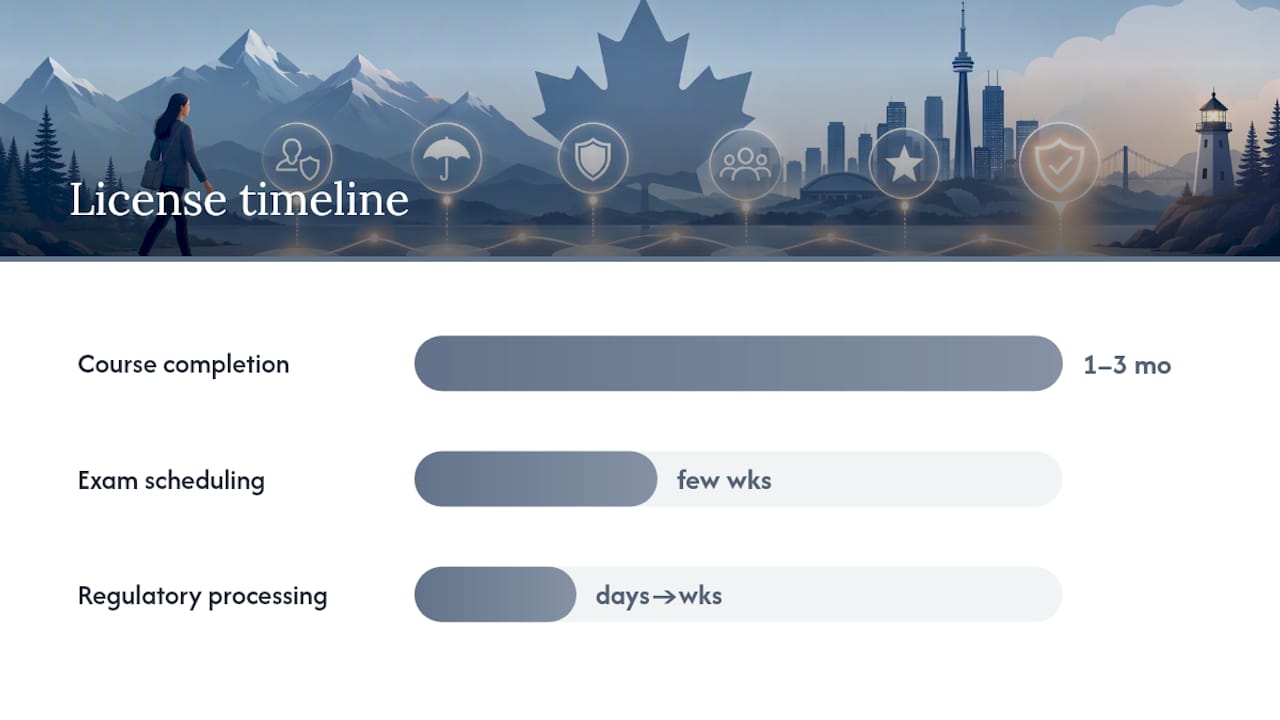
Budget one to three months for course completion, another few weeks for exam scheduling, and anywhere from a few days to several weeks for the regulator to process your application once submitted.
Which insurance licence do you actually need?
The word “insurance agent” covers several distinct licences, and picking the wrong one wastes both time and course fees. Here’s how they break down.
- Life licence (LLQP) — required to sell life insurance, and it also covers accident & sickness and segregated funds/annuities depending on which modules you complete.
- General insurance licence (OTL/Level 1) — covers property, auto, and casualty products; this is the “general insurance agent” path most people mean when they say P&C.
- Broker licence — in provinces like Ontario, brokers (regulated by RIBO) can represent multiple insurers, while agents are typically tied to one.
- Adjuster licence — a separate credential for handling and settling claims, not for selling policies.
The LLQP itself is built from four modules, and you only write the ones relevant to what you’ll sell:
- Life Insurance — the foundation module, required for anyone selling life products.
- Accident & Sickness — covers disability and critical illness coverage.
- Segregated Funds & Annuities — needed if you’ll sell investment-linked insurance products.
- Ethics & Professional Practice — mandatory for every LLQP candidate, regardless of specialization.
You need a CIPR profile before you can register for any of these exams, since course providers upload your results directly to that registry.
How does licensing differ by province?
This is where most first-time applicants get tripped up. The licence category might be the same across the country, but the regulator, the exam, and the paperwork are not.
- Ontario — FSRA handles general agent licensing; life agents write the LLQP. General licences require sponsorship by a licensed insurer, and FSRA’s own guidance puts the new-application fee at $150, covering your first two years.
- British Columbia — the Insurance Council of BC oversees licensing, and BC has historically run unique prerequisite routes (such as C81/C82 or C11 plus C130) that differ from other provinces, per the Insurance Institute’s provincial guide.
- Quebec — licensing runs through the Autorité des marchés financiers (AMF), with its own exam structure separate from the LLQP model used elsewhere.
- Alberta — often uses CAIB1 as an alternate general licensing pathway alongside LLQP for life products.
- Ontario brokers specifically — need to satisfy RIBO exam requirements, though a CIP designation from the Insurance Institute of Canada can create exemptions in some cases.
Criminal record and suitability checks are typically handled one of two ways: your sponsoring insurer submits results on your behalf, or you go through a regulator-approved vendor. FSRA, for example, offers an approved vendor option called Triton, priced around $19.15, as an alternative to sponsor submission.
Pro Tip: If you plan to work across provincial lines, check the CCIR/CISRO jurisdictional overview first. Most provinces accept joint non-resident application forms, but Yukon and Alberta run their own exceptions, so don’t assume reciprocity applies everywhere.
What’s the best way to study for the LLQP exams?
Passing four modular exams on the first attempt comes down to sequencing and repetition, not cramming the week before.
- Start with Life Insurance and Ethics — these two modules underpin the other two, so learning them first makes Segregated Funds and A&S click faster.
- Study in short, spaced blocks — 45 to 60 minutes a day beats one long weekend session for retention.
- Run at least two full-length mock exams per module before booking the real thing, timed under real exam conditions.
A few practical notes candidates often miss:
- Your CIPR profile has to be active before you can register for any exam date.
- Keep proof of course completion on hand. Regulators sometimes request it separately from your exam results.
- Watch your exam eligibility window so a completed course doesn’t expire before you sit the test.
Pro Tip: Weak spots hide best in modules you’ve only skimmed once. A platform like LLQPGuide that tracks readiness by module makes it obvious where you actually need another pass.
Applying to your regulator after you pass
Once your exams are done, the application itself is mostly a documents exercise. You’ll typically need government ID, proof of course and exam completion, your CIPR results, a completed criminal record check, and, for most general licences, a signed sponsorship letter from your insurer or brokerage.

In Ontario, sponsors submit the application through FSRA’s Licensing Link portal rather than you filing it solo, and the $150 new-application fee covers your first two years on the books. Across Canada more broadly, total upfront costs, including courses, exams, and application fees, commonly fall within a moderate range, depending on province and licence type.
After submission, expect one of three outcomes: approval and licence issuance (often retrievable online rather than mailed), a request for additional documents, or in some cases a short provisional period while your file finishes review. If your sponsor is handling the file, follow up with them directly rather than the regulator. They usually see status updates before you do.
Keeping your licence active after you’re approved
A licence isn’t a one-time achievement. Every province runs a renewal cycle, usually annual or biennial, tied to continuing education (CE) hours you have to log and report.
- CE activities commonly include approved courses, industry conferences, and in some provinces, exam retakes for lapsed credentials.
- Some licences carry restricted status or a probationary period early on, with closer sponsor oversight.
- Moving provinces later doesn’t always mean starting from zero. The CCIR/CISRO framework supports non-resident and reciprocal applications in most cases.
Check your specific regulator’s renewal page well before your deadline. Lapsed licences are far more work to reinstate than to renew on time.
What new agents commonly get wrong
New agents lean too hard on their sponsor early, assuming licensing is entirely the employer’s job. It isn’t. Track your own exam expiry windows and confirm whether your CIP or RIBO credential actually earns an exemption. It doesn’t always. The quiet killers are administrative: a name mismatch between your ID and your application, a lost exam receipt, or a criminal record check ordered too late to arrive before your submission deadline.
Recommended LLQP exam-prep option
Studying for four modules across shifting provincial exam rules is a lot to hold in your head alone. LLQPGuide was built specifically for that gap: province-specific lessons, unlimited practice quizzes, and full-length mock exams that mirror real exam conditions, so you find your weak spots before test day instead of during it.
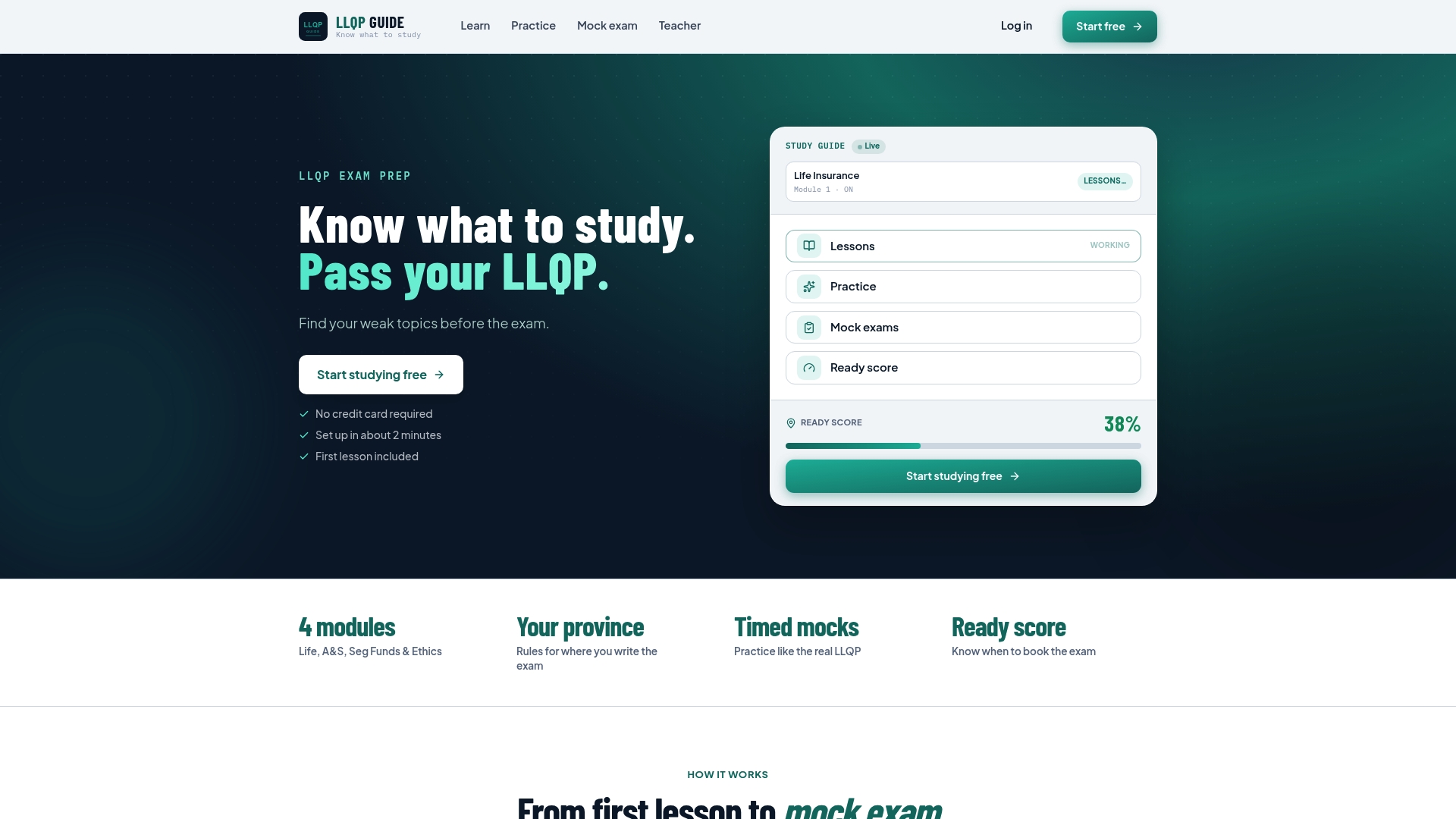
Each of the four LLQP modules gets its own dedicated study path on the platform. Life Insurance, Accident & Sickness, Segregated Funds & Annuities, and Ethics & Professional Practice all map directly to what you’ll register for once your CIPR profile is active. If English isn’t your first language, in-lesson translation tools cover more than 11 languages, so the exam content stays accurate while the explanations meet you where you are.
If you’re in Ontario or BC, the province-specific guides for writing the LLQP in Ontario and writing the LLQP in BC walk through local registration quirks directly. Start with a free trial, check the full module lineup, or compare plans on the pricing page before you commit to a study schedule.
Sources
- Licensing
- Apply for a general insurance agent licence | Financial Services Regulatory Authority of Ontario
- Canadian Insurance Regulatory Frameworks - Jurisdictional Overview
- Broker/Agent Licensing Provincial Guide - Insurance Institute
Recommended
Frequently asked questions
How do I get an insurance agent licence in Canada?
Enrol in an accredited pre licensing course for your licence type, pass the required exam (LLQP for life, OTL/Level 1 for general), secure sponsorship if needed, then apply to your provincial regulator with your criminal record check and documents.
Which insurance licence is hardest to get?
Most candidates find the LLQP demanding because it requires passing four separate modules, including Segregated Funds & Annuities, which involves investment concepts on top of insurance law and ethics.
Is a RIBO licence worth it?
A RIBO licence lets you operate as a broker representing multiple insurers rather than one, which suits agents who want flexibility across carriers, though it comes with its own exam and ongoing CE obligations.
Do I need a licence to sell insurance in Canada?
Yes. Every province requires a licence to sell insurance products, issued by that province's own regulator, and selling without one is not permitted anywhere in Canada.
Can I transfer my insurance licence between provinces?
Often yes, through non-resident or reciprocal licensing forms coordinated by CCIR and CISRO, though a few jurisdictions, including Yukon and Alberta, apply their own exceptions to that process.