Non-forfeiture options: your rights when a policy lapses
Non-forfeiture options: your rights when a policy lapses ! Hands balancing blocks symbolizing insurance options A non-forfeiture option is a policy provision that lets you keep some value from a permanent life insurance policy even after you stop paying premiums.

Non-forfeiture options: your rights when a policy lapses
A non-forfeiture option is a policy provision that lets you keep some value from a permanent life insurance policy even after you stop paying premiums. If your whole life or universal life policy lapses or you decide to surrender it, you’re not walking away empty-handed. Canadian policies typically offer three main routes:
- Cash surrender value (CSV): take the accumulated cash value as a lump sum
- Reduced paid-up insurance (RPU): convert cash value into a smaller, fully paid policy
- Extended term insurance: use cash value to keep your original death benefit for a limited time, with no further premiums
Exact mechanics vary by insurer and contract. Check your policy wording, and use the Canadian Life and Health Insurance Association (CLHIA) and Canada Revenue Agency (CRA) as reference points for how these rules typically work in Canada.
Table of Contents
- What is a non-forfeiture option and when does it apply?
- What are the main non-forfeiture options and how do they work?
- How do these options change your death benefit and taxes?
- How available are these options in Canada, and what should you check?
- How do you choose the right non-forfeiture option?
- Where does this guidance come from, and why it matters for LLQP candidates
- A practitioner’s view on choosing between the options
- Understanding these mechanics turns a lapse notice from a crisis into a decision
- Study these mechanics before exam day, not after
- Sources
- FAQ
What is a non-forfeiture option and when does it apply?
The term comes from contract law: an insurer can’t simply “forfeit” the value you’ve built up in a permanent policy just because you stop paying. Non-forfeiture clauses exist because whole life and many universal life products accumulate real cash value over time, and provincial insurance regulation requires insurers to protect that equity once it exists.
These provisions typically kick in during a few specific moments:
- Your policy lapses because you stopped paying premiums past the grace period
- You voluntarily surrender the policy for its cash value
- You’re converting term coverage or restructuring a policy and need to know what value transfers
One detail catches people off guard: cash values usually stay small for the first several years, then grow more meaningfully once a policy has been held for roughly a decade. A policy purchased at 35 might carry almost no surrender value at 40, but a substantial one by 50.
What are the main non-forfeiture options and how do they work?
Each option trades something for something else. None of them is free money, and none is automatically the “right” one.
Cash surrender value pays out the policy’s accumulated cash value, minus any surrender charges, outstanding loans, and administrative fees. You get liquidity now, but you lose all future insurance coverage. It suits someone who no longer needs the death benefit and wants access to the funds, say, to cover a financial emergency or fund retirement income.
Reduced paid-up insurance (RPU) uses your existing cash value as a single premium to buy a smaller permanent policy that’s fully paid up. One illustrative example: an amount of cash value might buy a paid-up policy with a death benefit well below your original face amount, but you’ll never pay another premium and the coverage never expires. This suits people who want lifetime coverage without the ongoing cost, even at a reduced level.
Extended term insurance does the opposite trade: it uses your cash value to buy term coverage at your original death benefit amount, but only for a limited number of years and months, calculated based on your age and cash value. No further premiums are required, but coverage eventually runs out. This fits someone who needs the full death benefit for a defined period, like until a mortgage is paid off or kids finish school.
Automatic premium loan (APL) isn’t technically a non-forfeiture option. It’s a policy provision, distinct from the three above, that lets the insurer pay an overdue premium out of your own cash value automatically, keeping the policy in force without your active intervention. A regular policy loan works similarly, letting you borrow against cash value while keeping full coverage, but you choose the amount and timing.
Pro Tip: Before surrendering for cash, ask your insurer whether an automatic premium loan or a standard policy loan could bridge a temporary cash crunch. It preserves your death benefit instead of ending it.
| Option | Effect on death benefit | Premiums required after |
|---|---|---|
| Cash surrender value | Eliminated | None (coverage ends) |
| Reduced paid-up | Reduced permanently | None |
| Extended term | Unchanged, but time-limited | None |
| Policy/APL loan | Unchanged (reduced if unpaid at death) | Yes, ongoing |
How do these options change your death benefit and taxes?
The dollar mechanics matter more than the labels. Surrendering cancels your death benefit outright. Reduced paid-up trims it permanently but locks it in for life. Extended term preserves the full number on paper but puts a clock on it. Any outstanding policy loan gets deducted first, from whichever option you choose, which can shrink the numbers more than people expect.
On taxes: surrendering a policy in Canada can trigger taxable income if the cash surrender value exceeds the policy’s adjusted cost basis (ACB). The CRA treats that difference as income in the year you surrender, not as a capital gain. Reduced paid-up and extended term conversions generally don’t trigger this because you’re not receiving cash, but confirm the specific treatment with your insurer or a tax professional before deciding.
Worked example: Say a 55-year-old’s whole life policy has built up $40,000 in cash value against a $250,000 death benefit, with a $10,000 ACB. A full surrender pays the accumulated cash value (before surrender charges), with the difference between that and the adjusted cost basis treated as taxable income. Converting the same cash value to reduced paid-up might instead buy a fully paid smaller death benefit with zero further premiums and no tax event. Extended term might preserve the full death benefit for a limited number of years. The right answer depends entirely on whether you value cash now, permanent coverage, or a big number during a defined risk window.
How available are these options in Canada, and what should you check?
CLHIA describes non-forfeiture provisions as standard features of most permanent policies, but the exact menu, calculation method, and charges are set by each insurer, not by a single national rule. The Office of the Superintendent of Financial Institutions (OSFI) supervises the solvency and conduct of federally regulated insurers, while the CRA governs how any resulting payout gets taxed. Neither dictates the specific non-forfeiture formula your contract uses.
Before you assume you know what your policy offers, pull out the actual contract and look for:
- The non-forfeiture clause itself, and which options it lists by name
- Surrender charge schedules, especially in the first 10 to 15 years
- Loan provisions and how outstanding balances get deducted
- Whether the policy is participating (eligible for dividends) or non-participating, since participating policies may offer paid-up additions or dividend offsets that change the math
- Any automatic premium loan wording and its trigger conditions
Pro Tip: Insurers apply their steepest surrender charges in the early policy years. If you’re inside year 10, ask specifically how much of your cash value survives the charge schedule before you compare options.
How do you choose the right non-forfeiture option?
Work through this in order, ideally with your policy documents in hand:
- Clarify your cash need. Do you need money now, or are you optimizing for future coverage?
- Rank coverage priority. Is keeping a death benefit for dependants more urgent than liquidity?
- Check your tax position. Ask whether your CSV exceeds your ACB and what that means for this year’s tax return.
- Consider creditor exposure. Life insurance cash values can carry creditor protection in some provinces, particularly with an irrevocable beneficiary; surrendering removes that protection.
- Assess future premium capacity. If you can’t sustain premiums long term, RPU or extended term may solve the problem better than a policy loan that just delays it.
- Revisit your estate plan. A reduced death benefit or a time-limited one both change what your estate or beneficiaries can expect.
Ask your insurer directly: how is CSV calculated, what surrender charges apply today, what happens to any outstanding loan, and will this transaction generate a tax slip? These are the exact mechanics LLQP candidates are expected to recognize on the life insurance module of the exam.
Where does this guidance come from, and why it matters for LLQP candidates
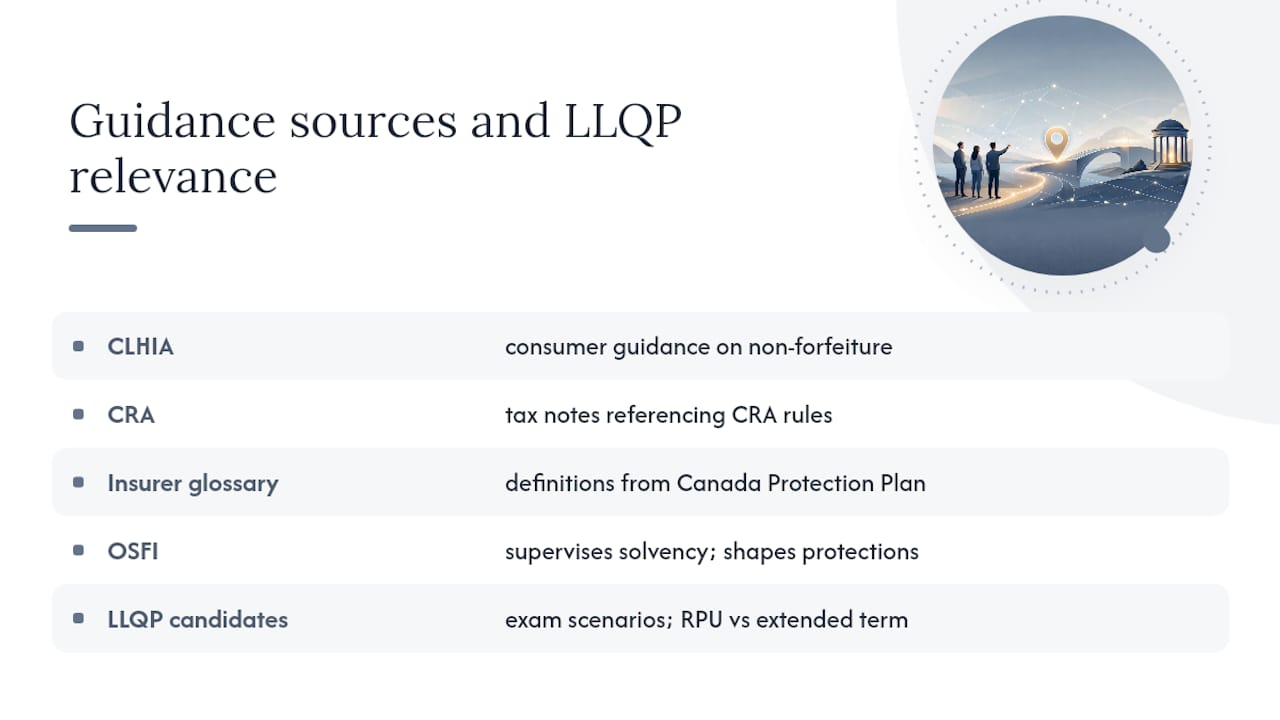
This explainer draws on consumer guidance from the Canadian Life and Health Insurance Association, tax treatment notes referencing CRA rules, and insurer glossary definitions from Canada Protection Plan. OSFI’s supervisory role over insurer solvency shapes why these provisions exist as a consumer protection at all.
For LLQP candidates, non-forfeiture mechanics show up repeatedly in exam scenarios involving policy lapses and client conversations. Understanding the difference between RPU and extended term, in particular, tends to separate strong exam answers from weak ones.
A practitioner’s view on choosing between the options
Most people default to surrendering because it’s the option they’ve heard of. In practice, reduced paid-up serves better for anyone over 50 who still wants permanent protection but can’t sustain premiums. Extended term makes more sense for a defined, shorter-term obligation, like a remaining mortgage.
Pro Tip: If the lapse is temporary, a policy loan or automatic premium loan almost always beats surrendering. You keep full coverage and avoid triggering a taxable event over what might be a short-term cash gap.
Understanding these mechanics turns a lapse notice from a crisis into a decision
The most useful thing to remember: a lapsing policy still has value, and which non-forfeiture option you pick determines whether that value becomes cash, reduced permanent coverage, or temporary full coverage.
| Point | Details |
|---|---|
| Three main options | Cash surrender value, reduced paid-up insurance, and extended term insurance cover most Canadian permanent policies. |
| Cash values grow slowly early | Meaningful surrender value typically doesn’t appear until a policy is roughly 10 years old. |
| Surrender can trigger tax | CSV above the policy’s adjusted cost basis counts as taxable income under CRA rules. |
| Loans preserve coverage | Automatic premium loans and policy loans keep the death benefit intact, unlike surrender. |
| Study the mechanics for LLQP | Llqpguide’s life insurance module breaks down these provisions with exam-style practice questions. |
Study these mechanics before exam day, not after
Non-forfeiture provisions are a recurring theme on the life insurance portion of the LLQP exam, and they trip up candidates who memorize definitions without understanding the trade-offs behind them. Llqpguide’s life insurance module walks through cash surrender value, reduced paid-up, and extended term with practice questions built around real policy scenarios, not just flashcard definitions.

If ethics and disclosure obligations around client policy options come up on your version of the exam, the ethics and professional practice module covers what advisors owe clients when a policy is about to lapse. And if segregated funds or annuity alternatives show up in your province’s exam blueprint, the segregated funds module picks up where this article leaves off. Start with a free trial at Llqpguide and see which modules match your weak spots before you book your exam date.
This article is general information, not a substitute for advice from a qualified financial advisor. Consult a qualified financial professional about your own circumstances before acting on anything here.
Sources
- CLHIA — A guide to life insurance (consumer information)
- PolicyAdvisor — Surrendering a whole life insurance policy in Canada
- Canada Protection Plan — Life insurance glossary
Bring your policy’s illustration schedule, current cash value statement, and any loan documents to your next meeting with your insurer or advisor.
Recommended
Frequently asked questions
What are examples of a non-forfeiture option?
Common examples include taking the cash surrender value as a lump sum, converting to reduced paid-up insurance with no further premiums, or switching to extended term insurance that keeps your original death benefit for a limited number of years.
Which non-forfeiture option offers the highest death benefit?
Extended term insurance typically preserves your full original death benefit, the highest of the three main options, but only for a set number of years rather than for life.
Which non-forfeiture option provides permanent protection at a reduced amount?
Reduced paid-up insurance converts your cash value into a smaller death benefit that lasts for your entire life with no further premiums required, unlike extended term's time-limited coverage.
What are the disadvantages of a non-forfeiture option?
Cash surrender ends your coverage entirely and can trigger taxable income if the payout exceeds your policy's adjusted cost basis. Reduced paid-up and extended term both permanently shrink or time-limit your death benefit compared to the original policy.
Does a non-forfeiture option always apply to my policy?
Not automatically. Non-forfeiture provisions are standard in most permanent policies, but exact terms, charges, and available options vary by insurer, so you need to check your specific contract wording.