Run a full timed mock today: the LLQP strategy that actually works
Run a full timed mock today: the LLQP strategy that actually works ! Hands starting timer on study desk Run a full, timed mock of the exact LLQP module you're weakest in today, under real exam conditions, and review every wrong answer before you study anything new.

Run a full timed mock today: the LLQP strategy that actually works
Run a full, timed mock of the exact LLQP module you’re weakest in today, under real exam conditions, and review every wrong answer before you study anything new. That single habit does more for your pass odds than another week of passive reading.
Here’s the context that makes this urgent. The national first-time pass rate for LLQP modules ranged from 69% to 78% in 2024, with Segregated Funds and Annuities is considered one of the more challenging modules. Every module is multiple choice, open book, 60% to pass. And every module hides five pilot questions you can’t identify, so there’s no such thing as a “safe” question to skim past.
Your action for today:
- Pick your weakest module and book a full, timed mock, matching the real question count and time limit.
- Sit it without notes open on a second screen, without pausing the clock, without answering the phone.
- Score it, then flag every wrong answer for review before you touch a textbook again.
Key Takeaways
Passing the LLQP on the first attempt comes down to running realistic, timed mocks early and often, then converting every mistake into a targeted correction before exam day.
| Point | Details |
|---|---|
| Start with a diagnostic mock | Run a full, timed mock before further studying to find your true weak module. |
| Treat every question as scored | Five pilot questions per module are unidentifiable, so pacing must stay consistent throughout. |
| Weight practice by pass rate | Segregated Funds and Annuities sits near 69% first-time pass, so it earns extra mock cycles. |
| Build an error log, not just a score | Log the topic, cause, and correct answer for every miss, then convert repeats into flashcards. |
| Use Llqpguide to run the loop | The platform pairs timed mocks with readiness tracking and ESL translation to execute this strategy directly. |
Table of Contents
- Why an LLQP mock strategy beats passive review
- How to build a mock exam schedule that scales with your timeline
- Making a mock feel like the real LLQP exam
- Turning mock exam mistakes into real knowledge
- Time management tactics for the 75-minute exam window
- Module-by-module mock focus: where to spend your practice time
- Executing this strategy with a structured platform
- What actually separates a pass from a fail on the LLQP
- Get your mock strategy running on Llqpguide
- Sources
- FAQ
Why an LLQP mock strategy beats passive review
Most candidates who fail aren’t failing because they didn’t read enough. They’re failing because they never rehearsed the exam itself: the clock, the open-book lookup speed, the fatigue of 20 to 30 questions in a row with no breaks. Practitioner feedback on repeat candidates points to the same pattern again and again: skipped practice questions and shallow review of mistakes are the most common causes of failure. A mock exam strategy fixes both problems at once, because it forces you to perform under the actual conditions and then forces you to confront exactly what you got wrong.
The pass-rate spread tells you where to spend your time. National first-time pass rates for 2024 landed between 69% and 78%, with Segregated Funds and Annuities near 69% and Accident and Sickness closer to 76%. A 9-point gap between modules is not noise. It means Segregated Funds and Annuities deserves more mock cycles than Life Insurance, full stop.
Then there’s the pilot question problem. Each module contains five pilot questions that don’t count toward your score, but you have no way to tell which five. That means:
- You cannot skip a question because it “feels experimental.”
- You cannot slow down on questions you assume are scored and rush the rest.
- Every mock you run needs to be treated as fully live, because the real exam is.
A mock that mirrors timing and question count exposes weaknesses a casual quiz never will. Untimed practice tells you what you know. A timed mock tells you what you know fast enough to use, which is the actual bar you’ll be judged against.
How to build a mock exam schedule that scales with your timeline
The mistake most candidates make is running mocks randomly, whenever they feel ready. A better approach treats mock frequency as a progression, starting broad and narrowing toward exam-day precision.
- Run a diagnostic full mock first, before you study anything else. This sounds backward, but it’s the fastest way to find your true weak points instead of guessing based on how confident a topic feels. Score it by module, not just overall, so you can see if your 65% average is hiding a 40% on one section.
- Move into weekly module-specific mocks. Once you know your weak areas, run a shorter mock focused on one module per week, alternating based on where your diagnostic showed gaps.
- Add biweekly full-day mocks as you approach the midpoint of your study window. These combine all four modules back to back, the way exam day can actually unfold if you book multiple sessions.
- Enter a final two-week ramp of near-daily short mocks and error review, tapering the length but increasing the frequency, so the exam format feels routine rather than novel.
If you’re working with one to four weeks, compress this into a diagnostic on day one, module mocks every two to three days, and a full mock every four to five days, with the final three days reserved entirely for error review and light drilling. If you have two to three months, you can afford the full progression above, plus a slower ramp into full-day mocks around week five or six.
Pro Tip: Set a hard stop-new-learning date, roughly one week before your exam. After that point, every study session should be mock practice or error review, never new content. Cramming fresh material in the final days tends to crowd out the recall you’ve already built, and it does nothing for your timing skills.
Candidates who ignore this stop point often walk into the exam having “covered” every topic but never having proven they can apply it under time pressure. Coverage and readiness are not the same thing, and mocks are the only tool that measures the second one. The Ottawa and British Columbia exam paths differ slightly in scheduling logistics, so check your province’s process early rather than discovering it during your final week.
Making a mock feel like the real LLQP exam
A mock that doesn’t replicate exam conditions is just a long quiz. The gap between “practice questions” and a true mock is almost entirely about environment, not content.
- Single monitor, no notes on a second screen. Provincial exams administered online enforce a single-monitor rule, and getting caught reaching for a second window on exam day is treated as a misconduct issue, not a technical hiccup.
- Check your device the way you’d check it on exam day. Camera angle, microphone, stable internet, a clean desk. The examinee information guide from the Insurance Council of British Columbia walks through the exact identity verification and login steps proctors expect, and rehearsing that sequence once removes a genuine source of exam-day panic.
- Practise your open-book lookups, don’t just allow them. Open book does not mean open time. Build a mental index of where key definitions and formulas sit in your approved references, because flipping through fifteen pages during a 75-minute exam burns minutes you don’t have.
- Use a real two-pass strategy in every mock. First pass: answer everything you know cold, flag anything uncertain. Second pass: return to flagged questions with whatever time remains, using your reference materials strategically rather than randomly.
Pro Tip: Rehearse the login and ID verification steps at least once before exam day, even though it feels unnecessary. Candidates lose real exam minutes fumbling through proctoring software they’ve never actually used, and that stress compounds into worse performance on the questions themselves.
Each provincial exam runs on a multiple-choice, open-book format at roughly 75 minutes per module, which sounds generous until you’re 40 questions in in real time. Mocks that skip the technical and logistical layer only test your knowledge. Mocks that include it test your readiness, which is the thing that actually determines your score.

Turning mock exam mistakes into real knowledge
A mock without a review process is wasted effort. The exam itself is the test. The error log is where the actual learning happens.
- Log every wrong answer with four fields only: the question topic, why you got it wrong (knowledge gap, misread, time pressure), the correct answer, and one sentence explaining the rule behind it. Keep it minimal. A bloated log you never revisit is worse than no log at all.
- Convert recurring errors into spaced-repetition flashcards. If you’re missing the same category of question twice, that’s not bad luck, that’s a gap. Flashcards reviewed a few days apart cement the correction far better than rereading the textbook chapter once.
- Build a short targeted quiz from your error log topics and retake it within 48 hours, while the correction is still fresh but not memorized by rote.
- Weight your mock cycles toward your weakest modules. If your diagnostic showed Segregated Funds and Annuities lagging, run two or three mocks on that module for every one you run on Life Insurance. The Segregated Funds and Annuities module tends to carry more investment-specific mechanics than candidates expect, and it rewards dedicated drilling rather than general insurance review.
- Retake a mock only after your error log shows the same mistakes have stopped appearing. A rising score on a mock you’ve already seen tells you less than a clean pass on a fresh one covering the same weak topics.
Improvement between mocks should show up as fewer new errors in your weak categories, not just a higher raw score. A candidate who jumps from 55% to 70% by fixing the same three recurring mistakes has made real progress. A candidate who jumps the same amount by getting lucky on easier questions hasn’t learned anything durable.
Time management tactics for the 75-minute exam window
Everything you rehearse in mocks should be aimed at making exam-day time management automatic, not something you’re figuring out live.
- Split your first pass and second pass roughly 70/30. Spend most of the 75 minutes answering everything you’re confident about, then dedicate the remaining time entirely to flagged, uncertain questions.
- Flag and move on, don’t linger. If a question takes more than 60 to 90 seconds on your first pass, flag it and keep moving. Time sunk into one hard question is time stolen from three easy ones later in the module.
- Reserve your reference lookups for genuine uncertainty, not confirmation. If you’re 90% sure of an answer, checking the reference material anyway just to feel safe eats minutes you’ll want back in the final ten questions.
- Plan for a technical hiccup before it happens. Know your proctoring platform’s support contact and keep it visible, because a frozen screen handled calmly costs you two minutes; handled in a panic, it costs you the rest of the exam.
Pro Tip: Practise your two-pass method in every single mock, not just the final few. Time-management habits built under pressure in week one carry into the real exam far more reliably than a strategy you try for the first time in your last practice run.
Stress compounds under a countdown clock, and candidates who’ve never rehearsed the pacing tend to freeze on question twelve and rush question thirty. Mocks are where you find that failure pattern safely, with no licence on the line.
Module-by-module mock focus: where to spend your practice time
Not every module rewards the same kind of mock practice, and treating them identically wastes hours you don’t have.
Life Insurance rewards scenario-based practice over rote memorization. Focus your mocks on needs-analysis questions and product application scenarios, where you’re asked to match a client situation to the right coverage type rather than just define a term. The Life Insurance module leans heavily on this applied format.
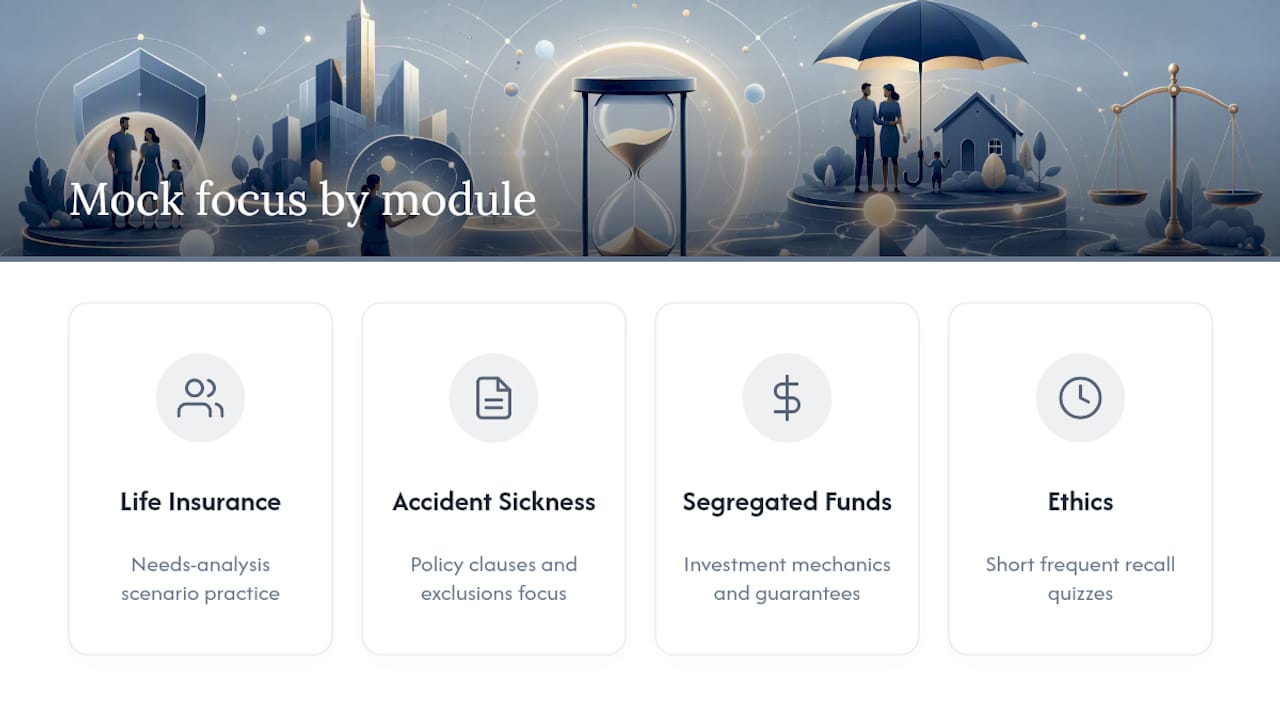
Accident and Sickness hinges on policy clauses, exclusions, and claim scenarios. Candidates who only memorize definitions get tripped up by questions that hinge on a specific exclusion buried in a clause. Drill scenario questions specifically, not just terminology, through the Accident and Sickness module.
Segregated Funds and Annuities deserves treatment as a specialised module, not a Life Insurance add-on. Investment mechanics, guarantee structures, and product distinctions show up repeatedly, and candidates without an investment background tend to underestimate how different this content is from the rest of the exam.
Ethics rewards frequency over depth. Short, frequent quizzes on conduct rules and disclosure obligations work better here than long mock sessions, because ethics questions test quick recall of rules rather than applied problem-solving. Keep a running quick-reference sheet and quiz yourself on it in five-minute bursts through the Ethics module.
Align your practice question topics with the CISRO curriculum and sample exam questions so you’re drilling what’s actually tested, not just what feels important.
Executing this strategy with a structured platform
Running this entire mock strategy manually, tracking your own error log, building your own flashcards, sourcing your own timed practice, is possible. It’s also where most self-directed candidates lose momentum around week three.
Llqpguide’s platform maps directly onto each step above:
- Full-length, timed mock exams that mirror real question counts and durations across all four modules
- Module-specific drills for targeted practice, including dedicated depth on Segregated Funds and Annuities
- Readiness tracking that functions as your error log automatically, surfacing weak categories without manual spreadsheet work
- In-lesson translation tools across 11-plus languages, built specifically for ESL candidates working through dense insurance terminology
A candidate working through this material in a second language shouldn’t have to choose between understanding a clause and finishing on time. Translation support built into the lesson itself removes that tradeoff entirely.
A practical workflow: run a diagnostic mock, let the platform surface your weakest module, work through targeted drills on that module, run a full mock again to confirm the gap closed, then finish with a short final drill set in the days before your exam. That loop, diagnostic to drill to mock to drill, is the same progression outlined earlier in this article, just executed inside one connected system instead of stitched together from separate tools.
What actually separates a pass from a fail on the LLQP
Most study advice treats the LLQP like a memorization test. It isn’t, not entirely. The pass-rate gap between modules, roughly 9 points between the toughest and easiest in 2024, tells you the exam rewards applied reasoning under time pressure more than raw recall. Candidates who memorize definitions but never rehearse the clock tend to run out of time on the exact questions they actually know how to answer.
The conventional advice, “read the material a few more times,” undersells how much of this exam is a performance problem, not a knowledge problem. You can know the content and still fail if you’ve never practised finding it fast enough in an open-book format, or if pilot questions throw your pacing off because you didn’t expect them.
If there’s one priority worth acting on first, it’s this: stop treating mocks as a final check before the exam and start treating them as the primary study method from week one. Everything else, flashcards, review sessions, textbook reading, should support the mock, not replace it.
Get your mock strategy running on Llqpguide
Llqpguide gives you the full mock strategy in one place instead of assembling it from scattered PDFs, forums, and a stopwatch. You get full-length timed mocks that match real question counts, module-specific drills weighted toward the sections that actually sink first-time candidates, and readiness tracking that builds your error log for you automatically.
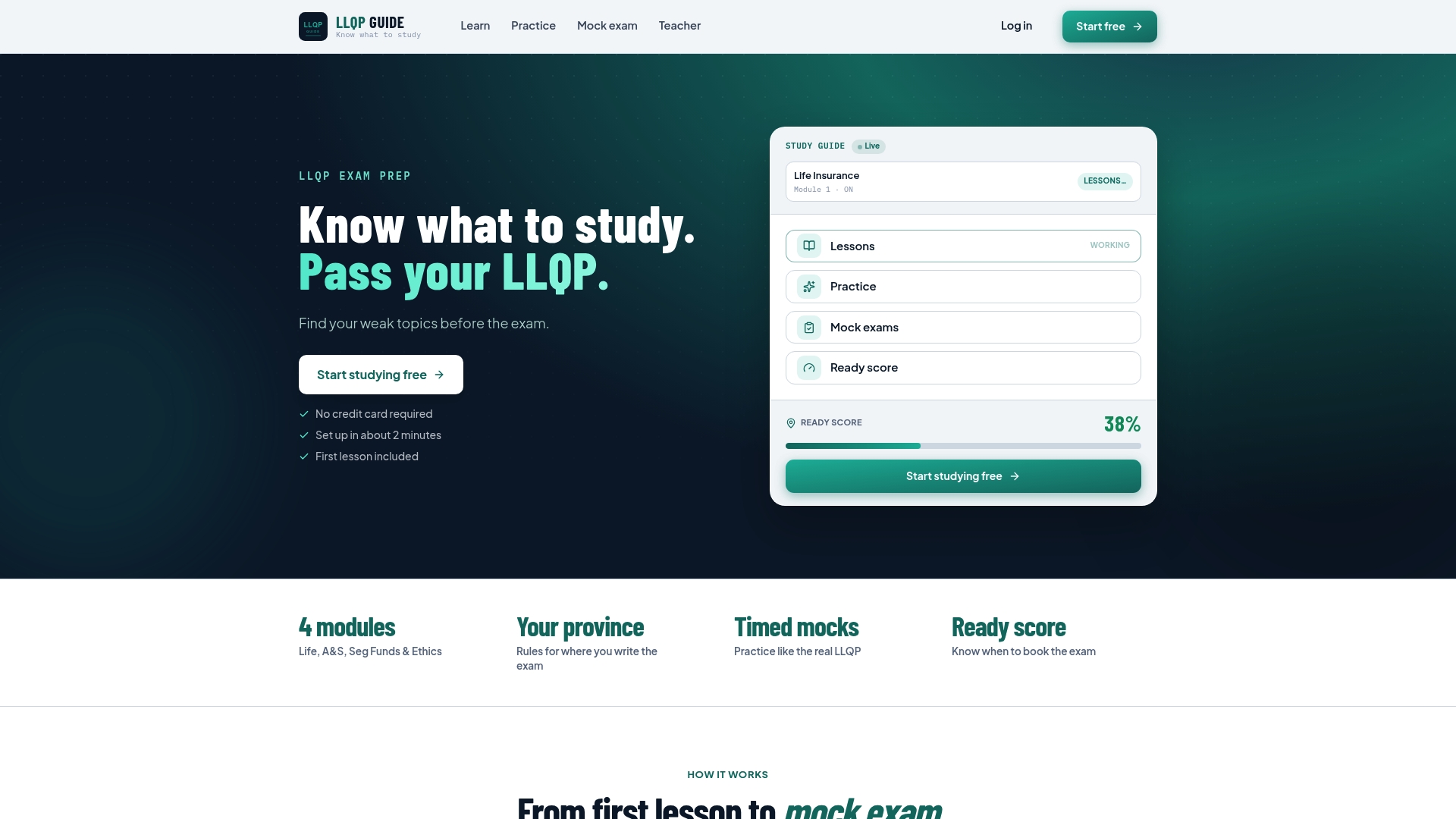
If you’re an ESL candidate, the built-in translation tools across 11-plus languages mean you’re not losing exam minutes to unfamiliar terminology on top of everything else. And if Segregated Funds and Annuities is your weak point, as it is for a large share of candidates given its lower national pass rate, the dedicated module gives you the specialised drilling that module actually needs.
Start with a diagnostic mock on the platform today, see which module needs the most work, and build your study schedule around that result instead of a guess. Check the pricing options to find the access level that matches how much time you have before your exam date.
Sources
- LLQP first-time pass rates in 2024 released - Investment Executive
- LLQP exam information and registration - Insurance Council of British Columbia
Recommended
Frequently asked questions
Is it hard to pass the LLQP exam?
It depends on the module: national first-time pass rates ranged from 69% to 78% in 2024, with Segregated Funds and Annuities the hardest and Accident and Sickness comparatively easier.
Can I find free LLQP Ethics exam questions and answers in PDF format?
Free scattered PDFs exist, but they rarely match real exam timing or question counts, which limits how much they reveal about your actual readiness; a platform like Llqpguide's Ethics module provides structured, exam-aligned quizzes instead.
Is the LLQP exam proctored?
Yes, provincial LLQP exams administered online use remote proctoring with identity verification and a single-monitor rule, detailed in the examinee information guide.
How long does it take to pass LLQP?
Timelines vary widely, from a focused one to four weeks of study for candidates with prior financial background to two to three months for those starting from scratch, with mock-exam frequency scaling to match the available window.
How many pilot questions are on each LLQP module?
Each module includes five pilot questions that don't count toward your score, but since they're indistinguishable from scored questions, every question needs full attention during mocks and on exam day.