Disability definitions for the LLQP: what the exam expects you to know
Disability definitions for the LLQP: what the exam expects you to know ! Open textbook and notebook for insurance study Disability is not a medical term on the LLQP exam.

Disability definitions for the LLQP: what the exam expects you to know
Disability is not a medical term on the LLQP exam. It is a contract term, and the Accident & Sickness module tests whether you can apply the exact policy wording to a claim scenario. Every question about a client who can’t return to their job, or can’t work at all, hinges on three occupation-based definitions: own occupation, regular occupation, and any occupation. Own occupation is the most favourable to the insured because it pays a benefit even if the person could work in a different job.
Your fastest exam rule: read the definition stated in the stem first, then match the facts to that wording. Don’t reason from what you’d assume “disability” means in real life.
- Own occupation: can’t do your specific job, even if you could do a different job
- Regular occupation: can’t do your own job or one reasonably similar, based on training and experience
- Any occupation: can’t do any job you’re reasonably suited for by education, training, or experience
According to FSRA, the A&S module is built around applied knowledge, not memorized trivia, which is exactly why definition-matching questions show up so often.
TL;DR:
- The exam focuses on quickly identifying whether a claim falls under own, regular, or any occupation, especially paying attention to changeover points after 24 months.
- Understanding that residual disability benefits are based on income loss rather than duties is crucial for correctly answering claims involving reduced work hours.
- Memorizing key definitions and practicing scenario-based questions under timed conditions are more effective strategies than passive rote memorization.
- Many policies shift from a more favorable to a stricter occupation standard after a set period, often 24 months, which affects claim eligibility.
- Recognizing the difference between elimination periods and benefit durations helps prevent common exam mistakes regarding claim timing and payout conditions.
Table of Contents
- Core disability definitions and how the LLQP tests them
- Policy features that shape how definitions actually pay out
- How to read an LLQP disability stem without getting tricked
- Turning definitions into exam-day reflexes with structured practice
- Quick-reference glossary for last-minute review
- Short-term versus long-term disability policies
- What typical LLQP disability questions actually look like
- Legal and regulatory considerations behind LLQP disability content
- Key Takeaways
- An editorial take on what actually moves the needle for candidates
- Sources
- FAQ
Core disability definitions and how the LLQP tests them
Almost every disability question on the exam is really a vocabulary test disguised as a claims scenario. Get the definitions locked in, and half the battle is won before you even read the policy details in the stem.
Own occupation: the insured’s best friend
Own occupation coverage pays a benefit if the insured can’t perform the substantial duties of their specific job, regardless of whether they could physically do something else. A surgeon who develops a hand tremor and can no longer operate, but could teach or consult, still qualifies as disabled under an own-occupation definition. This is why own-occupation policies cost more and skew toward high-earning professionals like physicians, dentists, and lawyers.
The exam trap here is time-limited own-occupation wording. Many contracts only apply the own-occupation standard for the first two years of a claim, then shift to a stricter test. If a stem says “own occupation for 24 months, then any occupation,” don’t assume the client is protected forever under the easier standard. CLHIA’s consumer guide confirms that the specific policy wording, not a general industry standard, decides whether a claim qualifies.
Regular occupation: the middle ground
Regular occupation sits between own and any occupation. It typically means the insured can’t perform the duties of their own job or one that’s reasonably comparable given their training, education, and experience. It’s less generous than own occupation because an insurer could argue a construction supervisor with a back injury can shift into a similar supervisory role elsewhere in the trade.
Many mid-tier disability contracts use regular occupation for the entire benefit period, without a changeover date. Watch for stems that use “regular occupation” and “own occupation” almost interchangeably. They are not the same, and the exam will test that distinction directly.
Any occupation: the toughest bar to clear
Any occupation is the most restrictive definition. Under this standard, the insured must be unable to perform any job they’re reasonably suited for, not just their previous line of work. Group long-term disability plans and lower-cost individual policies frequently rely on any-occupation wording, especially after an initial period.
The changeover from a more generous definition to any occupation is a classic exam pivot point. A common contract structure runs own or regular occupation for 24 months, then any occupation for the remainder of the benefit period. If a claimant’s condition improves enough that they could work in some capacity, even a lower-paying one, benefits can stop once the any-occupation clause kicks in.
Total, partial, and residual disability
These three terms describe the degree of impairment, layered on top of the occupation definition.
- Total disability means the insured cannot perform any of the substantial duties of their occupation (as defined by the policy) and is not working at all.
- Partial disability means the insured can still perform some duties, or work reduced hours, but not the full scope of the job.
- Residual disability measures the loss of income caused by a partial impairment, rather than a fixed percentage of duties lost. If a dentist’s income drops by 40% because an injury limits caseload, a residual disability rider typically pays 40% of the total disability benefit.
The distinction matters on the exam because total and partial disability are usually assessed by duties or time, while residual disability is calculated from actual income loss. A stem describing someone who “returned to work three days a week at reduced pay” is almost always pointing you toward residual disability, not partial.
Presumptive and recurrent disability
Presumptive disability triggers a full benefit regardless of the insured’s ability to work, when the loss is severe and permanent. CLHIA outlines standard presumptive triggers such as total and irrecoverable loss of sight, hearing, speech, or the use of two limbs. There’s usually no elimination period for a presumptive claim, and no requirement to prove ongoing income loss.

Recurrent disability deals with relapse. If an insured returns to work after a claim and the same or a related condition disables them again within a specified window, often six months, the insurer treats it as a continuation of the original claim rather than a brand-new one. This matters because a recurrent claim skips the elimination period a second time, while a fresh, unrelated disability requires satisfying it again.
Pro Tip: When a stem mentions a client returning to work and then becoming disabled again from the same injury, check the recurrent disability clause before assuming a new elimination period applies. That single detail flips the correct answer on plenty of practice questions.
Policy features that shape how definitions actually pay out
Definitions decide if someone qualifies as disabled. The rest of the policy decides when and how much they get paid, and the LLQP loves testing the gap between those two ideas.
Elimination period is the waiting period between the onset of disability and the start of benefit payments. Common elimination periods run 30, 60, 90, or 120 days, with longer periods lowering the premium. CanadianLIC’s explainer notes that elimination periods exist specifically to filter out short-term absences and keep premiums manageable for genuine long-term claims. A frequent exam distractor swaps “elimination period” with “benefit period” in the answer choices, betting that a rushed candidate won’t notice the difference between the waiting period and the payout duration.
Benefit period is how long payments continue once the elimination period is satisfied and the claim is approved. Typical structures include:
- Two years, common on cheaper individual or group plans
- Five years, a middle-ground option
- To age 65, the standard for comprehensive individual own-occupation policies
Shorter benefit periods reduce premiums but leave the insured exposed if a disability drags on for decades. A stem describing a 35-year-old with a two-year benefit period and a permanent disability is testing whether you understand that payments stop at two years regardless of ongoing impairment, unless a different provision extends them.
Benefit amount and integration with other income is where math-based exam questions live. The goal is to prevent the insured from earning more disabled than while working.
Occupation class affects both the definitions available and the premium. Insurers group occupations into classes, often labelled from lower-risk professional and executive roles down to higher-risk manual trades. A dentist and a roofer pay very different premiums for the same benefit amount because manual occupation classes carry a higher probability of claim and often can’t access own-occupation wording at all.
Worked example: a simple residual benefit calculation
Say a self-employed electrician earned $6,000 a month before an injury and now earns $3,600 a month working reduced hours. This is why residual riders matter so much for self-employed and commission-based clients: a strict total disability definition alone might pay nothing if the insured is technically still working.
How to read an LLQP disability stem without getting tricked
Exam stems are written to reward candidates who slow down for ten seconds and identify exactly which definition and which policy feature the question is testing. Rushing straight to gut instinct is how correct-seeming wrong answers get picked.
- Identify the definition in play. Scan for “own occupation,” “regular occupation,” or “any occupation” in the stem itself, not the answer choices.
- Check the timeline. Is there a changeover point (24 months is common)? Has the claim just started, or is it in year three?
- Separate the waiting period from the payout period. If the stem mentions “60 days” alongside “5 years,” identify which number is the elimination period and which is the benefit period before reading the answers.
- Watch for CI versus DI mislabelling. Canada Life’s comparison makes the distinction clear: critical illness insurance pays a lump sum on diagnosis of a specified condition, while disability insurance replaces income over time based on inability to work. A stem describing a lump-sum payment after a cancer diagnosis is a critical illness question wearing a disability costume.
- Confirm whether income loss or duty loss is being tested. If the client is working reduced hours, you’re almost certainly in residual disability territory, not partial disability.
Common distractor patterns worth memorizing:
- Assuming a doctor’s note alone triggers benefits, when most contracts require the insured to also meet the occupation-based definition
- Confusing “regular occupation” with “own occupation” because the words sound similar
- Picking critical illness as the answer when the stem describes ongoing income replacement, not a one-time payout
- Forgetting that presumptive disability claims often skip the elimination period entirely
Sample stem: “A client working as an accountant loses the use of both hands in an accident. The policy defines total disability as loss of use of two limbs. How soon does the benefit start?” The correct reasoning path: recognize the presumptive disability trigger, then recall that presumptive claims typically bypass the standard elimination period. Mastery Exam Prep’s quick reference treats the definition of disability as the single highest-yield topic in the A&S disability content, which tracks with how often these distinctions show up across practice tests.
Pro Tip: If you can eliminate two of four answer choices just by identifying which definition applies, you’ve already cut your guessing odds in half before doing any math.
Turning definitions into exam-day reflexes with structured practice
Reading definitions once won’t make them stick under exam pressure. You need repetition that forces recall under time constraints, not passive review.
- Definition flash drills. Write each core term (own occupation, regular occupation, any occupation, presumptive, recurrent) on one side and force yourself to produce the definition from memory in under ten seconds. Repeat daily until you can do the full set in under two minutes.
- Timed mixed quizzes. Combine disability questions with life insurance and segregated funds content so your brain practises switching contexts the way it will on the actual exam, not just drilling one topic in isolation.
- Scenario practice. Work through short one- or two-sentence client scenarios and identify the definition and policy feature being tested before looking at any answer options. This mirrors findings that scenario-based practice beats pure flashcard recall for retention.
- Error logging. Every missed question gets a one-line note explaining why you picked the wrong answer, not just what the right one was. Review that log weekly and you’ll start noticing your own recurring blind spots.
The gap between knowing a definition and applying it under time pressure is where most candidates lose marks. Structured, scenario-based repetition closes that gap far faster than rereading notes.
LLQPGuide’s Accident & Sickness module is built around exactly this drill structure: bite-sized lessons on each definition, unlimited practice quizzes that mix definition recall with scenario application, and full mock exams that simulate real time pressure. The in-lesson translation tools also help candidates working through Accident & Sickness content in a second language, since disability terminology gets dense fast.
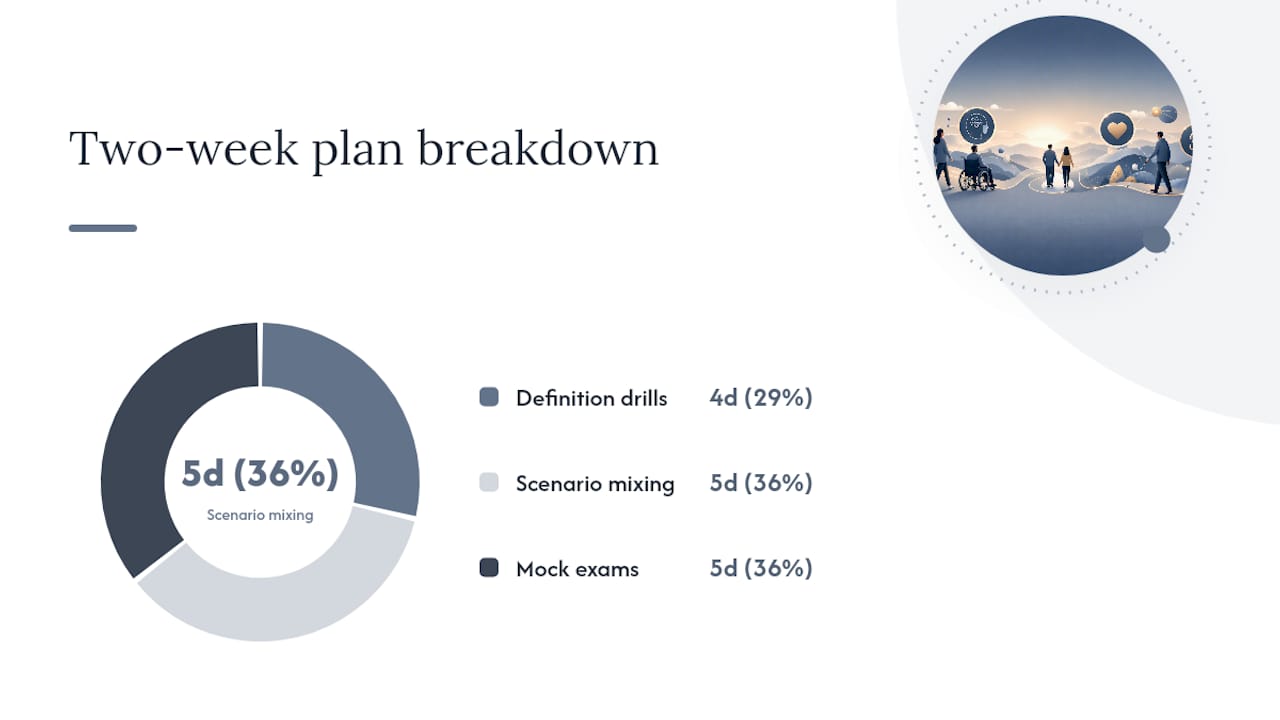
A reasonable two-week intensive plan for this module: spend days one through four on definition drills and glossary memorization, days five through nine mixing in scenario quizzes and policy-feature questions (elimination periods, benefit periods, offsets), and the final days running full-length mock exams under timed conditions while logging every miss.
Quick-reference glossary for last-minute review
Keep this list open the night before your exam. Say each definition out loud once, since verbalizing forces a different kind of recall than silent reading.
- Own occupation: Can’t do your specific job, even if you could do a different one.
- Regular occupation: Can’t do your job or one reasonably similar based on training.
- Any occupation: Can’t do any job you’re reasonably suited for.
- Total disability: Can’t perform any substantial duties of the occupation and isn’t working.
- Partial disability: Can perform some duties or work reduced hours.
- Residual disability: Benefit tied to percentage of income lost, not duties lost.
- Presumptive disability: Automatic full benefit for severe, listed losses (sight, hearing, limbs).
- Recurrent disability: Same condition returns within the specified window; treated as a continuation of the original claim.
- Elimination period: The waiting period before benefits start.
- Benefit period: How long benefits continue once approved.
- Offset/integration: Reduction of benefit for income from other sources like CPP, EI, or workers’ compensation.
Memory cue: “Own beats Regular beats Any” for generosity to the insured, and “Elimination starts, Benefit continues” to keep the two time periods straight.
Short-term versus long-term disability policies
Short-term disability (STD) plans typically cover the early phase of an illness or injury, with elimination periods as short as zero to 14 days and benefit periods usually capped between 13 and 26 weeks. They’re common as employer group benefits and often use a fairly loose definition of disability, close to regular occupation, since the payout window is short and the insurer’s exposure is limited.
Long-term disability (LTD) policies pick up where STD ends, or apply directly to individual buyers, with elimination periods of 60 to 120 days and benefit periods stretching to two years, five years, or age 65. LTD contracts are where the own-occupation, regular-occupation, and any-occupation distinctions matter most, since a multi-year or multi-decade payout makes the definition choice financially significant for both insurer and insured.
On the exam, expect stems that ask you to identify which type of policy fits a described elimination and benefit period combination, or that test whether you know STD plans rarely offer own-occupation protection the way premium LTD individual policies do. If a stem describes a 14-day waiting period and a 26-week payout, that’s short-term disability, full stop. If it describes a 90-day waiting period paying to age 65, you’re looking at long-term disability, likely with an occupation-based definition doing the heavy lifting.
What typical LLQP disability questions actually look like
Most disability questions on the LLQP follow a predictable shape: a short client scenario, a specific policy detail buried in the wording, and four answer choices where two are plausible and two are clearly wrong once you isolate the right definition.
Take a stem like this: “A financial advisor’s contract defines disability as inability to perform the substantial duties of their own occupation for the first 24 months, then any occupation thereafter. At month 30, the advisor could work as a general office administrator but not as a financial advisor. Is the advisor still considered disabled?” The correct approach is recognizing the changeover point has passed. Since the advisor can perform work reasonably suited to their training under an any-occupation standard, the benefit likely stops, even though they still can’t do their original job.
Another common pattern tests offsets: a client receiving $2,500 a month from a group LTD plan and $800 a month from CPP disability, where the policy’s total benefit cap is $3,000. The correct answer usually involves subtracting the other income sources from the cap rather than adding the disability benefit on top of them.
The best approach for all of these: underline the definition and the timeline first, do any math second, and only then compare answer choices.
Legal and regulatory considerations behind LLQP disability content
Provincial insurance regulators set the LLQP curriculum specifically to test applied contract knowledge, not general insurance theory. FSRA’s program description confirms the Accident & Sickness module is designed around real product mechanics, including disability definitions, elimination periods, and benefit structures, because licensed agents need to explain these terms accurately to clients after they’re certified.
This applied focus exists partly because disability definitions are a leading source of consumer complaints and disputes when claims get denied. A client who assumed “disability” meant what it means in everyday language, rather than the narrower contract definition their policy actually uses, is far more likely to file a complaint or dispute a denial. Regulators expect licensed agents to explain the specific definition in a client’s contract at the point of sale, not after a claim goes sideways.
Provincial insurance councils, which administer the LLQP exam itself, also require agents to understand how definitions vary by product and insurer, since there’s no single national standard dictating exact wording for own-occupation, regular-occupation, or any-occupation clauses. That variation is precisely why the exam tests your ability to read and apply the wording given in each stem, rather than recalling one universal definition.
Key Takeaways
Passing LLQP disability questions comes down to matching contract-specific definitions and timelines to the exact wording given in each exam stem, not applying a general idea of disability.
| Point | Details |
|---|---|
| Definitions rank by generosity | Own occupation is most favourable to the insured, regular occupation is the middle ground, any occupation is the strictest. |
| Watch the changeover point | Many contracts shift from own or regular occupation to any occupation after 24 months, changing whether a claim still qualifies. |
| Separate waiting from payout | The elimination period delays the start of benefits; the benefit period determines how long they continue. |
| Residual pays on income loss | Residual disability calculates the benefit from percentage of income lost, not duties lost, which matters for reduced-hours claimants. |
| Practise with scenarios, not just flashcards | Mixing definition recall with short client scenarios builds the applied skill the LLQP actually tests. |
An editorial take on what actually moves the needle for candidates
Most study guides treat disability definitions as trivia to memorize once and forget. That’s backwards. The definitions are the easy part. What separates a pass from a near-miss is whether a candidate can spot, in ten seconds, which definition a stem is testing and whether a changeover clause has already kicked in. Conventional advice leans too hard on rote glossary memorization and not nearly hard enough on timed scenario practice, which is the only method that mirrors what the actual exam demands.
If you take one thing from this article, prioritize scenario drills over flashcards from day one, not as a final review step. Run mixed quizzes that force you to identify the definition before touching the math, and keep an error log so your weak points don’t repeat. The candidates who struggle aren’t the ones who don’t know what “own occupation” means. They’re the ones who freeze when a stem buries that definition inside a 30-day elimination period and a group offset clause.
— Reza
This article is general information, not a substitute for advice from a qualified financial advisor. Consult a qualified financial professional about your own circumstances before acting on anything here.
Sources
- CLHIA — Guide to disability (consumer brochure)
- FSRA — Life licence qualification program (LLQP)
- CanadianLIC — What is the elimination period in disability insurance?
- Canada Life — Disability vs critical illness: what’s the difference?
Recommended
Frequently asked questions
What counts as a disability for LLQP and insurance purposes?
Disability is defined by the specific insurance contract, usually through one of three occupation-based standards: own occupation, regular occupation, or any occupation. The CLHIA guide confirms there's no single universal definition; the policy wording controls each claim.
What are the 14 categories of disabilities?
There's no standard "14 categories" list used in Canadian disability insurance contracts or on the LLQP exam. If you've seen this figure elsewhere, it likely refers to a different context, such as education or human rights classifications, not insurance product definitions.
What are the 7 types of disability?
Insurance contracts don't use a fixed numbered types framework either. For LLQP purposes, focus instead on the recognized structure: three occupation-based definitions (own, regular, any) combined with total, partial, and residual disability, plus presumptive and recurrent disability provisions.
What is the 21 disabilities list?
This is not a term used in Canadian disability insurance or the LLQP curriculum. Skip it for exam prep and concentrate on the occupation-based and severity-based definitions covered throughout this article.
What's the difference between own occupation and regular occupation?
Own occupation covers inability to do your specific job, even if you could work elsewhere; regular occupation covers inability to do your job or one reasonably similar based on training and experience, which is a stricter standard.
Why do elimination periods matter so much on the exam?
The elimination period determines when benefit payments start, and confusing it with the benefit period is one of the most common exam traps in the Accident & Sickness module.