8 Week LLQP Video Study Using LLQP Guide to Get Exam Ready in Canada
8 Week LLQP Video Study Using LLQP Guide to Get Exam Ready in Canada ! Candidate using translated LLQP video lesson A video-first, province-aligned LLQP course beats text-only study for most Canadian candidates because replayable lessons make dense insurance concepts click faster than reading alone.

8 Week LLQP Video Study Using LLQP Guide to Get Exam Ready in Canada
A video-first, province-aligned LLQP course beats text-only study for most Canadian candidates because replayable lessons make dense insurance concepts click faster than reading alone. A practical Canadian option pairs province-specific videos with unlimited quizzes and full-length mock exams across all four modules. Video wins because it lets you rewatch a tricky segregated funds calculation or an ethics scenario until the reasoning actually sticks.
TL;DR:
- A province-specific, video-first LLQP course with unlimited quizzes and mock exams improves understanding of complex insurance concepts through replayability and targeted practice.
- Verify that the course offers full-length, timed mock exams aligned with provincial exam pacing and that it includes accessible features like translation tools for ESL candidates.
- Choose a program that directly maps to your province’s licensing requirements, provides a valid completion certificate, and clearly explains how pass rates are calculated.
- Focus study time more intensively on ethics and segregated funds modules where applied reasoning and calculations are most challenging, rather than overloading on memorization-heavy modules.
- Confirm your provider issues a recognized certificate and supports device compatibility, especially if studying on mobile devices or during commutes.
Table of Contents
- What does a video-first LLQP course actually include?
- How do you choose the best video-first LLQP course for you?
- An 8-week video-first study plan for the LLQP
- Studying ethics with video and case practice
- What proof exists that video-first LLQP prep actually works?
- Why the “just read the textbook twice” advice is outdated
- Start your LLQP prep with a course built for how you actually learn
- Where to verify exam rules and funding options
- Sources
- FAQ
What does a video-first LLQP course actually include?
Before you hand over money for any llqp video study program, check it against a real feature list. Plenty of providers advertise “video lessons” but skimp on the practice volume that turns watching into knowing.
A course worth paying for should include:
- On-demand lesson videos mapped to each LLQP module (Life Insurance, Accident & Sickness, Segregated Funds & Annuities, Ethics & Professional Practice), not generic insurance content repackaged for four provinces at once.
- A deep question bank with rationales, so every wrong answer explains the underlying rule, not just the correct letter.
- Full-length, timed mock exams built to mirror actual provincial exam conditions and pacing.
- Progress tracking and readiness indicators that flag weak modules before exam day instead of after.
- Translation tools, captions, and other accessibility features for candidates studying in a second language.
- Clear format options, whether that’s fully self-paced video, live instructor webinars, or a hybrid of both.
That last point matters more than most candidates realize. Course providers commonly market on-demand videos, quizzes, and mock exams as their core selling points, but the fee structure behind those features varies wildly. Some charge once for lifetime access to a single module; others bill monthly across all four. Before comparing prices, confirm what’s actually bundled. A $300 course cost that excludes mock exams isn’t cheaper than a $400 one that includes them. It’s just missing a piece you’ll need to buy separately later.
If English isn’t your first language, the accessibility features aren’t a nice extra. Insurance terminology is dense even for native speakers, and a course with in-lesson translation support can cut hours off your study time simply by removing the friction of looking up unfamiliar terms mid-lesson.
How do you choose the best video-first LLQP course for you?
Picking a course comes down to five checks, and skipping any one of them tends to cost candidates either money or a failed attempt.
- Confirm the curriculum matches your province’s requirements. Every candidate must complete a qualifying course from an accredited provider before booking a provincial exam, so verify the provider issues a valid certificate of completion, not just a completion badge inside their own platform.
- Check that videos map directly to exam objectives. A course with hours of generic insurance theory but thin coverage of Ethics & Professional Practice will leave you underprepared for the module that trips up the most candidates.
- Look for mock exams that mirror real exam length and pacing, not five-question quizzes labelled as “mock exams.”
- Ask how pass-rate claims are calculated. A provider claiming a 90% pass rate might be counting only candidates who finished the entire course and sat the exam within 30 days, quietly excluding everyone who dropped off or delayed.
- Test device compatibility before you pay. If you plan to study on a tablet during commutes, confirm the video platform actually performs well on that device rather than assuming it does.
Pro Tip: When a provider quotes a pass rate, ask directly: “What’s the denominator?” A rate calculated against everyone who registered looks very different from one calculated against everyone who finished the course. If they can’t answer clearly, treat the number as marketing, not evidence.
Budget and support style matter too. If you learn best with someone to ask questions, prioritize courses with instructor access over ones that are purely self-paced. If you’re disciplined and just need structure, a lower-cost self-paced video plan probably serves you just as well.
An 8-week video-first study plan for the LLQP
Most candidates need somewhere between six and ten weeks of consistent study, depending on how many modules they’re tackling and how much time they can dedicate daily. Here’s a structure that front-loads video learning, then shifts weight toward active recall and mock exams as exam day approaches.
- Weeks 1 to 2: Life Insurance module. Watch all lesson videos once through, then rewatch any segment where you paused to reread a slide. Follow each video with a short quiz on that specific topic.
- Weeks 3 to 4: Accident & Sickness module. Same pattern: video first, quiz immediately after. Start a miss log now, tracking whether each wrong answer stems from a concept gap, a careless read, or a regulatory detail you simply hadn’t seen yet.
- Week 5: Segregated Funds & Annuities. This module leans more numerical, so slow down on any video covering fund calculations and rewatch before quizzing.
- Week 6: Ethics & Professional Practice, with heavier emphasis on case-based videos over straight lecture content.
- Week 7: First full-length mock exam, timed and taken in one sitting. Review your miss log afterward and identify which module needs another video pass.
- Week 8: Targeted review and a second mock exam, focused specifically on your weakest module from week 7.
A miss log works because it turns vague anxiety (“I’m bad at ethics”) into a specific, fixable pattern (“I keep missing questions about conflict-of-interest disclosure”). Recheck it weekly.
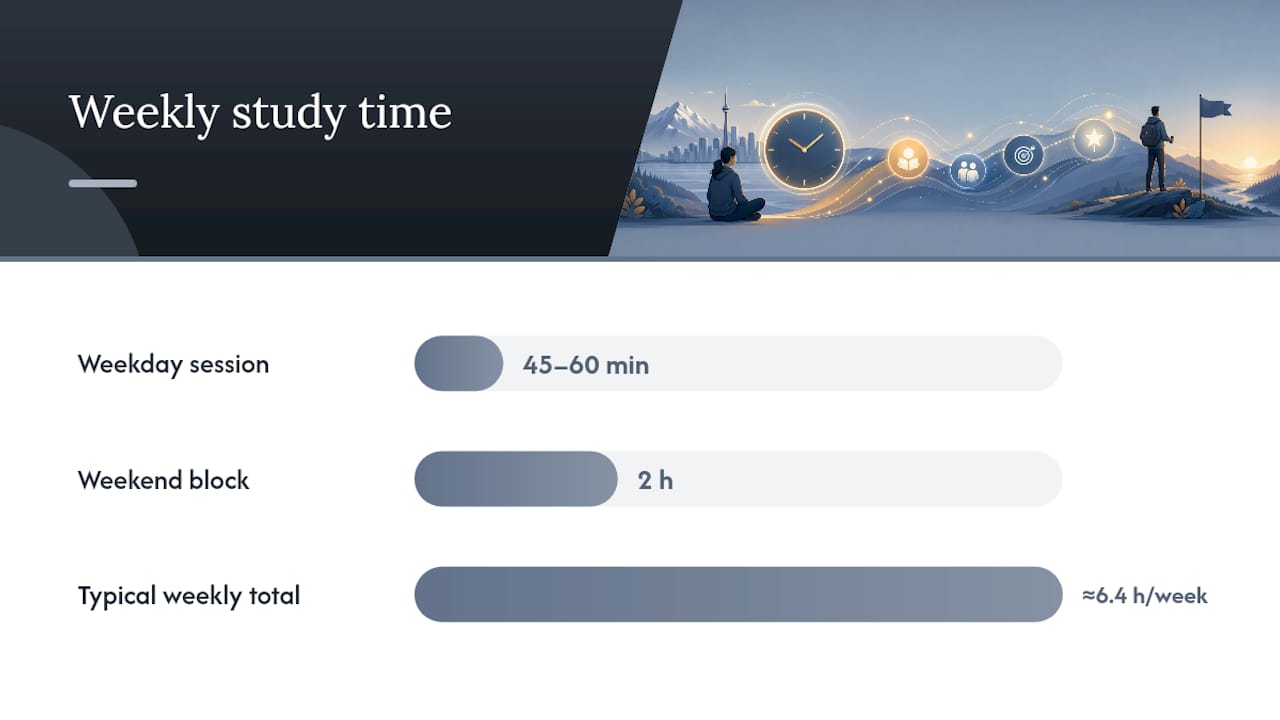
Daily targets matter more than marathon weekend sessions. Aim for 45 to 60 minutes on weekdays and a longer two-hour block on one weekend day for a mock exam or review cycle. If you fall behind, don’t try to cram two weeks into one. Drop the newest module content temporarily and protect your mock exam weeks. Readiness on three modules beats surface familiarity with four.
Studying ethics with video and case practice
Ethics & Professional Practice is the module candidates most often underestimate, and video is the single best format for closing that gap. The module rarely asks you to define a term. It asks you to judge what an advisor should do in a specific, murky situation, and that kind of applied reasoning is hard to learn from a textbook definition alone.
Experts who study exam prep patterns point to a recurring problem: candidates memorize the rules but freeze when a scenario blends two rules at once, say, a disclosure obligation layered with a conflict-of-interest question. Video walkthroughs solve this by showing the reasoning step by step: what facts matter, which rule applies first, and why the “obvious” answer is sometimes wrong.
Build your ethics prep around:
- Watching instructor debriefs that explain why an answer is correct, not just which option it was.
- Keeping a separate case log distinct from your general miss log, noting the specific ethical principle each scenario tested.
- Running targeted mock questions on ethics alone before your first full-length mock exam.
- Reviewing provincial competency outlines periodically to catch any scenario type you haven’t practised yet.
The LLQP curriculum formally lists four modules, with several provinces setting a passing mark per module rather than an overall blended score, meaning a weak ethics score can’t always be offset by a strong life insurance score. Study time on this specific module tends to pay off in a way that’s easy to underestimate going in. LLQP Guide’s ethics module resources pair case-based video walkthroughs with scenario drills built around exactly this kind of applied judgement, an approach similar to the case-based learning design used in insurance industry training programs more broadly.
What proof exists that video-first LLQP prep actually works?
Some platforms build their product around the components candidates need to verify before buying any course, mapping directly onto what a rigorous llqp video study program should deliver.
Here’s how the platform lines up against the checklist covered earlier:
- Province-specific video lessons for all four modules, including Life Insurance and Ethics, rather than one generic national script.
- Unlimited practice quizzes with rationale explanations attached to every question.
- Full-length mock exams built to simulate real provincial timing and pacing.
- Readiness tracking that flags weak modules before exam day rather than after a failed attempt.
- In-lesson translation tools covering 11 or more languages for candidates studying in a second language.
- Flashcards and podcast-style audio lessons for candidates who want to reinforce video content during a commute.
Testimonials on the platform describe measurable score improvements between practice attempts, consistent with what active recall research would predict when quizzing is paired with targeted video review rather than passive rewatching.
Once you finish a qualifying course, the administrative steps are straightforward but easy to overlook. You’ll need your certificate of completion, and depending on your province, a CIPR (Canadian Insurance Participant Registry) number before you can book your provincial exam. Confirm your provider issues that certificate automatically rather than on request, since delays here are a common, avoidable reason candidates push their exam date back.
Why the “just read the textbook twice” advice is outdated
The conventional wisdom on LLQP prep, read the manual, highlight the key terms, take a practice test at the end, was built for a different kind of exam. It works reasonably well for the Life Insurance module, where a lot of content is definitional. It falls apart on Ethics & Professional Practice, where the exam is testing judgement under ambiguity, not recall.
What the research on active recall actually supports is narrower and more useful than most study guides admit: short, frequent quizzing paired with a miss log beats long reading sessions, and video adds real value specifically where reasoning needs to be demonstrated step by step, not just stated. That’s ethics, and it’s the segregated funds calculations too.
If you take one thing from this guide, prioritize video for the modules where you’re applying a rule to a messy scenario, and lean on flashcards and quizzes for the modules that are closer to pure memorization. Don’t treat all four modules the same. Candidates who do tend to overprepare on Life Insurance and walk into Ethics underprepared, which is exactly backwards given where most first-attempt failures happen.
— Reza
Start your LLQP prep with a course built for how you actually learn
If you’ve read this far, you’re probably weighing video-based study against a static PDF manual or a generic online course that treats all four modules the same. Some course platforms are built to close that gap: providing province-specific video lessons, unlimited quizzes, full mock exams, and translation tools, mapped to the modules Canadian regulators test.
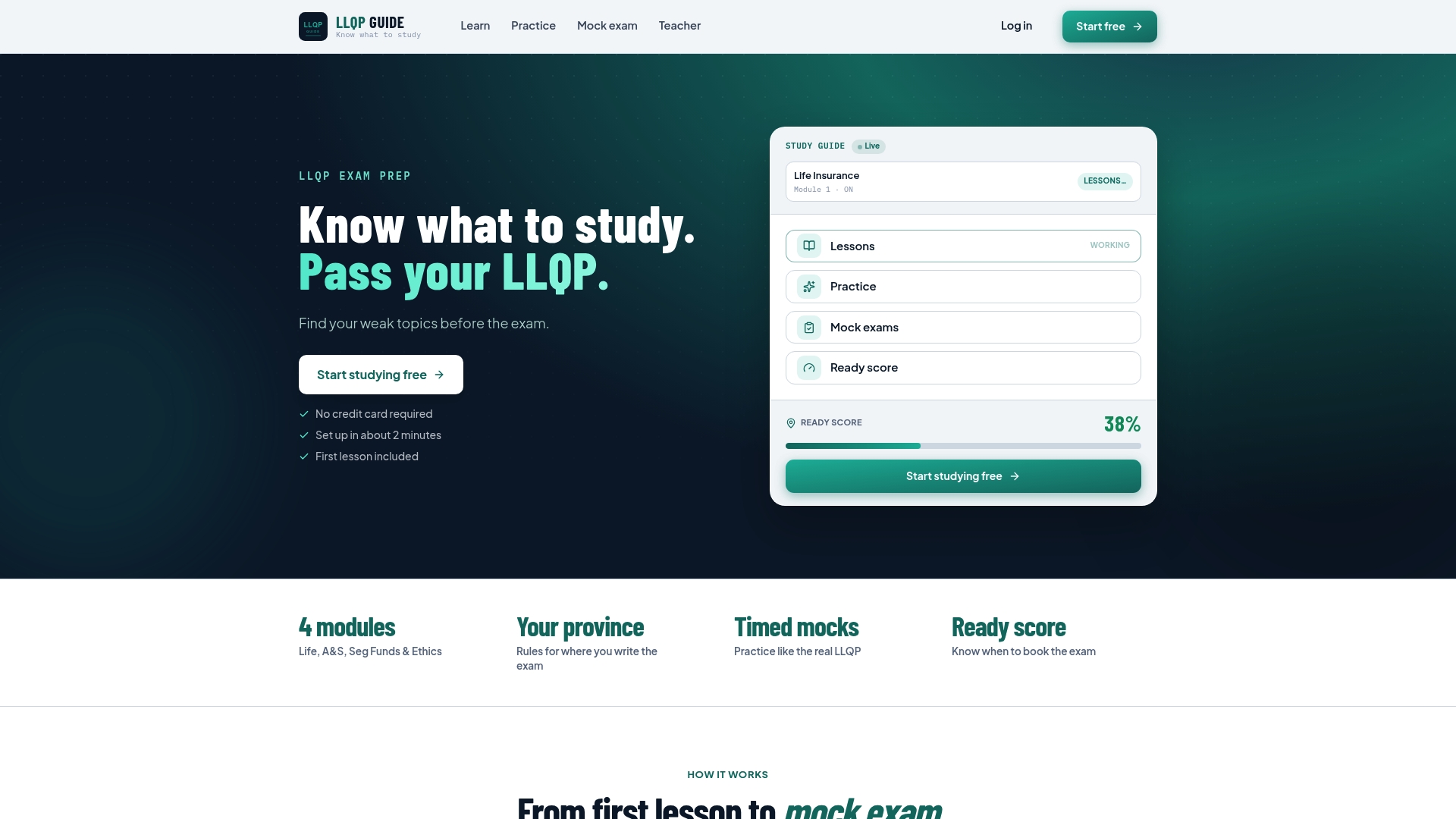
Candidates who benefit most tend to be first-time test-takers who want structure without a live class schedule, and ESL learners who need translation support built directly into lessons. Module content may adjust based on provincial exam requirements.
Start with the free trial through the pricing page to see the video lessons and quiz format before committing, or head straight to the main LLQP exam prep platform to browse all four modules and pick where to begin.
Where to verify exam rules and funding options
Before booking your exam, confirm the rules directly with your provincial regulator. The AMF’s LLQP examination pages outline module structure and administration details, while New Brunswick’s FCNB licensing page covers accredited provider requirements that apply broadly across provinces. If you’re weighing the cost of a course against your budget, the Canada training credit may help offset eligible training expenses, and the designated schools list is worth checking if you’re relying on an employer or government program to fund your course.
Sources
- Canada training credit
- Licensing requirements - Life Licence Qualification Program | New Brunswick Financial and Consumer Services Commission
- Best ways to revise — active recall (Bucks New University)
Recommended
Frequently asked questions
Is it easy to pass the LLQP exam?
Candidates who use structured video lessons, quizzes, and mock exams tend to walk in more prepared than those relying on a single read-through of the manual.
How long does it take to finish LLQP?
Most candidates complete their course and reach exam readiness in a number of weeks of consistent part-time study, though this depends on prior insurance knowledge and how many hours you can commit weekly. A video-first plan covering all four modules with mock exams built in is a reasonable target for many working candidates.
Can I take the LLQP exam through WFG?
WFG (World Financial Group) is a distribution company, not an LLQP course provider or exam administrator. You still need to complete a qualifying course from an accredited provider and book your exam through your province's designated administrator regardless of which agency you plan to work under afterward.
How many times can you take the LLQP exam?
Retake rules and any waiting periods between attempts are set by each provincial regulator, so the exact number and timing varies by province. Check your specific provincial regulator's page, such as the AMF in Quebec or FCNB in New Brunswick, before assuming a national standard applies.
What should I check before buying a video-first LLQP course?
Confirm the provider issues a valid certificate of completion accepted by your provincial regulator, that videos map directly to all four LLQP modules, and that mock exams are full-length and timed. Some providers build video lessons, quizzes, and mock exams specifically around these four modules and provincial requirements.