Lock Your Exam Date in Canada: LLQP Checklist, 4–8 Week Plan
Lock Your Exam Date in Canada: LLQP Checklist, 4–8 Week Plan ! Candidate selecting an exam appointment date Before you book your LLQP exam, confirm your provincially approved course completion and your CIPR number.

Lock Your Exam Date in Canada: LLQP Checklist, 4–8 Week Plan
Before you book your LLQP exam, confirm your provincially approved course completion and your CIPR number. Those two items gate everything else. Once they’re sorted, verify your legal name matches your government ID exactly, check your course’s certification validity window (often 12 months, sometimes 24), and book your exam through your province’s approved administrator. Skip any step and you risk a denied booking or a wasted exam fee.
TL;DR:
- Confirm your course completion is certified and your CIPR number matches your government ID exactly to avoid registration delays.
- Check your course certification is still valid within your province’s specific time window before booking the exam.
- Prioritize practicing timed full-length mock exams and review weak areas thoroughly to ensure proper pacing and knowledge retention.
- Verify your registration is through the correct portal and your home province allows your chosen exam location to prevent last-minute issues.
- Using a dedicated study plan spanning four to eight weeks with active recall and targeted quizzes improves readiness more than passive review.
Table of Contents
- The complete llqp readiness checklist, step by step
- What do you need to check before registering for the LLQP exam?
- How should you structure your LLQP study plan?
- Instructor perspective: the checklist items candidates skip
- How LLQP Guide fits your readiness checklist
- Sources
- FAQ
The complete llqp readiness checklist, step by step
Most rejected LLQP bookings trace back to paperwork, not knowledge gaps. A candidate who knows the Ethics module cold can still get turned away at the door over a mismatched name or an expired certificate. This ordered checklist moves from administration through study to exam day, in the sequence that actually prevents delays.
- Confirm your course completion is certified. Your provincially approved training provider must report your completion to the Canadian Insurance Participant Registry (CIPR) before you’re eligible to register for any module.
- Get and verify your CIPR number. This national registry is how provincial administrators confirm you actually completed an approved course. Your legal name on file must match your government-issued ID precisely, down to spelling and middle names.
- Check your certification validity window. Some provinces set this at one year, others allow up to 24 months, and the ICM’s exam process notes that missing the window means re-certifying, not just rebooking.
- Decide your module sequence. You can write all four modules in one sitting or spread them out within your certification period. Staggering suits candidates juggling work schedules; writing consecutively suits candidates whose recall is sharpest right now.
- Book through the correct portal. Depending on your province, that might mean a provincial exam portal or Durham College, which now runs eligibility checks as part of registration.
- Confirm home-province rules. Some provinces restrict where you can sit the exam if you’re licensing to sell in that jurisdiction; check this before assuming any test centre works.
- Work through lessons and targeted quizzes. Use quiz results to flag weak modules early rather than assuming even coverage across all four.
- Run at least one full-length timed mock exam. Exam-day pacing catches people who know the material but haven’t practised finishing on time.
- Prepare your documents and test environment. For remote proctoring, that means ID, a clear desk, and a stable connection. For in-person testing, it means knowing the venue and building in arrival buffer.
- Know the rewrite rules before you need them. You get three supplemental rewrites with a mandatory 24-hour wait between attempts, and a failed fourth attempt triggers a significant waiting period before you can try again.
Pro Tip: Screenshot your CIPR profile and your course completion certificate the day you finish training. Provincial systems occasionally lag in updating status, and having your own proof speeds up any dispute with an administrator.
What do you need to check before registering for the LLQP exam?
Registration failures rarely come from weak subject knowledge. They come from mismatched paperwork that nobody caught until booking day. A few checks, done early, remove many common risks.
- Your training provider must be provincially approved. A course from an unrecognized provider won’t generate a valid CIPR record, no matter how good the content was.
- Your CIPR entry needs your legal name to match your government ID exactly. This is the single most common reason candidates get flagged at registration, according to guidance from Newfoundland and Labrador’s government services.
- Course completion validity isn’t universal. The Insurance Council of BC sets a one-year validity window in its exam administration policy, but your province may differ, so confirm with your own regulator rather than assuming.
- Exam administrators like Durham College perform their own eligibility verification during booking, which can include specific ID document requirements beyond what your course provider asked for.
- If you previously held an older insurance licence or completed only part of a pre-licensing course years ago, check with your provincial regulator on whether you need full re-certification before you can register again.
None of these checks take long individually. Skipping even one, though, can push your exam date back by weeks while you resolve a mismatch.
How should you structure your LLQP study plan?
A 4 to 8 week window covers most candidates’ study needs when the time is used deliberately rather than just logged. That guidance holds across most candidate experiences, provided you’re mixing lesson review with active recall and not just re-reading notes.
- Weeks 1 to 2: Work through Life Insurance and Accident & Sickness lessons, using module-specific practice to catch gaps in policy wording and clause interpretation early.
- Weeks 3 to 4: Move into Segregated Funds & Annuities and Ethics & Professional Practice. Segregated funds punishes shortcuts on calculations, so work through prospectus-reading questions rather than memorizing formulas in isolation.
- Weeks 5 to 6: Shift to mixed practice across all four modules using flashcards and spaced review, revisiting anything you flagged as weak in the first pass.
- Weeks 7 to 8: Run full timed mock exams under real exam conditions, then dedicate remaining days to whatever the mocks expose as your softest area.
Ethics tends to get under-practised because it feels intuitive. Scenario-based questions test judgment under specific regulatory framing, which isn’t the same as knowing the “right” answer in the abstract. Exams also include pilot questions that don’t count toward your score but still eat into your time, according to the Alberta Insurance Council, so aim for a mock score comfortably above the passing mark rather than right at the line.
Pro Tip: When you review a missed quiz question, read the explanation for every wrong option, not just the correct one. Understanding why the distractors are wrong builds the pattern recognition that timed exams actually reward.
Instructor perspective: the checklist items candidates skip
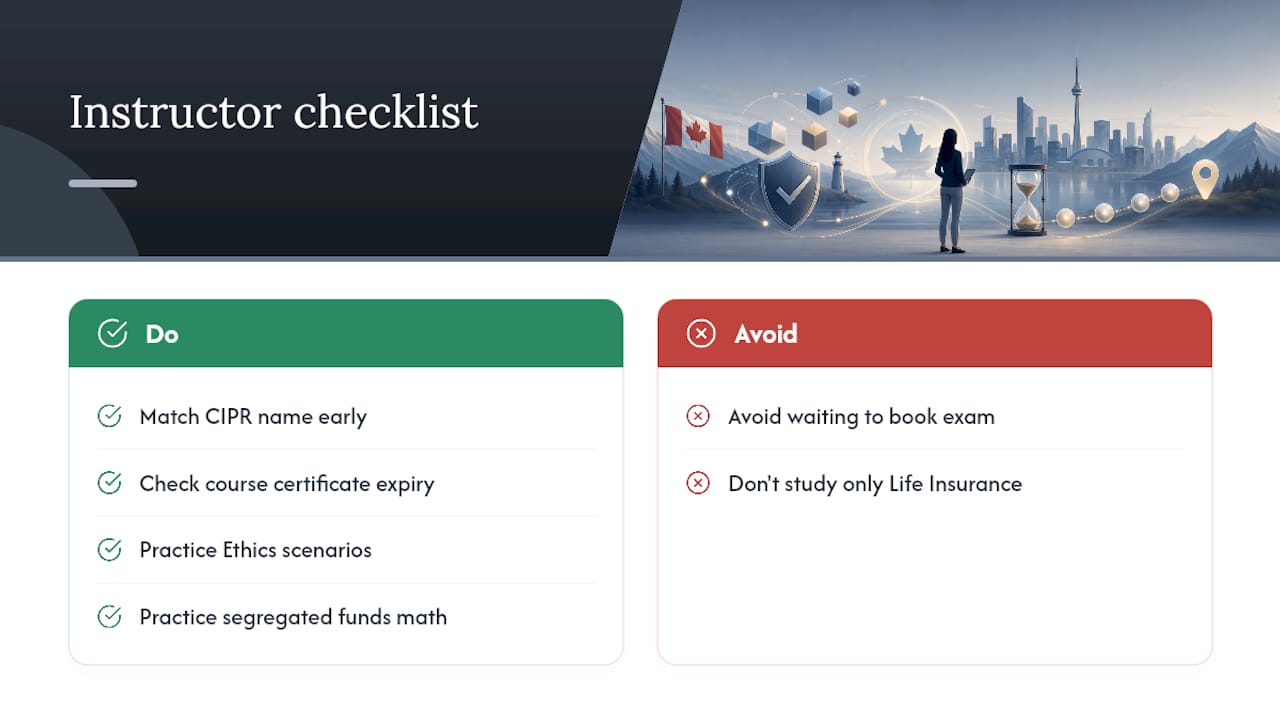
The failures I see most aren’t knowledge failures. They’re a name spelled differently on CIPR than on a driver’s licence, or a course certificate that quietly expired while someone waited for “the right week” to book. Check your CIPR match the day you finish training, not the day before your exam.
The other blind spot is effort allocation. Candidates over-study Life Insurance because it feels familiar and under-practise Ethics scenarios and segregated funds math because both feel uncomfortable. Uncomfortable is exactly where your practice time belongs.
— Reza
How LLQP Guide fits your readiness checklist
Every item on this checklist points to a gap a good study platform should close, not create. A good study platform is built around that mapping: province-specific lessons for each of the four modules, unlimited practice quizzes to find your weak spots before an administrator does, and full-length timed mock exams that mirror real exam pacing, including the pressure of finishing on time.
If English isn’t your first language, translation tools covering multiple languages can help ensure you study the concept, not struggle with vocabulary. Readiness tracking can show which modules may need more review before booking your exam, rather than relying solely on confidence levels. Start with the free trial to see how your current knowledge maps against the four modules, then check the pricing page for the plan that matches your study timeline, whether that’s a focused four-week sprint or a longer runway.
Sources
- Life Licence Qualification Program (LLQP) | Financial Services Regulatory Authority of Ontario
- LLQP examination administration policy — Insurance Council of BC
- Life Licence Qualification Program (LLQP) - Government Services
- Life License Qualification Program (LLQP) | Government of Prince Edward Island
Recommended
Frequently asked questions
What is a CIPR number and why do I need one?
CIPR stands for Canadian Insurance Participant Registry, and it's the national record that proves your course provider certified your LLQP training completion. You cannot register for provincial exams without one, and your legal name on the record must match your government ID.
How long is my LLQP course completion valid?
Validity windows vary by province, with some setting one year and others allowing up to 24 months, per the Insurance Council of BC's administration policy. Confirm your specific window with your provincial regulator before assuming you have time to spare.
How many times can I rewrite a failed LLQP module?
You get three supplemental rewrites with a mandatory 24-hour wait between attempts, and a failed fourth attempt requires a full one-year wait before you can register again, according to FSRA.
How long should I study before writing the LLQP exam?
Many candidates require several weeks of structured study mixing lesson review, targeted quizzes, and timed mock exams. Candidates who skip the timed mocks often know the material but struggle with exam-day pacing.
Can Llqpguide help me prepare for all four LLQP modules?
Yes. Llqpguide covers Life Insurance, Accident & Sickness, Segregated Funds & Annuities, and Ethics & Professional Practice with province-specific lessons, unlimited quizzes, and full mock exams, plus translation tools for candidates studying in a second language.