LLQP Not Offered in Vietnamese: 8 Week Canada Study Plan
LLQP Not Offered in Vietnamese: 8 Week Canada Study Plan ! Bilingual insurance exam study materials No.

LLQP Not Offered in Vietnamese: 8 Week Canada Study Plan
No. The LLQP exam is written in English or French only, and no Canadian regulator offers a Vietnamese-language version. Vietnamese-speaking candidates can and should use Vietnamese study materials to build understanding, but the exam itself must be written in an official language. The next step is simple: pick the province where you plan to sell insurance, confirm that province’s course and exam rules through its regulator, and build a bilingual study plan around the official-language test.
TL;DR:
- Vietnamese-speaking candidates should focus on bilingual study tools and build a personal English or French glossary, as the exam is only offered in these languages.
- The exam is modular, with a 60% passing mark per module, and includes four key subjects: ethics, life insurance, accident and sickness, and investment products.
- Most provinces permit up to five attempts, with mandatory waiting periods after the third and fifth failures, and the exam must be completed within one year of course certification.
- Preparing with timed practice exams in the official language and avoiding reliance on machine translation improves speed and accuracy under pressure.
- No official Vietnamese-language LLQP exam exists, so candidates must rely on bilingual support and official-language mastery to succeed.
Table of Contents
- What is the LLQP and what does the exam cover?
- What Vietnamese-language support actually exists?
- Province rules: Ontario, Québec, and BC compared
- How much does the exam cost, and how many tries do you get?
- An 8-week study plan and pre-exam checklist
- Terminology traps that trip up Vietnamese speakers
- What challenges do Vietnamese candidates run into most?
- Why bilingual prep plus official-language drilling works
- Where LLQP Guide fits into a bilingual study plan
- Sources
- FAQ
What is the LLQP and what does the exam cover?
The Life Licence Qualification Program is the mandatory training and testing sequence required before you can apply for a life and accident & sickness insurance licence almost anywhere in Canada. You cannot skip it, and you cannot pass it by scoring well overall while bombing one subject area. The exam is modular, meaning you are graded on each of four separate topics rather than a single blended score.
The exam consists of multiple modules covering key topics relevant to the licensing requirements.
- Ethics and professional practice — conduct rules, disclosure obligations, and regulatory expectations
- Life insurance — policy types, underwriting basics, and needs analysis
- Accident and sickness insurance — individual and group health and disability coverage
- Segregated funds and annuities — investment-linked insurance products and their regulation
Provincial administrators generally set the passing mark at 60% per module, which means a strong Ethics score cannot rescue a weak Segregated Funds score. Before you commit to any course or study platform, check the rules published by FSRA in Ontario, the AMF in Québec, or CISRO for the harmonized national framework that most other provinces follow.
What Vietnamese-language support actually exists?
There’s no official Vietnamese sitting of the LLQP, and no regulator has announced plans to add one. What exists instead is a layer of Vietnamese-language study support that sits underneath the English or French exam you’ll actually write. Understanding that distinction early saves candidates from a common and costly mistake: assuming a “Vietnamese LLQP course” means a Vietnamese exam.
Three realistic forms of support are worth considering:
- Bilingual lesson explanations — platforms and tutors that explain English or French insurance concepts in Vietnamese, so the ideas land even when the test won’t be in Vietnamese.
- Official-language timed practice — quizzes and mock exams written in English or French, which is the only way to build the speed and terminology recall the real exam demands.
- Formal accommodations — if you qualify under a documented need (not a language preference), regulators may approve specific testing accommodations, but this is a separate approval process, not a language swap.
Build a personal glossary that pairs the exact English or French term used in your course manual with your own Vietnamese explanation, side by side. CISRO’s harmonization guidance is blunt about this: translating vocabulary in isolation is not enough. Insurance and legal terms often carry meaning that doesn’t map cleanly between languages, so a term-by-term glossary built from your actual course material beats any generic translated word list.
Pro Tip: Never rely solely on machine translation for policy or legal terminology. Run any AI-translated definition against your regulator’s own manual or a bilingual glossary you’ve built yourself. A mistranslated nuance in “insurable interest” or “material misrepresentation” can cost you marks on a question you actually understood.
Province rules: Ontario, Québec, and BC compared
Exam content is harmonized across most of Canada, but the paperwork around it is not. Skipping this step is how candidates end up with a valid pass and no path to a licence.
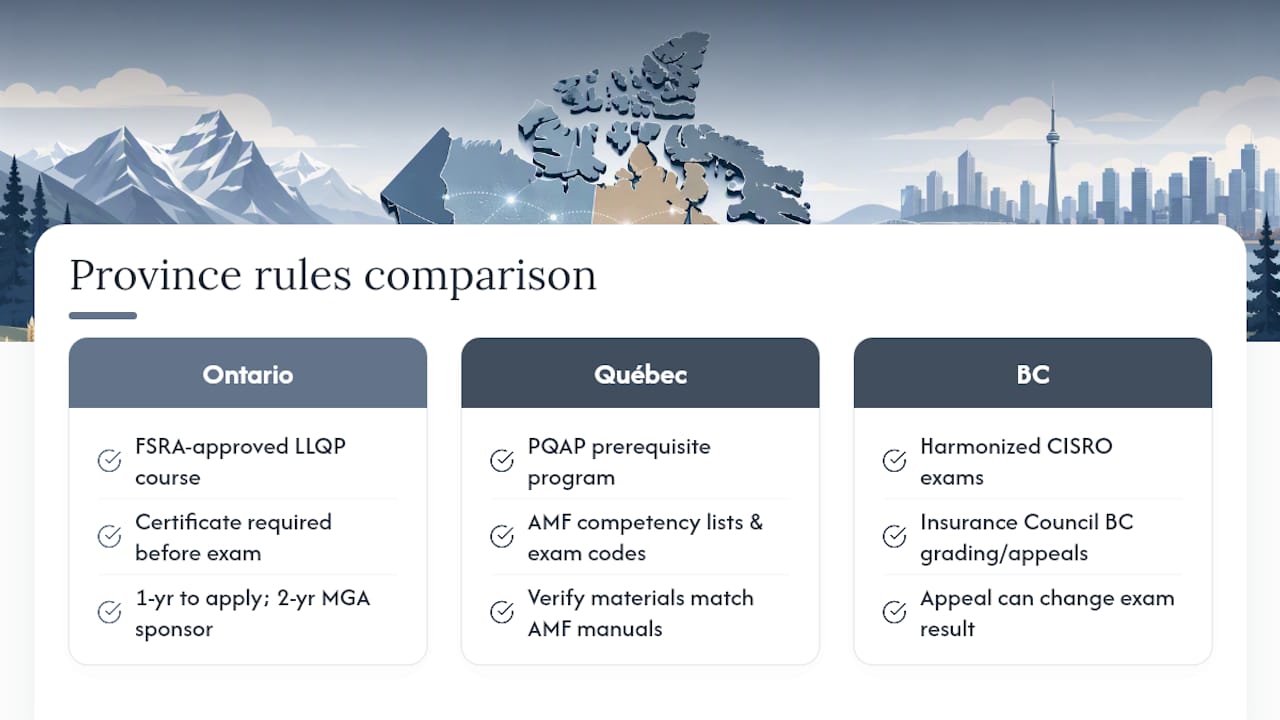
Ontario requires you to complete an FSRA-approved LLQP course and hand in your completion certificate before you can sit the exam. Once you pass, you have one year to apply for your licence, and you’ll need sponsorship from a managing general agency or insurer for your first two years of practice.
Québec calls its prerequisite program PQAP rather than LLQP, and the AMF publishes its own competency lists and exam codes. If your study materials were built for Ontario’s LLQP, double-check they still align with Québec’s specific manuals before you rely on them.
British Columbia follows the harmonized CISRO exam structure, but the Insurance Council of BC sets its own policies on hand-grading near-passing scripts and on appeals. An appeal there can confirm, raise, or lower your original result, so it’s a correction mechanism, not a safety net.
Whichever province you target, verify that your course provider is nationally accredited and locally approved to issue a certificate your regulator will actually accept.
How much does the exam cost, and how many tries do you get?
The LLQP exam is open-book by design. You’re allowed to bring or use permitted reference materials, which rewards candidates who know where to find an answer fast rather than those who’ve memorized every page.
Delivery format varies by jurisdiction and provider. Some sittings are on a controlled tablet at a physical test centre, some are on paper, and some run as virtually proctored sessions from home. Confirm which formats your province and provider offer before you book, because a virtual sitting is not automatically available everywhere.
Fee snapshot: Durham College, one of the main exam administrators, updated its fee schedule effective August 1, 2025, and virtual online exam sittings now cost more than in-person module sittings. Course fees are set separately by individual providers, so always confirm current pricing directly before registering.
A few logistics points worth locking in early:
- Attempts: harmonized guidance generally allows up to five attempts per module, with mandatory waiting periods kicking in after the third and fifth failed attempts in many jurisdictions.
- Waiting periods: these exist to force meaningful re-study rather than repeat guessing, and they differ by province, so check your regulator’s exact policy.
- Validity: most provinces run a one-year clock from your first exam pass or course certificate to your licence application, and missing that window can mean repeating steps you already completed.
An 8-week study plan and pre-exam checklist
A study plan that ignores the language gap sets Vietnamese-speaking candidates up to understand the material but fumble the wording under time pressure. This plan builds comprehension first, then deliberately shifts toward official-language speed.
- Weeks 1 to 2: Build bilingual foundations. Read each module’s core concepts in Vietnamese explanation alongside the original English or French term. Start your personal glossary now, not later.
- Weeks 3 to 4: Move module by module through Life Insurance and Accident & Sickness, using official-language flashcards and short quizzes. Begin practising on the same device type (tablet or virtual platform) you’ll use on exam day.
- Weeks 5 to 6: Add Segregated Funds & Annuities and Ethics & Professional Practice. Introduce timed mock exams in the official language only, no Vietnamese cheat sheets during the timer.
- Week 7: Run full-length mock exams under real time limits. Track which module keeps dropping below 60% and drill that one specifically.
- Week 8: Final review of weak areas, confirm your exam booking, and complete every administrative item on your checklist.
Before exam day, confirm you have: your approved prerequisite course certificate in hand, your exam registered through the correct administrator (Durham College handles this in many jurisdictions), a sponsor lined up if your province requires one, valid government ID, and a clear understanding of what reference materials are permitted in the room or on screen.
Tools like the Exam Study Planner from Syncronos can help structure the weekly schedule and timed-mock cadence above if you’d rather not build it in a spreadsheet.
Pro Tip: By week 4, stop translating questions in your head before answering them. If you’re still mentally converting English to Vietnamese and back during practice quizzes, you’re losing 15 to 20 seconds a question. On a timed exam, that adds up to running out of time on the last module.
Terminology traps that trip up Vietnamese speakers
Insurance English carries a lot of terms that sound like everyday words but mean something narrower and more specific in a policy context. “Material” in “material misrepresentation” doesn’t mean physical substance. “Consideration” in a contract sense has nothing to do with kindness. Vietnamese translations of these terms sometimes borrow the everyday meaning, which quietly misleads a candidate who’s translating word-for-word instead of learning the legal concept underneath it.
Segregated funds create a particular problem because the product category barely exists outside Canada, so there’s no established Vietnamese financial vocabulary for it. Terms like “maturity guarantee” or “death benefit guarantee” need to be learned as concepts tied to Canadian insurance regulation, not looked up as isolated vocabulary.
Ethics and professional practice questions are often scenario-based, asking what an agent should do in a specific situation rather than testing a definition. That format punishes literal translation, because the correct answer depends on grasping the regulatory reasoning behind a rule, not just the words describing it. CISRO’s own harmonization guidance points to exactly this risk: standardized terminology exists precisely because isolated vocabulary translation causes candidates to miss context.
The fix is consistent across every module: keep the original English or French term visible next to your Vietnamese explanation in your notes, always. Never let the Vietnamese gloss replace the official term. When you get to the exam, your brain needs to recognize the official-language phrase instantly, not translate it first.
What challenges do Vietnamese candidates run into most?
The most common problem isn’t vocabulary. It’s speed. A candidate who fully understands a concept in Vietnamese can still run out of time hunting for the matching English phrase under exam pressure, especially on scenario-based Ethics questions that run longer than a simple definition question.
The second challenge is over-reliance on translated study materials that were never checked against the actual regulator manuals. A course built loosely around general insurance knowledge, then translated, can drift from what FSRA, the AMF, or your specific province actually tests.
A third, quieter challenge is administrative: missing the one-year window between passing and applying, or not lining up sponsorship in time, because so much study energy went into the exam itself and not enough into what comes after it. Track that validity clock from the day you pass, not the day you start filling out paperwork.
The most effective countermeasure to all three is the same: shift practice into the official language early and often, verify materials against the regulator’s own manuals rather than a general translation, and calendar your licensing deadlines the same week you book your exam. Candidates who treat the exam and the licensing paperwork as one connected sequence, rather than two separate finish lines, tend to avoid the costly repeat cycle.
Why bilingual prep plus official-language drilling works
Comprehension in your first language and performance in the exam language are two different skills, and treating them as one is where a lot of study plans quietly fail. Vietnamese explanations get you to genuine understanding faster. Timed, official-language practice is what turns that understanding into a passing score, because the exam rewards speed and precise recognition of terms, not just knowledge of the underlying concept.
Readiness tracking that flags a weak module before exam day matters more for bilingual candidates than for anyone else, because a language gap can quietly hide inside a “Segregated Funds” score that looks fine on average but falls apart under a scenario question’s specific wording. Targeted mock exams, run under real time pressure in the official language, expose that gap while there’s still time to fix it.
My honest recommendation: don’t choose between Vietnamese comprehension support and English or French exam practice. Run both, but weight the balance intentionally, heavy on Vietnamese explanation early, heavy on official-language timed drills as exam day approaches.
— Reza
Where LLQP Guide fits into a bilingual study plan
There are platforms that offer province-specific lessons, unlimited practice quizzes, and full-length mock exams built to mirror real exam conditions, plus in-lesson translation tools to assist non-native English speakers in building understanding without abandoning the official-language terms tested on the exam.
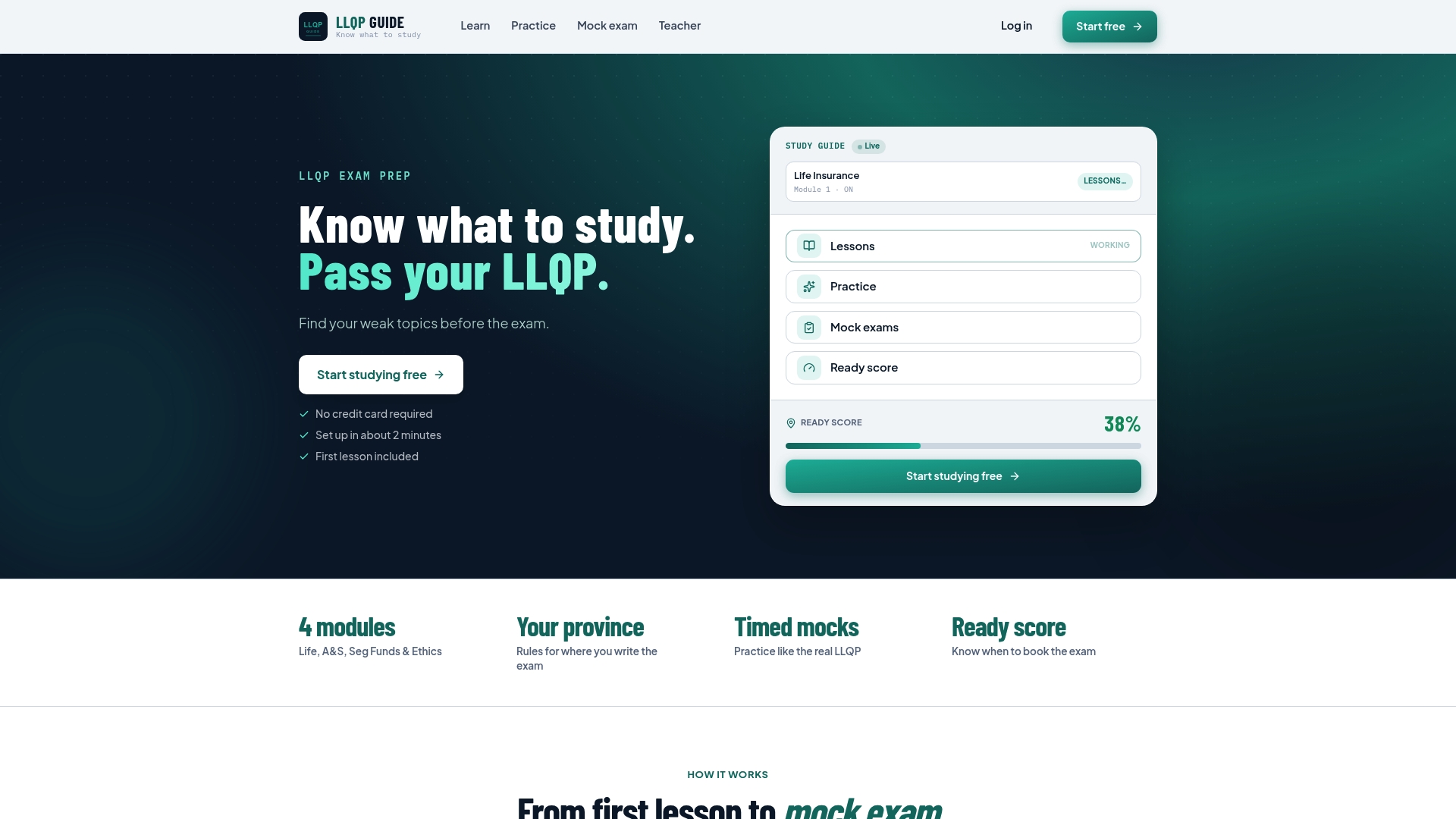
The platform covers all four LLQP modules, including Life Insurance and Ethics & Professional Practice, with readiness tracking that flags which module needs more work before you book your sitting. Vietnamese-speaking candidates specifically have used the platform’s translation tools to build the kind of term-by-term glossary this guide recommends, without losing the official-language phrasing the exam actually uses.
Start by picking your target province’s module set, use the translation tools to build your glossary as you go, then run a full-length mock exam under real time limits to see where you stand. Plans run weekly at $40, monthly at $125, or yearly at $400, and you can check current details on the pricing page before you commit.
Sources
- Apply for a new life and accident & sickness insurance licence | Financial Services Regulatory Authority of Ontario
- Course providers | CISRO
- Examens | AMF
Recommended
Frequently asked questions
How difficult is the LLQP exam?
Difficulty depends heavily on preparation and language comfort, but the modular design and 60% pass threshold per module mean you can't average your way to a pass. Segregated Funds & Annuities and scenario-based Ethics questions tend to challenge candidates most, especially those studying in a second language.
How many attempts do you get on the LLQP exam?
Harmonized guidance generally permits up to five attempts per module, with mandatory waiting periods after the third and fifth failed attempts. Exact rules differ by province, so confirm your regulator's current policy before you book a rewrite.
How much does the LLQP course cost?
Course fees are set individually by each accredited provider and vary by province, so check pricing directly with your chosen provider. Llqpguide's own study platform runs $40 weekly, $125 monthly, or $400 yearly, separate from the mandatory prerequisite course fee charged by an approved course provider.
What is LLQP certification in Canada?
LLQP certification confirms you've passed all four required modules and completed an approved prerequisite course, making you eligible to apply for a life and accident & sickness insurance licence. In Ontario, that application must happen within one year of your first pass, and new agents typically need sponsorship for their first two years.
Is there a Vietnamese-language version of the LLQP exam?
No regulator in Canada offers the LLQP exam in Vietnamese. Vietnamese-language study support, including bilingual lessons and translation tools, can help you prepare, but the exam itself must be written in English or French.