Ukrainian Speakers in Canada: Pass the LLQP Without a Translation
Ukrainian Speakers in Canada: Pass the LLQP Without a Translation ! Candidate preparing insurance vocabulary study cards No.

Ukrainian Speakers in Canada: Pass the LLQP Without a Translation
No. Every provincial regulator administers the LLQP exam in English or French only, and there is no Ukrainian version available anywhere in Canada. Translation is not offered as an accommodation, either. If you’re a Ukrainian-speaking candidate, your best move is to contact your provincial regulator’s examinations department now to confirm accommodation options and start building a study plan around English or French insurance terminology.
TL;DR:
- The LLQP exam is only available in English and French, with no Ukrainian version offered or accommodation for language translation across Canada.
- Candidates must prepare by building English or French insurance vocabulary, focusing on common terms and timed mock exams, since language accommodations are only for disabilities, not language barriers.
- Approved exam accommodations are limited to disability-related support, such as extended time or assistive technology, and require medical documentation, not just language difficulties.
- Starting early with bilingual glossaries, practice exams, and potentially joining informal Ukrainian study groups can significantly improve exam success for non-native speakers.
- Passing depends on rapid recognition of insurance terminology under timed conditions, which can be developed through repeated practice with tools designed for second-language candidates.
Table of Contents
- Why the LLQP exam isn’t offered in Ukrainian
- What accommodations are available, and where the line gets drawn
- How to request accommodations and prepare your application
- Practical study options for Ukrainian speakers in Canada
- Registration, modules, pass rules, and what happens if you fail
- Exam day: what to expect if English or French isn’t your first language
- Where to find language support beyond formal accommodations
- Building insurance vocabulary when English or French isn’t your first language
- Support networks for Ukrainian LLQP candidates
- What actually helps Ukrainian candidates pass
- Study smarter with tools built for non-native speakers
- Sources
- FAQ
Why the LLQP exam isn’t offered in Ukrainian
The Life Licence Qualification Program exists to prove that everyone selling life and health insurance in Canada meets the same knowledge bar, no matter which province licenses them. That consistency is the whole point, and it’s why the exam is locked to two languages. Ontario’s regulator confirms LLQP exams run in English or French, and every other province follows the same policy.
Adding a third language isn’t a matter of hiring a translator for an afternoon. A psychometric audit conducted by Yardstick for CISRO found that LLQP exam development already meets most recognized testing standards, and that any new language version would need its own equivalence study to prove it measures the same knowledge at the same difficulty. A Ukrainian exam form that scored differently from the English or French version, even slightly, would undermine the entire licensing system.
CISRO’s own guidance on translation and adaptation backs this up: it recommends keeping exam language as simple as possible and using rigorous translation methods specifically because word-for-word conversion can shift meaning and difficulty in ways that are hard to detect. That’s a technical hurdle, not bureaucratic stubbornness, and it’s unlikely to change soon.
What accommodations are available, and where the line gets drawn
Provincial regulators and their exam administrators do offer accommodations for candidates who need them, but those accommodations are built around removing disability-related barriers, not language barriers. The Insurance Council of British Columbia is explicit that candidates with documented disabilities can request support, though translating the exam into another language isn’t one of the options.
Typical approved accommodations include:
- Extended time to complete each module
- A scribe or reader for candidates with certain disabilities
- A distraction-reduced or separate testing room
- Additional scheduled breaks during longer sittings
- Assistive technology for candidates with visual or motor impairments
Requests go through the provincial regulator or the third-party exam administrator handling your sitting, and you’ll almost always need medical documentation to support the request. That means a letter or form from a physician or specialist confirming the disability and recommending specific supports, not just a note saying English is your second language.
Pro Tip: Being a non-native English or French speaker, on its own, does not qualify you for extra time or other accommodations. Those are reserved for documented disabilities. If English or French is your challenge, the solution is preparation, not a formal accommodation request.
How to request accommodations and prepare your application
Getting accommodations approved is mostly a paperwork and timing exercise. Here’s the sequence that works:
- Finish your prerequisite course first. You need a completed LLQP course and, where applicable, a registry number such as a CIPR number before you can even schedule an exam sitting.
- Contact your regulator or exam administrator early. The Insurance Council of BC’s examinee guide lays out registration steps and submission windows, and accommodation requests generally need to land well before your intended exam date, not the week of.
- Gather your documentation. That usually means a completed accommodation request form plus a medical report or specialist letter outlining the disability and the specific support needed.
- Submit and confirm. Send your paperwork through the official channel your province uses and follow up if you don’t hear back within a reasonable window. Silence usually means something is missing from your file, not that you’ve been declined.
If you’re studying in Ontario or British Columbia, checking the Ontario-specific LLQP requirements or BC exam requirements before you submit anything will save you a resubmission.
Practical study options for Ukrainian speakers in Canada
If translation isn’t coming, your realistic path is building English or French insurance vocabulary fast enough that the exam language stops being the obstacle. That’s a solvable problem, and it’s mostly about repetition under timed conditions.
Start with a bilingual glossary of core insurance terms rather than trying to translate whole textbook chapters. Terms like “cash surrender value,” “incontestability clause,” or “adverse selection” show up constantly, and once you’ve mapped them to Ukrainian equivalents once, you stop needing the translation. In-lesson word-translation tools built into a study platform do this automatically as you read, which saves the constant tab-switching to a separate dictionary.
Practical tactics that consistently help:
- Build a personal glossary of the 100 to 150 terms that repeat most across practice questions
- Work through timed mock exams regularly, since exam-day pressure is often the real problem, not comprehension
- Partner with a bilingual tutor or a study group where you can ask “what does this actually mean” without slowing down a whole class
- Read questions twice before answering. Insurance exam questions are often written with double negatives and qualifying clauses that trip up native speakers too
LLQP Guide was built with exactly this kind of candidate in mind. Its lessons cover all four modules, its quizzes are unlimited so you can drill weak terminology as many times as needed, and its mock exams mirror real exam timing. The in-lesson translation tools support over a dozen languages, letting you check unfamiliar terms without leaving your study session.
Practice under real time pressure early. Candidates who wait until the final week to attempt a full timed mock exam are usually the ones caught off guard by pacing, not content.
Registration, modules, pass rules, and what happens if you fail
The LLQP is split into four modules: Life Insurance, Accident & Sickness, Segregated Funds & Annuities, and Ethics & Professional Practice. Each module is multiple choice, includes a small number of unscored pilot questions mixed in to test future items, and you need a score of 60% on each module to pass it.
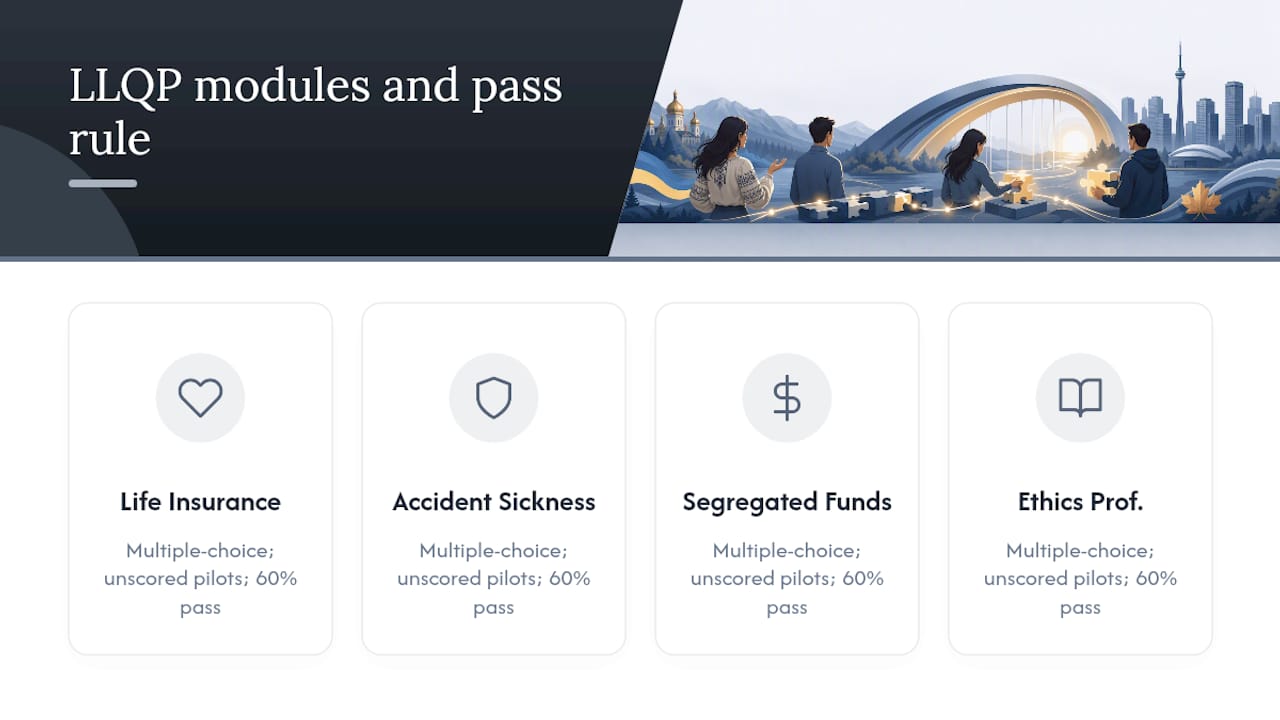
You typically have one year from completing your course to finish all required modules, after which your course completion can expire and you’d need to retake it. If you fail a module, provinces generally allow a retake after a waiting period, though exact fees and wait times vary by regulator and by how many attempts you’ve already used. Check your provincial regulator’s page directly for current fee schedules, since these change and shouldn’t be assumed from another province’s rules.
Exam day: what to expect if English or French isn’t your first language
Exam day logistics catch people off guard more than the content does. A few rules matter enough to double check before you leave home:
- Bring valid government-issued photo ID, and make sure the name on it matches your exam registration exactly. Mismatches can forfeit your entire sitting, with no exceptions for spelling variants.
- Each module has its own time limit and question count, including the pilot items mixed in that don’t count toward your score but look identical to scored questions.
- If you’re writing remotely, expect camera and ID verification checks before the exam starts, and have a backup plan (a charged device, stable internet, a quiet room) ready in case of a technical hiccup.
Arrive rested. Timed multiple choice in a second language is mentally taxing in a way that catches people off guard on the first module.
Where to find language support beyond formal accommodations
Since the exam itself won’t bend on language, the real leverage for Ukrainian speakers sits outside the exam process entirely. Settlement agencies across Canada, many funded through provincial immigrant services programs, run free or low-cost English and French language classes specifically aimed at newcomers entering regulated professions. These aren’t generic ESL classes; several are tailored toward professional or workplace vocabulary, which overlaps heavily with insurance terminology.
Community organizations serving Ukrainian newcomers, including local cultural associations and mutual aid groups that expanded rapidly after 2022, often maintain informal networks of people who’ve already gone through provincial licensing processes. Asking in one of these groups whether anyone has written the LLQP recently can surface practical, hard-won advice, like which sections of the exam trip up non-native speakers most, that you won’t find in an official guide.
Post-secondary continuing education departments in most provinces also run English-for-professionals courses, and some insurance industry associations occasionally host informal mentorship or study-buddy matching. None of these replace targeted LLQP prep, but combining a general English fluency boost with focused insurance vocabulary work tends to move candidates forward faster than either approach alone. The goal isn’t fluency for its own sake. It’s enough comfort with formal English or French sentence structure that exam questions stop requiring a second read.
Building insurance vocabulary when English or French isn’t your first language
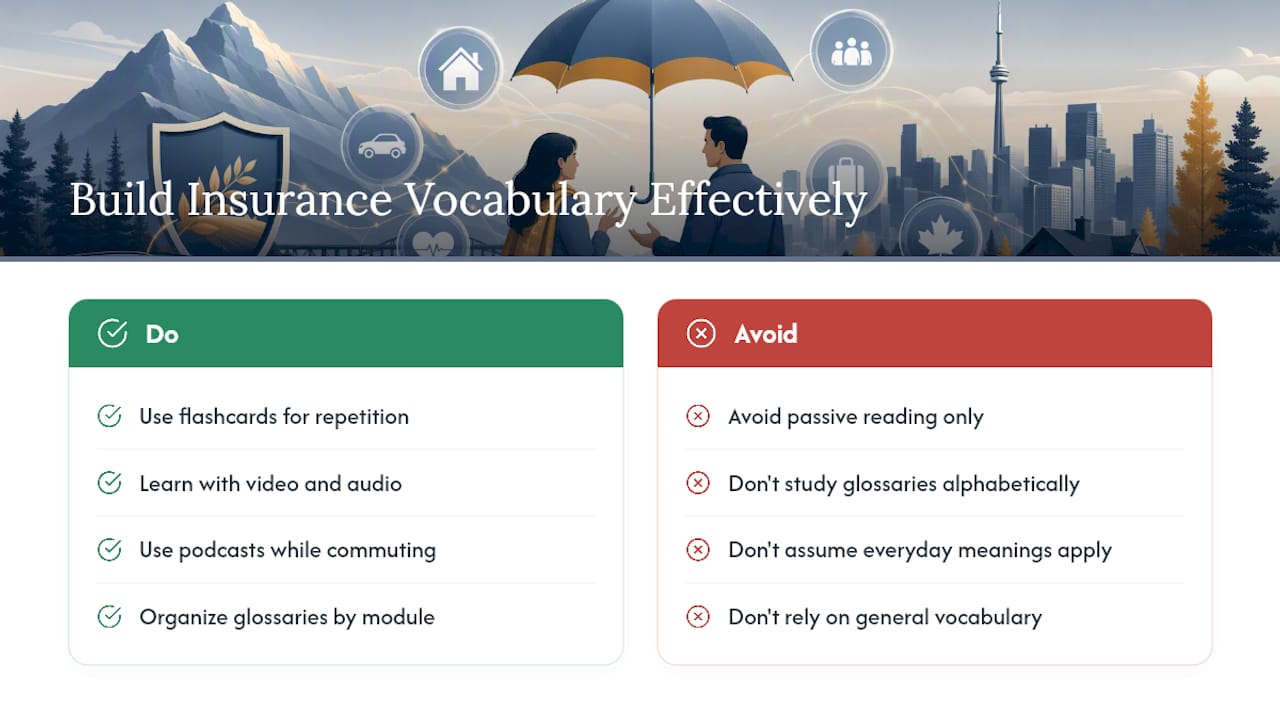
Insurance language is its own dialect, full of terms that don’t map cleanly onto everyday English or French, let alone Ukrainian. Words like “rider,” “cede,” “indemnity,” and “surrender” carry precise legal meanings that have nothing to do with their everyday use, and that gap is where a lot of non-native speakers lose marks.
Flashcard-based repetition works better here than reading definitions passively, because insurance terms need to be recognized instantly under time pressure, not just understood eventually. Video and audio lessons help too, since hearing a term used correctly in context, several times, builds recognition faster than reading it once in a glossary. Podcast-style review while commuting or doing chores adds passive repetition without requiring dedicated study time.
Glossaries organized by module, rather than alphabetically, also help more than people expect. Learning every Ethics term together, then every Segregated Funds term together, builds the kind of clustered vocabulary recall that mirrors how the exam actually tests you: module by module, concept by concept. A resource like LLQP Guide’s study materials organizes practice this way by design, which matters more for second-language candidates than it might for native speakers who can lean on general vocabulary to fill gaps.
Support networks for Ukrainian LLQP candidates
Formal, LLQP-specific Ukrainian-language forums are thin on the ground in Canada right now, which makes informal networks disproportionately valuable. Facebook groups and Telegram channels serving Ukrainian newcomer communities in cities like Toronto, Vancouver, and Calgary regularly field questions about professional licensing, and insurance credentials come up often enough that threads on the topic tend to get real answers from people who’ve been through it.
Provincial settlement service organizations sometimes maintain informal referral lists connecting newcomers with mentors already working in insurance or financial services. Reaching out to one of these organizations directly, even with a general question about “how do I get licensed to sell insurance,” often leads to a warmer introduction than searching online.
Study groups matter more for this exam than for most licensing tests, simply because talking through unfamiliar terminology out loud, in either language, cements it faster than silent reading. If you can’t find an existing Ukrainian-speaking LLQP study group in your city, starting one through a local newcomer network is often easier than it sounds. Most people studying for the same exam at the same time are looking for exactly that kind of connection.
What actually helps Ukrainian candidates pass
The biggest misconception I see is that language accommodation requests are a workaround worth pursuing. They’re not, and chasing that route usually burns weeks that would be better spent drilling vocabulary. The candidates who do well aren’t the ones who find a loophole. They’re the ones who accept the English or French requirement early and build a study routine around it.
What tends to separate a pass from a retake isn’t raw insurance knowledge. It’s speed of recognition under a ticking clock, which is exactly what repeated timed practice builds. Tools that let you drill unlimited quizzes and check unfamiliar terms mid-lesson, the way LLQP Guide’s platform does, close that gap faster than reading a textbook cover to cover. Start early, treat vocabulary like a separate subject from the insurance concepts themselves, and contact your regulator well before your target exam date if you think you’ll need a disability accommodation.
— Reza
Study smarter with tools built for non-native speakers
Studying for four modules in a second language is a real time crunch, and most generic study guides assume you’re already comfortable with English or French insurance jargon. LLQP Guide was built differently: every module, from Life Insurance through Ethics & Professional Practice, comes with in-lesson word translation across more than a dozen languages, so you’re not stopping every paragraph to look something up elsewhere.
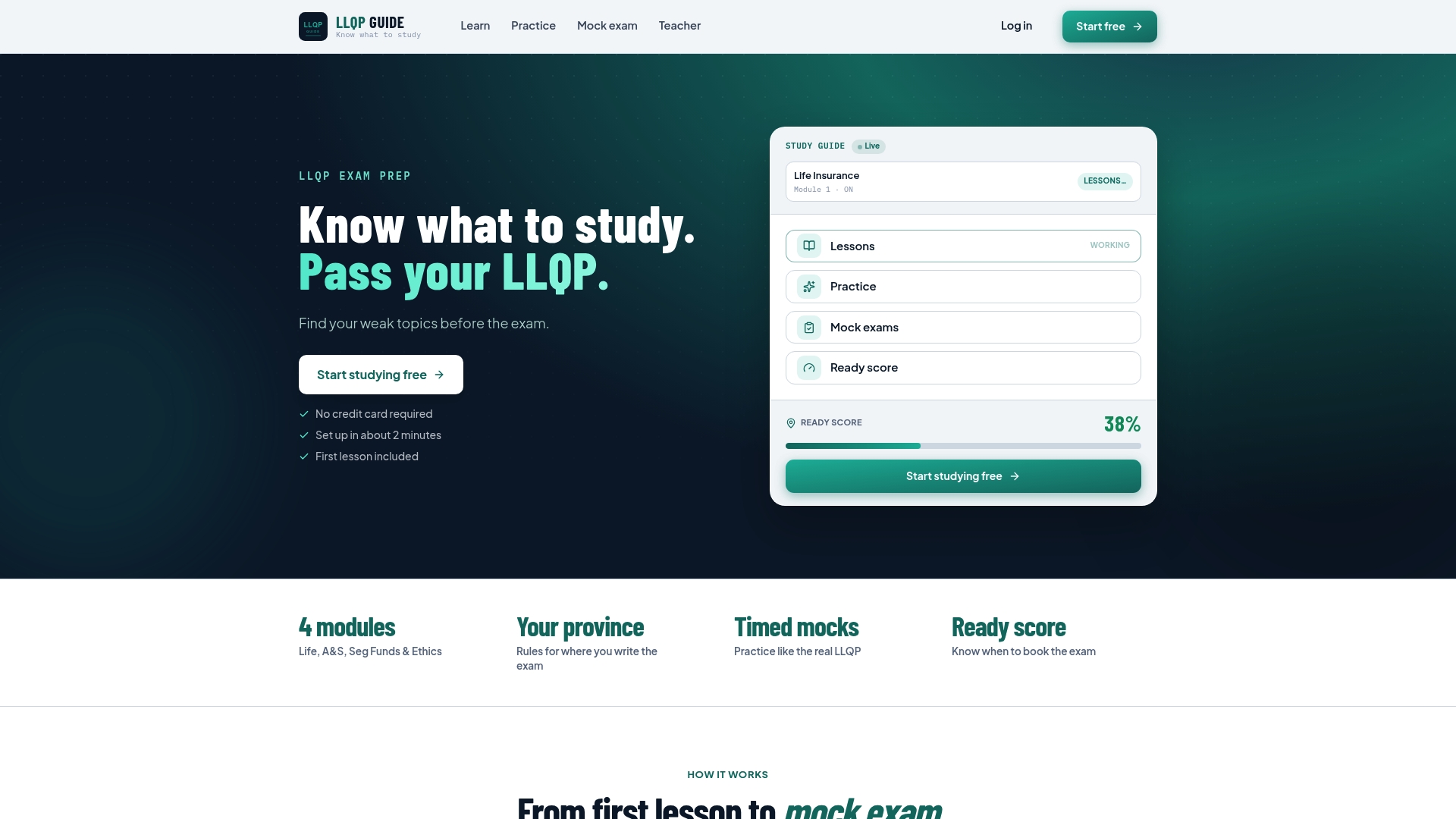
Beyond the lessons, you get unlimited practice quizzes to drill weak terminology as many times as it takes, plus full-length mock exams timed to match real exam conditions, which matters more for second-language candidates than almost anyone else writing this test. If you’re in Ontario or BC, the province-specific pages walk through local registration steps alongside the study content. Start with the free trial and see how the translation tools fit your study routine before committing to a plan.
Sources
- Exam information and registration | Insurance Council of British Columbia
- CISRO LLQP psychometric audit report
Recommended
Frequently asked questions
How much does the LLQP course cost?
Course and exam fees vary by province and provider, so check your provincial regulator's current fee schedule directly rather than relying on a general estimate; study platforms like LLQP Guide list separate subscription pricing for their prep materials.
How many exams are there for LLQP?
There are four modules: Life Insurance, Accident & Sickness, Segregated Funds & Annuities, and Ethics & Professional Practice, and you typically need to pass all four within one year of completing your course.
What happens if I fail my LLQP exam?
You can usually retake a failed module after a waiting period set by your provincial regulator, though exact wait times and retake fees vary by province and by how many attempts you've used.
Can I request the LLQP exam in Ukrainian?
No. Translation into Ukrainian, or any language other than English and French, is not offered as an exam accommodation anywhere in Canada.