75 minutes per module: Canada's LLQP exam format, tablet rules
75 minutes per module: Canada's LLQP exam format, tablet rules ! Candidate navigating tablet-based insurance exam Before you can book a sitting, you must finish a provincially approved LLQP course.

75 minutes per module: Canada’s LLQP exam format, tablet rules
Before you can book a sitting, you must finish a provincially approved LLQP course. In most jurisdictions, you’ll sit at a tablet with the course material loaded on it, open-book style.
TL;DR:
- Candidates should focus their study time on the specific modules they find most challenging, especially Segregated Funds, which has the lowest pass rate at 69%.
- Practicing under timed, full-length mock exams that replicate the actual 75-minute per module pace improves time management and question-answering accuracy.
- Candidates must complete and validate an approved course, typically around 100 hours, before booking any LLQP module, and classroom sittings often limit candidates to two modules per session.
- The exam consists of four independent modules with 20 to 30 questions each, including pilot questions that do not count toward the passing score of 60%.
- Confirming test location rules, device setup, and time constraints before exam day can prevent common mistakes that affect performance, especially on scenario-heavy questions.
Table of Contents
- What is the LLQP exam format, exactly?
- How is each LLQP module structured?
- What are the timing and test-day conditions?
- How do you register and meet LLQP prerequisites?
- How is the LLQP exam scored?
- How should you prepare for the LLQP’s format?
- What candidates get wrong about the LLQP format
- Prepare for the exact format you’ll face
- Sources
- FAQ
What is the LLQP exam format, exactly?
Every province that uses the LLQP follows the same basic blueprint, coordinated through the Canadian Insurance Services Regulatory Organizations framework that member regulators adopt. That’s the point of the “harmonized” label: a candidate in Alberta and a candidate in Newfoundland write structurally identical modules, even though each province’s regulator administers registration separately.
Each module stands on its own. You’re not writing one giant exam. You’re writing up to four separate multiple-choice tests, one per licensing area, and each has its own time limit, its own question bank, and its own pass mark. That structure matters for how you study: cramming everything into one marathon session doesn’t reflect how the actual test day works.
Quick facts before you book
- Modules: Life Insurance, Accident & Sickness, Segregated Funds & Annuities, and Ethics & Professional Practice.
- Questions per module: 20 to 30 scored questions, plus five pilot questions that don’t count toward your grade.
- Time: 75 minutes per module.
- Passing grade: 60% on each module.
- What to bring: government-issued photo ID and your course completion proof. Bring nothing else, since notes and outside materials aren’t allowed at the desk.
How is each LLQP module structured?
The four modules cover distinct territory, and the split explains why some candidates breeze through one module and stall on another.
Life Insurance covers policy types, underwriting basics, needs analysis, and the sales practices tied to permanent and term coverage. Accident & Sickness focuses on disability, critical illness, and health insurance products, along with claims and contract provisions. Segregated Funds & Annuities is the one most candidates find toughest. It blends investment concepts with insurance contract law, and the segregated funds module posted the lowest first-time pass rate nationally in 2024 at 69%. Ethics & Professional Practice deals with disclosure obligations, conduct standards, and complaint handling.
Ethics has a twist: there are two versions. Candidates in common law provinces write one variant, and candidates in Quebec write a civil code version, since contract and insurance law differ between the two legal systems.
You won’t know which five questions on your screen are pilot items. They’re mixed in with the scored ones, timed the same way, and used by regulators to test future exam content. Answer every question as if it counts, because you genuinely can’t tell which ones don’t.
For a deeper look at what each module actually tests, the module breakdown on LLQPGuide goes topic by topic.
What are the timing and test-day conditions?
Seventy-five minutes for up to 30 questions works out to roughly two and a half minutes per question, tighter than it sounds once you factor in the multi-part scenario questions common on the Segregated Funds module.
Test conditions follow a consistent pattern across most provinces, though details vary by centre:
- Exams run open-book on a tablet, with your course material and an on-device calculator built in.
- You can’t bring outside notes, textbooks, phones, or food and drink to the desk.
- Photo ID gets checked before you sit down, every time.
- Many provinces run exams only in person at designated testing sites; some also offer online proctored sittings.
Because rules shift slightly by jurisdiction, confirm the specifics with your provincial regulator before exam day rather than assuming your friend’s experience in another province applies to you.
How do you register and meet LLQP prerequisites?
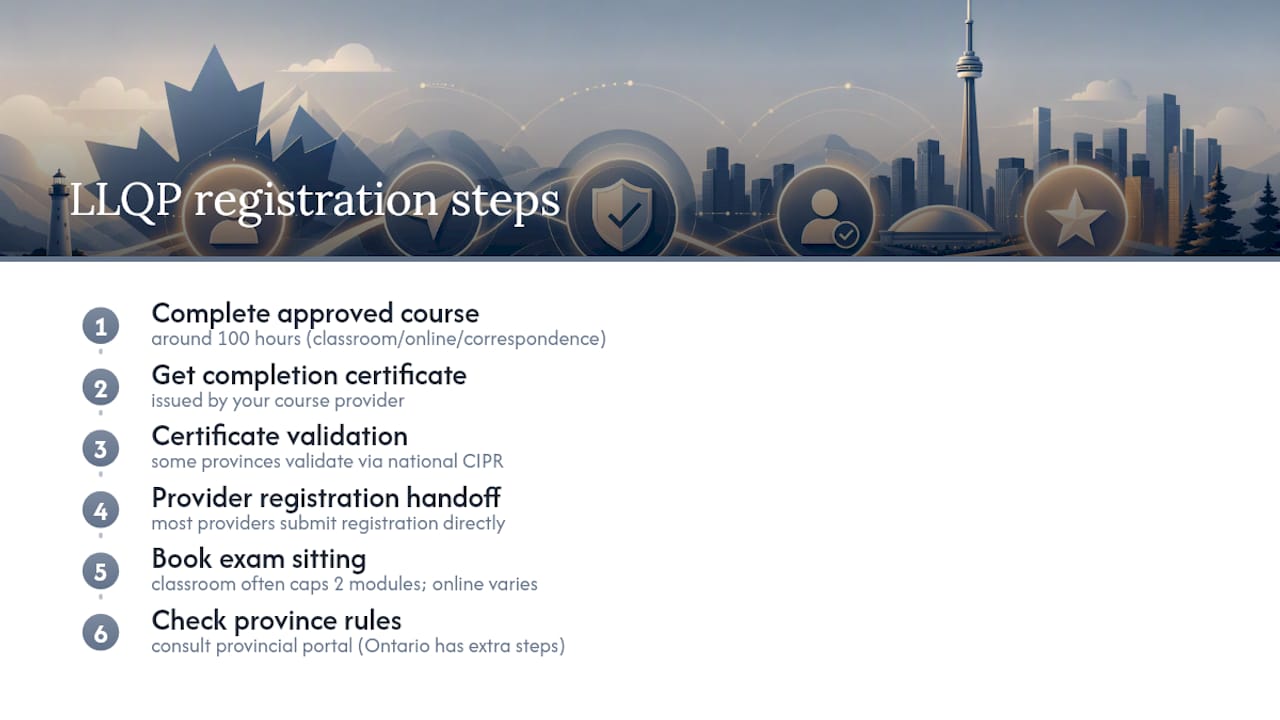
You can’t book an LLQP module until you’ve completed an approved pre-licensing course, and course length typically runs around 100 hours, whether delivered in a classroom, online, or by correspondence.
Your course provider issues a completion certificate, and in some provinces that certificate is validated through the national CIPR system before you’re allowed to register. Most course providers handle the registration handoff directly, which simplifies the paperwork considerably.
One booking detail catches people off guard: classroom sittings often cap candidates at two modules per session. Online availability can differ, so check your province’s booking portal for exact limits before planning a two-module or four-module day. If you’re writing in Ontario, the province-specific registration steps are worth a read before you book.
How is the LLQP exam scored?
Every scored question carries equal weight. There’s no bonus weighting for harder questions and no partial credit for multi-part scenarios.
Rewrite rules vary by province, including waiting periods and attempt limits, so check your regulator’s page directly rather than relying on secondhand advice from a study group.
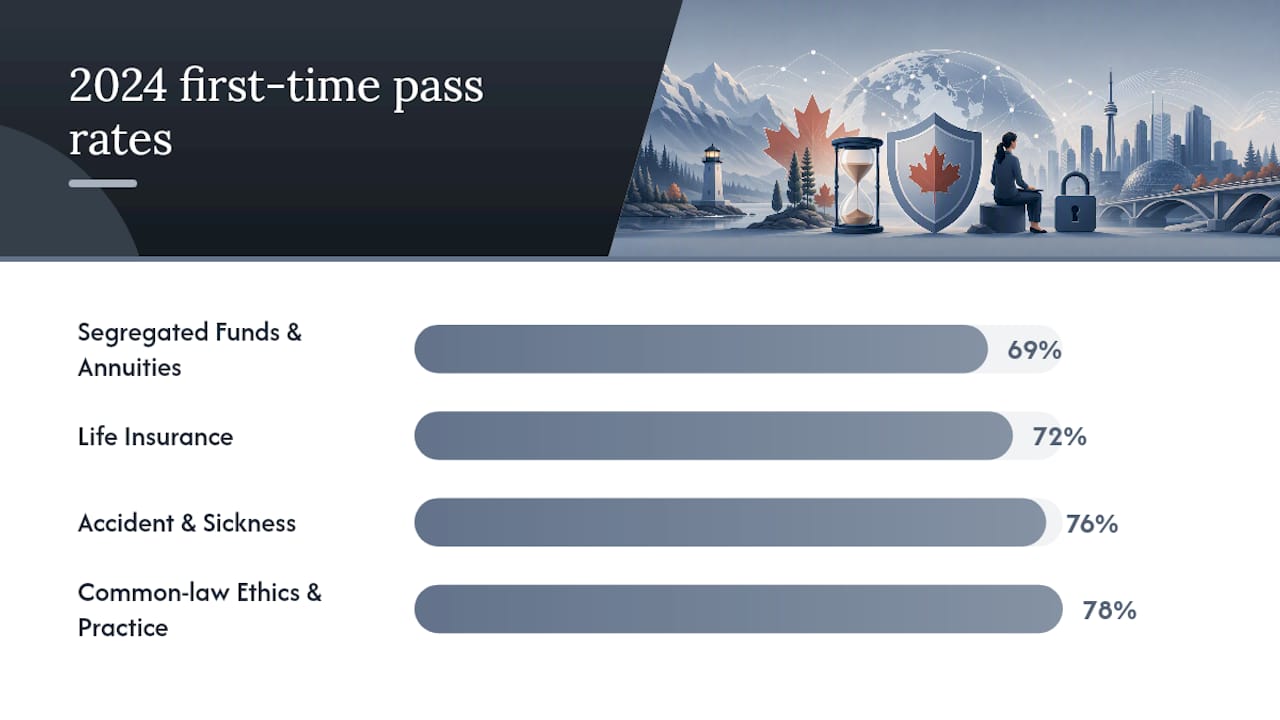
National context helps set expectations. First-time pass rates in 2024 ranged from 69% to 78% across the four modules: segregated funds sat lowest at 69%, life insurance at 72%, accident & sickness at 76%, and common law ethics highest at 78%. That spread tells you something concrete: ethics is the most forgiving module for most candidates, and segregated funds demands the most careful preparation. A closer breakdown of these numbers by province is available in LLQPGuide’s pass-rate analysis.
How should you prepare for the LLQP’s format?
Study strategy should mirror the exam’s actual shape, not just its content. Three tactics matter more than raw hours studied.
First, practise under real time pressure. Doing untimed review is comfortable, but it doesn’t train you for the two-and-a-half-minute-per-question pace you’ll face. Full-length mock exams that run the true 75-minute clock, including pilot-style filler questions, build the pacing instinct that timed practice under exam conditions is the closest simulation of the real thing available.
Second, run diagnostic quizzes early, before you commit to a study schedule. If Segregated Funds is your weak module, and national pass-rate data suggests it often is, you want three weeks of extra attention there, not three days.
Third, if English isn’t your first language, lean on translation support and frequent short quizzes rather than one long study block. Comprehension barriers on multiple-choice items shrink when you can check unfamiliar terms in context instead of guessing at meaning mid-question.
Pro Tip: Do at least one full mock exam on an actual tablet before test day. The on-screen navigation, the built-in calculator, and the flagging tool for skipped questions all feel different than they do on a laptop, and you don’t want to be learning the interface while the clock is running.
What candidates get wrong about the LLQP format
Most candidates assume the exam has one fixed order or a hidden trick to spotting pilot questions. Neither is true. Modules can typically be booked in whatever sequence suits you, and pilot questions are indistinguishable from scored ones, which means the “skip anything that looks unusual” strategy actively backfires.
The bigger misunderstanding is time management. Candidates who’ve written other professional exams often assume 75 minutes is generous. It isn’t, once scenario-based questions on Segregated Funds start eating two or three minutes each. Reconfirm your test centre’s tablet setup and device policy before you go. Assuming your course provider’s practice environment matches the real exam interface is a common, avoidable mistake.
— Reza
Prepare for the exact format you’ll face
Everything above describes a structure that rewards format-specific practice over general review, and that’s precisely what exam prep platforms are built around. Such platforms typically map directly to the four modules: Life Insurance, Accident & Sickness, Segregated Funds & Annuities, and Ethics & Professional Practice, with lessons, quizzes, and full-length mock exams that simulate the timing you’ll face at the test centre.
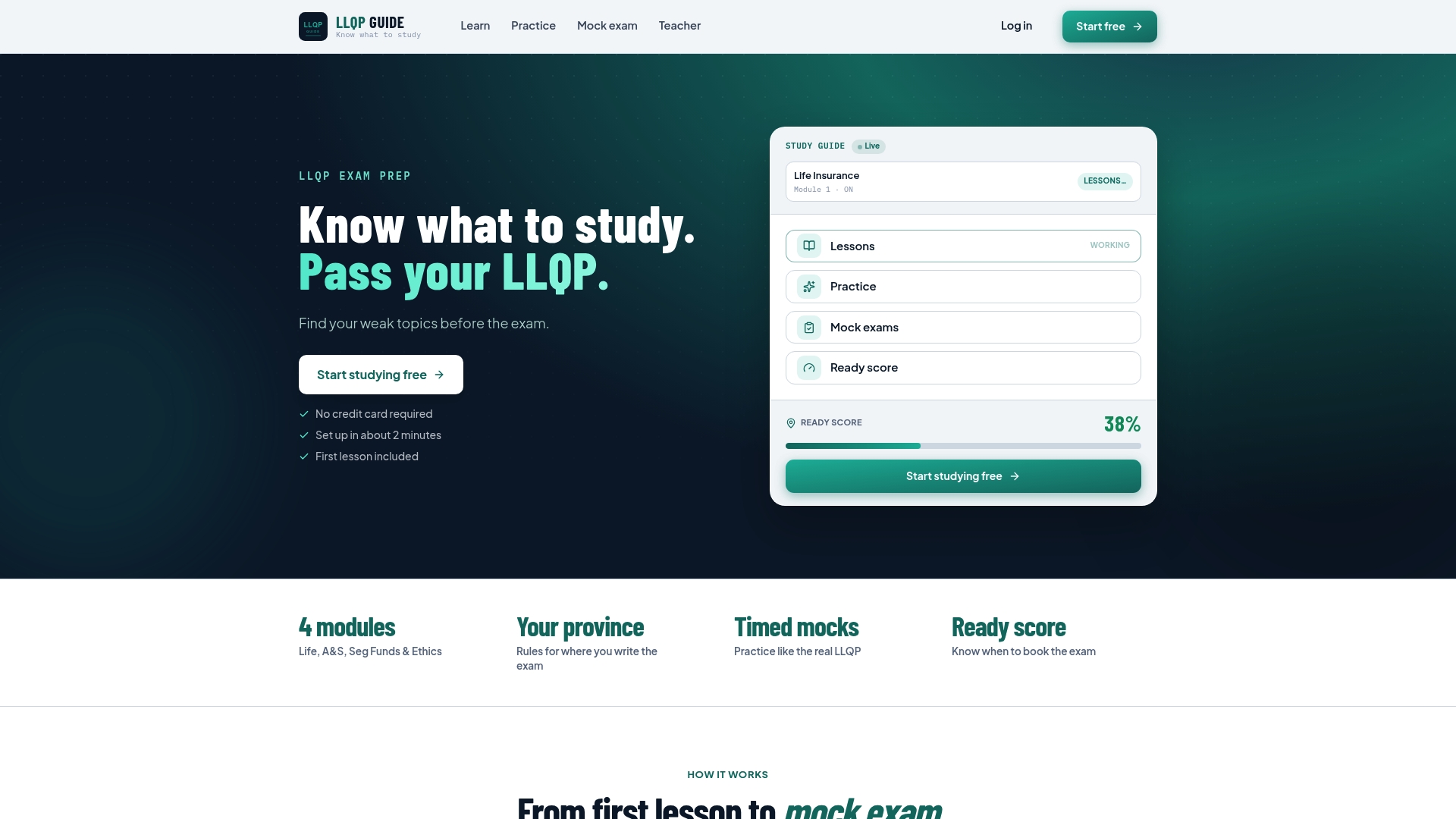
Diagnostic quizzes flag your weakest module before you’ve wasted a week studying the wrong material, and built-in translation tools cover candidates working in a second language. If Segregated Funds is where you expect trouble, the module-specific study path targets it directly. Start with the free trial and see the pricing tiers to unlock full mock exam access before you book your first module.
Sources
- LLQP first-time pass rates in 2024 released
- Taking the LLQP Exam In-person
- Life License Qualification Program (LLQP) - Alberta Insurance Council
Recommended
Frequently asked questions
How hard is the LLQP exam?
Difficulty varies by module. National first-time pass rates in 2024 ranged from 69% for Segregated Funds & Annuities to 78% for common law Ethics, so Segregated Funds is generally the toughest hurdle.
What questions are on the LLQP life insurance exam?
The Life Insurance module tests policy types, underwriting fundamentals, needs analysis, and sales practice standards, delivered as 20 to 30 scored multiple-choice questions within 75 minutes.
How many exams are there for LLQP?
There are four separate module exams: Life Insurance, Accident & Sickness, Segregated Funds & Annuities, and Ethics & Professional Practice, each written and scored independently.
What happens if I fail my LLQP exam?
You'll need to rewrite the specific module you failed, though exact waiting periods and attempt limits vary by province, so check your regulator's page for the precise rules before rebooking.
Are pilot questions counted toward my LLQP score?
No. Each module includes five pilot questions that are timed like every other question but excluded from your final grade.