What does an LLQP course actually cost in 2026?
What does an LLQP course actually cost in 2026? !

What does an LLQP course actually cost in 2026?
Most Canadians budget between $700 and $2,000 to go from a standing start to a licensed life and accident & sickness agent, with the gap between those two numbers comes down almost entirely to your province, your exam format, and how many modules you have to rewrite.
That total covers five things: course tuition, LLQP exam fees paid through the Durham College exam portal, your provincial application or licence fee, Errors & Omissions (E&O) insurance, and a handful of smaller administrative charges. A typical mid-range candidate doing an online self-study or instructor-led course, writing exams virtually, and passing all four modules on the first try, typically spends a moderate total amount all in.
Here’s the checklist you’re actually paying against:
- Course tuition for an approved LLQP provider (self-study, hybrid, or classroom)
- Durham College exam fees, charged per module or bundled per session
- Provincial application/licence fee, paid to your provincial insurance regulator
- E&O insurance, either self-funded or covered by a sponsoring agency
- Rewrite fees if you fail a module (charged per attempt)
- Incidental admin costs: criminal record checks, proctoring surcharges, certificate shipping
Two places verify this pricing better than anyone else: the Durham College exam fees announcement published through Ontario’s Financial Services Regulatory Authority, and your own provincial insurance council’s licensing page. If you’re comparing prep options while you budget, LLQPGuide’s province-specific modules are built so you’re not paying twice for materials you don’t need for your jurisdiction.
Key Takeaways
Total LLQP course cost in Canada typically runs $700 to $2,000, and exam readiness, not tuition price, is the biggest factor separating the low end from the high end.
| Point | Details |
|---|---|
| Budget the full stack | Tuition, exam fees, provincial licence, E&O insurance, and rewrite risk all add up separately. |
| Exam fees are standardized | Durham College charges $84 per module virtually and $66 in-person as of August 2025. |
| Provincial fees vary widely | Licence costs range from roughly $35 to $200 depending on your province and renewal period. |
| E&O isn’t always your cost | Sponsored agents often get E&O covered; independents typically pay $150 to $300 annually themselves. |
| Compare prep on readiness, not price | LLQPGuide’s unlimited quizzes and mock exams reduce rewrite risk more than a lower tuition sticker price. |
Table of Contents
- LLQP course cost: the line-by-line breakdown
- Provincial exam and licence fees compared
- How your course provider changes the total price
- Realistic ways to cut your out-of-pocket total
- Three real-world budget scenarios
- Your step-by-step path from signup to licence
- Why the sticker price is the wrong number to budget around
- Get exam-ready without paying for rewrites you didn’t need
- Sources
- FAQ
LLQP course cost: the line-by-line breakdown
Tuition is where providers differentiate themselves the most, and it’s also where a lot of candidates overspend without realizing it.
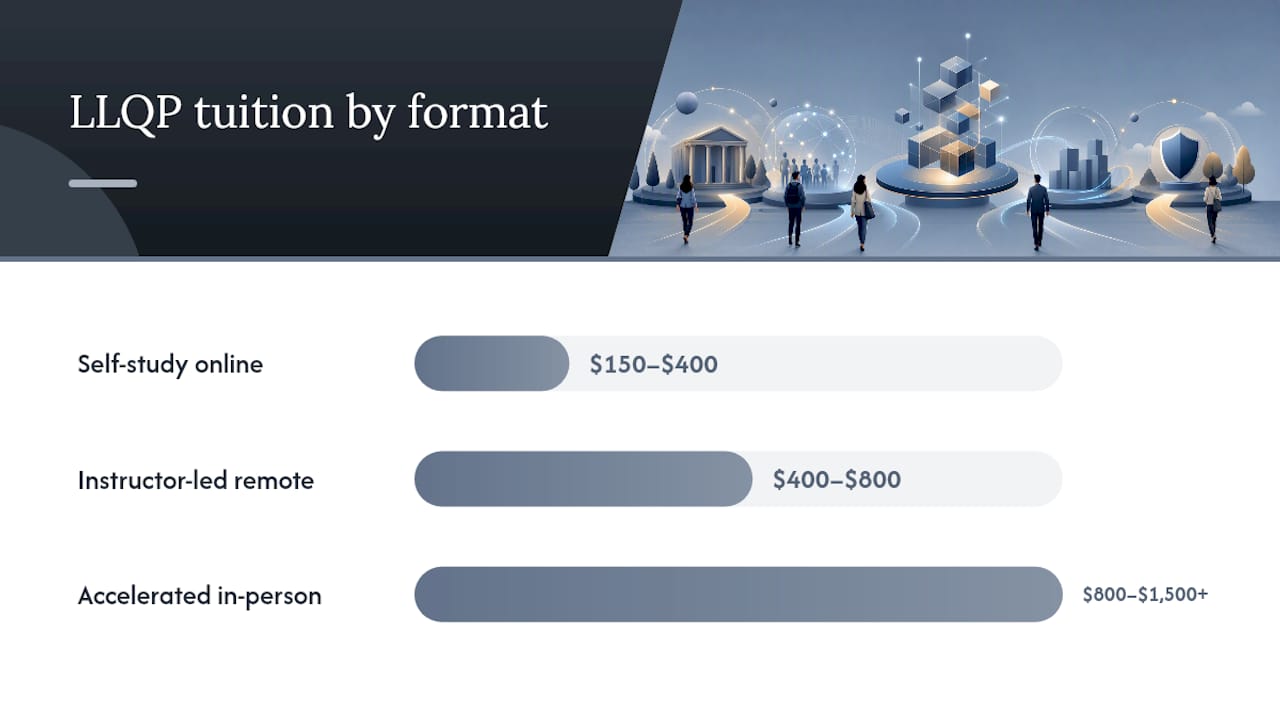
Self-study online courses typically run $150 to $400 and include recorded lessons, a workbook, and sometimes a limited number of practice questions. Instructor-led remote courses sit higher, usually $400 to $800, because you’re paying for live class time and direct access to an instructor. Classroom or accelerated in-person programs, the kind offered through some colleges and continuing-education providers, can run $800 to $1,500 or more, largely because they compress the material into a few intensive days with an instructor physically present.
Then there’s the exam itself. Since August 1, 2025, Durham College’s fee schedule charges $84 per module for virtual online examinations and $66 per module for paper-based or in-person electronic exams. With four modules (Life Insurance, Accident & Sickness, Segregated Funds & Annuities, and Ethics & Professional Practice), writing everything virtually costs roughly $336 in exam fees alone, while in-person testing brings that down to about $264. Rewrite fees for a failed module are charged again at the same per-module rate, so a single retake on a virtual exam adds another $84 to your total.
Provincial licence fees vary widely, with some provinces charging modest fees and others charging higher fees depending on the licence validity period and renewal cycle.
E&O insurance is the cost most first-time candidates forget to budget for. Industry pricing typically falls in the $150 to $300 annual range for a newly licensed agent, and whether you pay it yourself depends entirely on your employment setup. Captive agents working for an insurer, or agents joining an established agency like Primerica (Canada), often have E&O bundled into their sponsorship. Independent agents, including many who go on to work under a managing general agency, usually pay it directly.

Round out the list with smaller admin items: a criminal background check ($20 to $50 depending on the service), possible proctoring surcharges for virtual exams, and certificate or transcript fees that some provinces charge when issuing your official licence document.
Pro Tip: A provider charging $200 more up front but including two free rewrites and a proctored mock exam can end up cheaper than the bargain option once you factor in even one $84 rewrite fee at Durham College.
Provincial exam and licence fees compared
Provincial regulators set their own application and renewal fees, and the differences are bigger than most people expect walking in.
| Province/Territory | Exam Fee (per attempt) | Provincial Licence Fee | Notes |
|---|---|---|---|
| Ontario | Per-module fees apply as per Durham College schedule | Licence fees contribute to overall provincial cost estimate | Exam fees and licence fees vary locally |
| British Columbia | Per-module fees apply with a single-day fee option | Licence fees contribute to estimated total cost | Single-day exam available |
| Alberta | Combined fee for all modules significantly less than standard per-module fees | Licence fees vary by type | Lower combined exam costs |
| New Brunswick | Per-module fees apply | Licence fees are relatively low | Modest provincial fees |
| Prince Edward Island | Per-module fees apply | Licence fees higher with longer validity period | Licence fee offset by duration |
Alberta stands out here. The Alberta Insurance Council prices all four exams together at roughly $100, well below what candidates pay writing modules individually through Durham College’s standard per-module structure. British Columbia’s insurance council also offers a single-day option to sit all four modules in one sitting, which can save you a return trip to a testing site if you’re writing in person.
Quebec runs on a separate civil-code framework and its own regulatory body, so provincial fee comparisons for Quebec candidates don’t map cleanly onto the common-law provinces listed above. If you’re licensing in Quebec, check directly with the Autorité des marchés financiers rather than assuming the Durham College fee schedule applies unchanged.
The province-by-province cost data circulating in industry summaries puts Ontario’s total closer to $1,200 and British Columbia’s closer to $900, a gap driven mostly by licence fee differences and local market pricing on tuition, not exam costs, which are largely standardized nationally through Durham College.
How your course provider changes the total price
Sticker price tells you almost nothing about total cost until you know what’s included.
Delivery format is the first variable. Online self-study courses ask for roughly 60 to 90 hours of independent study and cost the least up front, but they also put the entire risk of failing a module on you, since there’s no instructor catching gaps before exam day. Instructor-led remote courses run over four to eight weeks with scheduled live sessions and cost more, but the structure tends to reduce first-attempt failure rates. Classroom and hybrid formats sit at the top of the price range and compress the same material into a shorter calendar window, which suits someone who needs a licence fast and has an employer footing the bill.
What’s bundled into that tuition matters just as much as the delivery format:
- Practice quizzes and mock exams modelled on real exam conditions
- Exam vouchers that prepay your Durham College exam fee
- Translation tools for candidates studying in a second language
- Rewrite credits if you fail a module on the first attempt
- Study material expiry windows, since some providers cut off access after 60 or 90 days
When you’re comparing providers, whether that’s an established name like the Canadian Securities Institute (CSI), Advocis’s continuing-education offerings, Learnedly, the College for Financial Professions, or an online-first platform, run the comparison against six dimensions: tuition, delivery format, provincial coverage, what’s actually included, expected study hours, and the refund or rewrite policy. A course that costs $150 less but excludes mock exams and charges full price for a rewrite can cost you more the moment you fail one module.
This is the exact gap LLQPGuide is built to close. Because it bundles unlimited practice quizzes and full-length mock exams into every subscription tier, you’re not paying separately for the one thing that most reduces your odds of a $66 to $84 rewrite fee: knowing where your weak spots are before exam day.
Realistic ways to cut your out-of-pocket total
The single biggest lever most candidates ignore is employer or agency sponsorship. Insurers like iA Financial Group and Beneva (La Capitale), along with agencies like Primerica (Canada), frequently cover tuition, exam fees, or E&O insurance for new recruits as part of onboarding. If you’re entering the industry through a hiring agency or MGA rather than studying independently, ask what they cover before you pay for anything yourself.
Timing matters more than most candidates assume. Course providers run seasonal promotions, particularly around the new year and back-to-school periods in September, and bundled packages (course plus exam voucher plus rewrite credit) are almost always cheaper than paying for each piece separately after the fact.
Your retake strategy is where real money gets saved or lost. Every rewrite costs $66 to $84 per module at current Durham College rates, so a provider offering unlimited practice quizzes and a full mock exam under timed conditions is worth more than its sticker price suggests. Prioritize mock exams over passive review; the format mismatch between studying from notes and sitting a timed, scenario-based exam is the most common reason first attempts fail.
Free resources have a place too, provincial regulator sites and organizations like Advocis publish guidance documents and continuing-education material at no cost, but check the publication date before relying on anything, since exam content and provincial rules get updated periodically.
Pro Tip: Skip the printed textbook add-on most providers upsell during checkout. Digital materials cover the same content, update faster when regulations change, and most candidates never crack the physical binder after week one.
Three real-world budget scenarios
Seeing three complete budgets side by side makes it easier to spot where your own situation lands.
The low-cost scenario assumes a disciplined self-study candidate in British Columbia who passes every module on the first try and writes in person to avoid the virtual exam surcharge. The mid-range scenario reflects the most common real-world path: an instructor-led remote course, one rewrite somewhere along the way, and virtual exams for convenience. The high-cost scenario stacks a pricier classroom program with two rewrites and no employer support, which is what happens when someone underestimates the exam and skips structured practice altogether.
Your step-by-step path from signup to licence
- Choose your course provider based on your province, your preferred delivery format, and whether mock exams and rewrites are included in the price.
- Register and pay tuition, confirming the course covers all four required modules for your province.
- Schedule your exam through the Durham College exam portal, choosing in-person or virtual based on the fee difference and your comfort with proctored software.
- Apply to your provincial regulator once you’ve passed all required modules, submitting any background check documentation they require.
- Arrange E&O insurance and confirm sponsorship, if applicable, before your licence is finalized.
Budget six to twelve weeks from your first day of study to holding a licence, assuming steady study habits and no rewrites. Add two to four weeks for every module you need to retake, plus however long your provincial regulator takes to process your application, which varies by province and season.
If your employer or agency is covering any part of this, keep every receipt: tuition invoices, exam confirmation emails, and E&O insurance statements. Most sponsorship arrangements require documentation for reimbursement, and some costs may be tax-deductible depending on your employment status.
How these numbers were verified
- Provincial regulator fee pages (FSRA, provincial insurance councils) checked directly for current application and renewal fees
- Durham College’s official exam fee announcement, effective August 1, 2025
- Approved course-provider pricing pages reviewed for tuition ranges across delivery formats
- Industry cost-overview sources cross-checked against regulator figures where available
Fees were verified against the August 2025 Durham College update, which raised virtual exam pricing to $84 per module. Course promotions, bundle pricing, and employer sponsorship terms shift more frequently than regulator fees, so treat tuition figures as ranges rather than fixed numbers, and confirm anything time-sensitive directly with the provider before paying.
Why the sticker price is the wrong number to budget around
Most cost guides for the LLQP focus on tuition because it’s the easiest number to advertise. That’s backwards. Tuition is the most visible cost and the least predictive of what you’ll actually spend, because it says nothing about your odds of passing each module on the first try.
The conventional advice, find the cheapest course, treats the exam like a formality instead of the actual cost driver it is. A $150 rewrite fee stacked on top of a “budget” course erases the savings instantly, and two rewrites can push a bargain-priced path past what a pricier, better-structured course would have cost from day one. The real budgeting question isn’t “what’s the cheapest tuition,” it’s “what’s the total cost if I fail one module,” because for a meaningful share of first-time candidates, that’s exactly what happens.
Provincial variation gets underweighted too. Candidates comparing course prices rarely factor in that their province’s licence fee and renewal cycle can shift the total by several hundred dollars before tuition even enters the picture. Check your provincial regulator’s fee page before you shop for a course, not after.
If there’s one thing worth prioritizing above all else, it’s exam readiness over course price. A provider with unlimited practice quizzes and a realistic mock exam, the exact model LLQPGuide is built around, does more to control your total cost than shaving $100 off tuition ever will.
Get exam-ready without paying for rewrites you didn’t need
Every dollar you spend on LLQP prep either reduces your risk of a $66 to $84 rewrite fee or it doesn’t, and that’s the lens worth applying to any course you’re considering. LLQPGuide is built around that exact math: province-specific lessons so you’re never studying content that doesn’t apply to your licence, unlimited practice quizzes to close weak spots before they cost you an exam fee, and full-length mock exams modelled on real exam conditions so test day isn’t the first time you’ve faced the format under pressure.
The platform also includes in-lesson translation tools across 11 languages, which matters if English is your second language and you’d otherwise be budgeting extra study time just to parse question wording. Readiness tracking shows you exactly which of the four modules, Life Insurance, Accident & Sickness, Segregated Funds & Annuities, or Ethics & Professional Practice, needs more work before you book your Durham College exam slot.
Compare what’s included against your province’s requirements on the full modules page, or go straight to LLQPGuide’s pricing to see which plan fits your timeline and start your free trial today.
Sources
- Durham College increasing LLQP exam fees | Financial Services Regulatory Authority of Ontario
- Scheduling and Fees for LLQP Exams
- LLQP License Cost Breakdown for Canadian Provinces
- Exam fees
Recommended
Frequently asked questions
How much does the LLQP course cost?
Total cost typically runs $700 to $2,000, covering tuition, Durham College exam fees ($66 to $84 per module), your provincial licence fee, and E&O insurance. Most candidates land in a mid-range amount.
Is the LLQP licence worth it?
For anyone entering life or accident & sickness insurance sales in Canada, the licence is mandatory, not optional, so the real question is how to get it efficiently rather than whether it's worth pursuing. A well-chosen provider with strong mock exams typically pays for itself by avoiding rewrite fees.
How long does it take to pass the LLQP?
Most candidates complete study and pass all four modules within six to twelve weeks, depending on delivery format and study hours per week. Add two to four weeks for each module you need to retake.
Is it hard to pass the LLQP exam?
The exam tests scenario-based application of insurance concepts rather than pure memorization, which trips up candidates who study passively instead of practising with timed mock exams. Providers like LLQPGuide that include unlimited quizzes and full mock exams under real exam conditions tend to reduce first-attempt failure risk.
Do exam fees differ between provinces?
Most provinces use the same Durham College fee schedule, $66 per module in-person or $84 virtually, but provincial licence and application fees vary from roughly $35 to $200 depending on your jurisdiction and renewal period.